
How Dollar Tree's DoorDash Deal Widens the Gap with Dollar General
A data-backed comparison of Dollar Tree and Dollar General's delivery strategies using Placer.ai foot traffic and earnings data, explaining why foot traffic is diverging and what Dollar Tree's DoorDash bet means for its customer base.
Dollar Tree’s DoorDash delivery marketing push lands in a strange-looking moment. The company can point to a healthy sales story: Q1 2026 net sales rose 7.2% to $4.6 billion, and comparable sales increased 3.5%.[1] Yet the store-visit picture is moving the other way. By April 2026, Placer.ai showed Dollar General up 2.3% year over year in same-store visits while Dollar Tree was down 3.5%.[2]
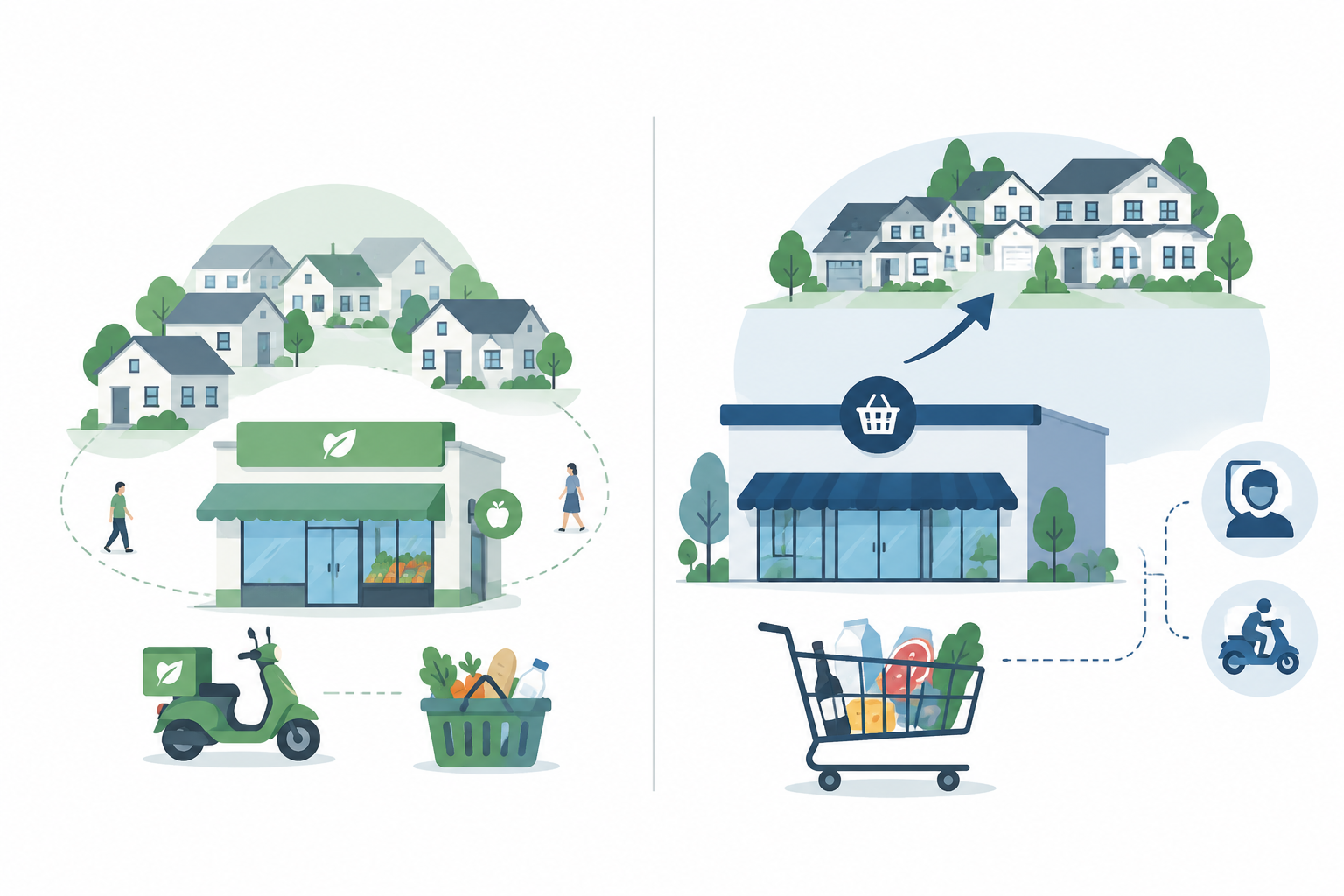
That gap is tempting to turn into a clean delivery verdict. It is not one. Dollar General adopted DoorDash years earlier than Dollar Tree, and it is the chain gaining visits. Dollar Tree is making the flashier app-platform move, and it is losing visits. The more useful read is narrower: the two chains are using delivery for different customer missions. Dollar General’s model looks built around frequency and fill-in trips. Dollar Tree’s newer delivery strategy looks more like a filter for bigger baskets and a different household mix.
The traffic gap starts with proximity
The most important Placer.ai detail is not only the visit divergence. It is where the visits originate. Dollar General draws 12.4% of visits from within 0.5 miles, compared with 7.3% for Dollar Tree.[2] That difference changes what delivery is likely to mean operationally.
A half-mile customer is not just a demographic unit. That shopper can be a quick in-store trip, a last-minute delivery order, or a pickup replacement depending on weather, time, mobility, household schedule, and item urgency. The closer the store sits to the customer, the easier it is for delivery to act as another version of the same neighborhood errand.
Dollar General’s store base reinforces that advantage. The chain operates more than 20,000 stores and planned 575 new stores for 2026, compared with Dollar Tree’s 9,000-plus stores and 325 planned net new stores.[2] Store count does not automatically create delivery profitability, but density gives an essentials retailer more chances to match small, urgent missions with short delivery radiuses.
| Strategic signal | Dollar General | Dollar Tree |
|---|---|---|
| Same-store visits by April 2026 | +2.3% year over year | -3.5% year over year |
| Visits from within 0.5 miles | 12.4% | 7.3% |
| Store base | 20,000+ stores; 575 new stores planned for 2026 | 9,000+ stores; 325 planned net new stores |
| Delivery timing | DoorDash partnership began in 2021; same-day pilot from 75 stores | Uber Eats launched August 2025; DoorDash added May 2026 |
| Assortment direction | Fresh produce expansion to 5,500+ stores by 2026 | Multi-price assortment up to $10; 85% of items still $2 or less |
| Customer acquisition signal | Reported disproportionate growth from higher-income households | 60% of 3 million new quarterly households reportedly earned over $100K |
Dollar General’s delivery case is less flashy because it fits the store network
Dollar General partnered with DoorDash in 2021, well before Dollar Tree’s 2025 and 2026 app-platform expansion.[3] The earlier date matters less as a first-mover trophy than as an operating clue. Delivery has had more time to become part of Dollar General’s local shopping model rather than a separate marketing event.
The company has also been testing its own same-day delivery pilot from 75 stores.[3] A pilot of that size does not prove a chainwide economics case, but it does show the direction of learning: how to move urgent household goods from nearby stores without depending entirely on a marketplace interface.
Assortment strengthens that local-essentials logic. Dollar General’s fresh-produce expansion reached more than 5,500 stores by 2026.[2] Produce is not a decorative category in a delivery strategy. It gives households a reason to use the store for a more frequent grocery-adjacent mission, especially in markets where a full supermarket trip is farther away or harder to fit into the week.
None of this means DoorDash caused Dollar General’s positive same-store visit trend. The available traffic data supports a comparison in outcomes and local draw, not a causal claim about the app. The stronger point is that Dollar General’s delivery strategy has fewer contradictions with its physical footprint. A nearby store, a low-friction fill-in mission, and a growing fresh offering all point in the same direction.
Dollar Tree’s DoorDash deal is really an audience bet
Dollar Tree’s DoorDash announcement was larger and more visible: more than 9,000 stores across 48 states, with over 10,000 products available through the platform.[4] It followed the company’s August 2025 Uber Eats partnership, giving Dollar Tree a two-platform delivery presence within less than a year.[5]
The app coverage matters, but the order threshold says more. Dollar Tree’s DoorDash launch promotion required a $25 minimum subtotal.[1] For a retailer historically associated with very small-ticket trips, that is not a neutral convenience feature. It pushes the order toward a bigger stock-up basket and away from the shopper who only needs a few immediate low-price items.
That threshold is especially important because Dollar General’s average transaction has been described as sub-$10. A $25 delivery minimum does not simply digitize the old dollar-store mission. It selects for customers who can consolidate more items, absorb delivery-related fees or tips, and treat Dollar Tree as a broader value assortment rather than a last-dollar stop.
Dollar Tree’s assortment strategy points the same way. Its multi-price “3.0” model includes items up to $10, while 85% of items remain at $2 or less.[1] That split lets the company defend the value banner while building baskets that make more sense for delivery platforms. The tension is obvious: the broader assortment can make the brand more useful to households with more spending flexibility, while the delivery minimum can make the channel less accessible to the low-income shopper who helped define the chain’s resilience.
The customer data makes that tradeoff harder to dismiss as accidental. CEO Mike Creedon reportedly said that 60% of Dollar Tree’s 3 million new quarterly households earned more than $100,000.[1] That figure came through secondary reporting and should be checked against the original earnings-call transcript before being treated as exact campaign attribution. Even with that caveat, it is a meaningful audience signal: Dollar Tree is not only chasing convenience demand; it is trying to make the brand legible to higher-income households.
Healthy sales do not erase the visit problem
Dollar Tree’s Q1 2026 numbers complicate the easy bearish read. Sales growth of 7.2% and comparable-sales growth of 3.5% are not signs of a retailer with no demand.[1] They suggest the company is getting more dollars through the box, even as measured same-store visits are moving down.
That combination can happen when baskets grow, prices move, mix changes, or higher-spending customers offset weaker frequency. The available materials do not isolate the exact contribution of delivery, multi-price products, or customer mix to Dollar Tree’s Q1 performance. What they do support is the strategic pattern: Dollar Tree can look better in sales than in traffic because it is pursuing a basket and household shift, not simply trying to maximize store trips.
For merchants and CPG teams, that distinction matters. A declining visit line does not automatically mean the shelf is losing relevance. It may mean the chain is becoming a different kind of route to the consumer, with more emphasis on planned baskets, delivery-enabled stock-up behavior, and households that would not have previously put Dollar Tree into their regular consideration set.
Retail media follows the audience, but the data claims need restraint
Dollar Tree and Dollar General both have retail media ambitions. Dollar Tree introduced Chesapeake Media Group in 2021, originally with a Family Dollar emphasis, while Dollar General operates DG Media Network.[6] Both networks are positioned around the usual value proposition CPG advertisers want from retailers: shopper access and closed-loop reporting.
The delivery moves sharpen the retail media story, but only up to a point. It is reasonable to see Dollar Tree’s DoorDash and Uber Eats expansion as part of a broader digital distribution arc. It is not supported, from the available materials, to claim a proven DoorDash-to-Chesapeake Media Group data integration or a measurable delivery-driven retail media lift.
The safer implication is about audience quality and advertiser interest. If Dollar Tree is adding higher-income households while expanding multi-price assortment and digital ordering, it becomes more interesting for brands that previously treated the chain as a narrow discount channel. If Dollar General is still winning local frequency, it remains attractive for brands that care about repeat essentials behavior and neighborhood reach.
The gap between the two chains is widening in strategy, not just traffic
Dollar General’s advantage is coherence. Its larger store base, closer-in visit profile, earlier DoorDash adoption, same-day delivery testing, and produce expansion all support a quick-trip essentials model. Delivery can extend the nearby-store mission without forcing the customer to behave like a different shopper.
Dollar Tree’s DoorDash deal is more ambitious and more exposed. The 9,000-store DoorDash rollout, the prior Uber Eats launch, the $25 minimum, the multi-price assortment, and the high-income new-household signal all point toward a retailer trying to stretch beyond legacy trip behavior. That may be smart customer acquisition. It is not the same thing as traffic recovery.
The strategic tension is that Dollar Tree may be widening the gap with Dollar General in audience ambition while also widening the distance from the core shopper who made the brand durable. Delivery can bring in a more affluent household. It can also quietly tell a lower-income household that the most convenient version of the store was not built around their basket.
References
- Dollar Tree expands service many customers can't afford — Yahoo Finance/TheStreet
- Why Dollar General Is Outpacing Dollar Tree in Early 2026 — Placer.ai, May 2026
- Why dollar stores are embracing delivery apps like Uber Eats and DoorDash — Modern Retail
- DoorDash and Dollar Tree Partner — DoorDash, May 2026
- Dollar Tree and Uber Partner — Uber, August 2025
- Dollar Tree introduces Chesapeake Media Group — Dollar Tree, 2021

Comments
Join the discussion with an anonymous comment.