
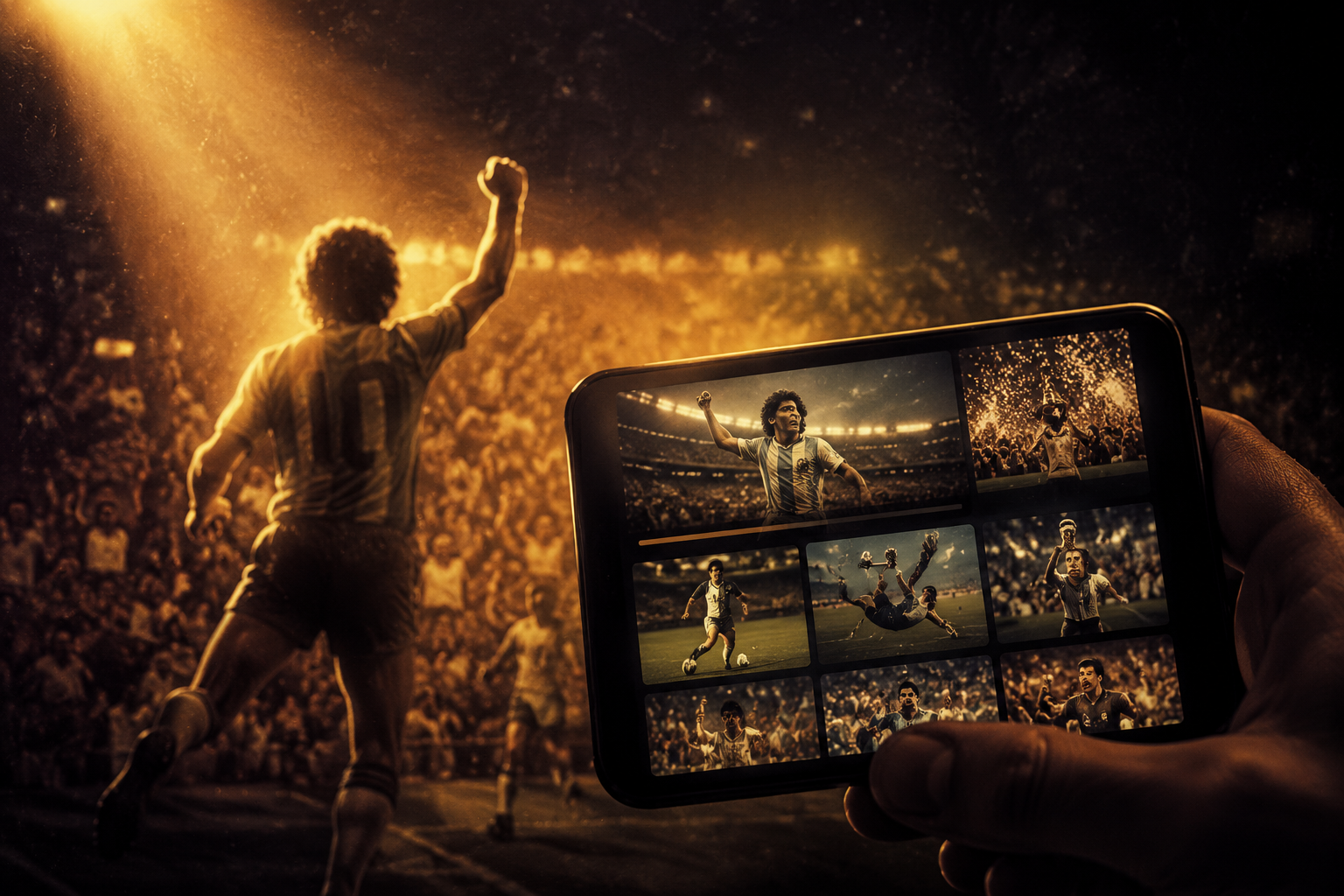
How DAZN Uses Nostalgia Marketing with Its Classic Players
DAZN's classic players strategy offers a replicable model for brands using nostalgia marketing to cut through AI fatigue and content saturation. This article breaks down DAZN's three-tier approach—ambassador deals, archive content, and campaign ads—and the psychology that makes nostalgia ads outperform factual ones.
The harder problem for sports streaming in 2026 is not only getting in front of people. It is being remembered after the scroll, the second screen, the highlight clip, the group chat, and the next app notification. DAZN operates in that environment with scale already behind it: the company reported 20 million paid subscribers and 300 million monthly users in its 2023 Annual Review, while Kantar data cited in Q1 2025 showed 11% quarter-over-quarter subscriber growth, with under-34 audiences driving the gains.[1][2]
Those numbers matter, but they do not explain why a sports service becomes less interchangeable. A rights package can bring a fan in for a match. Distribution can remove friction. Original programming can fill the calendar. The more interesting marketing question is how DAZN makes the service feel familiar before it asks for a subscription, a sign-in, or another hour of attention.
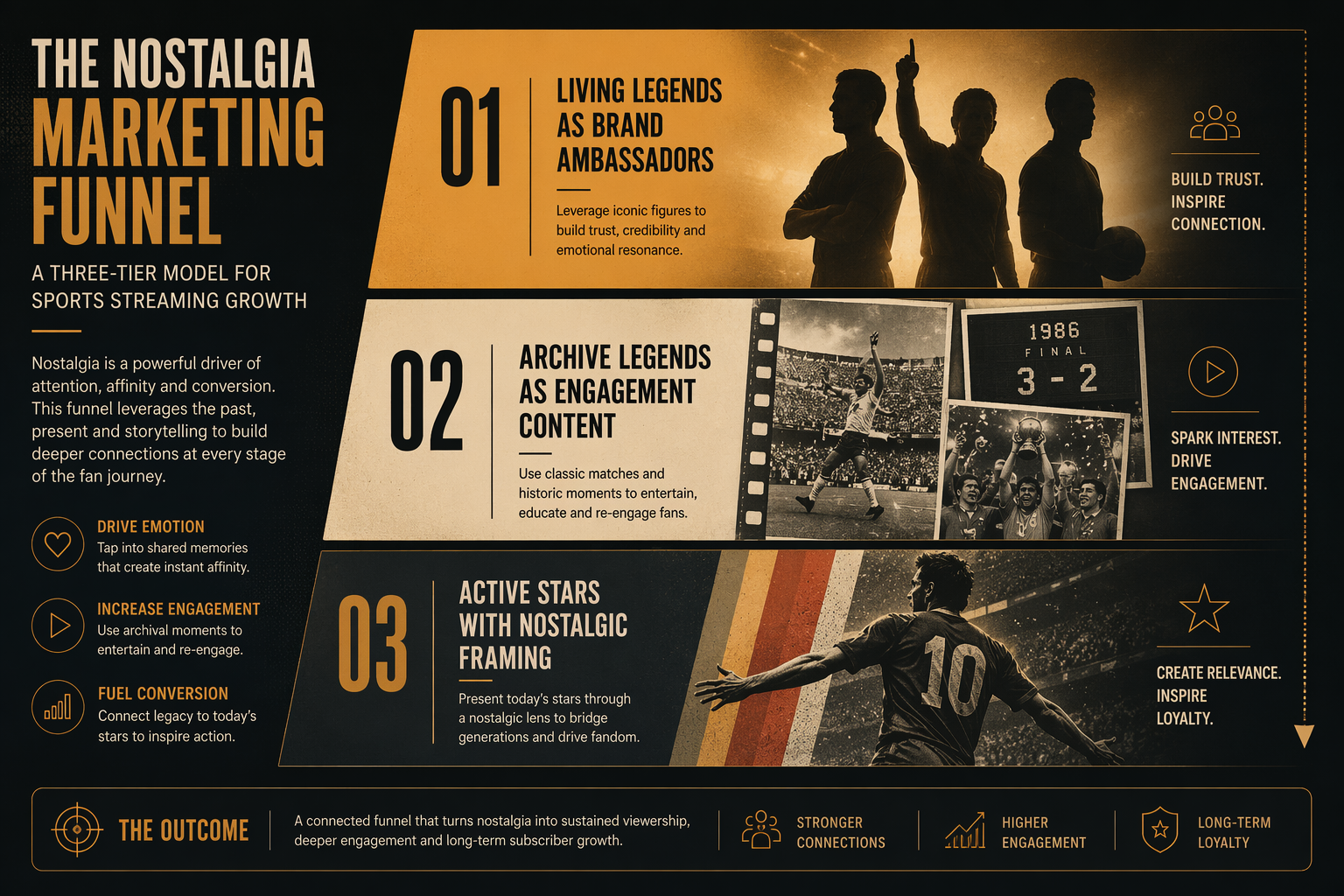
That is where DAZN's sports streaming marketing around classic players becomes more than a celebrity habit. The strongest version of the strategy is not “put a famous footballer in the ad.” It is a three-part use of memory: living legends create instant credibility, archive legends keep old emotional assets available inside the product, and current stars are framed through older sports codes so even new events arrive with a familiar shape.
DAZN's Classic Player Strategy Is a Funnel, Not a Mood
Nostalgia is often treated as a creative finish: grainy footage, old jerseys, a famous face, a soundtrack that tells the audience how to feel. DAZN's better lesson is structural. Different kinds of football memory are assigned different jobs.
| Nostalgic asset | DAZN example | Marketing job |
|---|---|---|
| Living legends | Cristiano Ronaldo, Neymar, José Mourinho ambassador and promotional roles | Borrow trust, fame, and cross-market credibility near acquisition moments |
| Archive legends | FIFA+ Classic Players programming on DAZN featuring Pelé, Zico, Bobby Moore, Iniesta, Messi, Ronaldo, and Klose | Turn memory into engagement content that can be watched, revisited, and merchandised inside the service |
| Active stars in nostalgic codes | The FIFA Club World Cup 2025 “Undisputed” campaign with Erling Haaland, Harry Kane, Luis Suarez, and Edinson Cavani in a boxing-promo frame | Make a current event feel instantly legible by borrowing older sports-show and fight-night grammar |
That distinction is the part worth stealing. Most brands cannot borrow Ronaldo. They can still decide whether memory is being used for awareness, conversion, engagement, or retention. Without that assignment, nostalgia becomes decoration.
Tier One: Living Legends Make the Brand Easier to Trust
DAZN's first global ambassador deal with Cristiano Ronaldo came in 2018, shortly after his move to Juventus, and was reported as a 2.5-year agreement.[3][4] The timing was not subtle. Ronaldo's move was itself a media event, and DAZN attached its young global streaming brand to a player whose recognition traveled across leagues, languages, and generations.
A player like Ronaldo does not simply supply reach. He carries proof that people already understand. Fans know the Champions League nights, the arguments about greatness, the national-team stakes, the transfer spectacle. For a newer streaming platform, that recognition reduces the amount of explanation the brand has to do.
DAZN later expanded that logic with Neymar, whose multi-year deal was tied to launches in Spain and Brazil, and with José Mourinho in punditry and promotional duties.[5] Those are not identical assets. Neymar helps DAZN speak to markets where personality, club allegiance, and national football culture overlap. Mourinho gives the platform a different kind of memory: press-conference theatre, tactical authority, and a long-running role as one of football's most watchable narrators.
The acquisition role is clear. Living legends make a service look less like another tile on a connected-TV screen and more like a place where football's recognized voices have gathered. That does not prove an ambassador caused a subscriber to convert. It does explain why a performance team might keep paying for familiarity even when cheaper digital creative can be generated faster.
Tier Two: Archive Legends Give Memory Something to Do
The second layer is more durable because it lives inside the product. In June 2026, FIFA+ launched on DAZN, with DAZN describing the move as part of its push toward becoming a global home of football. The FIFA+ presence included archive-led programming such as Classic Players, drawing on tournament-library material around names including Pelé, Zico, Bobby Moore, Iniesta, Messi, Ronaldo, and Miroslav Klose.[6]
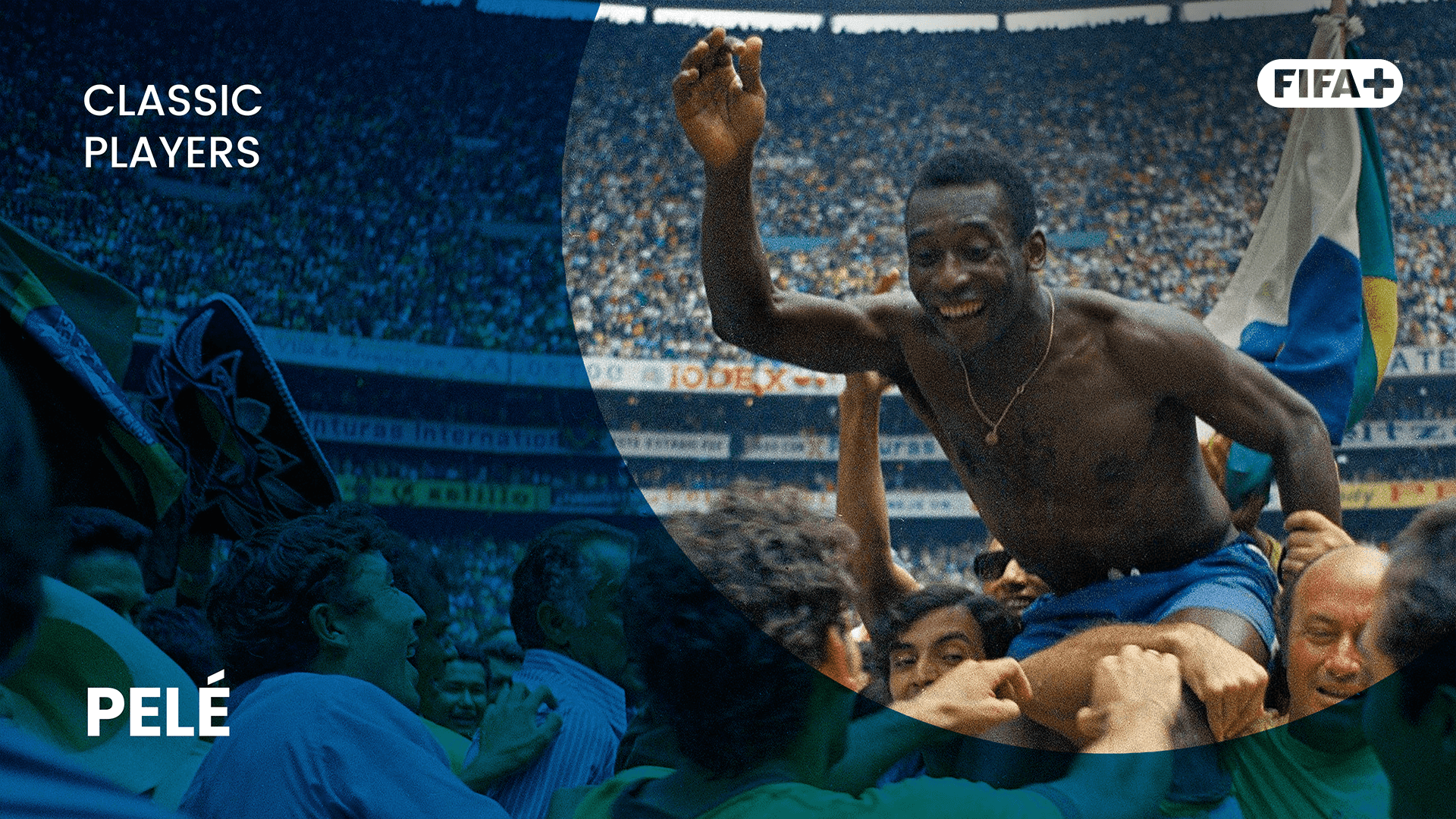
This is a different job from an ambassador announcement. Archive programming turns inherited sports memory into inventory. It can fill time between live events. It can support search and recommendation surfaces. It can give older fans a reason to revisit the app when nothing urgent is live, while giving younger fans a guided way into inherited football mythology.
It is also where the word “classic” needs discipline. A clip is not valuable because it is old. It is valuable when it reconnects the viewer to a stored emotional map: watching with a parent, learning a national team story, discovering why a tournament still gets discussed, or finally seeing the full sequence behind a highlight that has been recycled for years.
The available material does not establish Classic Players as DAZN's flagship product, and it should not be treated that way. Its importance is more precise: it shows how DAZN can keep football memory active as engagement content instead of spending nostalgia only at the top of the funnel.
Tier Three: Current Stars Become Easier to Process When the Frame Is Familiar
The “Undisputed” campaign for the FIFA Club World Cup 2025 is the cleanest example of DAZN using nostalgia without relying only on retired players. The ad put Erling Haaland, Harry Kane, Luis Suarez, and Edinson Cavani into a boxing-themed promotional world, with Michael Buffer introducing the spectacle.[7]
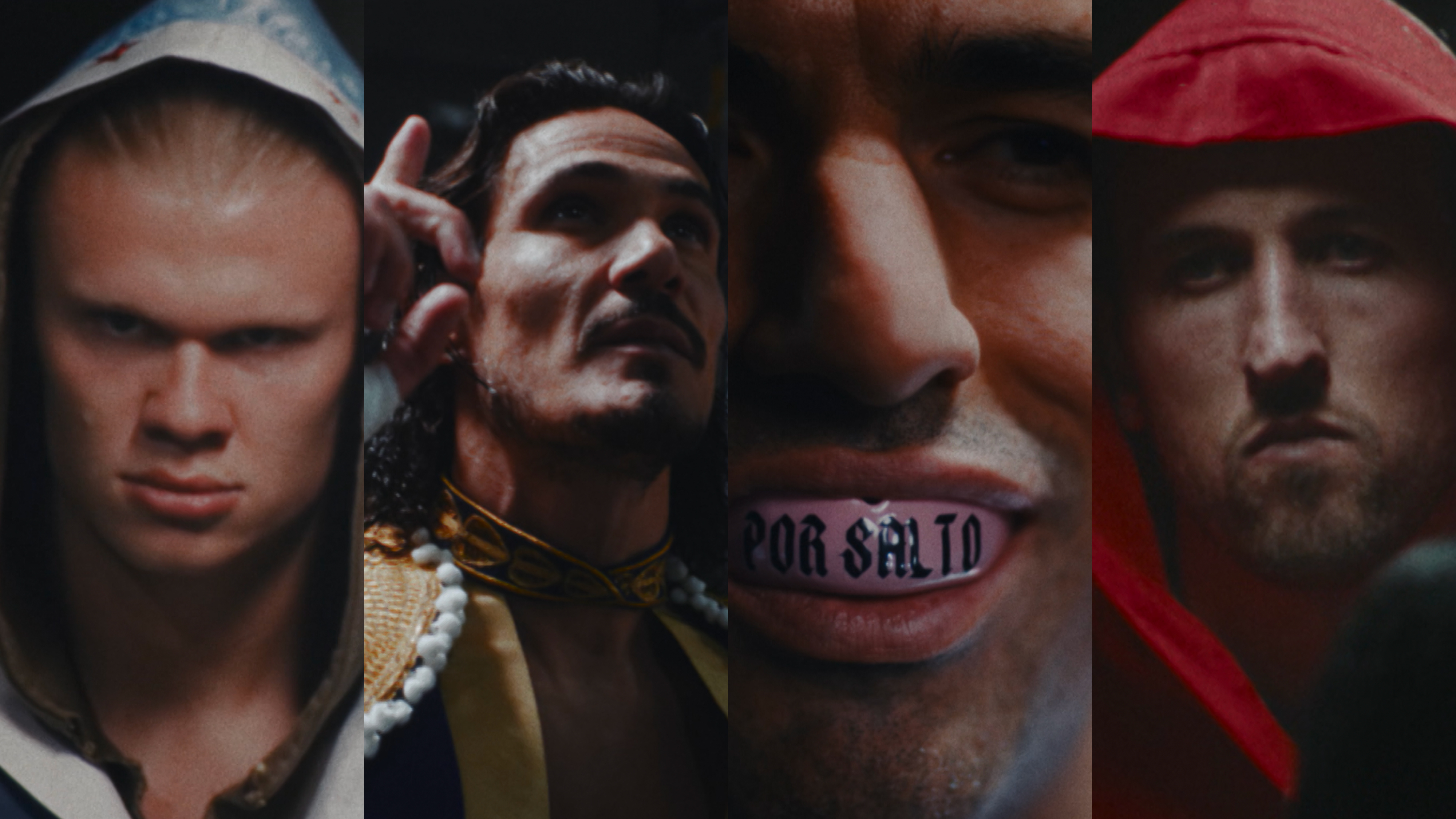
The creative move is simple but useful. A global club tournament can be complicated to explain: new format, unfamiliar matchups for casual viewers, different clubs carrying different levels of recognition. A fight-night frame compresses the proposition. The viewer understands stakes, rivalry, entrance, confrontation, and appointment viewing before the media plan has finished doing its work.
This is where “nowstalgia” becomes practical. Nostalgia cycles are no longer only about reaching back 20 or 30 years; compressed cycles of roughly 10 years mean relatively recent sports memory can already feel emotionally charged. Suarez and Cavani can carry older tournament and club memories, while Haaland and Kane keep the campaign anchored in the current premium product. The ad does not ask viewers to leave the present. It makes the present feel like it already belongs to a recognizable sports tradition.
Why This Works Better Than Another Clever Ad
The evidence for nostalgia is stronger than the average marketer's embarrassment about using it. The reported benchmark data is not DAZN-specific, so it should not be used to claim DAZN's exact lift. It does, however, explain why this kind of architecture is commercially rational.
Nostalgic advertising has been reported to produce roughly a 20% lift in brand favorability and up to a 60% boost in purchase intent in Amazon Ads data cited by Ideafoster, while Nielsen data cited by Ideafoster found a 23% average sales lift for nostalgia campaigns.[8] Kantar has also reported that nostalgic ads can gain 15 points in enjoyability and 14 points in distinctiveness against non-nostalgic advertising.[9]
The psychology is not mysterious. A 2025 Psychology & Marketing study found that nostalgic ads improved brand name recall by reactivating brand-related autobiographical memories.[10] That matters because recall is not the same as passive liking. If an ad sends someone back to a personal memory, the brand is no longer competing only as information. It is riding along with a memory structure the audience already owns.
That is also why sports is unusually fertile ground. A classic player is rarely just a celebrity. Pelé, Ronaldo, Mourinho, Neymar, Messi, Iniesta, Bobby Moore, or Klose can stand in for a match watched at home, a tournament summer, a family argument, a national disappointment, or a club obsession that survived long after the original broadcast ended. DAZN's advantage is that the product itself can satisfy the memory it activates.
The 2026 Context Makes Familiarity More Valuable
The cultural backdrop helps explain why this strategy feels timely rather than retro for its own sake. Google Trends data cited by Ideafoster showed nostalgia-related search terms up 300% since 2020, while Pinterest reported “retro aesthetic” saves up 185% year over year and “2016 nostalgia” searches up 450%.[8] The numbers point to a market looking backward quickly, not waiting for a full generational cycle.
At the same time, sports viewing has become more fragmented. Zappio data in the research brief says 87% of fans aged 18 to 29 use sports apps, and 80% use second screens during broadcasts.[11] That does not mean every young fan is unreachable. It means the marketing has to survive divided attention and still leave a trace.
A synthetic-looking ad can be technically impressive and still disappear. Nostalgia has a different advantage: it arrives pre-indexed. The viewer already has a shelf for it. That shelf might be a tournament, a player era, a commentary voice, a type of sports promo, or the ritual of watching a major match with other people. DAZN's model works when it puts the new offer on that shelf instead of asking the audience to build one from scratch.
What Non-Sports Brands Can Actually Copy
The transferable lesson is not “find your Ronaldo.” Most brands do not have access to a living global icon, and many would misuse one if they did. The replicable mechanism is to separate nostalgic assets by funnel role.
- Use familiar people or symbols when the buyer needs trust quickly, especially in a crowded or low-differentiation category.
- Turn old assets into product or content experiences when the goal is engagement, not just awareness.
- Frame new launches through familiar formats when the offer is complex, unfamiliar, or easy to ignore.
- Measure nostalgia against business outcomes such as favorability, recall, purchase intent, sales, retention, and repeat use instead of treating warm reaction as success.
A bank might use trusted legacy cues to reduce anxiety around a new digital product. A retailer might turn past catalog imagery into shoppable content rather than a one-off social post. A software company might launch a new AI feature through a familiar workflow metaphor instead of another abstract future-of-work video. These are hypothetical examples, but the decision rule is the same: memory should reduce cognitive effort at the exact point where the customer is most likely to hesitate.
The Claims Need Boundaries
DAZN's growth cannot be credited to nostalgia alone. The company is also shaped by live sports rights, market-by-market distribution, original programming, pricing, product experience, and the basic availability of events people care about. A classic-player strategy can make attention warmer, but it cannot compensate for a weak sports calendar or a frustrating streaming experience.
The available business figures also need care. DAZN's 20 million paid subscribers and 300 million monthly users came from its own 2023 Annual Review, which makes them company-reported and not current to mid-2026.[1] Kantar's Q1 2025 subscriber-growth figure is more recent third-party context, but it still does not isolate nostalgia as the cause of growth.[2]
The same caution applies to the benchmark studies. Favorability, intent, sales lift, enjoyability, distinctiveness, and recall data support nostalgia as a serious marketing mechanism. They do not prove that every nostalgic execution will outperform every non-nostalgic one. Lazy retro packaging is still lazy packaging.
The useful strategic judgment is narrower and stronger: in a market crowded by streaming choices, synthetic creative, and divided attention, DAZN shows how nostalgia can be organized into an acquisition and engagement system. Living legends make the brand easier to trust. Archive legends give subscribers something emotionally familiar to watch. Current stars in old sports codes make new events easier to understand. Nostalgia is not a replacement for product, rights, distribution, or creative quality, but in 2026 it is an undervalued way to make marketing feel human, familiar, and memorable before asking for conversion.
References
- 2023 Annual Review, DAZN Group
- Strong subscriber growth for DAZN but Netflix still top streamer, Broadband TV News
- DAZN Signs Ronaldo as Brand Ambassador Amid Complaints About Tech, SportsBusiness Journal, 2018
- Cristiano Ronaldo signs as DAZN's first global ambassador, SportsPro
- Neymar signs up as DAZN goes live in Spain, SportsPro
- FIFA+ Launches On DAZN: A Major Step Towards The Global Home Of Football, DAZN Group, June 4, 2026
- Haaland and Suarez Help DAZN Punch Up FIFA Club World Cup Ad, Adweek
- The Power of Remembering: Why Nostalgia Marketing Works in 2026, Ideafoster
- Nostalgia in advertising effectiveness research, Kantar
- Nostalgic advertising and brand name recall, Psychology & Marketing, 2025
- Sports app and second-screen fan behavior research, Zappio

Comments
Join the discussion with an anonymous comment.