
CoreWeave Stock Rating: Buy Signal or AI Hype in 2025?
CoreWeave posted explosive 2025 revenue growth but also a GAAP net loss and massive debt, leaving analysts deeply split between buy and sell ratings. This article unpacks what the $32 to $303 price target range really reveals about the AI cloud market's trajectory.
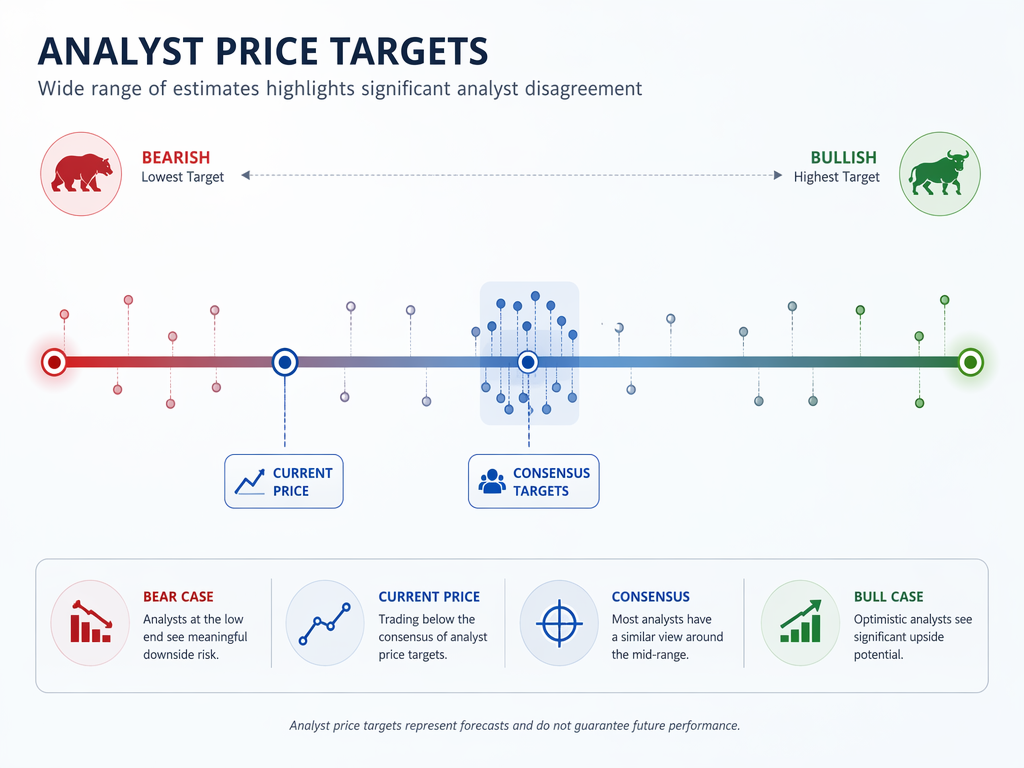
CoreWeave’s stock rating looks simple until the price targets enter the room. As of July 20, 2026, the company carried a consensus “Moderate Buy” profile: roughly 20 buy ratings, 12 holds, and 2 sells across 34 analysts, with an average 12-month target around $140 against a stock trading near $73. That headline implies confidence. The range underneath it does not. Analyst targets ran from $32 at the low end to $303 at the high end, a spread wide enough to make the consensus label almost decorative.[1][2]
That is the better entry point for anyone trying to read CoreWeave as an AI cloud signal rather than as a day-trading setup. The market is not merely asking whether CoreWeave can grow. It already did. The harder question is whether a purpose-built AI infrastructure company can turn huge signed demand into delivered capacity and durable profit while carrying the capital costs that make the demand possible.
This article uses stock and analyst data available as of July 20, 2026. Prices, ratings, and targets can change quickly, so current figures should be verified before making any investment or budgeting decision. The analysis here is for AI market and vendor-ecosystem interpretation, not personal investment advice.
The Moderate Buy Label Hides the Real Disagreement
A “Moderate Buy” rating usually compresses a messy debate into a digestible market shorthand. With CoreWeave, the compression loses too much. A $32 target says the company’s debt load, capital intensity, concentration risk, and GAAP losses deserve a much lower valuation. A $303 target says the backlog and demand environment justify looking through near-term accounting pain because the company is building scarce AI compute capacity into a supply-constrained market.[1][2]
The stock’s own path since the IPO makes that split easier to understand. CoreWeave went public near $33, climbed to about $155 during the AI infrastructure enthusiasm, and had fallen back near $73 by July 2026, according to Tickeron’s price-history analysis.[3] In one ticker, investors have already lived through both versions of the story: the breakout cloud provider and the capital-intensive company being repriced after the first rush of excitement.
For marketing and growth teams watching the AI stack, that matters because CoreWeave is not an abstract market story. Its economics sit beneath the model providers, AI application vendors, and enterprise AI roadmaps that eventually flow into software pricing, availability constraints, procurement risk, and vendor survival.
What the Bulls Have to Believe
The bullish case starts with numbers that are difficult to dismiss. CoreWeave reported $5.13 billion in fiscal 2025 revenue, up from $1.92 billion in fiscal 2024, a 168% year-over-year increase. CEO Mike Intrator described the company as “the fastest cloud to reach $5B in annual revenue” in the company’s February 2026 results release.[4]
That is not normal software-company growth, and it is not normal infrastructure-company growth either. It reflects a period when access to high-end AI compute became a strategic bottleneck. If customers need capacity now and the largest clouds cannot satisfy every workload on preferred timing, a specialized provider can grow faster than the incumbents for a while.
The backlog figure gives the bull case its strongest foundation. CoreWeave reported $66.8 billion in revenue backlog at the end of fiscal 2025, up from about $15 billion, alongside $5.13 billion in annual revenue.[4] That backlog is the evidence analysts point to when they argue that demand is not merely speculative. Customers have signed contracts, many structured as take-or-pay commitments, and the company has a long runway of work to convert.
But backlog is not the same thing as cash already earned. It converts over time, and only if the company can deliver the capacity customers contracted for. This is where CoreWeave becomes more operationally interesting than a clean AI-demand chart. The bullish analyst is not just underwriting customer appetite. They are underwriting execution: data center capacity, GPU access, power availability, networking, financing, and the ability to bring all of that online quickly enough to meet contractual demand.
Backlog Is Demand, But It Is Also a Delivery Obligation
A $66.8 billion backlog sounds like safety. In a capital-light software business, a large contracted backlog can feel close to inevitability. In AI infrastructure, it is more complicated. CoreWeave has to spend before it can serve. Capacity has to be financed, built, powered, and depreciated. Customers may be committed, but the provider still has to turn those commitments into working compute.
| Metric | What It Shows | What It Does Not Prove |
|---|---|---|
| $66.8B revenue backlog | Large signed demand for future capacity | That all revenue has already been earned |
| $5.13B FY2025 revenue | Explosive conversion from prior demand | That growth can continue without heavier capital strain |
| $10.3B FY2025 CapEx | The scale of infrastructure investment required | That future returns will exceed financing and depreciation costs |
| 850 MW active capacity | A concrete operational footprint | That enough capacity exists today to satisfy the full backlog |
CoreWeave reported $10.3 billion of capital expenditures in fiscal 2025 and 850 megawatts of active capacity.[4] Those figures are useful because they pull the discussion away from “AI demand is strong” and toward “AI demand is expensive to satisfy.” The company is not only selling access to models or software seats. It is absorbing the physical and financial burden of infrastructure that has to exist before customers can consume it.
This is the central practical question behind CoreWeave’s stock rating debate: how much of the backlog should be valued like secured growth, and how much should be discounted because delivery itself is risky? The analyst at $303 is likely treating the backlog as proof that CoreWeave has won a privileged position in the AI cloud supply chain. The analyst at $32 is likely asking how much equity value remains if capacity delivery costs more, takes longer, or produces thinner margins than the adjusted numbers imply.

The Profitability Split Is Not a Footnote
CoreWeave’s fiscal 2025 profitability picture depends heavily on which line item gets the spotlight. On an adjusted EBITDA basis, the company reported $3.09 billion, equal to a 60% margin. On a GAAP basis, it reported a net loss of $1.17 billion, equal to a negative 23% net loss margin.[4]
Neither number should be waved away. Adjusted EBITDA shows that the business can generate substantial operating profit before certain charges. That matters for an infrastructure provider because it suggests demand is not being bought purely through uneconomic pricing. Customers are paying meaningful amounts for scarce capacity, and the company’s service economics can look strong before the full weight of financing and accounting costs arrives.
The GAAP loss matters just as much because the excluded costs are not random. For a company building AI cloud infrastructure at this speed, depreciation is not a technical nuisance; it is the accounting shadow of real capital spending. Interest expense is not an optional detail when the company has $21.37 billion in debt. Stock-based compensation also affects dilution and the cost of scaling a high-demand technical organization.[4]
That gap between adjusted EBITDA and GAAP net income is where much of the analyst dispersion lives. A bull can say the company is already profitable on a core operating basis and that GAAP earnings will improve as utilization rises across newly deployed capacity. A bear can say the adjusted view strips out exactly the costs that define the business model: buying infrastructure, financing it, depreciating it, and paying the people needed to operate it.
The more useful reading is not that one metric is “real” and the other is fake. The useful reading is that CoreWeave’s model can look powerful before capital structure and asset intensity, then fragile after them. That is not a contradiction to tidy up. It is the company’s actual strategic tension.
Customer Concentration Changes How Safe the Backlog Feels
Backlog quality depends on who is behind it. CoreWeave disclosed that Microsoft accounted for 62% of 2024 revenue, a level of concentration that would make any infrastructure provider more sensitive to one customer’s plans, negotiating posture, and timing.[5]
That does not make the revenue low quality. Microsoft is not a weak customer. But concentration changes the risk profile. A business with one dominant buyer can scale extremely fast when that buyer is expanding. It can also face sharper pressure if contract terms, renewal expectations, workload placement, or capacity needs shift.
The OpenAI agreement announced in 2025 helps explain why some analysts are more constructive. CoreWeave announced an $11.9 billion, five-year deal with OpenAI, which can reduce the perception that Microsoft alone defines the revenue base.[4] The important phrase is “can reduce.” A signed deal is diversification potential; delivered revenue over time is diversification realized.
For enterprise AI buyers, this is not just an equity-market detail. Vendor concentration and customer concentration both show up later as roadmap risk. If a provider’s capacity is heavily committed to a small number of strategic customers, smaller AI vendors and downstream software companies may feel that pressure through availability, pricing, or slower access to new infrastructure.
Why Hyperscaler Comparisons Can Mislead
It is tempting to compare CoreWeave directly with AWS, Azure, or Google Cloud and then declare it expensive or cheap. That comparison only works if the frame is narrow. Hyperscalers have mature revenue bases, broader customer portfolios, deeper balance sheets, and multiple business lines supporting infrastructure investment. CoreWeave is more concentrated, younger, and more exposed to the AI compute cycle.
That does not make the comparison useless. It explains why analysts can rationally disagree. On a simple revenue multiple, a fast-growing AI cloud specialist can look expensive beside mature cloud platforms. On a growth-adjusted basis, the premium may look more defensible if revenue keeps compounding and backlog converts on schedule. The mistake is treating either comparison as a complete valuation answer.
Tickeron has also cited claimed cost advantages for CoreWeave versus hyperscalers, including a 20% to 50% range.[3] That kind of claim is relevant to the bull case, but it should be handled carefully. A cost-positioning claim from market analysis is not the same thing as proof that margins will remain strong after depreciation, financing costs, and competitive responses.
The 2026 Momentum Data Still Needs the Same Filter
Third-party analysis has referenced CoreWeave’s Q1 2026 revenue at about $2.1 billion, described as roughly doubled year over year, along with more than $99 billion in total contracts signed and 2026 CapEx guidance of $30 billion to $35 billion.[6] Those figures point in the same direction as the 2025 story: demand is still large, and the capital bill is getting larger.
Because those Q1 2026 figures are cited here from third-party analysis rather than the official filing in the supplied materials, they should be confirmed against CoreWeave’s investor-relations release before publication or investment use. They are directionally useful for interpreting market expectations, but the heavier claims in this article rest on the official fiscal 2025 results.
If the 2026 CapEx guidance range is confirmed, it would sharpen the same question rather than answer it. More spending may be exactly what a company with massive contracted demand should do. It also increases the burden on utilization, financing access, depreciation schedules, and customer delivery timing.
What the Rating Says About the AI Cloud Market
CoreWeave’s analyst split is not a clean referendum on whether AI infrastructure demand is real. The backlog, revenue growth, and major customer commitments all argue that demand is very real. The disagreement is about how much equity value survives the process of satisfying that demand.
For growth leaders and marketing strategists, that is the more transferable lesson. AI demand can be authentic and still produce unstable economics for the companies supplying it. A vendor can grow quickly and still face balance-sheet pressure. A cloud provider can report strong adjusted profitability and still show GAAP losses that deserve attention. A large customer commitment can validate a market and increase concentration risk at the same time.
So the “buy or sell” framing is less useful than the dispersion behind it. A roughly $140 average target beside a $32-to-$303 range says Wall Street is not calmly converging on one view of CoreWeave. It is pricing several possible futures at once: a durable AI cloud winner, an overlevered infrastructure buildout, or something in between where demand remains strong but returns become harder to capture than revenue growth suggests.[1][2]
That is a more honest signal for the AI cloud market in 2026. Demand alone is no longer enough to settle the story. Delivery capacity, customer concentration, margin quality, depreciation, interest expense, and capital access now matter just as much as the next signed AI contract.
References
- StockAnalysis – CoreWeave (CRWV) Stock Forecast & Analyst Price Targets, StockAnalysis.
- MarketBeat – CoreWeave Stock Forecast and Price Target 2026, MarketBeat.
- CoreWeave CRWV Stock Analysis (+365% and AI Boom), Tickeron.
- CoreWeave Reports Strong Fourth Quarter and Fiscal Year 2025 Results, CoreWeave Investor Relations, February 2026.
- CoreWeave S-1 and subsequent filings, CoreWeave Investor Relations.
- TIKR analysis.

Comments
Join the discussion with an anonymous comment.