
Claude vs ChatGPT for B2B Marketing Copy: A 2026 Performance Comparison
Data-backed comparison of Claude and ChatGPT for B2B copywriting based on 247 ad campaigns with $2.3M+ spend. See which tool drives higher conversion rates, CTR, and cost efficiency — and learn the combined workflow that top B2B teams use.
Why generic AI voice is the enemy of B2B conversion
In early 2025, the default output of most large language models read like a press release from a company that doesn’t exist. By mid-2026, both Claude and ChatGPT have improved dramatically, but the fundamental problem hasn’t changed: B2B buyers have a well-calibrated sensor for language that sounds like it was generated, not written by someone who understands their industry.
The stakes are higher in B2B than in consumer advertising. A B2B prospect evaluating a six-figure SaaS contract is reading for signal: domain-specific terminology, nuanced value propositions, and a tone that matches the category’s conventions. Generic praise like “industry-leading solution” gets filtered out. When an AI tool produces copy that sounds like every other vendor in the space, the campaign bleeds conversion dollars into the noise.
That’s why a head-to-head performance comparison built on actual campaign data — not benchmark scores or feature lists — matters for B2B marketing teams. The question isn’t which model is smarter. It’s which one produces copy that actually converts when the budget is live and the CPA target is on the line.
Testing methodology: How we compared 247 campaigns with $2.3M+ in spend
The core data in this comparison comes from a 90-day controlled test conducted by Ryze AI, published in early 2026. The study ran 247 ad campaigns across 8 industries, with total combined ad spend exceeding $2.3 million. Campaign budgets ranged from $5,000 to $150,000 per month. Each tool received identical creative briefs, and a panel of 12 senior copywriters conducted blind quality and creativity evaluations of the output. Industries included B2B SaaS, healthcare, legal services, e-commerce, and professional services.
To supplement the Ryze AI findings, we also reference data from First Page Sage’s AI conversion rate study (150+ companies, May 2025–April 2026) and iReadCustomer’s analysis of B2B SaaS and D2C campaigns using Claude and ChatGPT. Enterprise pricing and market share data comes from IntuitionLabs (April 2026) and Zapier’s ongoing feature comparison (May 2026).
All performance figures reflect the model versions available in mid-2026: Claude Sonnet 4.6 and ChatGPT-5.5 (with GPT-5.1 behind ChatGPT Enterprise). Model capabilities can change rapidly, so the numbers below should be read as a snapshot, not a permanent ranking.
Head-to-head performance metrics
The Ryze AI study provides a side-by-side view across the six metrics that matter most to paid media and content teams. The table below summarizes the aggregate results from all 247 campaigns.
| Metric | Claude Sonnet 4.6 | ChatGPT-5.5 | Difference |
|---|---|---|---|
| Average CTR | 2.47% | 2.01% | Claude +23% |
| Conversion rate (all campaigns) | 4.2% | 3.2% | Claude +31% |
| Cost per acquisition (CPA) | $47.50 | $57.80 | Claude -18% |
| Creative variations per brief | 8.3 | 11.6 | ChatGPT +40% |
| Human quality score (1–10) | 7.8 | 7.4 | Claude +0.4 |
| Brand compliance score | 92% | 87% | Claude +5pp |
Claude led on conversion efficiency, CTR, CPA, quality scores, and brand compliance. ChatGPT produced significantly more creative variations and earned higher marks for novelty from the copywriter panel. The headline numbers suggest Claude is the stronger choice for B2B conversion goals, but the story changes when you break the data down by platform and industry.
Where Claude wins for B2B: Conversion rates, LinkedIn, and brand compliance
In B2B-specific campaigns within the Ryze AI study, Claude delivered 42% higher conversion rates than ChatGPT. On LinkedIn, the advantage was even starker: Claude achieved 45% higher engagement rates and 38% higher lead quality scores as rated by the advertisers.
The iReadCustomer analysis reinforces this pattern. A B2B SaaS company used Claude Sonnet 4.6 to produce a 10,000-word authoritative guide by ingesting 50 internal technical documents and SME interviews. The resulting content achieved 42% higher conversion rates at 3.5x lower cost per lead compared to a human-freelancer baseline. While this is a single case study and not a direct head-to-head versus ChatGPT, it supports Claude’s strength in long-form, knowledge-intensive B2B content.
Claude’s brand compliance advantage (92% vs. 87% in the Ryze AI test) is particularly relevant for B2B teams managing multiple product lines or strict messaging guidelines. Claude Projects allow marketers to upload brand guides, tone documents, and past high-performing copy that persists across sessions — a workflow that HubSpot’s analysis explicitly identifies as a key differentiator for maintaining voice consistency.
Why does Claude perform better in certain B2B contexts? The model’s natural language output — described by Zapier as “more natural sounding than GPT-5.5 for writing” — tends toward measured, precise prose that matches the tone B2B buyers expect. The 200K-token context window also enables single-session processing of complete brand guidelines alongside draft content, which reduces the risk of off-brand phrasing that erodes trust in professional audiences.
Where ChatGPT wins: Creative volume, Google Search ads, and TikTok
ChatGPT’s strongest advantage is volume. The Ryze AI study found it generated 40% more creative variations per brief (11.6 vs. 8.3) and scored 15% higher on creativity evaluations from the blind panel. For teams that need to rapidly iterate headlines, test multiple angles, or generate ad copy at scale, ChatGPT is the faster engine.
- Google Search ads: ChatGPT achieved 8% higher CTR than Claude. For search advertising where headline variety and keyword insertion matter, ChatGPT’s creative flexibility is an advantage.
- TikTok: ChatGPT drove 22% higher engagement — likely because its output is more casual and trend-aligned, which fits TikTok’s content style.
- DALL-E integration: ChatGPT offers native image generation, enabling campaigns that combine ad copy with AI-generated visuals in a single workflow. Claude does not yet have a built-in image generation tool.
The iReadCustomer D2C case study illustrates the creative-speed advantage: a fashion brand used ChatGPT-5.4 to feed it current fashion week trends, generate mood board imagery via DALL-E, and produce 500 ad copy variations for Facebook, TikTok, and email drops in under 15 minutes, achieving 6.8x ROAS. That level of output is logistically impractical with Claude alone.
Platform-by-platform recommendations
Based on the tested performance data, the recommendation for each major B2B ad platform is clear. The matrix below maps the Ryze AI platform-level findings to tool choices.
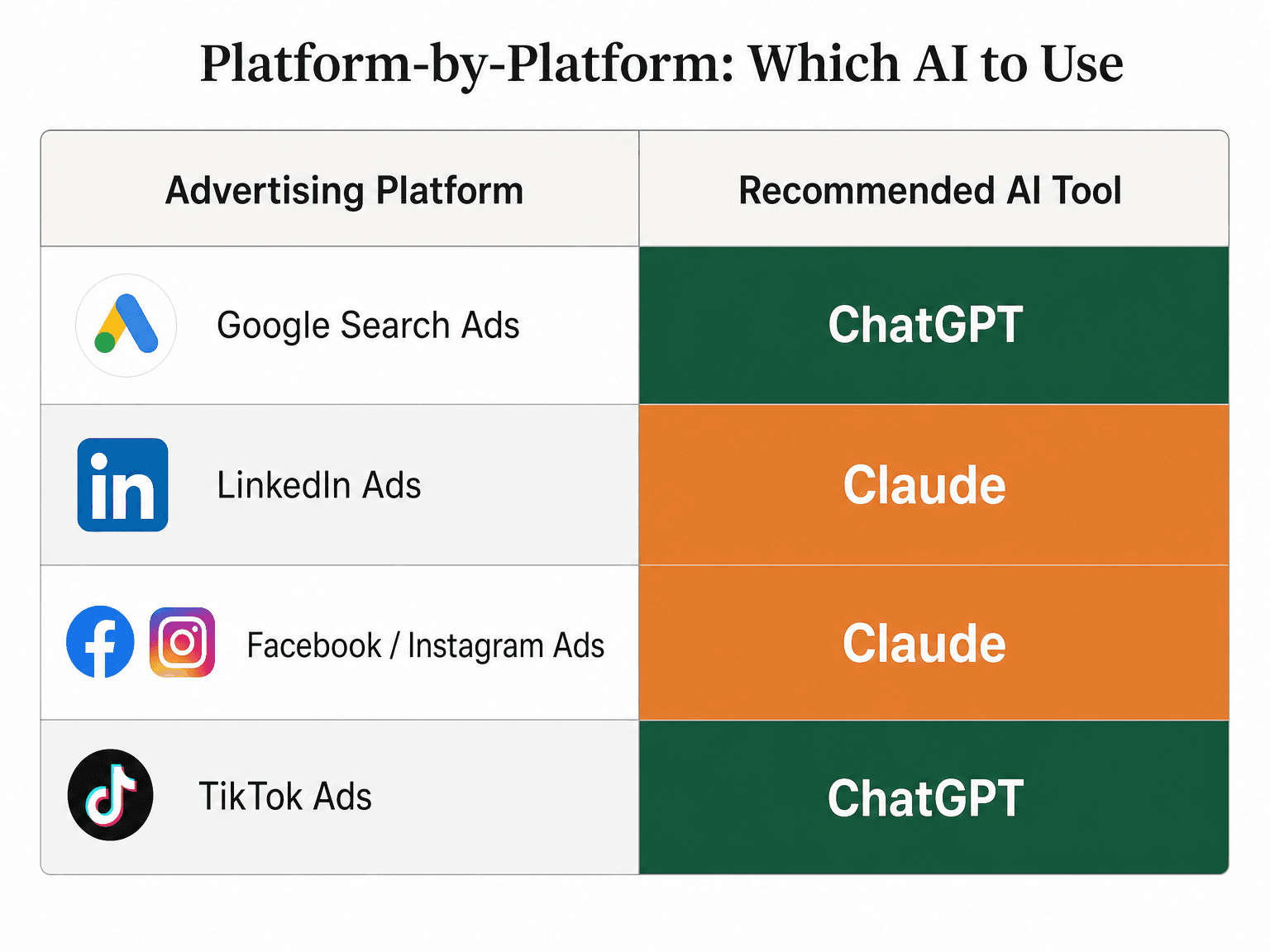
For B2B teams running a mix of channels, the simplest rule: use ChatGPT for search and short-form social where headline volume and creative variety drive performance; use Claude for LinkedIn and Facebook/Instagram where audience targeting relies on trust-building copy and brand consistency.
The combined workflow: ChatGPT for ideation, Claude for refinement
Multiple sources — including Zapier, HubSpot, and the Ryze AI analysis — converge on the same operational pattern: the strongest B2B teams use both tools in sequence rather than choosing one exclusively.
The recommended workflow has three stages:
- Research and ideation in ChatGPT. Use ChatGPT’s broader plugin ecosystem, web browsing, and faster creative generation to research competitors, brainstorm hooks, and generate an initial pool of headlines, subject lines, or ad concepts.
- Refinement and brand alignment in Claude. Move the strongest concepts into Claude, where the 200K-token context window can hold a full brand guide alongside the draft. Claude’s higher brand compliance score (92%) and more natural output (per Zapier’s evaluation) produce the final copy.
- Approval and production. HubSpot’s Content Hub, or any CMS with AI connectors, serves as the final approval layer before publishing or launching the campaign.
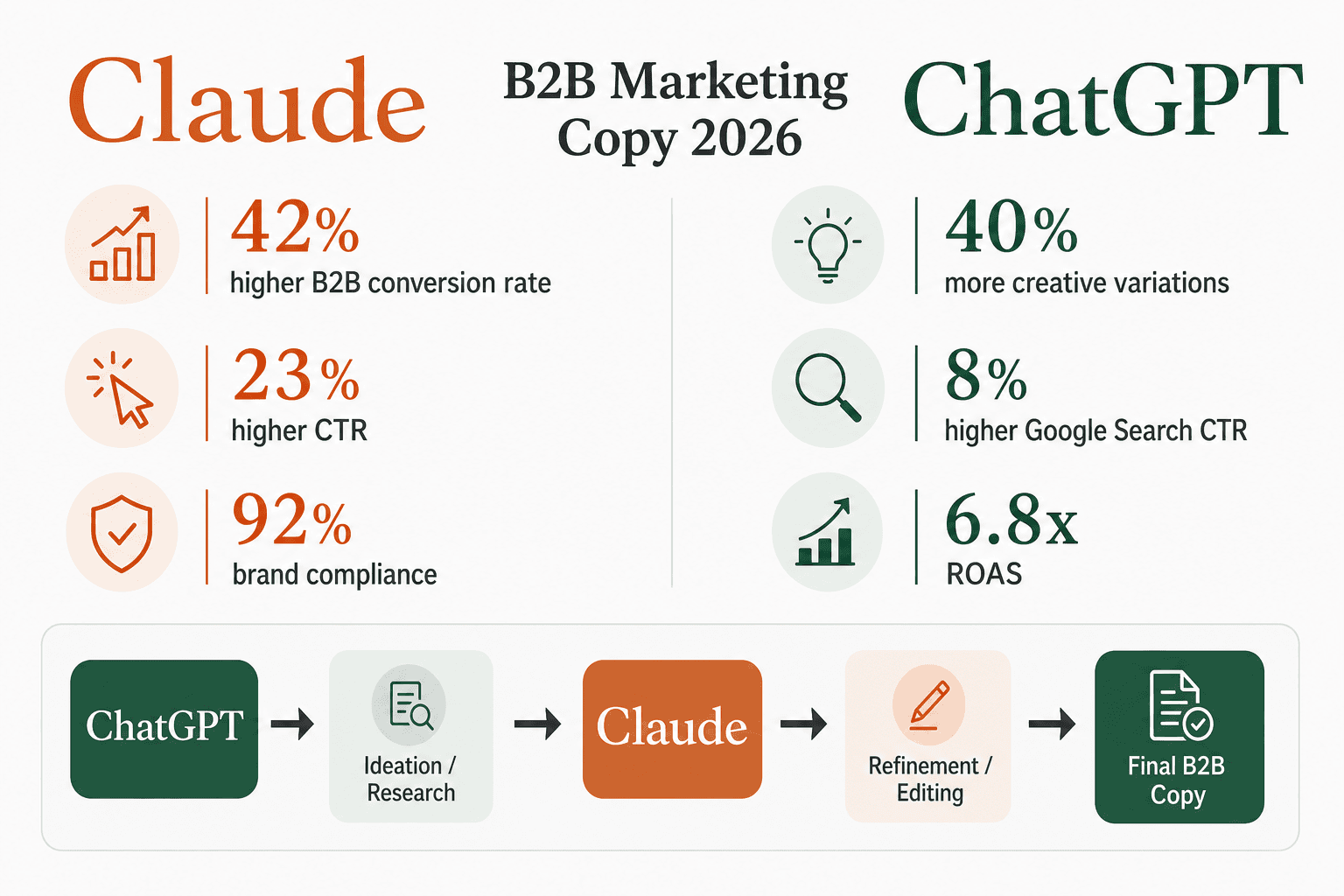
HubSpot’s analysis of the two tools explicitly endorses this split: “Marketing teams achieve best results by using Claude for editing and ChatGPT for drafting.” The rationale is that ChatGPT’s initial output is broader and more creative, while Claude’s editing pass tightens the copy to meet brand standards and structural requirements for B2B contexts.
Cost comparison: When each tool makes sense for your budget
| Pricing Tier | Claude | ChatGPT |
|---|---|---|
| Individual Pro (monthly) | $20 | $20 |
| Individual Max / Pro (monthly) | $100–200 | $100–200 |
| Enterprise per seat (500+ seats) | $30–35/user/month | $45–75/user/month (typical $42–55 after discounts) |
| API pricing (input / output per 1M tokens) | Varies by model; less expensive for high volume | Varies by model; generally more expensive |
| Enterprise LLM market share (Dec 2025) | 32% | 25% |
For a B2B team of 25–50 people, ChatGPT Enterprise can cost roughly 30–60% more per seat than Claude Enterprise. That difference adds up quickly for marketing departments that need 50+ seats with full API access. However, ChatGPT’s broader plugin ecosystem and built-in DALL-E image generation may offset the cost for teams that would otherwise pay for separate creative tools.
For teams on individual Pro plans ($20/month each), cost is a wash. The decision should rest on performance and workflow fit, not price.
Decision framework: Which AI should your B2B team use?
The data from 247 campaigns, $2.3M+ in spend, and three independent sources supports a nuanced conclusion. Here’s a decision framework based on your team’s primary needs.
- If your main goal is B2B conversion rate (landing pages, LinkedIn ads, long-form content, email nurture): start with Claude. The 42% higher B2B conversion rate and 92% brand compliance are hard to ignore.
- If your primary need is creative volume (Google Search headlines, TikTok variants, rapid A/B testing): lean into ChatGPT. Its 40% more variations per brief and higher creativity scores give you more shots on goal.
- If you’re in a regulated industry (healthcare, legal, financial services): check the FirstPageSage data for your vertical. Claude leads in healthcare and industrial IoT; ChatGPT leads in legal and financial services.
- If your budget is tight at the enterprise level: Claude’s $30–35/seat pricing makes it the economical choice for large teams, especially if you don’t need image generation.
- If you can afford both: adopt the combined workflow. Use ChatGPT for discovery and first drafts, Claude for polishing and brand alignment. That’s the pattern the highest-performing B2B teams in the Ryze AI study and HubSpot’s analysis both recommend.

Comments
Join the discussion with an anonymous comment.