
How to Choose Your AI Marketing Stack in 2026: 3–5 Tools Based on Your Business Model
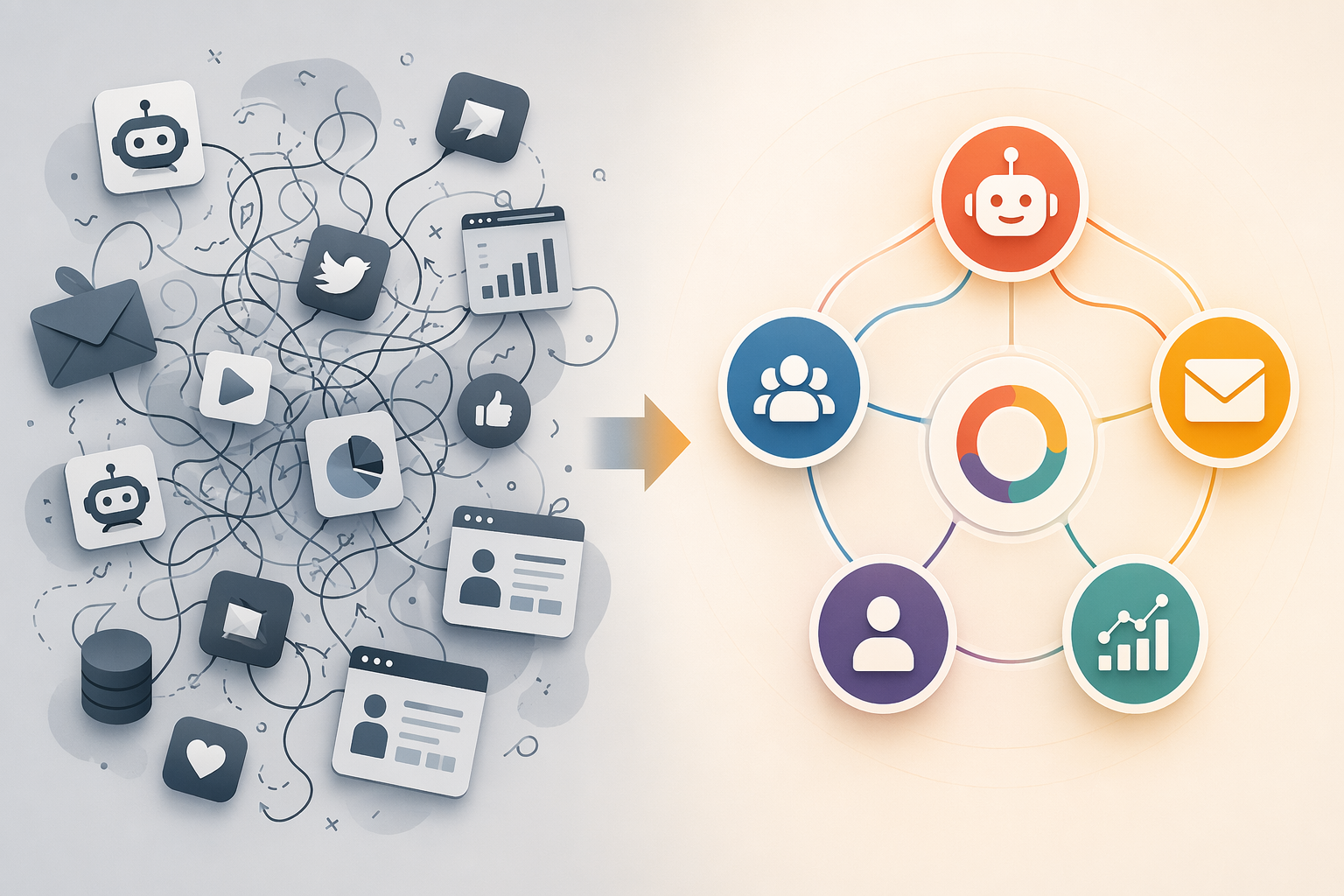
Marketing managers face over 15,000 AI marketing tools, but the winning strategy is consolidation, not accumulation. This guide provides a business-model-driven framework to select 3–5 integrated tools that fit your team size, budget, and compliance requirements, saving 8+ hours per week lost to context-switching.
The problem is not finding AI tools. It is surviving the stack.
The first mistake in AI online marketing is assuming the market is short on options. It is not. A 2026 tally put the broader martech landscape at 15,384 solutions, and that number matters because it shows how quickly teams can get buried before they have even chosen a direction. The operating cost shows up later: disconnected tools can eat 8+ hours per week in manual transfers and context-switching, which is the kind of invisible drain that turns a “quick trial” into a standing workflow problem. [1][2]
That is why the right answer for most small and mid-sized teams is not a larger list of candidates. It is a smaller stack with a clearer owner. In practice, that usually means 3–5 integrated tools, with one anchor platform that does the heaviest lifting and a few supporting layers added only where the anchor is weak.
Choose the anchor platform by business model
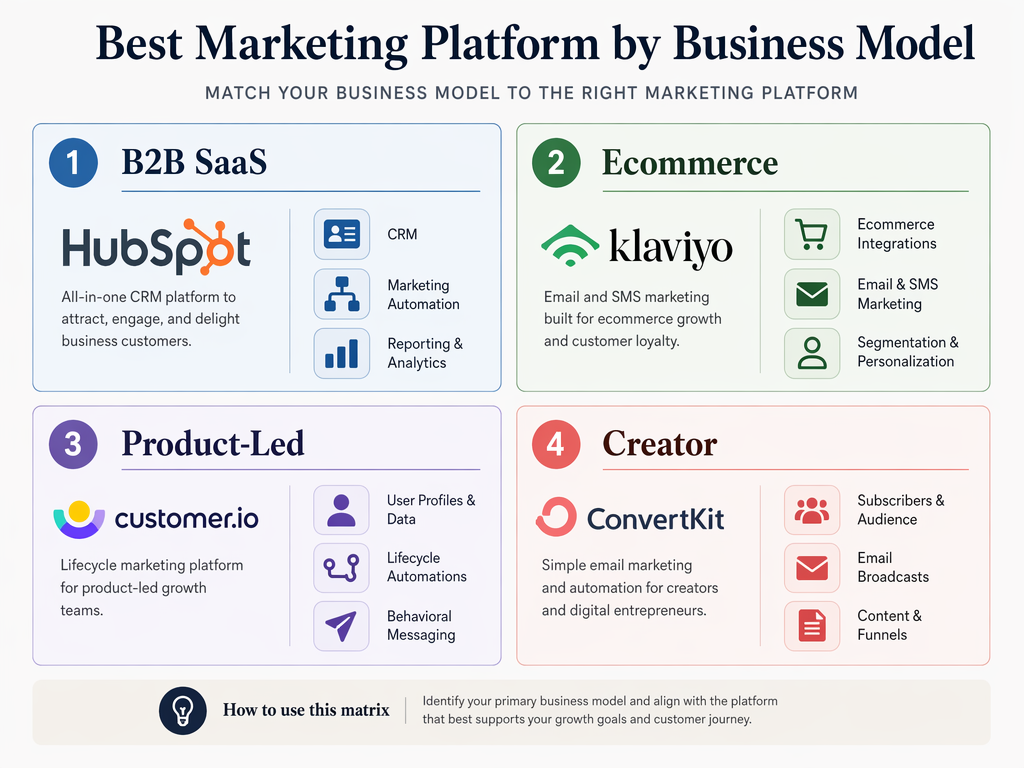
The most useful filter is not feature count. It is the business model that the stack has to support every week. The platform that feels underwhelming in a comparison chart can still be the best operational fit if it matches how the company sells, measures, and hands work across teams. Directionally, the best-fit anchors are HubSpot for B2B SaaS, Klaviyo for ecommerce, Customer.io for product-led teams, and ConvertKit for creators. [4][5]
| Business model | Anchor platform | Why it usually fits |
|---|---|---|
| B2B SaaS | HubSpot | Best when CRM, lifecycle messaging, and sales handoff need to live close together. [4][5] |
| Ecommerce | Klaviyo | Best when purchase behavior, catalog data, and repeat revenue drive the marketing workflow. [4][5] |
| Product-led | Customer.io | Best when product events trigger onboarding, activation, and expansion messaging. [4][5] |
| Creator | ConvertKit | Best when subscriber growth and audience management matter more than a deep enterprise stack. [4][5] |
For B2B SaaS teams, the hard part is rarely sending an email. It is keeping the CRM, lead source, lifecycle stage, and reporting logic aligned after the first few handoffs. HubSpot is useful because it gives one place for those motions to meet before the team starts adding extra tools for forms, sequences, or pipeline visibility. If the business later needs deeper account-based marketing or more advanced attribution, those additions make more sense as layers on top of the anchor than as separate systems running beside it.
Ecommerce teams face a different pattern. The pressure sits in purchase data, repeat-order timing, and campaign volume, so Klaviyo tends to fit better than a generic marketing suite. It reduces the number of exports between store data, audience segments, and lifecycle campaigns, which is exactly where fragmented stacks start to leak time and create inconsistent customer records. Creative testing may still live elsewhere, but the lifecycle core usually belongs in one place.
Product-led and creator teams can move faster with lighter anchors. Customer.io makes more sense when product usage events should trigger the message, while ConvertKit fits when the audience is the primary asset and the team needs a simpler path from subscriber capture to send. The exception is a hybrid model: if one company sells across multiple motions, the stack may need more than one strong anchor, but that is a business-model problem, not a reason to turn every channel into its own AI project.
The subscription price is usually not the real price
The public monthly plan is the least important number in the buying process. Zylo’s 2026 pricing analysis found that 31% of AI vendors use hybrid pricing, and that the real cost can run 2–4× the list price once credits, add-ons, seat overages, automation limits, and integration work are counted. [3]
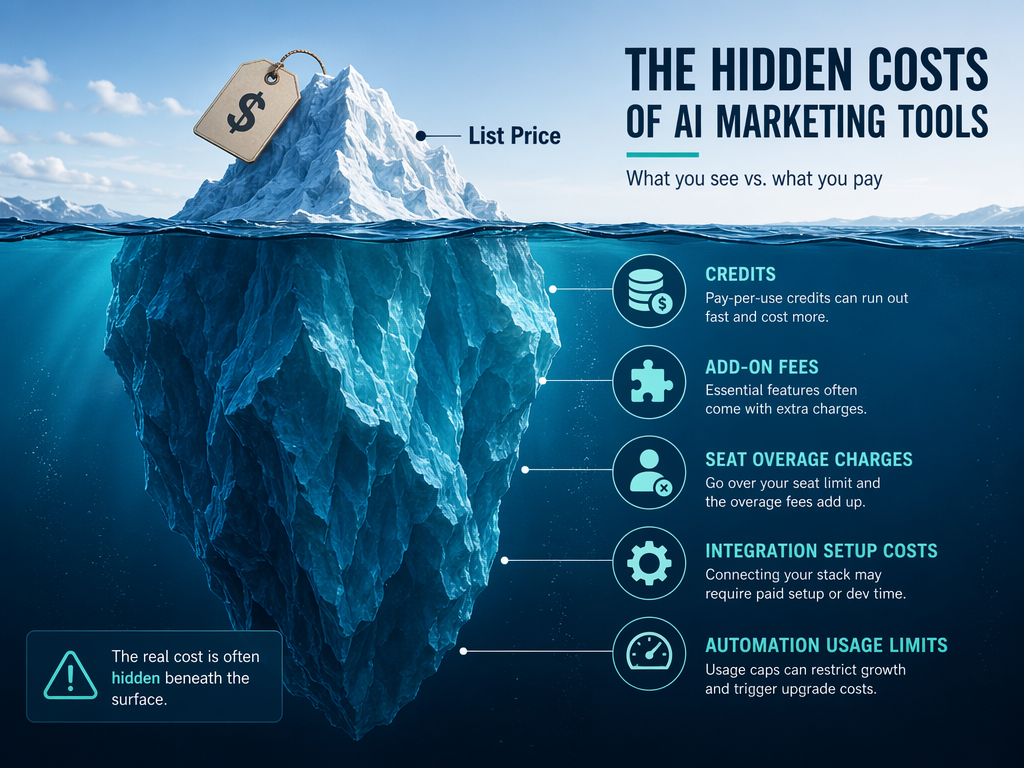
That gap is where many comparison posts become misleading. They quote the entry plan and skip the conditions that force an upgrade. A team can look disciplined on paper and still overspend because one tool bills for usage credits, another charges for extra contacts, and a third hides the cost in setup time and connector maintenance.
- Credits that reset after a usage threshold
- Add-ons for features that looked included in the demo
- Seat overages when more people need access than expected
- Automation limits that push the team into a higher tier
- Integration setup and maintenance that no one invoices separately but everyone pays for
The useful comparison is not “Which plan is cheapest this month?” It is “What will this cost after the team actually uses it the way marketing operations needs it used?” That question usually changes the ranking of vendors faster than any feature checklist does.
Compliance belongs before the trial, not after it
Teams lose time when compliance is treated as a late-stage objection. If the vendor will touch personal data, the procurement check needs to include GDPR coverage, DPA status, and whether the data-processing paperwork is in place before anyone starts a trial. That matters more now because the August 2026 EU AI Act enforcement window is close enough to affect procurement timing, not just policy decks. [6][7]
For UK teams in particular, DPA verification is not ceremonial. If the vendor cannot show how it handles personal data and processor obligations, the evaluation should stop there. A stack that looks elegant in marketing terms is still a poor purchase if legal and operations cannot approve it without extra back-and-forth.
How to narrow a messy shortlist to 3–5 tools
A workable SME stack usually starts with one anchor platform and stops when each added tool has a clear job. The goal is not minimalism for its own sake; it is avoiding the second job of managing software that nobody owns.
- Pick the anchor platform that matches the business model and owns the highest-frequency workflow.
- Add only the missing layer the anchor does not handle well, such as analytics, content generation, or ad creative.
- Assign one owner for CRM syncs, permissions, and invoice review so the stack does not become orphaned.
- Calculate total cost with credits, seats, add-ons, and setup time included, not just the published plan.
- Check GDPR, DPA, and AI-governance requirements before the trial starts, not after the team has already invested time in testing.
Once that sequence is clear, the stack usually stops growing. Three tools can be enough for a small team. Five is often the ceiling before administration starts to compete with marketing work. Extra platforms only help when they remove a real constraint that the anchor cannot handle, not when they merely offer a nicer demo.
In 2026, the edge in AI online marketing does not come from collecting more tools. It comes from choosing fewer tools that fit the way the business actually sells, measures, and governs its work.
References
- eMarketer MarTech Report 2026 — eMarketer — March 2026 — link not provided in brief
- Marketing Brew AI Productivity Research — Marketing Brew — date not provided in brief — link not provided in brief
- Zylo AI Pricing Analysis 2026 — Zylo — 2026 — link not provided in brief
- Tested Media 2026 tool comparison — Tested Media — 2026 — link not provided in brief
- Marketing Mary 2026 evaluation criteria — Marketing Mary — 2026 — link not provided in brief
- ICO UK GDPR Guidance — Information Commissioner's Office — date not provided in brief — link not provided in brief
- Marketing Mary GDPR analysis — Marketing Mary — 2026 — link not provided in brief

Comments
Join the discussion with an anonymous comment.