

Why ChatGPT Gives Better Movie Recommendations Than Netflix
ChatGPT can deliver more satisfying movie recommendations than Netflix when users provide explicit preference context. This comparison reveals what the gap between behavioral and intent-based signals means for the future of AI-driven marketing personalization — and where LLM-based recommendations still fall short.
Netflix can be technically right and still feel wrong. It sees the detective, the subtitles, the actor, the completion rate. Then it offers another title that shares enough surface features to make sense on a slide and not enough of the reason the film worked in the first place. The annoyance is familiar because the miss is not random. It is adjacent. It understands the trail of behavior better than the taste behind it.
That is why ChatGPT for movie recommendations has become a more interesting question than it first appears. The useful claim is not that ChatGPT has a better recommendation algorithm than Netflix in some blanket, leaderboard sense. It does not. Give it a lazy prompt like “recommend a good thriller,” and it will often drift toward the same safe, widely known titles any entertainment homepage could have surfaced. The advantage appears when the user gives it what most recommendation systems have to infer: the reasons.
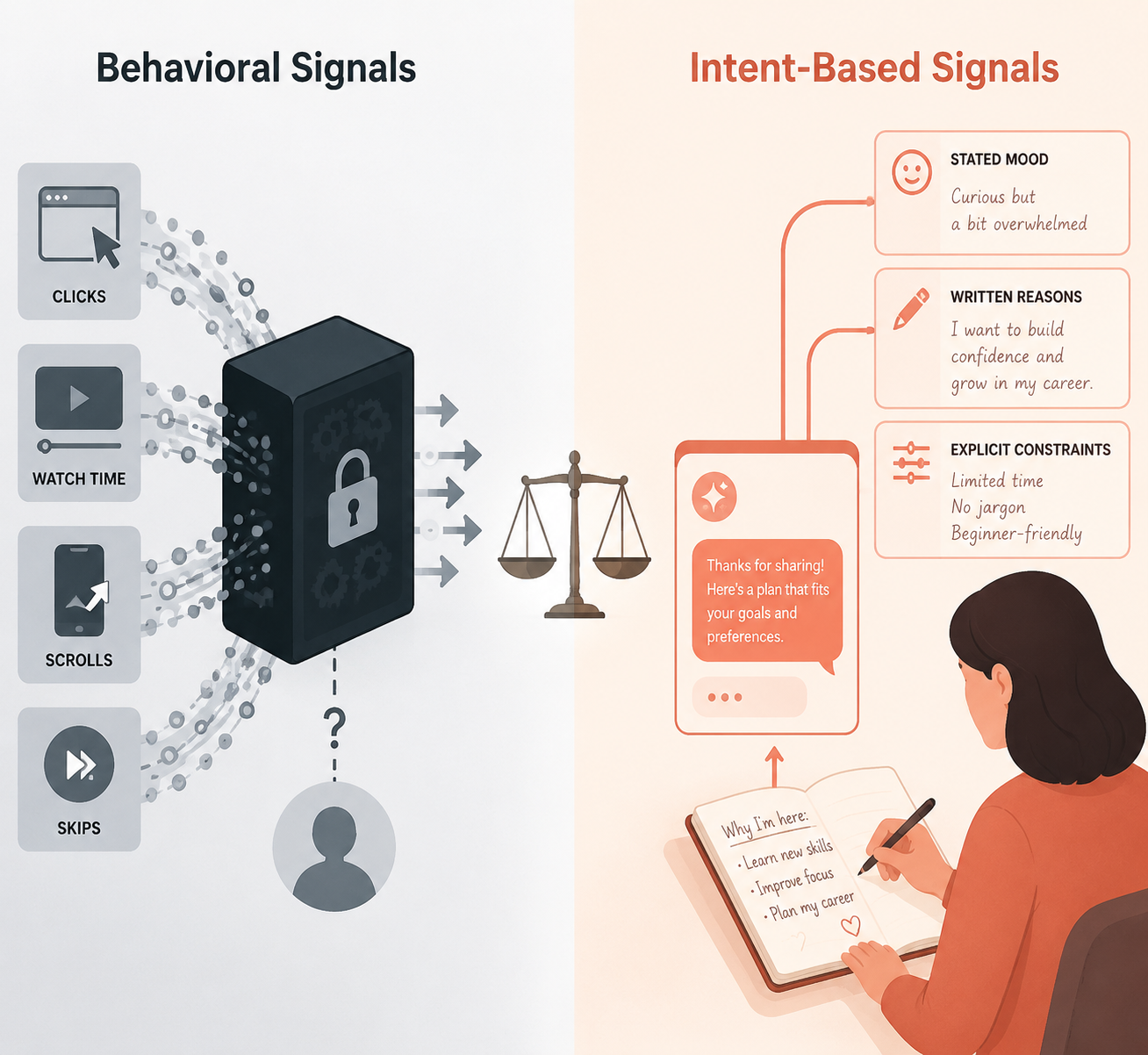
A person can tell ChatGPT, “I liked that movie because it was restrained, morally ambiguous, under two hours, and did not explain every character motivation.” That sentence carries more usable preference signal than a dozen clicks that merely prove the movie was watched. It names taste, mood, constraint, and tolerance. For marketers, that distinction matters well beyond streaming. Most personalization programs are still built around what people clicked, opened, skipped, searched, or bought. LLM-based personalization points toward a different asset: stated intent that can be reused, corrected, and refined.
The Better Recommendation Starts Before the Prompt
The strongest example is not a clever one-off prompt. It is a LessWrong user’s deliberately unglamorous system: a living spreadsheet of liked and disliked books and films, paired with written explanations, then copied into ChatGPT sessions as preference context. The user described using that maintained record to get better recommendations, while also warning that ChatGPT fabricated about one in ten recommendations in their experience.[1]
The spreadsheet is the important part. It turns taste from a vague self-description into a feedback asset. “I like science fiction” is weak because it can mean space opera, hard engineering, bleak social allegory, or a gentle time-loop romance. “I liked this because the worldbuilding stayed in the background and the emotional stakes were intimate” is a different class of input. It gives the model dimensions to compare against.
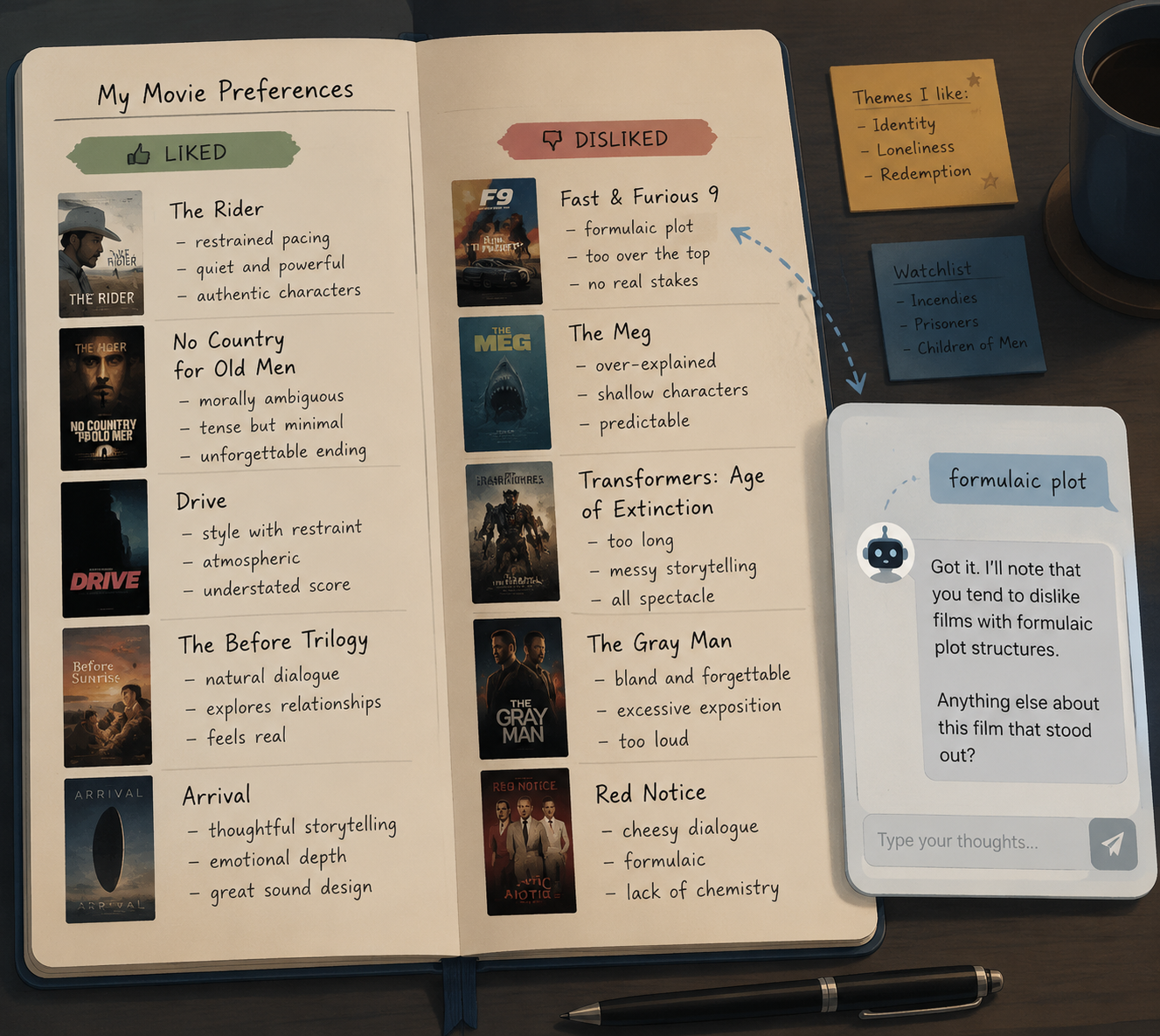
This is also where the casual “ChatGPT beats Netflix” take usually gets too sloppy. ChatGPT is not magically reading taste. The user is doing the work Netflix rarely asks for directly: labeling why an experience succeeded or failed. The model’s role is to use those labels conversationally, compare them across candidates, and make a recommendation that can explain itself in the user’s own vocabulary.
That workflow has obvious friction. A spreadsheet of taste is not a mainstream consumer behavior. Most people do not maintain a personal archive of disliked endings, pacing preferences, tolerance for violence, or whether they want something quiet after 9 p.m. Still, the method reveals the mechanism more cleanly than any polished demo. Better output came from better preference capture, not from the model simply being “smarter.”
The reported hallucination rate is not a footnote; it changes how the result should be judged. A recommendation system that invents titles cannot be treated like a production-grade catalog experience without verification. For a consumer, that means mild irritation. For a brand, it can mean broken trust, nonexistent products, false claims, or support burden. LLM recommendations need retrieval, inventory checks, human review, or some other grounding layer before they move from amusingly useful to operationally dependable.
Prompting Is Not Decoration
A week-long TechRadar test of GPT-5 as a streaming guide makes the same point from a more casual angle. The journalist tested five prompt strategies: role-playing, mood-matching, time travel, genre crash course, and wild card. Mood-matching and role-playing produced the highest satisfaction in that test.[2]
That result is not a universal benchmark. It is one journalist’s test, shaped by their preferences and the prompts they chose. But it is still useful because mood and role are recognizable inputs. “Recommend something for a tired weeknight when I want suspense without brutality” is a much richer request than “best thrillers.” “Act as a patient film programmer for someone who likes slow-burn mysteries but hates puzzle-box endings” gives the model a task frame, a taste frame, and a failure condition.
That is where LLM recommendations feel less like a content carousel and more like a competent clerk. The clerk does not only know what sold last week. The clerk listens for the job the recommendation has to do tonight. A movie can be right for a person and wrong for their current mood. The same is true for a white paper, webinar, product page, email sequence, or sales enablement asset.
For content marketers, prompt design is not a gimmick layered on top of personalization. It is the interface where the customer’s situation becomes legible. A system that knows “visited pricing page three times” has a useful behavioral signal. A system that also knows “comparing vendors for a small team, worried about implementation time, needs a plain-language business case by Friday” has a different level of intent. The first can route someone into a segment. The second can shape the next answer.
What Netflix Still Has That ChatGPT Often Lacks
There is a correction worth making here. Explicit preference data is powerful, and it is easy to overvalue it after years of watching brands mistake behavioral clusters for understanding. But Netflix has one structural advantage a plain ChatGPT session often lacks: automatic feedback. If someone starts a recommendation, abandons it after ten minutes, rewatches it twice, or ignores an entire row, the system can learn from the next action without requiring a confession.
ChatGPT does not reliably get that loop for free. If it recommends a movie and the user hates it, the model usually will not know unless the user comes back and says so. Even then, the feedback has to be preserved somewhere useful. Otherwise, the next session can become another first date with a very articulate stranger.
OpenAI has been moving away from that blank-slate problem. ChatGPT memory rolled out to all accounts, including free accounts, in September 2024, and an April 2025 update expanded ChatGPT’s ability to reference past conversations.[3] In separate How-To Geek testing, the writer found that roughly ten seeded preferences could produce meaningful personalization across books, movies, TV, and music.[4]
That changes the operating model. The older spreadsheet-and-copy-paste workflow showed that explicit context works, but it depended on the user bringing the context every time. Persistent memory starts to make preference capture feel less like a workaround and more like a product behavior. The caveat is that memory still needs active correction. A durable wrong assumption is worse than a forgotten preference because it can keep confidently steering the user away from what they actually want.
The Marketing Lesson Is About Signals, Not Movies
Movie recommendations are low stakes, which makes them useful. The gap is easy to feel. A platform says, “because you watched.” A person says, “yes, but not because of that.” That missing “because” is where much of modern personalization breaks down.
Behavioral signals are still valuable. Clicks, watch time, scroll depth, purchases, returns, form fills, and search queries all contain information. The mistake is treating them as complete explanations. Behavior shows what happened. It does not always show whether the person was satisfied, constrained, bored, price-checking, researching for someone else, or settling for the least bad option.
Intent-based signals fill in some of that missing context. They can come from onboarding questions, preference centers, chat interactions, sales notes, support conversations, product reviews, survey responses, or direct feedback on recommendations. LLMs make those signals more usable because they can process messy natural language instead of forcing every preference into a tidy dropdown.
| Signal type | What it usually captures | Where it fails | What an LLM can add |
|---|---|---|---|
| Behavioral | Watched, clicked, skipped, opened, purchased | Often misses the reason behind the action | Can combine behavior with stated explanations when available |
| Explicit preference | Liked, disliked, mood, constraints, deal-breakers | Requires the user or team to provide and maintain it | Can translate natural-language reasons into recommendation criteria |
| Feedback loop | What happened after the recommendation | May be absent if the system does not observe follow-up behavior | Can revise future recommendations when feedback is captured |
This has a practical consequence for marketing teams evaluating LLM personalization. The strategic question is not “Can the model generate recommendations?” It can. The harder question is whether the organization can capture enough explicit preference, preserve it across interactions, ground it in available content or products, and update it when the customer pushes back.
A content recommendation engine that only says “people like you also read” is doing one kind of personalization. A system that can say “since you are comparing vendors for a regulated industry and previously rejected high-level thought leadership, here is the implementation checklist instead of the trend report” is doing something else. The second system does not merely have more data. It has more usable reasons.
Not All LLM Recommendations Behave the Same Way
The phrase “LLM recommendations” also hides meaningful differences between models and setups. NailedIt’s March 2026 practitioner testing compared GPT-4.1, Gemini 2.5 Pro, Claude Sonnet 4, and Grok 3 on movie recommendation prompts. The tester judged GPT-4.1 strongest for group and social recommendations, Claude Sonnet 4 strongest for taste analysis and obscure films, and Gemini 2.5 Pro strongest for streaming availability and runtime accuracy.[5]
That comparison should be read as practitioner testing, not definitive measurement. Its qualitative “5x better signal” claim is useful as a working observation, not as a standardized finding.[5] Still, the pattern is sensible: recommending for a group, parsing a single person’s taste, and checking availability are not the same task. A model that is good at one may be weaker at another.
The academic literature is also moving in this direction, though the available evidence should be handled carefully. An ACM CHI 2025 paper titled “Multi-Prompting Scenario-based Movie Recommendation with Large Language Models: Real User Case Study” points to formal interest in scenario-based, multi-prompt recommendation, but only the title and abstract were available here, so it can support the broader direction rather than settle the question.[6]
At the far end of the spectrum, one Hotelemarketer experimenter used ChatGPT’s Code Interpreter with 450 personally rated titles and an IMDB-derived database of 32,000 movies and TV shows to build a private recommendation engine.[7] That is not a benchmark either. It is a proof of concept for what happens when personal ratings, a larger catalog, and analysis tooling are pulled into the same workflow.
Where the Advantage Holds, and Where It Collapses
ChatGPT gives better movie recommendations than Netflix when three conditions are present: the user supplies explicit preference reasoning, the system preserves that reasoning, and feedback changes future recommendations. Remove those conditions and the advantage narrows quickly.
- If the prompt is generic, the recommendations tend to become generic.
- If memory is absent or polluted, the model loses continuity or repeats bad assumptions.
- If catalog facts are ungrounded, hallucinated titles and availability errors can break trust.
- If follow-up behavior is invisible, the system cannot learn from what the user actually did next.
That last point is especially important for marketers. A conversational interface can make weak personalization feel more human, but fluency is not understanding. If the underlying system does not retain stated preferences, observe outcomes, and revise its assumptions, it is just a smoother way to deliver the same old mismatch.
The practical target is reason-aware recommendation: systems that can combine what people do with what they say they want, why they want it, and what disappointed them last time. Netflix-style behavioral loops and ChatGPT-style explicit reasoning should not be treated as enemies. The better system borrows from both. It watches what happens, asks when behavior is ambiguous, remembers the answer, and stays humble when context is missing.
References
- How to Use ChatGPT to Get Better Book and Movie Recommendations, LessWrong, 2024.
- I tried letting ChatGPT be my streaming guide for a week – these 5 prompts were the winners, TechRadar.
- ChatGPT can now reference all past conversations - April 10, 2025, OpenAI Community, April 10, 2025.
- How I Use ChatGPT for Personalized Book, Movie, TV, and Music Recommendations, How-To Geek.
- Movie Recommendations, NailedIt, March 2026.
- Multi-Prompting Scenario-based Movie Recommendation with Large Language Models: Real User Case Study, ACM CHI 2025.
- I had ChatGPT build my own personal movie recommendation engine by analyzing 32K movies and TV shows, Hotelemarketer, July 22, 2023.

Comments
Join the discussion with an anonymous comment.