
ChatGPT for Digital Marketing: Channel-by-Channel Workflows, Prompts, and Honest Limits
This article provides channel-by-channel ChatGPT workflows with tested prompts for content marketing, SEO, paid ads, email, and social media. It covers the C-R-T prompt framework, real productivity data from Bain and OpenAI, and the specific limits where human judgment remains essential.
Using ChatGPT for digital marketing gets useful when the request stops sounding like “write me some marketing copy” and starts looking like a brief a teammate could actually work from. A marketer supporting content, SEO, paid ads, email, and social does not need another AI overview. They need a repeatable way to turn campaign context into decent first-pass work, then review it before it reaches a customer.
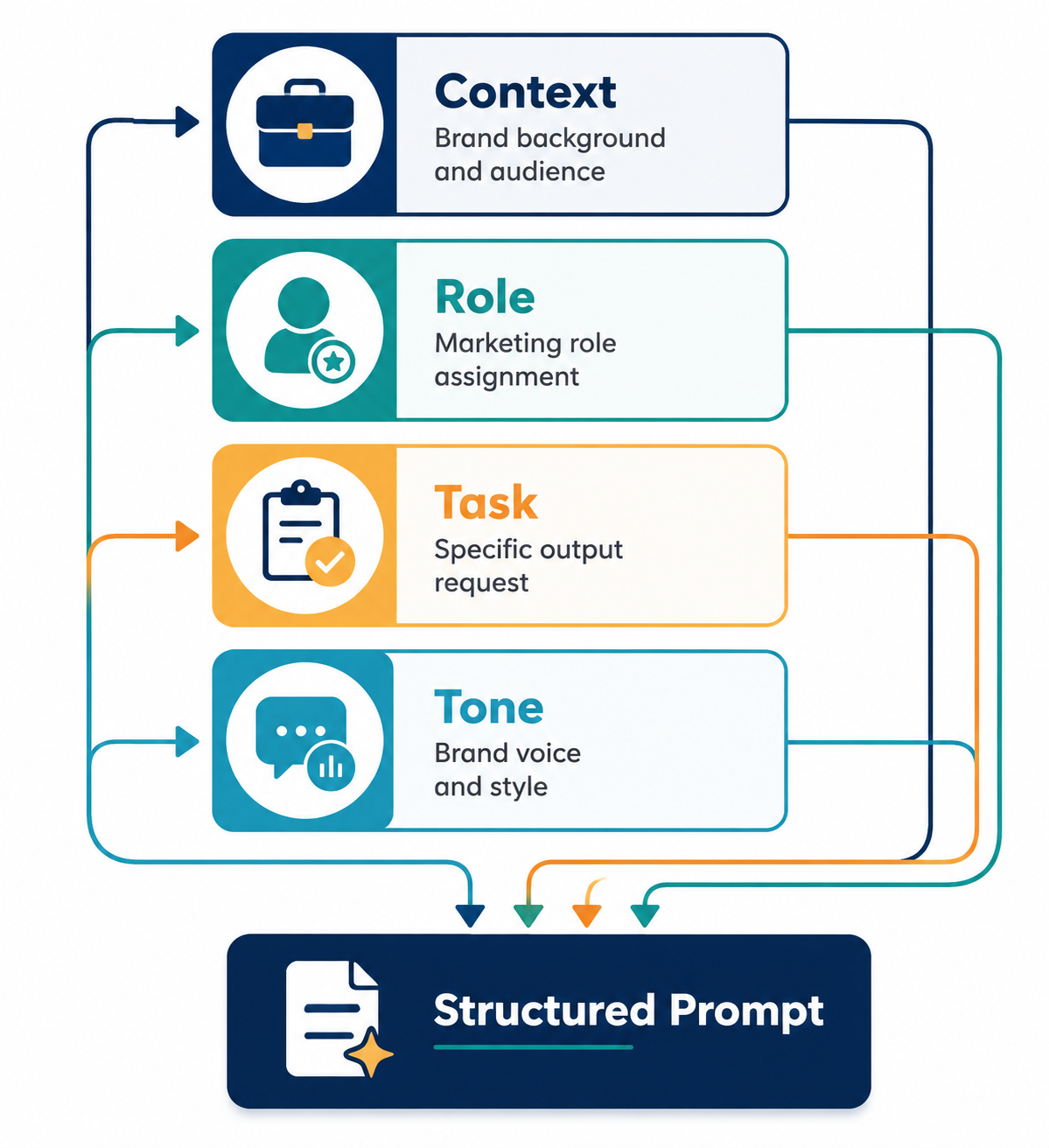
The operating rule is simple: give ChatGPT Context, Role, Task, and Tone before asking for channel-specific output. Smart Insights frames strong prompts around Context, Role, and Task, and warns that skipping Custom Instructions is “the biggest beginner’s mistake”; adding Tone makes the framework more useful for brand work because it tells the model how the answer should feel, not just what it should contain.[1]
There is enough productivity evidence to justify learning the workflow, as long as the numbers are not oversold. Coupler.io cites Bain research reporting that AI can reduce content production time by 30–50% and that AI-powered campaigns can deliver 10–25% higher ROAS, but those figures describe broader AI-enabled marketing systems, not a guarantee that ChatGPT alone will lift revenue.[2] Master of Code reports OpenAI enterprise findings that 75% of enterprise workers saw improved speed or quality, with average daily savings of 40–60 minutes.[3] Treat those as directional productivity signals: faster drafting, faster variation, faster synthesis. They do not remove the need for channel review.
Start With the C-R-T-T Prompt
A weak prompt makes ChatGPT guess the audience, goal, channel, constraints, and voice. That is how marketers end up cleaning up generic claims, invented positioning, or content that sounds polished but misses the assignment.
| Prompt element | What to include | Why it matters |
|---|---|---|
| Context | Campaign goal, audience, offer, funnel stage, product notes, source material, constraints | Reduces guessing and keeps the output tied to the actual marketing situation |
| Role | The specialist lens ChatGPT should use: SEO strategist, paid media copywriter, email marketer, social editor | Changes what the model prioritizes and what tradeoffs it considers |
| Task | The exact output: outline, brief, variants, subject lines, cluster, rewrite, checklist | Prevents the answer from drifting into advice instead of deliverables |
| Tone | Brand voice, formality, energy level, claim restraint, examples to follow or avoid | Protects fit, especially when output moves into customer-facing copy |
A vague version looks like this:
Write a blog post about our project management software.That prompt gives ChatGPT permission to invent the angle, audience, differentiators, and proof. A usable version gives it a job to do and a box to stay inside:
Context: We sell project management software to operations leaders at 50-500 person B2B service companies. The campaign goal is to capture non-branded search demand from teams that have outgrown spreadsheets but are not ready for enterprise software. Our differentiators are fast onboarding, client-facing project views, and simple workload tracking. Do not invent customer names, statistics, pricing, integrations, or product features.

Role: Act as a senior B2B content strategist with SEO experience.

Task: Create a content brief for a 1,500-word article targeting the keyword "project management software for client services teams." Include search intent, recommended angle, H2/H3 outline, sections that need product proof, and questions the writer must answer before drafting.

Tone: Practical, specific, low-hype, written for an experienced operator who dislikes generic productivity claims.
The better prompt does not ask ChatGPT to “be creative” in the abstract. It gives the model enough operating material to produce something a marketer can evaluate. It also names what must not be invented, which matters in any channel where claims, targeting, pricing, compliance, or customer evidence are involved.
Custom Instructions help because they keep standing rules out of every one-off prompt. If your brand never uses exaggerated claims, always asks for source-dependent facts to be flagged, or wants output in a specific structure, those rules belong in the default setup as well as in the prompt when the risk is high. The prompt still needs campaign-specific context; Custom Instructions are not a substitute for a brief.
Content Marketing: Use ChatGPT Before the Draft Becomes Expensive
Content is where ChatGPT feels most useful and where it is easiest to overtrust. It can turn a blank doc into angles, outlines, briefs, repurposing plans, interview questions, and draft sections. It cannot produce original research, verify claims, or decide whether an idea is strategically worth publishing. Portent’s content marketing guidance is strongest when it treats ChatGPT as useful for ideation, research support, content marketing, lead generation, and competitive analysis while keeping clear boundaries around what the tool can and cannot know.[4]
The first decision is not “Can ChatGPT write this?” It is “Which part of this content workflow should ChatGPT touch?” For that allocation step, use a task filter like deciding which content marketing tasks to delegate to ChatGPT: low-risk structure and variation work can move faster; proprietary insight, subject-matter judgment, and factual proof stay with the marketer and source experts.
Workflow: Turn Raw Inputs Into a Content Brief
- Paste the campaign goal, target audience, keyword or topic, product notes, known objections, and any source material the model is allowed to use.
- Ask for a brief, not a finished article, when the topic needs expertise or evidence.
- Review the angle, missing proof points, search intent assumptions, and claims before assigning a draft.
- Use the brief to guide the human writer, SME interview, or second ChatGPT pass.
Context: We are creating a content brief for [topic/keyword]. The audience is [audience], and the business goal is [goal]. Here are approved facts, product notes, and source excerpts: [paste material]. Do not add facts that are not present here. If a section needs outside verification, label it "needs verification."

Role: Act as a senior content strategist and editor.

Task: Create a content brief with the target reader, likely intent, recommended angle, outline, key points to cover, proof needed, internal link opportunities, and risks to avoid.

Tone: Clear, editorial, specific, and skeptical of generic claims.
The review point comes before drafting. If the outline is built on a false assumption about the audience or search intent, the final article will be faster to produce and still wrong. The marketer should check whether each section earns its place, whether claims have evidence, and whether the output asks for product proof where product proof is actually needed.
Workflow: Repurpose One Strong Asset Without Flattening It
ChatGPT is especially good at repackaging approved material. A webinar transcript can become a blog outline, sales enablement bullets, newsletter sections, social hooks, and FAQ drafts. The catch is that repurposing can sand off the sharpest ideas if the prompt does not tell the model what to preserve.
Context: This transcript is from a webinar with our product lead about [topic]. The strongest ideas are [list ideas]. The audience for the new asset is [audience]. Preserve the speaker's main argument, but remove filler and repetition. Do not create new examples, customer stories, metrics, or claims.

Role: Act as a content editor repurposing expert material for a B2B marketing audience.

Task: Turn the transcript into three reusable assets: 1) a blog outline, 2) a newsletter draft, and 3) five social post angles. For each asset, list what source material supports it and what needs human verification.

Tone: Useful, precise, and grounded in the speaker's actual points.
Do not skip the source mapping. It is the difference between “this came from the transcript” and “the model wrote something that sounds like it could have come from the transcript.”
SEO: Let ChatGPT Organize the Work, Not Verify the SERP
SEO teams can use ChatGPT for clustering, brief structure, title variants, meta descriptions, schema draft ideas, internal link suggestions, and intent hypotheses. The word “hypotheses” is doing work. ChatGPT should not be treated as a live SERP, keyword database, analytics platform, or fact checker.
A practical SEO workflow uses the model after the marketer has gathered the source inputs: keyword exports, SERP notes, competitor headings, existing content URLs, product pages, and analytics observations. Then ChatGPT can sort and synthesize without pretending it collected the data itself.
Workflow: Cluster Keywords Into Content Opportunities
Context: I am pasting a keyword list with search volume, difficulty, current ranking URL where available, and notes from manual SERP review. Use only this dataset. Do not invent volume, difficulty, trends, or SERP features.

Role: Act as an SEO strategist planning a content roadmap.

Task: Group these keywords into intent-based clusters. For each cluster, provide the likely search intent, recommended page type, primary keyword, supporting keywords, existing URL to update if one is present, and questions a human SEO should verify before production.

Tone: Analytical, concise, and cautious about uncertain data.

Keyword data: [paste export]
The output should be checked against the actual SERP and your own site. If ChatGPT groups two terms together, the SEO still needs to confirm whether the same page can satisfy both intents. If it recommends a new article, the SEO still needs to check cannibalization, internal links, product fit, and whether the business has anything credible to say.
Workflow: Pressure-Test an SEO Brief
One of the best uses is not generating the first brief but finding weak spots in a brief a human already made.
Context: Here is an SEO content brief for [keyword]. The target reader is [reader]. The business goal is [goal]. The SERP notes are [paste notes].

Role: Act as a skeptical SEO editor.

Task: Identify gaps in this brief before it goes to a writer. Flag unclear intent, missing proof, sections that look generic, claims that need sources, internal link opportunities, and places where the outline may not match the searcher's real problem.

Tone: Direct, practical, and specific. Do not rewrite the whole brief unless needed.

Brief: [paste brief]
That prompt saves time because it asks for editorial friction before the draft exists. It also keeps the SEO specialist in control of the source data instead of asking ChatGPT to magically know what is ranking today.
Paid Ads: Generate Variants, Then Cut the Claims Down to Size
Paid media is a good fit for ChatGPT because ad work needs variation: hooks, headlines, descriptions, angles, objections, CTAs, and landing page message matches. The model can produce more options than a tired marketer wants to type manually. The human review is where exaggerated claims, policy risks, and audience mismatches get removed.
Be careful with AI advertising case studies. Coupler.io cites the well-known JPMorgan Chase case in which Persado-generated copy reportedly produced a 450% CTR lift, but that was a Persado deployment reported through Marketing Dive, not a ChatGPT-specific result.[2] It is useful as a reminder that AI-assisted message testing can matter. It is not proof that a ChatGPT prompt will produce the same result.
Context: We are creating paid search ad variants for [offer]. The audience is [audience]. The campaign goal is [lead/demo/trial/purchase]. The landing page promise is [promise]. Approved claims are [claims]. Banned claims are [claims]. Character limits are [limits].

Role: Act as a performance marketer writing compliant paid search copy.

Task: Generate 12 headline options and 8 description options grouped by angle: pain point, outcome, speed, comparison, and objection handling. Keep every line within the character limits. Do not invent discounts, guarantees, rankings, customer counts, or results.

Tone: Clear, specific, and restrained. Avoid hype.
After generation, the paid media manager should check four things: whether each claim is approved, whether the copy matches the landing page, whether the angle fits the audience segment, and whether platform policy could reject the wording. For deeper paid media variants, use dedicated ChatGPT ad copy generation prompt templates rather than stretching one generic prompt across every campaign.
A Useful Second Pass: Ask for the Weakest Ads
Once the first set exists, do not only ask for “better” versions. Ask ChatGPT to identify likely weak performers and explain why.
Context: Here are paid ad variants for [campaign]. The landing page focuses on [message]. The target audience cares most about [priorities].

Role: Act as a paid media manager reviewing ad copy before launch.

Task: Rank these variants from strongest to weakest. Flag vague claims, mismatched intent, repeated angles, policy-sensitive wording, and lines that do not connect to the landing page. Suggest revised versions for the weakest five.

Tone: Critical, efficient, and practical.

Variants: [paste variants]
Email: Draft by Segment, Review the Logic
Email is another channel where ChatGPT can move the work forward quickly: subject lines, preview text, nurture sequences, re-engagement drafts, event follow-ups, and plain-text sales-assisted emails. The risky part is not just copy quality. It is segmentation logic. If the model invents why someone is in a segment or assumes behavior that is not in your data, the campaign can become irrelevant fast.
Context: We are writing an email to [segment]. These recipients [known behavior or source of opt-in]. The campaign goal is [goal]. The offer is [offer]. Approved proof points are [proof]. Do not assume job title, purchase history, company size, pain points, or intent beyond what is listed.

Role: Act as an email marketer writing lifecycle campaign copy.

Task: Draft one email with 8 subject lines, 4 preview text options, a plain-text body, and 3 CTA options. Then list any assumptions you made and any fields that should be personalized from our email platform.

Tone: Helpful, specific, and human. Avoid false urgency.
The assumptions list is not extra paperwork. It is how the email marketer catches invented personalization before it goes live. If the email references “your recent demo” and the segment only downloaded a guide, the model has created a relevance problem the brand now owns.
Use ChatGPT to Build Variant Sets
A useful email workflow is to ask for controlled variation, not endless creativity. The marketer can test different levers while holding the offer and audience constant.
Context: We need subject line variants for an email promoting [offer] to [segment]. The email angle is [angle]. Avoid spammy punctuation, fake scarcity, and claims not supported by the email.

Role: Act as a lifecycle email marketer.

Task: Generate 20 subject lines in four groups: curiosity, practical benefit, pain point, and direct offer. Keep each under [character target]. For each group, explain what psychological lever it uses in one sentence.

Tone: Clear, credible, and not pushy.
The review is simple: delete anything that overpromises, remove personalization the data cannot support, check links and UTM rules, and confirm the email matches the segment’s actual relationship with the company.
Social Media: Use It for Angles, Not a Borrowed Personality
Social output is where generic AI voice shows up fastest. ChatGPT can generate hooks, post variations, carousel outlines, comment prompts, short video talking points, and repurposed snippets from longer assets. It should not be allowed to replace the voice of a founder, subject-matter expert, or brand account without examples and a human edit.
Context: We are turning this approved article into LinkedIn posts for [audience]. The brand point of view is [point of view]. Here are three examples of posts that match our voice: [paste examples]. Avoid exaggerated lessons, fake personal stories, and generic thought leadership language.

Role: Act as a social media editor for a B2B brand.

Task: Create 10 LinkedIn post angles from the article. For each, include a hook, post draft, recommended format, and the source section it came from. Do not add claims that are not in the article.

Tone: Conversational, specific, and opinionated without sounding inflated.

Source article: [paste article or excerpt]
For executive or expert-led posts, the examples matter more than the prompt adjectives. “Sound authoritative” is vague. Three real posts with the right rhythm, level of detail, and opinion density give ChatGPT something to imitate, and even then the person whose name appears on the post should approve the final version. For a fuller approach, use a dedicated LinkedIn thought leadership workflow instead of turning every long-form asset into the same set of “key takeaways.”
Pressure-Test Hooks Before Posting
Context: These are draft social hooks for [platform] promoting [asset/campaign]. The target audience is [audience]. The brand avoids [voice constraints].

Role: Act as a social editor protecting brand voice and clarity.

Task: Review these hooks. Flag which ones are too vague, too clickbait, too generic, or unsupported by the source asset. Rewrite the best five to be sharper while staying accurate.

Tone: Honest, editorial, and concise.

Hooks: [paste hooks]
That second pass catches a common social problem: the hook gets stronger by becoming less true. If the post needs a sharper angle, sharpen the real point. Do not manufacture drama that the source material does not support.
Research, Competitive Analysis, and Data: Keep the Inputs Clean
ChatGPT can summarize pasted research, compare positioning from public website copy, turn customer interview notes into themes, and create question lists for deeper analysis. It should not receive sensitive customer data, confidential strategy, private performance data, or personally identifiable information unless your organization has explicitly approved the tool, settings, and data handling process.
Seer Interactive’s guidance on marketing data safety is useful because it treats the question as a judgment call by data type, not a blanket “AI is safe” or “AI is banned” answer.[5] The practical version: use public or approved material for everyday prompts, anonymize where possible, and keep restricted customer or business data out of casual ChatGPT workflows.
| Input type | Usually reasonable for a prompt | Needs stricter review |
|---|---|---|
| Public website copy | Summarizing positioning, extracting themes, comparing messaging | Claims about performance or market share not shown in the source |
| Keyword exports | Clustering, prioritization support, brief structure | Anything involving live SERP truth, revenue attribution, or confidential strategy |
| Customer interviews | Anonymized theme extraction from approved notes | Names, identifying details, private pain points, or sensitive account context |
| Ad and email performance | High-level anonymized learnings if approved internally | Raw customer-level data, proprietary benchmarks, or audience lists |
If the team needs repeatable production, prompts are only one layer. The workflow also needs review stages, approved data rules, and a way to catch unsupported claims before they ship. That is where a broader AI marketing workflow audit or AI marketing governance framework becomes more useful than another folder of prompts.
A Channel-by-Channel Review Loop
Every ChatGPT marketing workflow should end with a channel-specific review, not a generic “looks good.” The reviewer changes depending on the output.
| Channel | ChatGPT is useful for | Human review must check |
|---|---|---|
| Content marketing | Briefs, outlines, angles, repurposing, draft sections | Original insight, factual support, editorial quality, product accuracy |
| SEO | Clusters, brief pressure-testing, meta drafts, internal link ideas | Search intent, live SERP reality, cannibalization, source verification |
| Paid ads | Headline and description variants, hook testing, angle expansion | Claims, policy risk, landing page match, audience fit |
| Subject lines, preview text, sequence drafts, CTA variants | Segmentation logic, personalization accuracy, consent context, offer match | |
| Social | Hooks, post drafts, carousel outlines, repurposed snippets | Voice, truthfulness, source alignment, platform fit |
This is also where trust gets protected. AI-generated marketing can create a gap between polished output and believable output when claims, voice, or evidence are not reviewed. If that risk is showing up across channels, it is worth treating it as an AI-generated marketing trust gap problem, not just a copyediting problem.
What Not to Hand Off to ChatGPT
The honest limits are not a reason to avoid the tool. They are the guardrails that make it usable. ChatGPT should not be the final authority for original research, legal or compliance claims, customer data interpretation, brand-defining creative, current search facts, or performance attribution.
- If the task depends on proprietary facts, provide approved source material and ask the model to flag gaps.
- If the task depends on current market or search data, bring the data from a reliable tool and use ChatGPT to organize it.
- If the task depends on customer data, follow the organization’s data policy before pasting anything.
- If the task depends on distinctive voice, provide real examples and keep final approval with the person or team whose voice is being used.
- If the task creates claims, require verification before publication or launch.
PAN Communications’ practical “do this, not that” framing fits the day-to-day reality here: marketers get better results when they give ChatGPT specific context and use it for bounded support, rather than asking broad, unsupported questions and treating the answer as finished strategy.[6]
The Same-Day Operating Principle
For most digital marketing work, the best ChatGPT workflow is not complicated: build the prompt with Context, Role, Task, and Tone; generate options; edit against the channel’s standards; verify anything factual; and keep judgment with the marketer.
The better the input and the clearer the review loop, the more useful the output. When the work is drafting, iteration, restructuring, or angle generation, ChatGPT can remove a lot of blank-page drag. When the work depends on proprietary facts, original insight, legal claims, customer data, or a voice people recognize, the model can assist, but it should not drive.
References
- 15 best prompts for using ChatGPT for digital marketing, Smart Insights
- AI Marketing Use Cases in 2026, Coupler.io
- ChatGPT Statistics in Companies [January 2026], Master of Code
- 5 Best Ways to Use ChatGPT for Content Marketing, Portent
- What Marketing Data is Safe to Use in ChatGPT?, Seer Interactive
- Do This, Not That: A Practical Approach for How Marketers Can Use ChatGPT, PAN Communications

Comments
Join the discussion with an anonymous comment.