

ChatGPT Ads 2026: How to Measure When Standard Analytics Miss 15-30x of Your Results
ChatGPT Ads presents a new advertising surface where conversational intent drives lower CTRs but deeper discovery. This guide explains why standard analytics undercount contribution by 15-30x, how to implement a 3-layer attribution model, and a 90-day testing framework for paid media teams.
A standard paid media dashboard can make ChatGPT Ads look easy to dismiss. One early advertiser-reported figure puts CTR at 0.91%, while Google Search benchmarks are cited around 6.4%.[1][2] If that is the whole readout after 30 days, the channel looks weak before the budget conversation even starts.
That is the wrong first conclusion. The harder problem is that standard analytics may miss the majority of what the channel is doing. Radyant’s analysis, cited in industry coverage, argues that AI search and conversational discovery can be undercounted by 15-30x because users may discover a brand inside ChatGPT, leave without clicking, and return later through direct navigation or branded search.[1][3]
That does not make ChatGPT Ads automatically good. It makes them easy to misread. A conversational ad surface is not a search results page with a different logo. Search is often a launchpad: the user types a query, scans links, clicks out. ChatGPT is often the place where the user gets oriented, compares paths, asks follow-up questions, and narrows a shortlist before taking action somewhere else.
That distinction matters for anyone evaluating OpenAI marketing in 2026. A lower click-through rate may be structural to the interface, not proof that the creative failed. The practical question is whether the channel can be measured well enough to make a budget decision. If the team only plans to look at last-click conversions, the answer is probably no.
What changed in 2026 is testability
The reason this deserves a Q3 2026 test conversation is not novelty. It is access. ChatGPT Ads reportedly crossed $100 million in annualized revenue within six weeks of the February 9, 2026 U.S. pilot, then opened self-serve Ads Manager access around May 5 with no minimum spend, CPCs around $3-$5, a $200 daily cap, and support for pixel tracking plus Conversions API.[4]
That is a different buying reality from a platform that requires a large insertion order, a managed-service rep, and a long wait for reporting access. A paid media team can now run a bounded test without asking leadership to make a belief-based commitment. The entry cost is low enough to learn, but only if the test is built to capture more than click-through traffic.
| What is available or reported | Why it matters for a paid media test |
|---|---|
| Self-serve access opened around May 2026 | Ordinary paid media teams can test without waiting for a managed pilot. |
| No minimum spend and a reported $200 daily cap | Budget risk can be bounded while the team learns channel behavior. |
| Reported CPC range of about $3-$5 | The channel is not free to learn, but it is not limited to enterprise-only tests. |
| Pixel tracking and Conversions API support | Click-based measurement can be instrumented before launch instead of reconstructed later. |
There is also a product-caveat line worth drawing early. The June 17, 2026 Ad Tools Terms define Audience Tools for first-party data upload and Creative Tools for AI-assisted ad generation, but those features were not confirmed live in Ads Manager as of June 20.[4] They should not be treated as active levers in a test plan unless the advertiser can verify access inside the account.
The same terms include an Access Purpose clause allowing uploaded audience data to be used for OpenAI product development, not only ad delivery.[4] For privacy-conscious brands, regulated categories, or teams with strict customer-data governance, that is not a footnote. It can decide whether audience upload is allowed at all.
Why CTR is the least useful number to overreact to
The 0.91% CTR figure should be handled carefully. It is advertiser-reported through Adweek coverage cited in later guides, not an OpenAI-published cross-advertiser benchmark, and OpenAI has not published broad performance figures.[1][2] It is useful as a directional signal, not as a universal standard.
Still, the gap with search is not surprising. A search user expects a list of exits. A ChatGPT user often expects the answer to continue in the same interface. If the assistant helps compare vendors, clarify requirements, or explain tradeoffs, the ad impression may influence the shortlist even when the user does not click at that moment.
That creates an uncomfortable measurement shape. The ad may contribute high in the decision process, while the eventual conversion appears later as direct, organic branded search, email, a sales call, or a return visit from another device. A last-click dashboard will record the final door the buyer walked through. It will not necessarily record who put the brand on the buyer’s list.
This is why treating CTR as the main pass/fail metric is a category error. CTR still matters: if nobody clicks, the click-based data layer will be thin, and CPC efficiency has to be watched. But in conversational advertising, CTR is not a clean proxy for influence. It is one observable behavior inside a longer discovery path.
The 15-30x undercount problem
The 15-30x claim should not be treated as a guaranteed multiplier for every account. It comes from analysis of AI search attribution behavior, not from an audited OpenAI benchmark.[1][3] The useful takeaway is narrower and more operational: if buyers use ChatGPT to discover or compare options and then convert later through another route, normal analytics can materially understate the channel’s contribution.
That pattern is familiar in B2B software, education, travel, and high-ticket ecommerce, which are identified as better-fit categories for ChatGPT Ads because the path to purchase is conversation-driven rather than purely transactional.[1] These are categories where people ask layered questions: which tool fits a team size, which program matches a career goal, which itinerary works with constraints, which expensive product is worth trusting.
A buyer in that mode may not be ready for a landing page. They may be building language for the problem. They may be comparing criteria. They may be checking whether a known brand belongs on the shortlist. If the paid placement shapes that evaluation, the later conversion can still arrive through a channel that gets all the credit.
This is where a lot of tests fail politically. The media buyer comes back with weak last-click data. Sales says it is hearing ChatGPT mentioned in calls. The executive asks whether the campaign worked. Nobody designed a way to reconcile those signals before spend started, so the argument becomes anecdote versus dashboard.
Build attribution before the first dollar is spent
The measurement system needs three layers: click-based tracking, self-reported attribution, and verbal attribution from sales. This model is recommended in ChatGPT Ads measurement guidance as a way to counter the undercount created when discovery happens in ChatGPT and conversion happens elsewhere.[3]
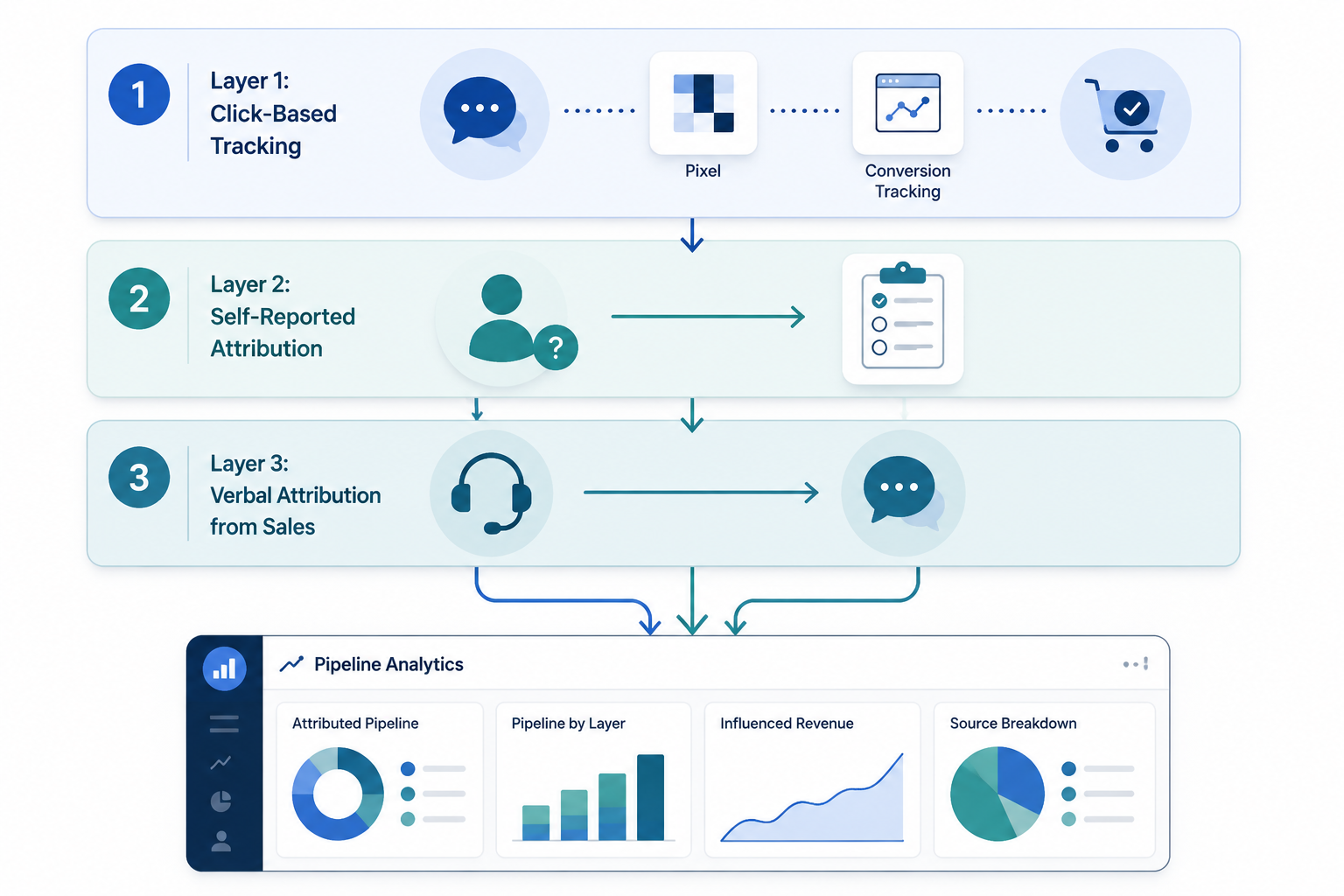
Layer 1: click-based tracking
This is the part most teams already know how to do, but it still has to be clean. Use platform pixel tracking, Conversions API where possible, UTMs, landing-page consistency, and CRM capture for campaign source. If the account can support server-side conversion events, implement them before launch rather than after the first reporting disappointment.
Layer 1 answers a limited question: what happened after a tracked click? It can show CPC, CTR, landing-page conversion rate, form fills, purchases, and opportunities tied to known click paths. It cannot reliably show the user who saw or engaged with the ad experience, continued the conversation, and returned later through a different path.
The mistake is not using last-click data. The mistake is pretending it is the whole measurement system. Last-click data is the floor. It tells you what the dashboard can prove with the fewest assumptions.
Layer 2: self-reported attribution
Add a post-conversion question that asks how the buyer first heard about the brand or what influenced the decision. Keep it plain. Do not bury ChatGPT inside a long list that nobody reads. Include an open text field, because people rarely describe discovery in the exact taxonomy a media team uses.
Self-reported attribution is imperfect. People forget. They compress multiple touches into one memory. They may write “AI search,” “ChatGPT,” “asked GPT,” or “saw you in an answer” instead of choosing a neat source. That messiness is the point. It captures memory and influence that click paths often miss.
For ecommerce, the question can sit after purchase. For lead generation, it can sit after form submission. For demo motions, it can be added to the booking flow. The exact placement matters less than making the field consistent enough to compare before, during, and after the test.
Layer 3: verbal attribution from sales
If sales is involved, the intake script needs one simple question: “How did you first hear about us?” A second prompt can ask what sources the buyer used while researching. This should be captured in the CRM as structured notes or a simple field, not left in call recordings that nobody audits.
This layer is especially important for B2B software, education, and high-ticket purchases. The person who converts may have spent days or weeks comparing options before filling out a form. If ChatGPT was part of that early exploration, sales may hear it before analytics can see it.
Sales attribution should not be used as a blank check for media spend. It is qualitative and memory-based. But when the same pattern appears across self-reported forms, sales notes, branded search lift, and tracked conversions, the channel deserves a more serious read than last-click alone can provide.
| Attribution layer | What it can see | What it cannot prove alone |
|---|---|---|
| Click-based tracking | Tracked clicks, CPC, landing-page behavior, pixel or server-side conversions | Discovery that did not produce an immediate click |
| Self-reported attribution | Buyer memory after conversion, including ChatGPT mentions and open-text discovery language | Exact spend-to-conversion causality |
| Verbal attribution from sales | Research sources mentioned in calls and early discovery paths | Reliable volume without consistent CRM capture |
A 90-day test is the minimum defensible read
The cleanest test plan is a 90-day sequence: 30 days to establish a baseline, 60 days to optimize, and 90 days to make the go/no-go decision using all three attribution layers.[3] That does not mean waiting three months to look at the account. It means not declaring success or failure from a partial dashboard before the channel has had time to show how it contributes.
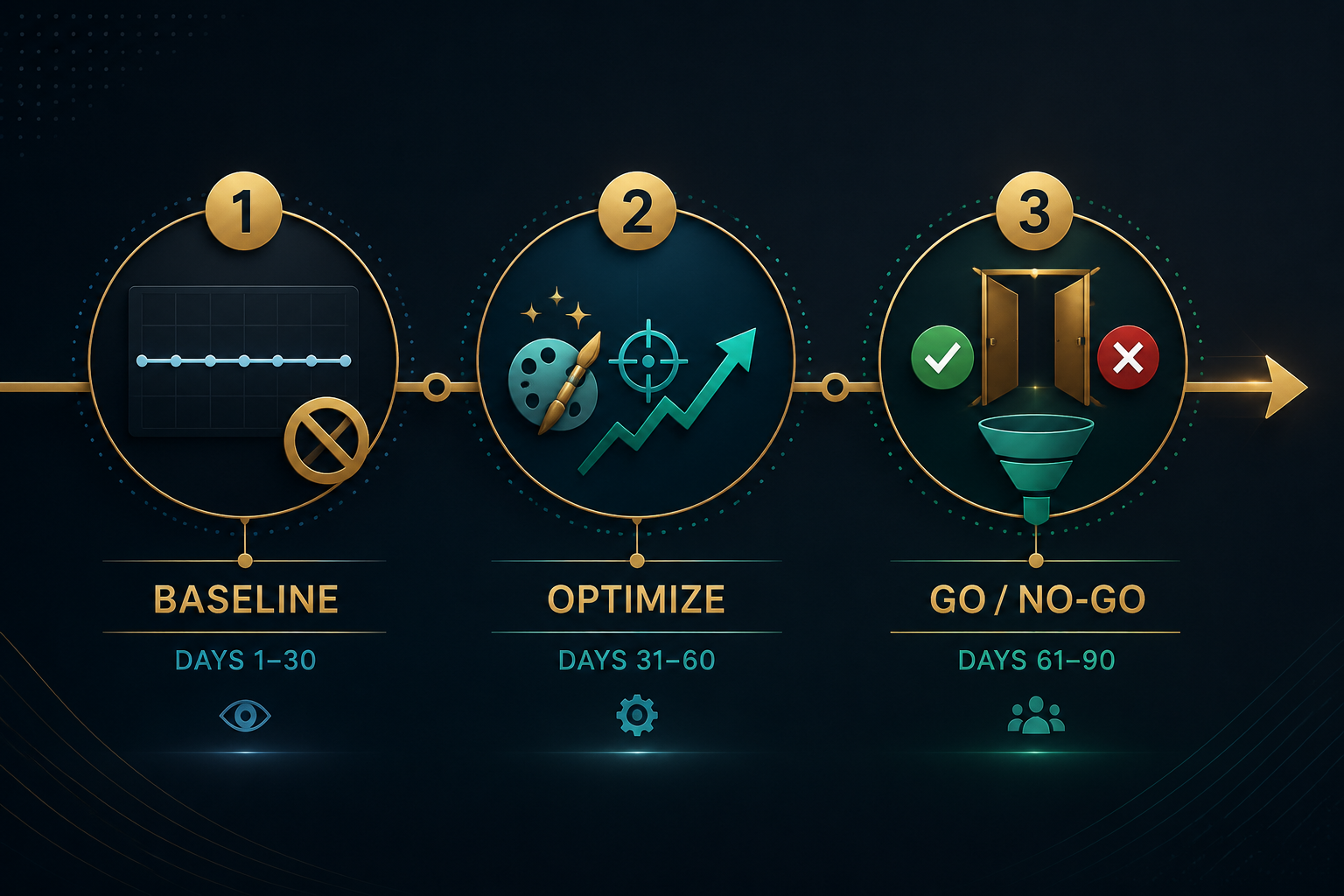
Days 1-30: baseline without over-optimization
The first month is not the time to rewrite the test every three days. Confirm delivery, spend pacing, CPC, CTR, landing-page behavior, event firing, CRM source capture, self-reported responses, and sales intake compliance. If tracking breaks here, the rest of the test becomes guesswork.
The team should resist treating a low CTR as an immediate creative verdict. Early CTR can help identify severe mismatch, but the more important question is whether the ad is appearing in conversations with the right buying context. A placement that shows up during active comparison may deserve patience even if it does not behave like search.
- Confirm pixel and Conversions API events are firing correctly.
- Check UTMs and CRM source fields against actual submitted leads or orders.
- Review self-reported attribution responses for ChatGPT or AI-search language.
- Audit whether sales is asking and recording discovery-source questions.
- Document baseline CTR, CPC, conversion volume, pipeline quality, and sales feedback without forcing a conclusion.
Days 31-60: optimize creative and targeting against intent
The second month is where optimization belongs. Creative should be adjusted around the questions buyers are actually asking, not around generic brand claims. If the channel is strongest during orientation and comparison, the ad should help the user move one step forward: clarify fit, compare options, estimate effort, or understand a tradeoff.
For B2B software, that may mean messaging by use case, team size, integration need, or migration pain. For education, it may mean program fit, credential value, schedule constraints, or career path. For travel, it may mean itinerary complexity, timing, budget bands, or trip type. For high-ticket ecommerce, it may mean trust, durability, compatibility, or total cost of ownership.
This is also the point to compare tracked and untracked signals. If click-based conversions are flat but self-reported ChatGPT mentions and sales notes are rising, the team has a measurement question before it has a performance verdict. If all three layers are quiet, the channel may simply not be reaching useful demand.
Days 61-90: make the decision with the full evidence set
The final month is for deciding whether ChatGPT Ads has earned more budget, a narrower test, or a pause. The decision should include click-based conversions, assisted pipeline indicators, self-reported attribution, verbal sales attribution, CPC stability, lead quality, and any movement in branded demand that coincides with the test.
A sensible go decision does not require pretending every ChatGPT mention was caused by the ad. It requires enough convergence across layers to justify continued spend. A sensible no-go decision does not require dismissing the platform. It may mean the category is a poor fit, the audience is too narrow, the creative failed to match conversational intent, or the organization cannot measure the channel well enough yet.
| Decision | Evidence pattern |
|---|---|
| Scale carefully | Tracked conversions are acceptable, qualitative attribution is present, and sales or revenue quality supports the spend. |
| Continue testing with changes | Some attribution layers show promise, but creative, targeting, or funnel capture needs another controlled iteration. |
| Pause | Click-based results are weak and self-reported plus sales attribution show little evidence of ChatGPT-influenced discovery. |
| Do not test yet | The team cannot implement tracking, self-reported attribution, or sales intake before launch. |
Where ChatGPT Ads is most likely to deserve budget
The best-fit categories are the ones where buyers already use conversation to think. B2B software, education, travel, and high-ticket ecommerce are cited as strong candidates because their purchase paths involve research, comparison, and confidence-building rather than a single impulse click.[1]
That does not mean every company in those categories should spend. A B2B software brand with no CRM discipline will struggle to learn. A travel brand with no post-booking attribution question will miss useful signals. A high-ticket ecommerce brand with a short return window but a long consideration cycle may misjudge the test if it only looks at same-session purchases.
The channel is less compelling when the purchase is highly commoditized, the decision window is extremely short, or the brand cannot absorb ambiguity in early measurement. Low entry cost helps, but it does not remove the need for a real readout.
Teams already working on organic AI discovery should connect the paid test to that work. A paid ChatGPT Ads test can sit beside content and visibility efforts such as ChatGPT for Marketers: Adapting Your Content Strategy for AI Discovery, but the paid program needs its own attribution plan and budget decision rules.
The practical decision rule
ChatGPT Ads is worth testing in Q3 2026 when three conditions are true. The category has a meaningful research or comparison path. The team can set up click-based tracking, self-reported attribution, and sales intake before launch. Leadership is willing to judge the test after 90 days instead of using a last-click dashboard as a 30-day verdict.
If those conditions are not true, the problem is not that the channel is unmeasurable. The problem is that the test will be designed to miss the behavior it is supposed to evaluate.
References
- ChatGPT Advertising: The Complete 2026 Guide to OpenAI’s Revolutionary Ad Platform — 2pointagency
- ChatGPT Ads in 2026: How They Work, Pricing, and the Measurement Problem — Optimum7
- ChatGPT Ads 2026: Complete Guide to OpenAI’s Sponsored Recommendations — marketingagent.blog, March 30, 2026
- OpenAI ChatGPT Ads Audience & Creative Tools 2026 Guide — Digital Applied

Comments
Join the discussion with an anonymous comment.