

The AI Marketing Tech Stocks in Cathie Wood's Portfolio
A breakdown of the marketing tech stocks Cathie Wood currently holds in her ARK Innovation ETF, with the AI thesis behind each position and why she exited The Trade Desk.
For marketers searching for Cathie Wood AI stocks for marketing tech, the useful answer is not “AI stocks” in general. It is which parts of the marketing system ARK Innovation ETF is actually exposed to: commerce checkout, connected TV inventory, seller and consumer engagement, platform-level personalization, and, just as important, the pure ad-tech intermediary it no longer owns.
Based on the latest ARKK holdings data available through cathiesark.com, the marketing-tech-relevant positions are Shopify, Roku, Block, and Meta. The weights below should be read as approximate filing-based snapshots, not as real-time portfolio instructions; ARKK can trade daily, and public holdings data can lag the current portfolio.[1]
| Company | Approx. ARKK Weight | Marketing Tech Read | AI Sub-Theme |
|---|---|---|---|
| Roku | ~5.3% | Connected TV advertising platform exposure | AI-assisted streaming ad inventory and programmatic CTV |
| Shopify | ~5.0% | Commerce infrastructure beneath discovery, checkout, payments, and fulfillment | Agentic commerce operating system |
| Block | ~1.8% | Payments, seller tools, and consumer engagement rather than classic ad inventory | AI assistants for customers and merchants |
| Meta | ~0.65% | Large AI personalization surface, but a small ARKK position | Ad automation, model distribution, and consumer AI reach |
| The Trade Desk | Exited by Q1 2026 | Former pure-play DSP exposure | Ad-tech intermediation under pressure if agents compress discovery and checkout |
Shopify Is the Clearest Marketing Tech Bet
Shopify deserves more attention than a normal ecommerce-platform mention because ARK’s thesis is unusually specific to how AI could change conversion paths. In ARK Issue #509, the firm says AI-driven traffic to Shopify stores increased 8x year over year, and that catalog-powered AI searches convert at roughly twice the rate of generic web-scraped AI searches.[2]
That distinction matters for marketing teams. A generic AI answer can summarize products, compare brands, and send a user somewhere. A catalog-connected agent can work with structured product data, availability, pricing, checkout, payments, and fulfillment. The marketer’s concern shifts from “How do I rank in an answer engine?” to “Is my product data, offer logic, and transaction path readable by the systems that will recommend and complete purchases?”
ARK calls Shopify the “operating system for agentic commerce,” a phrase that sounds grand but points to something concrete: Shopify sits close to the merchant catalog, the payment layer, and the fulfillment workflow.[2] If AI agents become a meaningful shopping interface, the valuable layer may be the one that can tell the agent what is in stock, what it costs, whether it can ship, and how the buyer can complete the transaction.
That is why Shopify is the most marketing-relevant ARKK holding in this group. It is not simply “AI ecommerce.” It is exposure to the plumbing beneath AI-assisted demand capture. Paid media managers may still buy search, social, retail media, and CTV, but the conversion surface could move closer to machine-readable catalogs and checkout rails. If that happens, creative and targeting remain important, but product feed quality, offer structure, checkout eligibility, and fulfillment reliability become more visible to the agent deciding what to recommend.
The caveat is that ARK’s agent-commerce view is ARK’s own research thesis. Its Big Ideas 2026 work includes a large forecast for AI agent commerce, but that forecast should be treated as ARK’s scenario, not a neutral market consensus.[3]
Roku Puts the Portfolio Closer to CTV Inventory
Roku is slightly larger than Shopify in the ARKK snapshot, at about 5.3% of the fund.[1] For marketers, the read is more straightforward: Roku is a connected TV advertising exposure, not a broad AI software bet. It sits where streaming audiences, ad-supported viewing, programmatic buying, and household-level media planning meet.
The AI angle is not that Roku alone determines the future of television advertising. It is that CTV creates more addressable, software-mediated inventory than linear TV, and that gives machine learning more surfaces to optimize: audience packaging, pacing, frequency, creative rotation, and measurement. A media buyer does not need to accept every bullish streaming narrative to see why ARK would prefer a platform tied to connected TV over a legacy broadcast proxy.
Roku also belongs in a different bucket from Shopify. Shopify is about the transaction layer. Roku is about premium video attention moving into a more programmatic buying environment. The practical question for marketers is therefore channel-specific: whether CTV budgets are being managed with enough discipline around reach, frequency, creative testing, and incrementality to justify the higher strategic excitement around streaming inventory.
Block Is Marketing-Tech-Adjacent, but Not Because It Sells Ads
Block’s ARKK weight is smaller, around 1.8%, but it is not a throwaway for this analysis.[1] It belongs here because payments, seller tools, and customer engagement are becoming part of the same operating layer marketers rely on to understand retention, repeat purchase, and merchant behavior.
ARK’s AI agents research points to MoneyBot and ManagerBot as examples of AI assistants producing engagement signals inside Block’s ecosystem. Cash App users are 5x more likely to return after taking a MoneyBot recommendation, sellers who complete a ManagerBot insight session are 33% more likely to stay with Block, and roughly 70% of conversations are initiated through proactive AI prompts rather than reactive queries.[4]
Those are not ad performance metrics. They do not say Block is becoming a demand-side platform or that AI prompts automatically create profitable growth. They do show something marketers should notice: AI can become a behavioral layer inside financial and seller workflows. If an assistant can prompt a consumer to take an action or help a merchant interpret business data, the engagement surface is closer to revenue operations than to traditional media buying.
That makes Block a more interesting marketing-adjacent holding than a generic fintech label suggests. It gives ARKK exposure to small-business decision support, payments data, consumer money movement, and AI-triggered interactions. For a growth team, those are not campaign objects in the normal sense, but they influence churn, retention, cross-sell, and seller productivity.
Meta Is Strategically Relevant, but Small in ARKK
Meta is the easiest holding for marketers to recognize and the easiest one to overstate. In the ARKK snapshot, Meta is only about 0.65% of the fund.[1] That is meaningful enough to mention, but not large enough to make Meta the center of Cathie Wood’s marketing tech positioning.
The relevance is obvious: Meta has one of the largest advertising surfaces in the world, an expanding consumer AI interface, and model distribution through Llama. ARK’s research notes that Meta AI reached roughly 500 million monthly active users and connects Llama models to AI-powered advertising personalization.[5]
For marketing strategy, Meta represents platform-level AI optimization more than a new workflow category. Advantage-style automation, creative variation, audience expansion, and ranking systems already shape how paid social works. The ARKK position acknowledges that surface, but its size says the bigger portfolio statement is elsewhere: commerce infrastructure and CTV carry more weight in this specific fund snapshot.
The Trade Desk Exit Changes the Shape of the Thesis
The Trade Desk is the negative space in this portfolio map. ARK accumulated the stock during its 2025 decline, when Stockcircle records show The Trade Desk fell about 63% that year, but the position was fully sold by Q1 2026.[6]
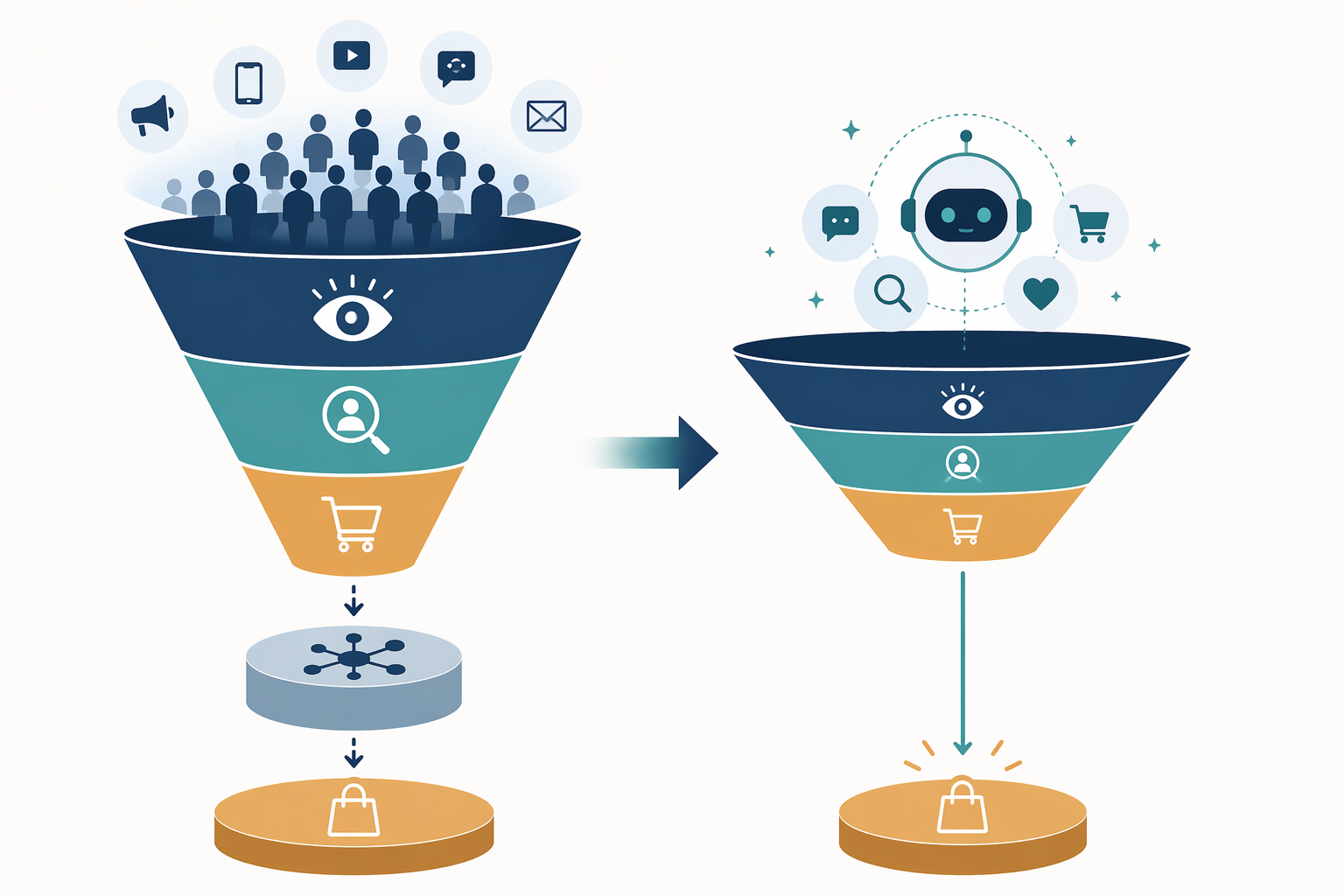
That does not prove a collapse of DSPs, and it should not be inflated into a universal verdict on programmatic advertising. The narrower read is more useful: Wood was willing to buy the dip, but ARKK did not keep The Trade Desk as a conviction marketing AI holding into 2026. That makes it look more like a tactical trade than a long-term expression of the agentic commerce thesis.
Strategically, the exit matters because The Trade Desk sits in a middle layer: it helps advertisers buy media across publishers and channels. That role remains important in today’s media market. But if AI agents shorten the path from discovery to comparison to purchase, some value may migrate toward systems that own proprietary product data, identity-rich customer surfaces, payment flows, and inventory access.
This is the tension marketers should watch. A DSP is valuable when the buying problem is fragmented media access, audience decisioning, and bid optimization. An agentic commerce layer is valuable when the buying problem moves closer to product selection, eligibility, checkout, and fulfillment. Both can coexist, but they do not capture value in the same place.
The evidence supports a careful interpretation: softened conviction in The Trade Desk as an ARKK AI marketing tech holding, not a proven end state for the DSP category.
What Marketers Can Actually Take From the Portfolio
ARKK also owns broader enterprise AI names, including Palantir, but that is portfolio context rather than the center of a marketing tech read.[1] The more relevant pattern is where the marketing-adjacent weight clusters: Shopify for commerce workflows, Roku for CTV inventory, Block for embedded customer and seller agents, and Meta for AI personalization at platform scale.
Taken together, these holdings suggest that the AI marketing value pool may be moving closer to proprietary data and workflow control. The attractive layer is not always the company that labels itself an advertising platform. It may be the company that owns the product catalog, the checkout rail, the seller dashboard, the streaming ad surface, or the customer assistant that nudges behavior before a campaign manager ever opens a buying platform.
That is the practical value of reading Cathie Wood’s AI marketing tech stocks this way. Not as stock tips, and not as a guaranteed map of marketing’s future, but as a signal about where one explicit AI investor thinks workflow control could matter. ARKK positions change, public holdings data can lag, and ARK’s agent-commerce forecasts remain ARK’s own research. The useful takeaway is the direction of attention: proprietary commerce data, embedded agents, CTV inventory, and transaction-adjacent systems are carrying more of the marketing-tech story than pure ad-tech intermediation in this portfolio snapshot.
References
- All 42 ARKK Holdings, cathiesark.com.
- ARK Issue #509 — Shopify Agentic Commerce Thesis, ARK Invest.
- ARK BIG IDEAS 2026, ARK Invest.
- AI Agents And The Intelligent Software Economy, ARK Funds.
- ARK Issue #433 — AI Software Value Chain / SaaS Disruption, ARK Invest.
- The Trade Desk transaction history (Cathie Wood), Stockcircle.

Comments
Join the discussion with an anonymous comment.