

Are Brain-Controlled Robots a Real Marketing Tool?
Brain-controlled robots are moving from research labs to commercial platforms, but what does that mean for marketers today? This article lays out the current state, the plausible trajectory, and when you should start paying attention without over-investing.
“Brain controlled robots for marketing” sounds like a phrase that escaped from a conference slide. In Q3 2026, it is also attached to real technical work: commercial brain-to-robot interface claims from BrainCo and academic systems such as Stanford’s NOIR, which has shown non-invasive EEG control across more than 20 everyday robot tasks.[1][2]
That does not make brain-controlled robots a marketing tool yet. It means the control layer is becoming more concrete. A person can wear a neural interface, the system can interpret intent signals, and a robot can execute simple physical actions. The missing piece is the part marketers are paid to care about: a verified customer-facing use case with an audience, a workflow, a budget owner, and a way to measure whether it changed behavior.
What Is Real Today
The strongest current signal is BrainCo’s brain-to-robot interface launch at WAIC 2025. The reported platform translates EEG neural activity into robot commands, moving the idea from speculative brain-computer interface talk toward a named commercial system.[1] For a marketer, the important word is not “thoughts.” It is “platform.” A prototype can impress a room. A platform suggests someone is trying to make the interface repeatable, purchasable, and extensible.
Stanford’s NOIR system gives the claim a different kind of weight. Developed as a research system and presented at the Conference on Robot Learning 2023, NOIR used a wearable EEG cap to let humans control robots across more than 20 everyday tasks.[2] That is impressive because it shows non-invasive brain-wave control can move beyond a single laboratory trick. It is also clarifying because the tasks are still relatively bounded. Picking, moving, or arranging objects is not the same as understanding a shopper’s hesitation, representing a brand, or adapting a promotion in a live store.
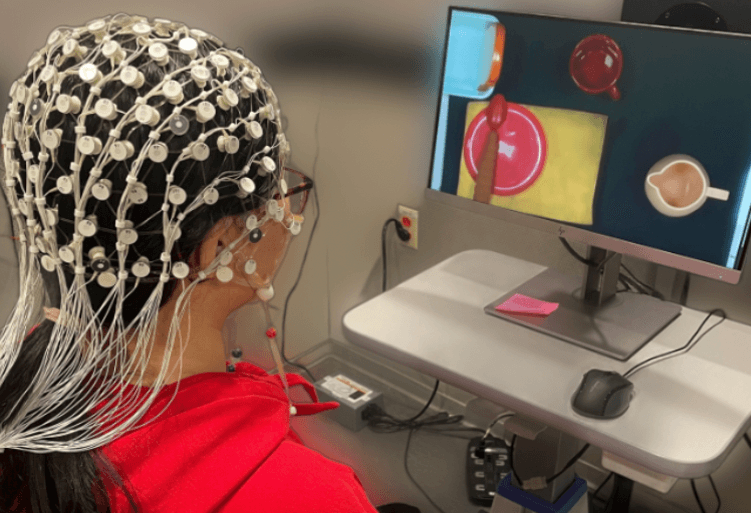
Those two examples define the current boundary. Brain-controlled robotics is no longer only a thought experiment. It is not yet a campaign format, a retail media unit, or a customer experience layer that a marketing team can brief, buy, launch, and optimize.
Where Marketing Actually Enters The System
If brain-controlled robots ever matter to marketers, the first use probably will not be a shopper mentally commanding a robot in a store. That is the most cinematic version, and also the least useful planning assumption. The more plausible path runs through existing retail robotics, accessibility use cases, experiential retail, and employee-assisted operations.
Retail already has robots with jobs. Brain Corp’s autonomous machines have operated in Walmart and other retail environments for tasks such as cleaning and inventory-related work.[3] Those robots are not marketing robots, and they are not brain-controlled. But they matter because they create deployment surfaces: stores with charging areas, operating procedures, safety reviews, vendor contracts, data policies, and employees who already understand that robots may be present on the floor.
That infrastructure changes the question. A marketer does not need to imagine a robot program from zero. The more useful question is whether a neural control layer could eventually sit on top of robots that already exist in retail operations, hospitality, healthcare retail, or accessibility-focused service environments.
| Layer | What exists now | Marketing relevance in 2026 |
|---|---|---|
| Brain-computer interface control | Early commercial platforms and lab systems using non-invasive EEG for robot commands | Worth monitoring, not ready for campaign ownership |
| Retail robotics | Autonomous robots already deployed for operational tasks in major retailers | Creates possible future deployment environments |
| Embodied AI | Improving robot perception, manipulation, and interaction capabilities | Could make robots more useful as brand or service agents later |
| Marketing workflow | No verified brain-controlled robot campaign case studies | No current basis for campaign budget allocation |
The distinction matters because marketers often get pulled into emerging technology too early. A technology can be operationally real and still commercially irrelevant to marketing. Today, brain-controlled robotics belongs in that middle space.
The Market Around It Is Larger Than The Use Case
The broader robotics base is not small. The global collaborative robotics market was estimated at $2.31 billion in 2025, which helps explain why BCI companies and robotics companies may eventually look for integration points.[4] Collaborative robots are designed to work near people, which makes them more relevant to retail, service, and experience environments than fenced-off industrial machines.
BCI market estimates are less helpful for near-term marketing decisions. Forecasts for 2026 vary from roughly $1.4 billion to $3.75 billion depending on methodology.[4] That range is too wide to treat as a budgeting signal. It is directional: investors, researchers, and device companies are active. It is not decisive: it does not prove consumer adoption, marketing effectiveness, or channel readiness.
This is where a practical manager should separate three questions that often get blended together in trend decks: Can the system work technically? Can it be deployed in a real environment? Can marketing use it to create measurable value? BrainCo and Stanford help answer the first question. Retail robotics helps answer part of the second. The third is still open.
Why The Marketing Conversation Is Starting Anyway
Marketing publications have been circling brain-computer interfaces for a reason. Advertising Week has framed BCI through companies such as Neuralink and Merge and asked what direct neural interfaces could mean for marketing.[5] Forbes has also connected neuromarketing, AI-enabled BCI, and the possibility of more direct feedback loops between cognition and digital systems.[6] Those pieces are useful because they name the strategic imagination around the category.
They should not be read as evidence that the marketing channel exists. There is a difference between measuring attention, interpreting neural signals, assisting a user, and deploying a robot as part of a branded customer journey. Each step adds consent, safety, privacy, procurement, training, and measurement requirements.
Ross Dawson’s BCI company roundup is useful for watchlist building because it places BrainCo-adjacent activity within a broader field that includes Neuralink, Merge, Neurable, and Emotiv.[7] But a company landscape is not the same thing as a marketing adoption curve. For now, it tells teams where to look, not what to buy.
The First Plausible Marketing Uses Are Narrow
The most credible early marketing-adjacent use cases are not mass-market campaigns. They are controlled environments where novelty, assistance, or accessibility has a clear role and the audience is small enough for supervision.
- Accessibility-led retail assistance, where a neural interface helps a person command a robot to reach, retrieve, or move items in a store or service environment.
- Brand theater at conferences or flagship locations, where the experience is supervised and the objective is attention rather than scalable conversion.
- Employee-assisted operations, where trained staff use neural or hybrid controls to guide robots during demonstrations, product handling, or high-touch service moments.
- Research environments, where neural response data may inform experience design, subject to consent and privacy controls.
Even these uses need careful wording. Accessibility assistance may create brand value, but its primary job is service. A conference demonstration may generate press, but that is not the same as proving repeatable customer acquisition. Research data may improve design decisions, but it is not a live personalization engine.
What Would Need To Change Before Budget Moves
A mid-level marketer briefing leadership in 2026 can give a clean answer: track the space, but do not allocate campaign budget yet. The reason is not that the technology is fake. It is that the marketing system around it is absent.
Before brain-controlled robots become a realistic marketing investment, several signals need to appear in the open market:
- Verified customer-facing pilots, not only lab demos or conference demonstrations.
- Non-invasive BCI systems that handle more nuanced intent than simple task selection.
- Integration with retail, event, or service robots that already meet safety and operations requirements.
- Clear consent, privacy, and data-use models for neural signals in commercial environments.
- Measurement models that connect the robot interaction to service quality, conversion, retention, accessibility outcomes, or earned media.
The consent point deserves particular caution. A shopper watching a robot is one thing. A shopper wearing a neural interface is another. Any customer-facing use would need to make participation optional, legible, and limited. The data involved is not ordinary clickstream exhaust, and treating it that way would create avoidable trust risk.
The 2028-2030 Window Is The One To Watch
The practical timeline for consumer-grade BCI adoption is more likely to matter around 2028-2030 than in the current planning cycle.[5] That does not mean every brand should wait passively. It means the right action now is structured monitoring rather than spend.
For 2026, the useful watchlist is specific. Follow BrainCo-style brain-to-robot platforms. Watch whether systems like Stanford NOIR improve the range and reliability of non-invasive control. Track whether retail robotics vendors add more expressive human-robot interaction layers. Look for the first independently documented pilots where a customer, not a researcher or presenter, uses a brain-controlled robot in a commercial setting.
That last signal is the one that should change planning behavior. Until then, brain-controlled robots belong in the strategic watchlist, not the quarterly campaign plan. They are real enough to monitor and too immature to brief as a marketing channel.
References
- Chinese company BrainCo unveils first brain-to-robot interface for controlling robots with your thoughts, TechRadar
- Wearable Device Allows Humans To Control Robots with Brain Waves, Stanford HAI
- Brain Corp retail robotics deployment, Brain Corp
- Global collaborative robotics market
- From Neuralink to Merge: What Brain-Computer Interfaces Could Mean for Marketing, Advertising Week
- Neuromarketing and AI-enabled BCI, Forbes, December 2024
- BCI company roundup, Ross Dawson

Comments
Join the discussion with an anonymous comment.