
Bloom Energy's Data Center Marketing Playbook for the AI Power Crunch
A case study of the four-part marketing strategy Bloom Energy used to turn fuel cell technology into a $25B pipeline serving AI data centers, with actionable takeaways for B2B marketers creating category demand.
The useful lesson in Bloom Energy's AI data center marketing is not that the company found a hotter market. Plenty of infrastructure vendors can point at AI demand and say the grid is constrained. Bloom did something harder: it made an unfamiliar fuel-cell category feel like a practical answer to a very current operating problem, then gave buyers enough language and proof to repeat that answer inside their own organizations.
The pressure was real, but pressure alone does not create demand. Bloom's 2026 Data Center Power Report framed the market in terms buyers, local officials, and executives could all recognize: data centers were looking for ways to reduce grid dependence, while community opposition was becoming a material constraint. The report said 32% of U.S. data centers aimed to operate fully off-grid by 2030, a 22% increase in six months, and cited 86 local moratoriums plus 18 state bills proposed as of May 2026.[1][2]
That is the move worth studying. The report did not ask the market to care about fuel cells first. It asked the market to care about power availability, speed, emissions at the point of use, and local strain. Only after those problems were established did Bloom's solution have somewhere to land.
The Market Window Was Urgent, But Still Needed Translation
AI infrastructure gave Bloom a sharper market entry point. Goldman Sachs Research projected that fuel cells could supply 6% to 15% of data center power by 2030, equivalent to 8 to 20 GW, and described fuel cells as 10% to 30% more efficient than gas turbines, deployable in under a year versus more than five years, with zero NOx and CO emissions.[3] Rystad Energy separately projected cumulative data-center fuel-cell demand of 10.4 GW from 2026 through 2030, representing a $30 billion market.[4]
Those are forecasts, not proof that Bloom's marketing caused pipeline or revenue. Their value in the story is narrower and more useful: they made the timing credible. A marketer selling an obscure infrastructure category needs that kind of outside context, because without it the pitch sounds like a vendor trying to pull a future into the present.
Bloom's more direct marketing problem was different. Data center operators had urgent power needs, but they also had to defend their choices to utilities, permitting authorities, finance teams, and communities already worried about the local consequences of AI buildout. In that environment, a technical superiority claim is not enough. The buyer needs a safer story to carry into rooms where the vendor is not present.
The Four Moves Behind Bloom's Playbook
Bloom's marketing system can be reduced without flattening it. The sequence matters more than the asset list.
| Move | What It Did In The Persuasion Chain | Why It Mattered |
|---|---|---|
| Commissioned original research | Created a trust anchor around power constraints and community concerns | Gave media, sales, and executives a shared evidence base |
| Put a distinctive CMO voice in market | Interpreted opposition as a reason to choose Bloom, not just a barrier | Turned local strain into a category-positioning advantage |
| Built a multi-format content stack | Repeated the same logic through reports, webinars, blogs, video, and social | Made the message usable across different buying conversations |
| Added partnership and customer proof | Reduced perceived risk through external validation | Helped buyers repeat the story internally with less explanation |
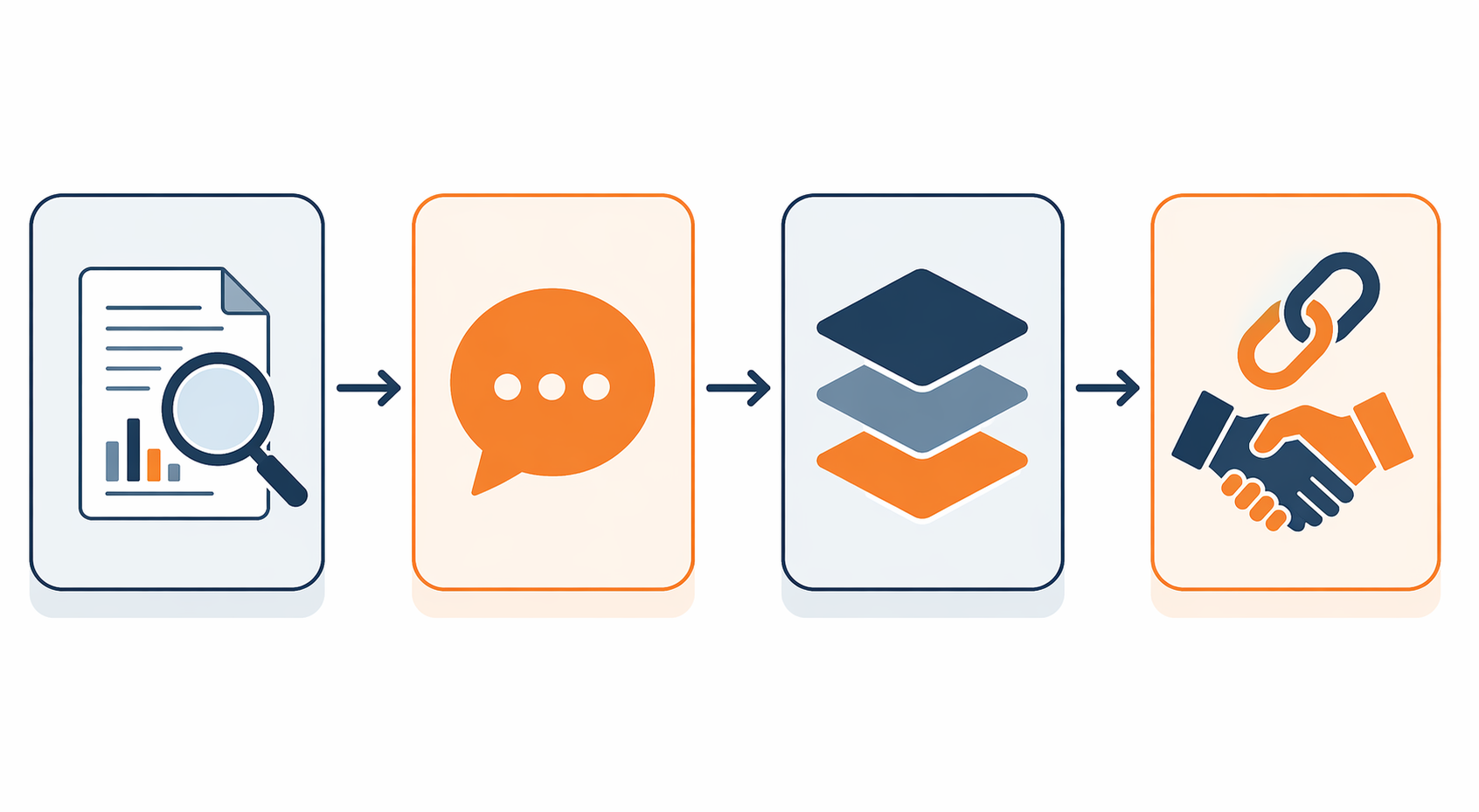
The order is the part most teams miss. Bloom did not appear to begin with a slogan and then hunt for proof. It built the proof asset first, then used executive voice and channel repetition to make that proof travel.
Original Research Became The Load-Bearing Asset
The Data Center Power Report worked because it measured a buying environment, not just awareness of Bloom. The report was based on vendor-commissioned research with a disclosed double-blind methodology and a stated sample size in the 152 to 156 decision-maker range, depending on the release.[1][2] That does not make it neutral industry consensus. It does make it more usable than a white paper built only from vendor assertions.
The strongest questions were not about whether respondents liked fuel cells. They were about constraints: whether data centers expected to rely less on the grid, whether power availability was delaying growth, and whether community concerns were becoming harder to ignore. That distinction matters. Adoption intent, operating constraints, and sentiment are different kinds of evidence. Bloom's report was most persuasive when it stayed close to the constraints buyers already felt.
For a B2B marketer, this is the replicable part: the report created a common object that could be used in several conversations without changing shape. A sales rep could cite off-grid interest. A PR team could pitch the connection between AI growth and local moratoriums. An executive could talk about community concerns without sounding as if the company had just discovered them after a permitting fight.
The report also gave Bloom permission to avoid leading with a fuel-cell explainer. That is a quiet but important content decision. In difficult infrastructure categories, the temptation is to educate the market by starting with the technology. Bloom's research let the company start with the consequence of not solving power: slower capacity, more conflict with communities, and more dependence on grid timelines.
The caveat should stay visible. A commissioned report can reveal useful market tension, but it cannot carry the same burden as independent longitudinal research. Bloom's data is best treated as a marketing intelligence asset with disclosed methodology, not as the final word on the data center power market.
The Messaging Pivot Was About Permission, Not Personality
Natalie Sunderland's role matters because the CMO voice did more than promote a campaign. Sunderland came to Bloom after enterprise software and cloud marketing roles, a background that matters in this case because she was not simply marketing hardware; she was translating an industrial technology into a buying motion familiar to executives used to software-like urgency and infrastructure-scale risk.[5]
The public framing was specific: Bloom positioned fuel cells as a way to reduce strain on local infrastructure while helping developers bring new capacity online faster.[1] That sentence does a lot of work. It acknowledges the community objection instead of treating it as irrational resistance. It gives data center developers a socially safer way to talk about new capacity. It also moves Bloom away from a narrow product category and toward a role in solving a public bottleneck.
This is where many technical companies underuse executive voice. They publish thought leadership that says the market is changing, the future is distributed, or AI needs resilient infrastructure. Bloom's sharper move was to choose an interpretation of the conflict: local opposition was not merely a communications problem to soften; it was evidence that grid-dependent growth had become harder to defend.
That interpretation gave the company a different competitive posture. If a data center project is facing concern over power draw, a vendor promising more capacity is only partly helpful. A vendor offering a way to talk about reduced grid strain changes the internal conversation. It helps the buyer answer the stakeholder who is not comparing spec sheets.
There is a useful restraint here. The available material supports the conclusion that Bloom used community-friendly power as a positioning strategy. It does not prove that this message independently caused pipeline growth, changed public opinion, or resolved local opposition. The marketing lesson is about narrative control under constraint, not a guaranteed playbook for winning every community argument. For broader context on that tension, the Signal & Convert articles “How Eminent Domain for AI Data Centers Creates Brand Liability” and “Why AI Data Center Marketing Makes Opposition Worse” are useful companion reads.
The Content Stack Repeated One Argument In Different Buying Rooms
Once the research and interpretation were in place, the rest of the content system had a job: repeat the argument without making every asset feel like a repackaged press release. Bloom's data center content ecosystem included white papers on fuel-cell heat capture and lower PUE, webinars such as DOE Western TAP programming, the “BE In the Know” video series, blog content, and executive LinkedIn thought leadership.
The important thing is not that Bloom used many formats. Everyone uses many formats. The important thing is that each format could serve a different stage of internal persuasion.
- The report made the market problem citeable.
- The blog and press materials made the problem timely.
- The white paper made the technical pathway more concrete.
- The webinar format gave technical and policy-adjacent audiences a lower-pressure forum.
- The executive social layer made the interpretation portable in public conversations.
A marketer trying to copy this should resist the urge to start with the channel calendar. The better question is: what does each stakeholder need to repeat? A sustainability lead may need the emissions and heat-reuse angle. A data center executive may need speed-to-power. A local affairs team may need the community-strain language. A finance leader may need a model that reduces upfront capital friction.
That last point is where packaging and pricing language enter the marketing system. A third-party Introl analysis described a Bloomberg-reported managed-service model at $0.099/kWh, including hardware, maintenance, and 24/7 monitoring, which reframed the purchase from CapEx toward OpEx.[6] Because this comes through secondary analysis, it should be handled carefully. Still, as a marketing mechanism, the implication is clear: the more a hard infrastructure offer can be discussed in operating terms, the easier it becomes for buyers to compare it with the cost of waiting.
The content stack also protected the company from overloading any single asset. The report did not have to answer every engineering question. The white paper did not have to prove the whole market shift. The executive voice did not have to carry the methodology. Each asset made the next one easier to accept.
Partnership Proof Made The Story Safer To Repeat
Partnerships and customer references came after the narrative had been established, which is where they belong. Bloom and Brookfield expanded an AI infrastructure partnership from $5 billion to $25 billion in eight months, according to Bloom's announcement.[7] Data Center Dynamics had previously covered the $5 billion Brookfield partnership to deploy Bloom fuel-cell technology across AI data centers.[8]
The number is impressive, but the marketing function is more specific than impressiveness. Brookfield gave the story a capital and infrastructure credibility layer. It made the message easier for buyers to repeat because it was no longer only Bloom saying the category mattered. A large partner had put its name next to the same premise.
Named customer references did similar work. Bloom's data center materials cite Equinix across 19 data centers and more than 100 MW, Oracle as its first direct hyperscaler supply contract, and references to CoreWeave and AEP in the data center power context.[9] These logos do not prove that every AI data center buyer will adopt fuel cells. They do reduce the perceived novelty of the decision.
That distinction matters in case-study writing. A customer logo is not causation. It is permission. It lets a buyer say, “This is not an experiment only we are considering.” In categories where the main competitor is often delay, skepticism, or internal risk avoidance, that permission can be as valuable as another product claim.
What Other B2B Marketers Can Copy
The copyable playbook is not “publish a report, post on LinkedIn, announce a partnership.” That version is too shallow to help. The more useful version starts with sequencing.
- Measure the constraint your buyer must explain to other people. Bloom's report focused on power availability, grid reliance, and community concern, not generic fuel-cell awareness.
- Disclose enough methodology for the research to travel. Vendor-commissioned research will still be scrutinized, but sample size and method give serious readers something to evaluate.
- Use executive voice to interpret the conflict, not to decorate the campaign. Sunderland's public framing made local strain part of the category argument.
- Assign each content format a persuasion job. Do not ask one white paper or webinar to carry the entire market narrative.
- Add partner and customer proof after the story is clear. External validation works best when it reinforces an argument the market already understands.
The hardest part is the first one. Many companies want category demand without doing the research work that makes the category feel necessary. They want buyers to accept the solution before the market has agreed on the problem. Bloom's case shows the value of reversing that order.
It also shows where not to overclaim. Goldman Sachs and Rystad provide market forecasts, not marketing attribution. Bloom's Power Report is commissioned research, not independent proof of universal buyer behavior. The Brookfield expansion and customer references demonstrate credibility, not a controlled test of message effectiveness. A good B2B case study can still be strong when it keeps those boundaries intact.
For marketers selling technical infrastructure into AI demand, the practical takeaway is disciplined: build a trust asset around the buyer's most visible constraint, give executives a point of view that helps buyers defend action, repeat the message through formats that match the buying committee, and use external proof to make the choice feel less lonely. That is a marketing playbook, not a guarantee that every adjacent market can produce the same pipeline outcome.
References
- AI Data Center Growth Hinges on Solving Both Power Constraints and Community Concerns, Bloom Energy Report Finds, Bloom Energy
- Data Centers Plan to Reduce Reliance on Grid, Finds Bloom Energy's 2026 Power Report, Bloom Energy
- Fuel Cells Could Help Meet the Power Demand from Data Centers, Goldman Sachs Insights
- Data center fuel cell power demand, Rystad Energy
- Natalie Sunderland, Bloom Energy
- Fuel Cells for Data Center Power: The Dark Horse in the $7 Billion Race, Introl
- Brookfield and Bloom Energy Expand AI Infrastructure Partnership, Bloom Energy
- Bloom Energy signs $5bn partnership with Brookfield to deploy fuel cell tech across AI data centers, Data Center Dynamics
- Data Center Power, Bloom Energy

Comments
Join the discussion with an anonymous comment.