
How to Structure Best Beaches Content for AI Search Visibility
Learn the three content formats, schema requirements, and freshness cadence needed to earn citations from ChatGPT, Perplexity, and AI Overviews for your best-beaches-in-X travel content.
The old “best beaches in X” page usually fails in the same place: it ranks ten beaches, adds a postcard sentence to each, and leaves both the traveler and the engine to infer the real use case. A family looking for calm water, a couple looking for a quieter beach, and a visitor planning a three-day shoulder-season trip do not need the same page. AI search makes that weakness harder to hide because citation-worthy answers need clean intent, extractable structure, and facts that still hold up when conditions change.
The pressure is not theoretical. AtlasPerk cites Digitaloft data showing that 78% of 671 travel publishers lost organic traffic after Google’s Helpful Content updates, with 32% losing more than 90%; the same source notes that generic listicles were disproportionately affected. AtlasPerk also reports that 85% of marketers use AI for content creation, which helps explain why thin “best beaches” pages now compete against a flood of similar-sounding content rather than a few comparable guides.[1] Goodie reported in June 2026 that 40% of travelers now use AI to plan trips, a useful directional signal even though the briefed source does not give an independent primary methodology for that figure.[2]
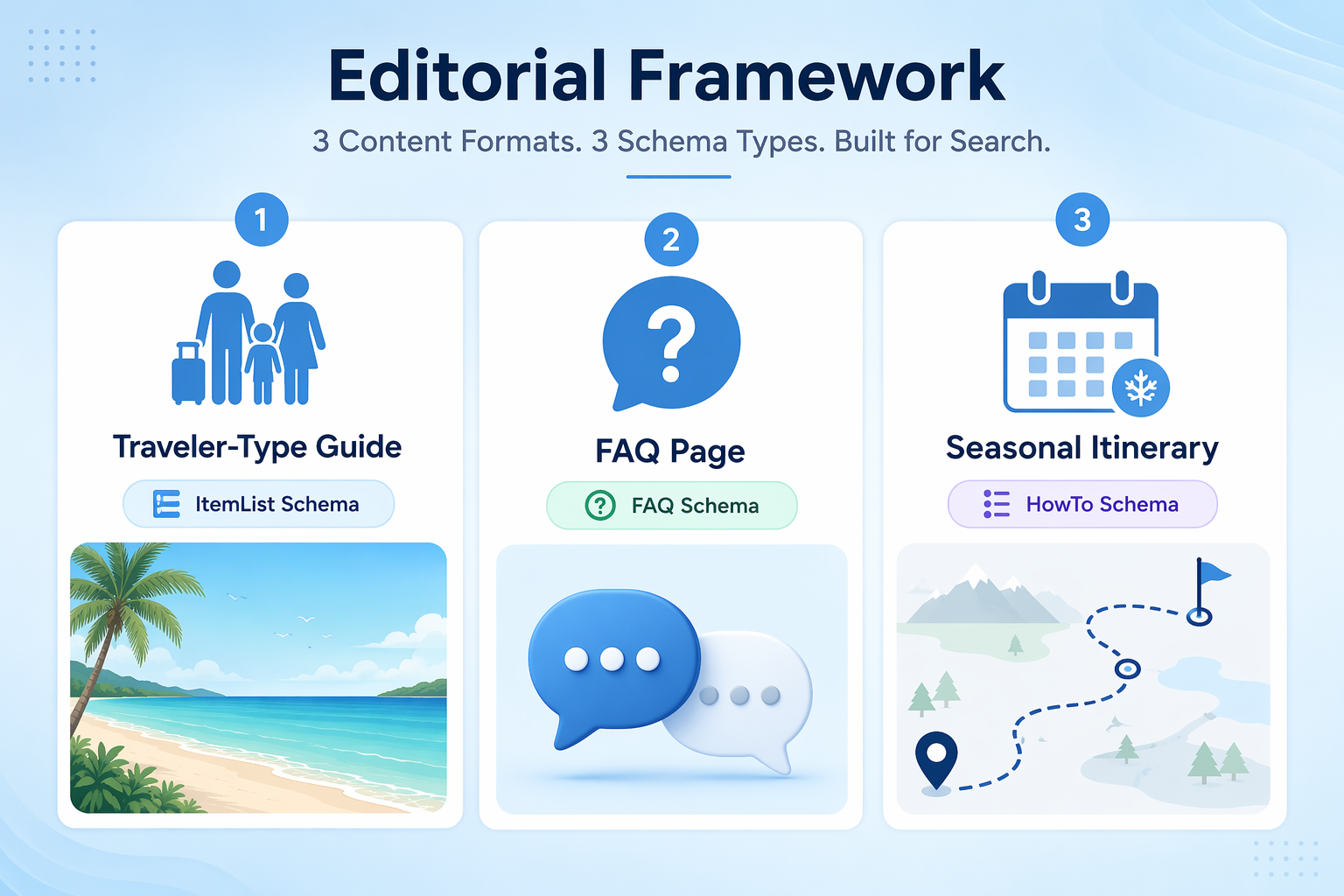
| If the search intent is… | Build this format | Use this schema | Best fit for |
|---|---|---|---|
| “Which beach should I choose for my traveler type?” | Traveler-type-specific beach guide | ItemList | Families, couples, surfers, accessibility needs, quiet beaches, dog-friendly beaches |
| “What is the answer to this beach-planning question?” | Question-driven FAQ page | FAQPage | Calmest beach, safest swimming area, best hidden beach, whether a beach has bathrooms or parking |
| “How do I fit beaches into a real trip?” | Seasonal itinerary page | HowTo | Weekend plans, shoulder-season trips, rainy-season alternatives, multi-stop coastal routes |
Start by replacing the ranking with a decision
A flat beach roundup asks the page to serve every traveler at once. That is why so many of these pages feel busy but not useful: every beach gets a ranking, a scenic adjective, and perhaps a parking note, while the hard decision criteria sit in the margins. For AI search, the bigger problem is that the page does not expose a clean answer unit. If every entry is “beautiful,” “popular,” and “worth visiting,” there is very little for an engine to cite.
The fix is not to delete every list. It is to stop treating the list as the strategy. A traveler-type beach guide can still contain a ranked or curated list, but the organizing principle changes from “best overall” to “best for this person, in this situation, with these trade-offs.” That gives the page a clearer entity set, a clearer audience, and a more honest reason for each recommendation.
For teams that need a broader primer on the discovery shift before rebuilding destination pages, the internal guide on ChatGPT for marketers and AI discovery is the better starting point. For beach content specifically, the practical question is narrower: what page type should exist for this intent, and what structure makes it easy to quote?
Traveler-type beach guides: the safest retrofit for old listicles
Most existing “best beaches” pages should first be tested against the traveler-type guide format because it is closest to what teams already have. The difference is that the page no longer ranks beaches as if there were one universal winner. It chooses a traveler segment and makes each beach entry answer the same practical questions.
A useful guide to “best beaches for families in Bali,” for example, would not simply swap “families” into the title and leave the rest intact. The entries need comparable fields: water conditions, shade, bathrooms, food nearby, stroller or walking access, crowd level by season, and what kind of family should skip it. The negative fit matters. A beach that is beautiful but difficult to access with small children should not be presented as a family pick just because it photographs well.
ItemList schema fits this format because the page is still presenting a set of recommended places. The schema should reflect the visible content rather than invent a cleaner version of it. If the page lists seven beaches, the structured data should identify those list items in the same order or grouping the reader sees. Each item should have a stable name, URL or anchor where possible, and enough surrounding on-page context for an AI system to understand why it belongs in the list.
Indexly says its travel customers have seen best-of listicles with ItemList schema win AI Overviews and ChatGPT citations for queries such as “top 10 hidden beaches in Bali.” That is vendor-reported customer data, not an independent industry benchmark, so it should be treated as a directional example rather than proof that ItemList alone creates citations.[3]
The common retrofit mistake is to add schema to a page that still has no useful selection logic. ItemList can help an engine parse the list, but it cannot supply the missing editorial judgment. The page still needs to state why a beach is right for a specific traveler type and what condition might make another beach a better choice.
A better entry pattern for beach guides
Each beach entry should be predictable without becoming templated filler. A practical pattern looks like this:
- Beach name and location context: enough to distinguish it from similarly named beaches or nearby resort areas.
- Best for: the traveler type or trip need the beach actually serves.
- Why it fits: the concrete features that support the recommendation, such as calmer water, nearby facilities, walkability, or a quieter setting.
- Watch-outs: access constraints, seasonal crowding, rougher water, limited shade, parking pressure, or other factors that change the choice.
- Best time or season note: only when the team can maintain it and source it responsibly.
That pattern gives editors a repeatable structure, but it also gives search systems cleaner passages to extract. The point is not to make every entry the same length. A complex beach with seasonal access issues deserves more space than a straightforward town beach with reliable facilities. Uniformity is less important than comparable decision data.
FAQ pages work when the query is already a question
Some beach searches should not be forced into a guide at all. “What is the calmest beach in Florida for toddlers?” is not the same content object as “best beaches Florida.” The first query asks for a direct answer with criteria. The second asks for a broad ranking. Treating them as interchangeable is how pages become long without becoming decisive.
Simpleview’s GEO guidance for DMOs makes this shift explicit by moving away from broad keyword targeting such as “best beaches Florida” and toward question-based content such as “What are the best hidden beaches in Florida for couples?”[4] That is a useful editorial correction because the page can now answer one job instead of pretending to satisfy every possible beach-planning need.
FAQPage schema fits when the page genuinely contains question-and-answer content. It should not be used as a markup wrapper for a normal article with decorative questions sprinkled through the headings. The visible page should contain the same questions the structured data marks up, and the answers should be concise enough to stand alone while still linking to deeper supporting pages where the traveler needs detail.
A strong beach FAQ page usually has fewer, better questions. It may answer which beach is calmest for toddlers, which beaches have lifeguards, where parking is easiest, whether a beach is swimmable during a certain season, or which beach is better for a couple avoiding crowds. These questions should come from real search behavior, customer-service logs, visitor-center questions, site-search data, and editorial judgment. A page that answers twenty nearly identical keyword variants is still a keyword page wearing an FAQ costume.
How to keep FAQ answers citable
- Lead with the answer before adding caveats.
- State the condition that changes the answer, such as season, tide, access, or traveler type.
- Link to a deeper beach guide or destination page when the traveler needs comparison.
- Avoid exact amenity, price, or access claims unless the team can verify them on a current review cycle.
- Use FAQPage schema only for questions and answers that appear on the page.
The answer does not need to be long to be useful. In many cases, the best structure is a short answer, a short “why,” and a link to the relevant guide. That gives AI systems a clean passage while still giving the traveler a route to continue planning.
Seasonal itineraries are harder to maintain, but harder to fake
A seasonal itinerary is the right format when the beach recommendation only makes sense inside a trip plan. A spring weekend beach route, a summer family itinerary, or a shoulder-season coastal drive can answer a richer question than a listicle: not just which beach is good, but when to go, what to pair it with, how long to spend there, and what to do if conditions change.
HowTo schema is appropriate only when the itinerary is structured as a sequence of steps or actions. A page that simply lists “Day 1,” “Day 2,” and “Day 3” with loose inspiration may not deserve HowTo markup. But if the page gives an actual plan — start at this beach in the morning, move inland during peak heat, return to a sunset viewpoint, reserve this type of activity in advance — the format becomes much more extractable.
This is also where thin AI-generated travel content struggles. A seasonal itinerary needs operational knowledge: travel time assumptions, closures, weather patterns, crowd behavior, booking constraints, and backup options. The more the page depends on current local conditions, the less convincing a generic paragraph becomes.
The itinerary format works especially well for DMOs and publishers that can connect beaches to other local assets. Instead of treating each beach as an isolated ranking item, the page can show how a traveler actually uses the destination: a calm beach in the morning, a shaded lunch area nearby, an indoor fallback if afternoon storms are common, and a less crowded sunset stop. Those connections are useful to readers and easier for an engine to understand than a list of interchangeable superlatives.
Choose the page type before choosing the schema
Schema should describe the content decision, not compensate for the lack of one. If the page’s main job is to compare beaches for a traveler type, use a guide format and ItemList. If the job is to answer a set of specific questions, use an FAQ page and FAQPage. If the job is to walk someone through a seasonal trip plan, use an itinerary structure and HowTo where the steps are real.
| Page signal | Likely format | Editorial test |
|---|---|---|
| The title contains “for families,” “for couples,” “for surfing,” or another traveler need | Traveler-type guide | Can each beach be judged against the same traveler-specific criteria? |
| The strongest queries begin with who, what, where, when, or whether | FAQ page | Can the page answer directly without forcing the reader through a long roundup? |
| The content depends on season, sequence, timing, or route planning | Seasonal itinerary | Would the recommendation be weaker if the day-by-day plan were removed? |
This choice can split one overgrown evergreen page into several useful pages. A destination might need a family beach guide, a hidden-beaches FAQ for couples, and a three-day summer itinerary. Those pages can share source material, but they should not share the same structure because they do not answer the same search intent.
Freshness is part of the format, not a cleanup task
Beach content decays quickly. Seasonal access changes, amenity closures, erosion, parking rules, concession hours, and pricing shifts can turn last year’s good recommendation into this year’s bad advice. Goodie’s travel AI optimization guidance includes a freshness checklist and recommends a 90-day refresh cycle for sustained AI visibility.[2]
That cadence is demanding, but it is easier to manage when each page has a clear purpose. A traveler-type guide needs its comparison fields checked. An FAQ page needs its direct answers verified. A seasonal itinerary needs timing, closures, and backup options reviewed. The editor should not have to reread a vague listicle and guess which sentences could hurt a traveler.
| Format | What to review every 90 days | What should trigger an immediate update |
|---|---|---|
| Traveler-type beach guide | Beach fit, access notes, amenities, crowd and season language, internal links | Closure, erosion event, major amenity change, changed access or safety guidance |
| FAQ page | Direct answers, caveats, source links, schema consistency | A frequently asked question starts receiving a different answer from local conditions or official guidance |
| Seasonal itinerary | Sequence, travel assumptions, seasonal timing, booking or parking constraints, backup options | Road/access change, event disruption, weather-season change, attraction or beach closure |
A visible “last reviewed” date is not a ranking magic trick. It is a publishing discipline. It tells the traveler and the content team that the page is not an abandoned evergreen asset. If the team cannot maintain live pricing or exact facility details, the page should avoid those claims or link to official sources where the traveler can verify them.
Support the page with sources and internal paths
AI visibility is not only an on-page formatting problem. Travel and hospitality websites averaged a 20% year-over-year organic traffic decline, with TransPerfect attributing part of that pressure to AI Overviews answering questions directly on search results pages.[5] If the answer is going to be summarized before the click, the source page needs to be unusually easy to trust.
For beach content, that means citing or linking to durable local sources where appropriate: official tourism pages, park authorities, transport pages, beach safety resources, accessibility information, and local event or closure notices. The goal is not to bury the reader in outbound links. It is to show where volatile facts come from and to separate editorial recommendations from operational claims.
Internal linking should be just as deliberate. A family beach guide can link to the destination’s family itinerary, a calm-water FAQ, and the individual beach pages that carry deeper logistics. A seasonal itinerary can link back to the beach guide when the traveler wants alternatives. This creates a hub-and-spoke structure without pretending that one giant page should answer every version of the query.
What to do with the existing “best beaches” page
Most teams do not need to delete their old page on day one. They need to audit what it is actually capable of becoming. If the page already has strong beach descriptions and comparison notes, it can often be rebuilt into a traveler-type guide. If search demand clusters around specific questions, carve out FAQ pages and let the old page become a hub. If the destination’s beach value depends heavily on season and trip shape, build itineraries and use the roundup only as supporting navigation.
- Export the page’s current queries and group them by traveler type, question, and itinerary intent.
- Mark which existing sections contain verifiable decision data and which are only descriptive filler.
- Choose one primary format for the current URL instead of trying to serve all intents equally.
- Add the schema that matches the visible structure: ItemList, FAQPage, or HowTo.
- Create supporting pages only where the intent is distinct enough to deserve its own answer.
- Put the page on a 90-day review cycle and assign the facts that must be checked.
There is no need to turn every beach asset into a sprawling content hub. A partial but precise rebuild is better than a polished page that still cannot tell a traveler which beach fits the trip. The practical win is to replace one undifferentiated roundup with a small set of purpose-built pages: a guide when the traveler needs comparison, an FAQ when the intent is a question, and an itinerary when the recommendation depends on sequence and season.
That structure does not guarantee citations from ChatGPT, Perplexity, or AI Overviews. It does give those systems clearer material to parse and gives travelers a page that makes an actual choice possible. For “best beaches” content, that is the standard worth building around.
References
- Content Strategy for Travel, AtlasPerk
- Travel AI Optimization Guide, Goodie
- Travel & Lifestyle Industry, Indexly
- GEO for DMOs: How Generative Engine Optimization Changes the SEO Game, Simpleview
- AI Reshaping Content Marketing: What Travel Industry Needs Know, TransPerfect

Comments
Join the discussion with an anonymous comment.