
How BÉIS Turned TikTok Hate Into a Product Relaunch Playbook
Learn how BÉIS turned negative TikTok feedback into a repeatable four-step playbook for product redesign and earned-media campaigns — including critic gifting, IRL pop-ups, and a self-deprecating founder cameo.
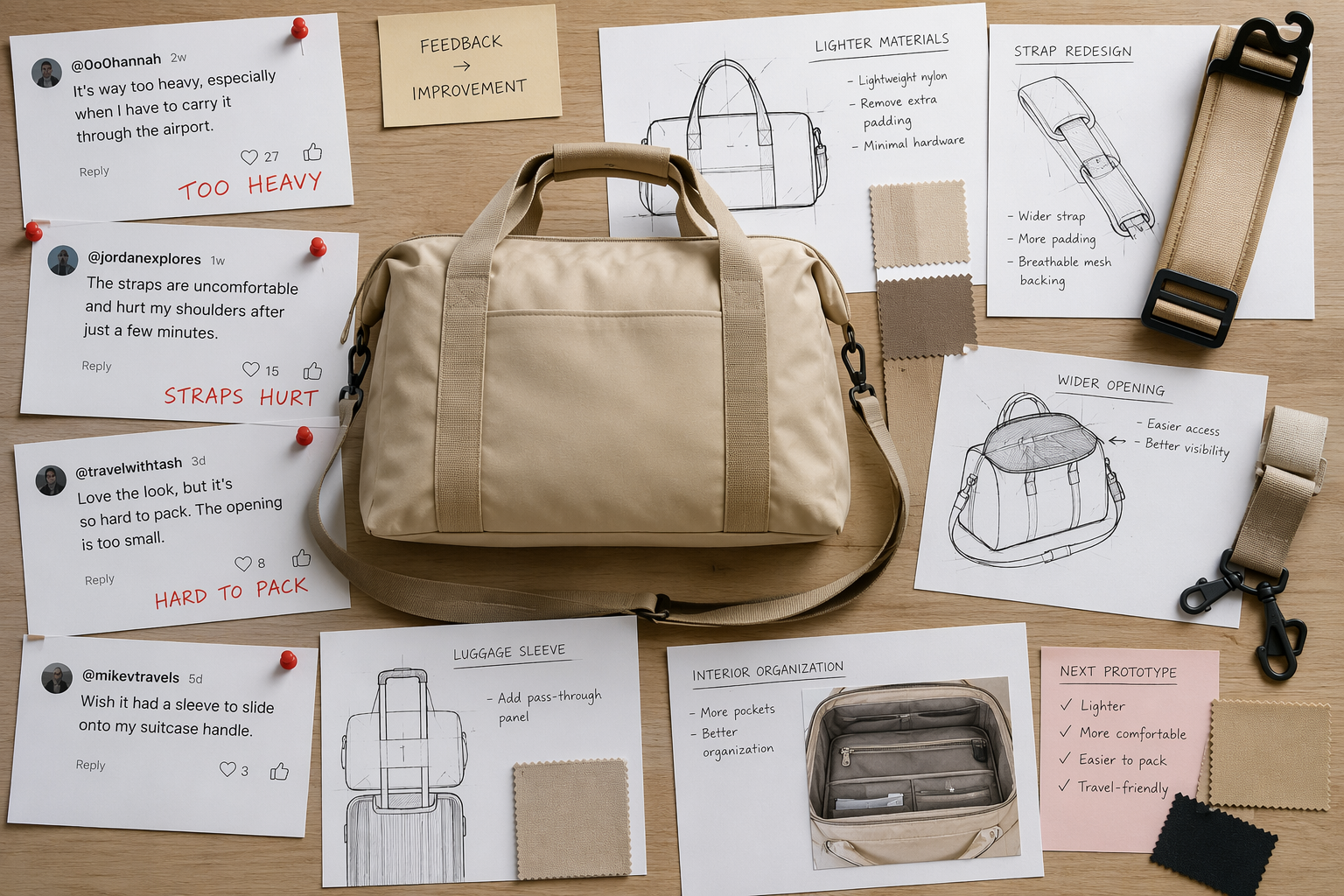
A cult product can be commercially successful and still have a public flaw narrative gathering momentum. Business Insider reported that BÉIS's team manually cataloged negative TikToks about The Weekender, even though the bag had already sold more than 2 million units since 2018, according to BÉIS as reported by USA Today, with complaints centering on weight, straps, and packing constraints.[1][2]
When criticism becomes the roadmap
The most interesting move was not the redesign itself. It was the labor before the redesign: Liz Money's team treated negative TikToks as input worth sorting, tagging, and using as a blueprint for the next version of the bag. That turns social listening from a reporting layer into a product workflow, which is a very different thing from simply knowing that people are annoyed.[1]
That also fits a longer pattern. Marketing Brew wrote in 2024 that BÉIS was already using customer feedback as part of its marketing strategy, so the Weekender relaunch looks less like an isolated apology and more like a brand that had already decided criticism could be operationalized instead of merely managed.[3]
The redesign stayed close enough to the original
BÉIS appears to have understood the core risk: if a bag already has a fan base, a fix can become its own kind of rejection. Over-correcting would have invited the familiar "new Coke" problem, where the brand solves the complaints so aggressively that it also destroys the product identity people liked in the first place. The smarter choice was restraint, keeping the Weekender recognizable while addressing the friction points the complaints kept surfacing.
The critic-gifting step changed the tone
The most credibility-efficient part of the playbook was sending the redesigned bag to the harshest TikTok critics with no obligation to post. That is not standard influencer seeding. The point is not to buy reach or force praise; it is to let people who already shaped the public objection decide whether the fix is real enough to mention on their own.
That distinction matters for DTC teams. A gifted product to a critic works only when the brand is willing to absorb silence, skepticism, or a lukewarm response. The upside is that any endorsement carries more weight because it comes after the person had already gone on record with the problem. Aspire's look at BÉIS's creator engine points to a broader multi-touch approach, which helps explain how a no-strings gift can sit inside a larger relationship system instead of feeling like a one-off stunt.[4]
The IRL layer gave the relaunch a second wave
Once the product story existed, BÉIS wrapped it in a public-facing campaign that made the joke impossible to miss: "missing" posters around New York City calling out the bag's flaws, a 20% trade-in discount at a pop-up, and a self-deprecating Shay Mitchell cameo in which she played a surgeon hacking away at the straps.[1] The humor mattered, but mostly because it sat on top of a genuine product change. On its own, clever copy would have looked defensive. With the redesign in place, it read as a brand willing to laugh at the exact criticism it had already fixed.

What the scale helps, and what it does not
BÉIS has more amplification than most brands trying this playbook. Business Insider put annual revenue at $250 million and noted 1.3 million Instagram followers and 606,000 TikTok followers, which helps a relaunch travel quickly once it is ready.[1] Shay Mitchell's visibility also widens the top of the funnel. But none of that explains the operating method. The useful part is the sequence: catalog the complaints, change only what needs changing, invite detractors back without demanding gratitude, and then stage the relaunch so the market has something worth covering. The Weekender's 2 million-plus sales figure comes from USA Today citing BÉIS, not from an independent audit, so it should be read as a brand-reported scale marker rather than verified unit economics.[2] The revenue number in recent coverage also functions more as directional context than as a precise operating metric.[1] Even with those limits, the managerial lesson holds: public criticism becomes a marketing win only when the brand proves it heard the criticism, makes a visible but bounded fix, brings critics back without coercion, and gives the relaunch a physical stage.
References
- How a buzzy luggage brand turned TikTok hate comments into a product road map — Business Insider, July 15, 2026
- I hated this one thing about my Béis bag — and the brand just fixed it — USA Today 10Best, July 2026
- How customer feedback is driving Béis's marketing strategy — Marketing Brew, April 2024
- Inside BÉIS' Influencer Engine — Aspire.io

Comments
Join the discussion with an anonymous comment.