

The B2B Personalization Paradox: Why Individual-Level AI Targeting Backfires on Buying Committees
Individual-level AI personalization can actively damage buying group consensus in B2B. This article explains why shifting to committee-level personalization improves outcomes — and when to make the switch based on your average deal size.
The uncomfortable question for AI B2B marketing in 2026 is no longer whether personalization can make one contact more responsive. It can. The harder question is whether that responsiveness is helping the account buy, or just giving sales a warmer conversation with the wrong shape of deal.
The sharpest data point on this problem comes from Improvado’s summary of Gartner research: individual-level personalization is cited as having a 59% negative impact on buying group consensus, while buying-group-level personalization is cited as improving consensus by 20%.[1] That finding should not be treated casually. Improvado is a vendor blog, and the original Gartner source should be traced before this becomes board-slide gospel. But even with that caveat, the direction of the finding matches a pattern many revenue teams recognize: better relevance for one person can make the buying committee harder to align.
The Deal Looks Engaged Before It Looks Confused
Contact-level AI personalization usually fails in a way that is flattering to dashboards. The champion clicks. The technical evaluator attends the webinar. The operations lead downloads a checklist. The sales rep gets a useful opening line. Nothing looks broken until the opportunity reaches the stage where the account has to agree on why the purchase matters.
At that point, the personalization engine may have created several private versions of the same deal. Finance heard an efficiency story. Security heard a risk-control story. The end user heard a workflow story. The executive sponsor, if reached at all, heard a growth or transformation story. Each message may be reasonable on its own. The problem is that the buying group now has to reconcile different value claims, different urgency levels, and different implied success metrics.
That is where individual engagement can become expensive. A highly personalized sequence can help a rep earn trust with the most responsive stakeholder while quietly leaving everyone else without a shared narrative. The CRM then records activity, intent, and influence signals, but the account has not actually moved closer to internal agreement.
This is not an argument against AI. ON24 reports that 56% of significant AI users exceeded their top business goals by a significant margin.[2] LinkedIn’s 2025 B2B marketing benchmark context also reflects how central AI skills, data, and creativity have become to modern marketing teams.[3] The issue is not whether AI belongs in the revenue motion. The issue is the level at which the system is optimizing.
For a broader channel-by-channel view of where AI fits in demand generation, see AI in B2B Demand Generation: A Channel Reference Guide. Here, the narrower question is more operational: should the system personalize to the person, or to the buying group?
Why Contact-Level Personalization Breaks Committee Consensus
B2B buying is already politically fragile before AI touches it. Improvado cites buying committees ranging from 5 to 16 decision-makers, and says 74% of buying groups experience internal conflict during evaluation.[1] Those figures also deserve original-source verification, but they are not hard to believe if you have watched a promising account stall because security, finance, and the business owner were solving different problems.
AI can intensify that fragility when it treats each contact as the primary unit of persuasion. A model sees a job title, recent behavior, firmographic profile, topic interest, and maybe a stage estimate. It then selects a message likely to matter to that person. That is useful if the goal is to increase reply rate or content consumption. It is riskier if the goal is to help a committee make one decision.
| What the system optimizes | What can happen inside the account |
|---|---|
| A technical evaluator receives deep feature and integration messaging | The evaluator frames the deal as a capability decision while finance waits for a cost case |
| A business leader receives outcome and growth messaging | The sponsor expects speed while operations worries about rollout burden |
| A user receives productivity messaging | The user supports the tool but lacks language to defend risk, budget, or priority |
| A procurement or finance contact receives savings messaging | The account may compress the value case into price before business impact is aligned |
None of these messages is necessarily wrong. The failure is architectural. The system has personalized the fragments without governing the whole account story.
That matters because consensus is not the same as enthusiasm. One stakeholder can be enthusiastic because the product solves a visible pain. Another can resist because the implementation risk is unclear. A third can stay neutral because the business case has not been translated into their language. The buying group does not need identical messaging, but it does need compatible messaging. Each stakeholder should be able to explain the same purchase from their seat without contradicting the others.
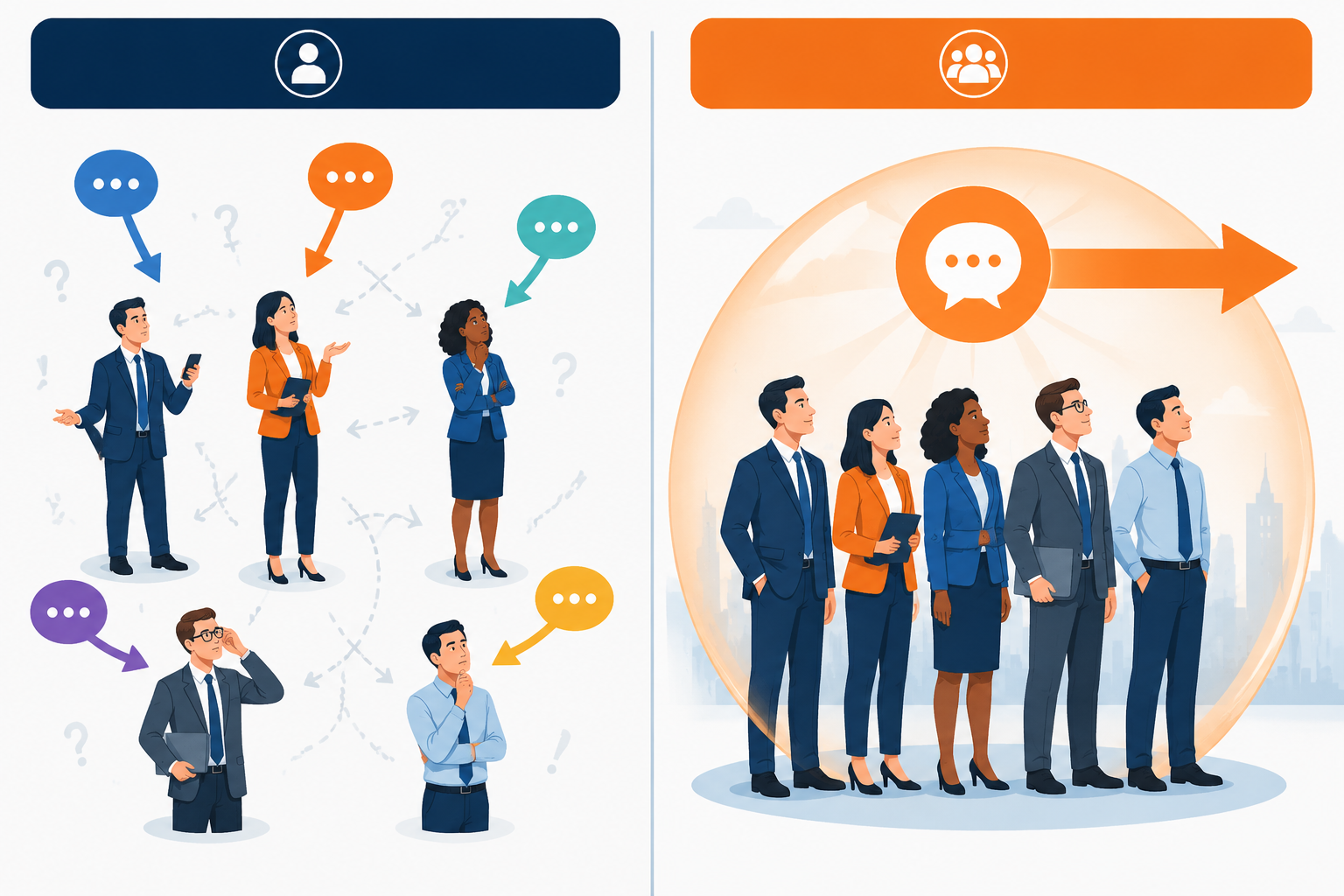
Buying-Group Personalization Changes the Unit of Relevance
Committee-level personalization does not mean sending the same generic account message to everyone. It means the AI system starts with the buying group’s shared decision problem, then adapts role-specific messaging inside that frame.
The difference is subtle in campaign setup and large in sales execution. Instead of asking, “What is this contact most likely to click?” the better question is, “What does this group need to agree on, and what does each person need in order to support that agreement?”
- The champion gets language for internal selling, not just proof that the vendor understands their pain.
- The economic buyer sees the business case in terms that do not erase operational or technical constraints.
- Security and technical reviewers receive risk and integration material connected to the same value narrative.
- Executives see why the purchase deserves priority now, not just why the category is interesting.
This is where the Gartner-via-Improvado contrast becomes useful, even before treating it as a final verified benchmark. A reported 20% consensus improvement from buying-group-level personalization suggests the value is not in making every person feel uniquely targeted. The value is in reducing the internal translation work the buyer has to do.[1]
That translation work is often invisible to marketing. It happens in forwarded emails, Slack threads, budget meetings, security reviews, and executive updates. If each stakeholder carries a different version of the vendor’s value proposition into those conversations, the vendor has accidentally made the buyer’s internal job harder.
The Engagement Signal Is Not the Consensus Signal
Individual-level AI campaigns can still produce impressive surface metrics. Reply rates improve. Meetings book. Content engagement rises. But those signals can be misleading when the deal requires group approval.
A campaign can prove that a message resonated with one role without proving that it helped the account advance. This is one reason attribution gets slippery in AI personalization work. A personalized email may create a real touchpoint, but the touchpoint’s business value depends on whether it helped the account build agreement or simply pulled one stakeholder deeper into a private conversation. The same problem appears in campaign analysis: AI Email Personalization in B2B SaaS: Campaign Results and What They Actually Show shows why individual engagement data needs careful interpretation before it is credited as pipeline progress.
The practical reporting gap is this: most systems are better at showing which person reacted than whether the buying group became more aligned. If sales later has to reframe the deal for finance, calm security concerns, or rebuild urgency with an executive sponsor, the earlier personalization did not disappear. It became cleanup work.
When the Switch Is Worth the Effort
Buying-group personalization takes more operational discipline than contact-level personalization. It asks marketing ops, demand generation, SDRs, and sales to agree on account roles, buying-stage assumptions, message governance, and handoff rules. That work is not automatically justified for every motion.
Improvado presents $50k in annual contract value as a threshold below which full committee personalization may waste resources.[1] That should be used as a practical heuristic, not a scientific cutoff. The point is not that a $49k deal behaves one way and a $51k deal behaves another. The point is that committee orchestration becomes more valuable as deal value, perceived risk, buying-cycle length, and stakeholder count increase.
| Deal motion | Better default |
|---|---|
| Low-risk, low-ACV, transactional purchase with one or two active contacts | Use individual-level personalization and keep the motion efficient |
| Renewal or expansion where the account already shares a clear value narrative | Use targeted role-specific messaging, but do not overbuild a committee program |
| New business deal with multiple functions involved and meaningful implementation or budget risk | Move toward buying-group-level personalization |
| Enterprise opportunity where sales often has to reconcile finance, security, operations, users, and executives | Treat consensus as the primary conversion constraint |
The easiest decision rule is to look at where deals actually stall. If opportunities are lost because the main contact goes quiet, individual targeting may still be the right place to improve. If opportunities are lost because the champion cannot secure budget, security enters late, procurement reframes the value case, or the executive sponsor never internalizes urgency, the personalization problem is probably not at the contact level.
What Changes in the AI Setup
The shift does not require a philosophical rewrite of the marketing strategy. It starts with changing what the system is asked to optimize and the success signals used to judge it.
- Define the account’s likely buying group before generating role-specific messaging.
- Anchor every role-specific variation to one shared business problem, one urgency case, and one next-step path.
- Give the champion content that helps them explain the deal internally, not only content that deepens their own interest.
- Review campaign performance against opportunity progression and stakeholder coverage, not only clicks, replies, or meeting creation.
- Flag accounts where different stakeholders are engaging with conflicting value themes before sales enters a late-stage negotiation.
This is a different standard of relevance. The message still has to matter to the person receiving it. But it also has to survive the internal meeting where that person explains the purchase to someone with a different budget, risk profile, or success metric.
The Strategic Rule for 2026
For small, low-risk, transactional motions, individual-level AI personalization can still be the efficient choice. If one or two people can evaluate, approve, and adopt the product without much internal coordination, there is little reason to burden the motion with committee orchestration.
For most B2B teams selling into multi-person committees, the higher-leverage AI change is to personalize at the buying-group level: one shared buying narrative, adapted for each stakeholder’s role, constraints, and decision responsibility. Use individual personalization where the motion is small, fast, and low-risk. Move to committee-level personalization when consensus risk is the real conversion bottleneck.
References
- B2B Marketing Trends, Improvado
- The State of AI in B2B Marketing, ON24
- Big insight: AI, B2B marketing skills, data, creativity, LinkedIn

Comments
Join the discussion with an anonymous comment.