

How B2B Marketers Can Use AI SMS for Pipeline Acceleration
This guide explains how B2B teams can leverage AI-powered SMS beyond broadcast blasts — for lead qualification, meeting booking, and re-engaging dormant pipeline — with real workflows, CRM integration requirements, and compliance boundaries.
The first place AI SMS marketing breaks in B2B is not the send. It is the reply backlog. A webinar follow-up goes out, two hundred people text back with some version of “send me details,” “not now,” “who is this,” “can you do healthcare,” or “talk to procurement,” and the team still treats the thread like a notification queue. Sales sees stale MQLs. Marketing sees campaign engagement. RevOps sees unstructured intent sitting outside the handoff rules.
That is why the more useful B2B question is not whether AI can write shorter promotional texts. It is whether AI can keep the conversation moving after the first touch. Salesmsg’s vendor-published 2026 benchmark reports that 42% of SMS replies come from follow-up messages rather than the initial text, which makes one-and-done broadcasting a weak operating model for pipeline work.[1] The same source says 28% of businesses are testing or using AI features in SMS workflows, 57% of teams text a new lead within 30 minutes, and only 14% have automated response under one minute.[1] Those numbers are directional, not independent proof that every B2B team needs another tool, but they point to a familiar gap: teams have learned to send faster than they can interpret.
The Workflow Starts After the First Reply
A workable B2B AI SMS flow usually starts with a very plain first message: a webinar asset, a post-demo follow-up, an event booth conversation, a pricing-page hand raise, or a dormant-opportunity check-in. The first message should not try to close the deal. Its job is to create a reply that can be interpreted. Once the contact responds, the AI reads the message against known context: source campaign, lifecycle stage, account fit, open opportunity status, territory owner, product interest, and consent record.
From there, the system has to do something more precise than “engage.” If the reply shows buying intent, it can ask one qualifying question: timeline, use case, employee count, current platform, region, budget owner, or whichever field actually changes routing. If the reply is vague, it can clarify without pushing for a meeting. If the reply is negative or asks to stop, it suppresses the contact immediately. If the reply belongs to an open opportunity, it alerts the owner instead of dropping the contact into a generic nurture path.
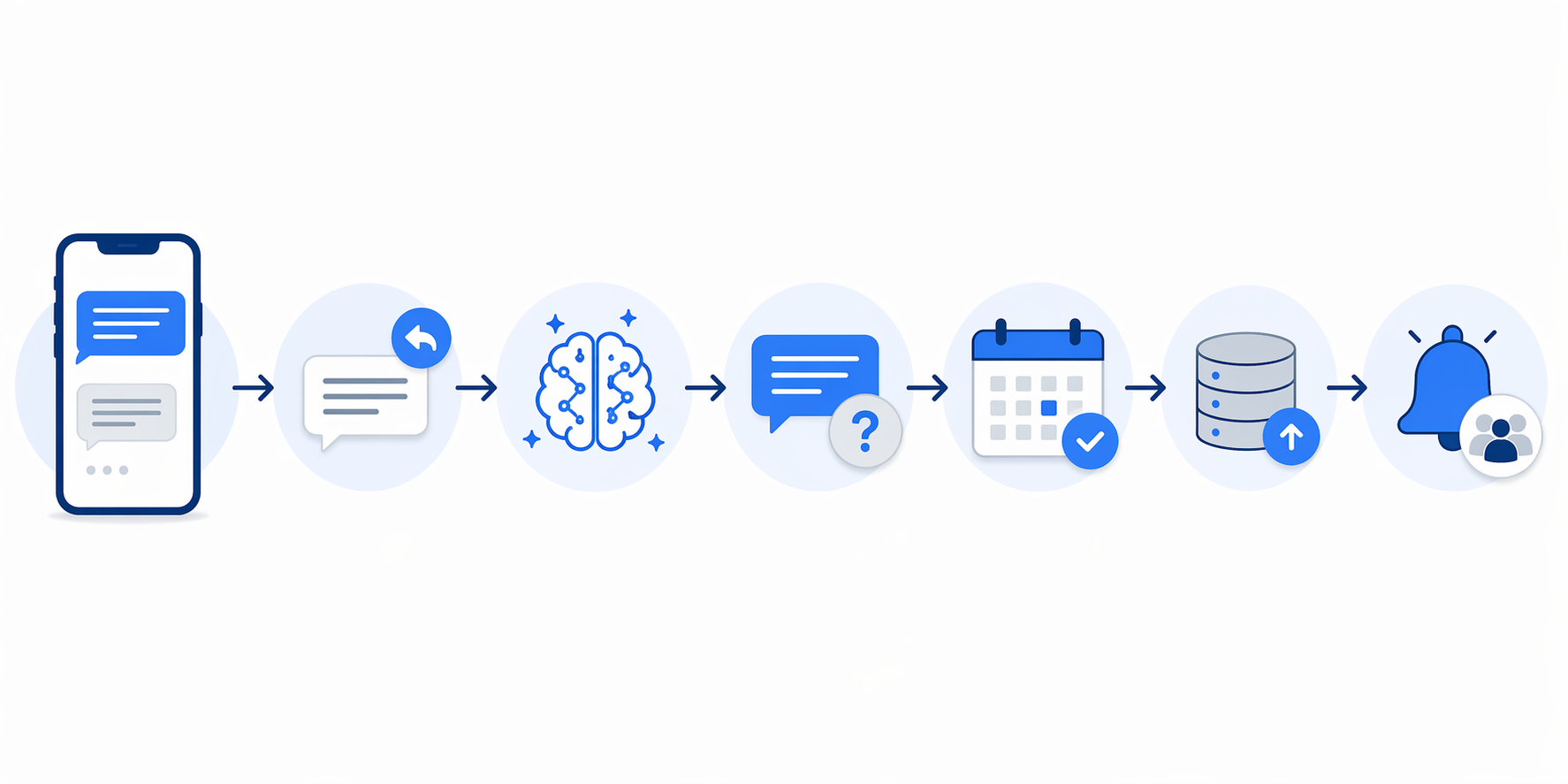
The highest-leverage version of this workflow is narrow. The AI classifies the reply, asks the next reasonable question, updates the lead or contact record, adjusts the score or ICP flag, books time when the threshold is met, and alerts the right rep with the transcript. Salesmsg describes a B2B lead qualification workflow in which AI turns a 200-reply backlog into 8 prioritized conversations by reading responses, asking qualifying questions, and flagging ICP-matched leads.[1] That should be treated as a vendor-reported illustration, not a universal benchmark. The operational lesson is still useful: the value is not that AI answered 200 people; it is that humans did not have to triage 200 threads to find the few worth immediate attention.
Meeting Booking Is Where Leadership Can See the Difference
Meeting booking is the cleanest place to prove whether AI SMS is improving pipeline operations. A reply like “yes, next week” should not wait in an inbox until a coordinator or SDR asks for times. The AI booking agent can offer scheduling options through a Calendly-style integration, confirm the meeting, write the activity back to the CRM, and route the owner based on territory, segment, or account assignment. Salesmsg describes AI booking agents that handle scheduling end to end through Calendly integration and log the activity to CRM without human touch.[1]
This is also where sloppy architecture shows up. If the SMS platform can book a meeting but cannot see account ownership, the wrong rep gets the alert. If it can read replies but cannot update Salesforce or HubSpot, the rep walks into the call without the conversation history. If it can create a task but cannot suppress contacts who opted out by email or form, compliance becomes a data hygiene problem. The implementation standard should be simple: no AI SMS workflow should create a parallel truth outside the CRM.
Lead Qualification Needs Guardrails, Not Theater
AI qualification works best when the team limits the number of judgments it asks the model to make. A model can classify “ready to talk,” “needs information,” “not a fit,” “existing customer,” “wrong person,” and “opt out” more reliably than it can infer a full buying committee from a two-line text. The qualifying question should map to a field that sales already uses. If the field does not affect routing, scoring, or the rep’s next action, it probably does not belong in the SMS thread.
The CRM handoff should include the raw transcript, the AI’s classification, the qualifying answer, the source campaign, and the reason a rep is being alerted. A sales alert that says “hot lead” is almost useless. An alert that says “Requested integration details, confirmed Q3 evaluation, matches healthcare ICP, booked Tuesday 2 p.m.” gives the rep a reason to move. This is where AI SMS connects naturally to lead scoring: the SMS conversation should feed the scoring model, not replace it.
Dormant Pipeline Is a Better Use Case Than Generic Blasts
Dormant opportunities are a practical test because the contact already has history. The AI does not need to pretend the account is new; it can reference the prior evaluation in a restrained way, ask whether the project is still active, and route only renewed intent. A dormant-pipeline text might be triggered by a closed-lost reason, a contract renewal window, a product launch relevant to the old evaluation, or a stalled opportunity with no activity for a defined period. The exact timing belongs to the team’s sales cycle, not to a generic nurture template.
The point is to separate “still interested” from “leave me alone” quickly. AI can do that by recognizing short replies that humans would otherwise batch-process later: “circle back in August,” “we went with another vendor,” “new team owns this,” “send pricing,” or “stop.” The system should revive the opportunity only when the reply justifies it. Otherwise, it should update the record, respect the preference, and get out of the way.
Compliance Belongs in the Workflow Design
SMS compliance cannot be bolted on after the automation works. TCPA-oriented guidance for AI-generated SMS emphasizes instant opt-out handling across channels, recognition of conversational variants of “STOP,” and A2P 10DLC registration.[2] In practice, that means the AI should understand “please don’t text me,” “remove me,” “wrong number,” and similar language as suppression signals, not edge cases for a weekly cleanup report.
Disclosure is part of the same operating standard. SimpleTexting’s 2026 consumer survey found that 52.5% of consumers want clear disclosure when they are texting with an AI chatbot.[2] The survey was conducted over a short January 7–8, 2026 window with 1,000 consumers and 400 businesses, so it should not be overread as a full-year B2B mandate.[2] Still, the preference is directionally important. If a company wants SMS to feel like a trusted sales handoff rather than a dark pattern, the contact should not have to guess whether a human is on the other side.
What to Pilot First
The strongest pilot is usually not a broad promotional campaign. It is a consented segment where the business already has clean CRM data, clear ownership, and a fast next step: webinar attendees with buying signals, demo no-shows, high-fit inbound leads, event scans, or late-stage dormant opportunities. The pilot should measure meetings booked, qualified conversations created, response-to-alert time, CRM completeness, opt-out handling, and sales acceptance. Open rate is not the scoreboard.
Current evidence points to conversational pipeline acceleration as the highest-value B2B use case for AI SMS: qualification, booking, and re-engagement rather than promotional broadcasting. The case is strongest where consent is documented, CRM fields are reliable, routing logic is already defined, and humans can take over when the conversation becomes strategic. Without those conditions, AI just creates a faster pile of messy replies.
References
- AI SMS Marketing, Salesmsg
- Texting and SMS Marketing Statistics, SimpleTexting

Comments
Join the discussion with an anonymous comment.