

Why average engagement rate misleads in athlete brand partnerships
Most brands choose athlete partners based on account-level engagement rates, but the largest athlete marketing dataset (14.9M posts) shows topic-specific engagement can be 4x higher. This article provides a three-part framework for relevance-first partner selection, multi-post narrative arcs, and paid amplification measurement that drives 7x ROAS.
The cleanest number in an athlete brand partnership deck is often the least useful one. OpenSponsorship’s 2026 State of Athlete Marketing Report analyzes 14.9 million posts from more than 25,000 athletes and finds that athletes average 10.97% engagement, compared with 4.92% for traditional influencers. That is a helpful market signal. It is not a partner-selection rule. The more consequential finding is that topic-specific engagement can run 4x or more above an athlete’s account average, which means the account-level average can hide the exact posts a brand should care about most.[1]
That is where athlete brand partnership decisions start going wrong. A brand sees a respectable average, compares it with another athlete’s average, picks the safer-looking profile, and then asks why the campaign did not move the audience it was supposed to move. The problem was not necessarily the athlete. It was the yardstick.
Averages flatten context. They put a training-day post, a family post, a product mention, a post-game reaction, a nutrition routine, and a charitable initiative into the same bucket. For a brand, those posts do not carry the same commercial meaning. A running-shoe brand does not need to know only whether an athlete’s account performs well in general. It needs to know whether movement, preparation, recovery, competition, and product-adjacent posts reliably pull the right audience into attention.
The practical cost is familiar: a partner gets approved because the headline engagement rate looks strong, creative is built around the wrong part of the athlete’s influence, and the post is judged after the fact as if it failed on execution alone. In reality, the mismatch was visible before launch if the team had looked at post-level topic performance instead of an account-level average.
What the average hides
An athlete’s influence is rarely evenly distributed. It clusters around moments, subjects, roles, and audience expectations. Some athletes overperform when they talk about training. Some overperform when they show the off-field routine. Some carry disproportionate trust in a narrow category because the product connects naturally to how the audience already understands them.
That does not make average engagement useless. It can screen for a baseline level of audience responsiveness. But once a brand is deciding fit, spend, and creative direction, the average becomes too blunt. The decision should shift from “Is this athlete engaging?” to “Where does this athlete’s audience lean in, and does that overlap with the brand’s story?”
| Common planning shortcut | What it misses | Better selection question |
|---|---|---|
| Rank athletes by account-level engagement rate | Which topics actually outperform the account average | Which recurring post themes produce above-average response? |
| Choose the biggest audience that fits the budget | Whether the audience responds to the category-relevant part of the athlete’s life | Where does the brand have a credible role in the athlete’s existing content pattern? |
| Judge one sponsored post against organic account benchmarks | Whether the partnership gave the story enough time to develop | Did the content arc build recognition, context, and action over multiple posts? |
| Treat organic engagement as the final readout | Whether the creative performs when distributed as paid media | What happens when the athlete asset is measured against paid social outcomes? |
The OpenSponsorship numbers support a narrower and more useful conclusion than “athletes are better.” Athletes in the dataset outperform traditional influencers on average engagement, and topic-specific posts can outperform an athlete’s own average by a wide margin.[1] That points to a selection method, not a universal guarantee. The win is in identifying the content pattern where the athlete’s credibility is already active.
Start selection at the post level
A relevance-first selection process starts by grouping an athlete’s posts by topic before comparing partners. The groupings do not need to be complicated to be useful. For most brand teams, the first pass is enough to separate performance-related posts from lifestyle posts, community posts, family posts, humor, recovery, travel, fashion, food, equipment, or category-adjacent habits.
Then the team looks for the pattern that matters commercially: which topics beat the account average, which ones underperform, and which ones already contain a believable bridge to the product or campaign idea. That last step is the part too many dashboards skip. A high-performing topic is not automatically a brand opening. If the content spike comes from a moment the brand cannot credibly enter, it is a weak fit no matter how attractive the chart looks.
- Use account-level engagement only as a first screen, not the final verdict.
- Tag historical posts by topic and format before shortlisting partners.
- Compare topic performance against the athlete’s own average, not only against other athletes.
- Check whether the brand can enter the topic without asking the athlete to behave unlike themselves.
- Separate evidence of audience attention from evidence of likely business action.
This protects both sides. The brand avoids paying for a general aura that never converts into relevant attention. The athlete avoids being judged on a forced post that sits outside the content their audience actually values.
A partnership needs more than one beat
Once partner selection is built around a real content pattern, the deal structure has to respect it. A one-off sponsored post can confirm awareness. It rarely gives the athlete enough room to move from context to use to endorsement to action. That is why the shift toward larger, multi-post deals matters.
OpenSponsorship reports that the average posts per deal grew from 2.9 to 3.5, a 20% year-over-year increase. Average deal size also grew from $2,500 to $5,147, more than doubling year over year.[1] Those numbers do not prove that every longer partnership works. They do show that brands are buying more than a single exposure. They are paying for enough surface area to let a story develop.
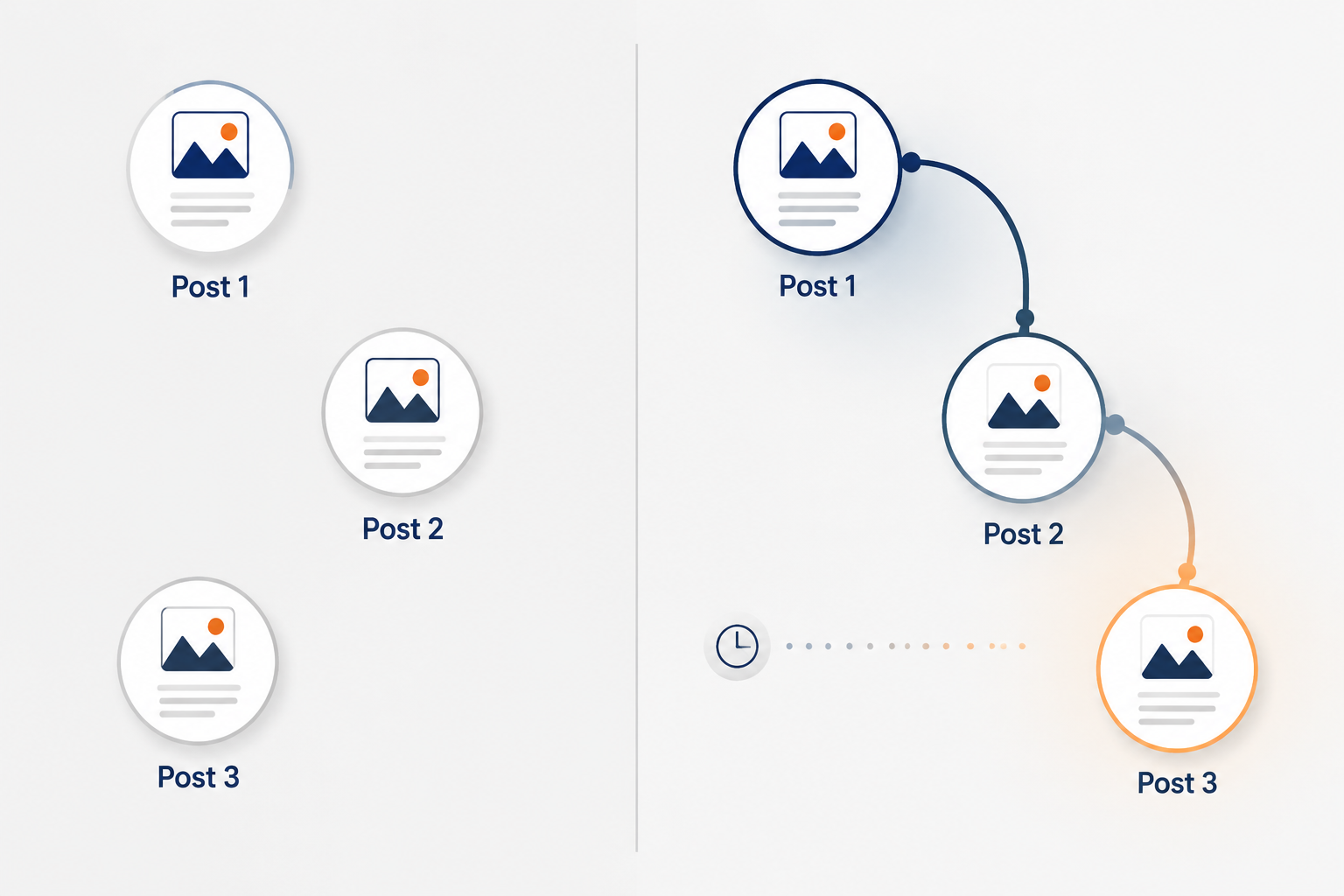
A narrative arc does not mean forcing an athlete into a scripted mini-series. It means assigning different jobs to different pieces of content. One post can establish the problem or routine. Another can show the product in use. Another can bring the audience closer to a decision, offer, event, or proof point. The structure matters because repetition without progression is just frequency with a cleaner name.
The sequence might be simple. A recovery brand could start with the athlete’s normal post-training routine, follow with how recovery changes during a dense competition period, and then use a final post to make the product role explicit. A food or supplement brand might begin with preparation, move into daily use, and end with a challenge, bundle, or store callout. These are hypothetical examples, but the operating point is real: the brand should know what each post is meant to advance before the first one goes live.
Digiday’s reporting shows brands already acting on this logic. Hugo Boss re-signed athlete partnerships before campaign results were finalized, a decision that placed value on the relationship and the longer arc rather than waiting only for the first performance readout. The Vitamin Shoppe activated more than 120 athletes simultaneously in a single program, using scale and serialization in a way no single influencer could replicate.[2]
Those examples should not be stretched into proof that every brand needs a big roster or an early renewal. They are useful because they show a different planning assumption. The partnership is not treated as a post to buy and inspect in isolation. It is treated as a content system that needs enough continuity to reveal whether the audience relationship is commercially useful.
What changes when the arc is planned first
The brief changes. Instead of asking for “one Instagram post and two stories,” the brand defines the audience movement it needs. The first asset may need to earn recognition. The second may need to make the product role specific. The third may need to test action. Creative review changes too: the team stops judging every post as if it has the same job.
Measurement changes with it. If the first post is designed to establish context, it should not be condemned only because it does not produce the strongest click behavior. If the final post carries the offer, it should be evaluated against action metrics, not only engagement. The arc gives the brand a cleaner way to separate creative failure from sequencing failure.
Paid amplification is where the asset gets tested
Organic performance is still useful. It shows whether the athlete’s own audience accepted the content. But if the brand stops there, it leaves the asset only half-measured. The stronger commercial question is what happens when the athlete creative is put into paid social and judged against media outcomes.

This is where the OpenSponsorship finding becomes especially useful, and also where it needs to be kept in bounds. The report says athlete content used in paid social delivers 7x ROAS, described as $5.78 in media value per $1 invested, and generates 4x higher click-through rate than brand creative used as paid ads.[1] That is not a claim about every athlete partnership in every channel. It is a paid social claim about athlete content in the dataset.
For planning, that distinction is important. The athlete post is not only an organic deliverable. It is a creative asset with a distribution plan. If relevance informs the partner choice and the narrative arc gives the content enough shape, paid amplification is the point where the brand can ask whether the asset earns economical attention beyond the athlete’s existing audience.
That also changes the creative standard. A paid-ready athlete asset needs to make sense to people who may not follow the athlete closely. The first seconds have to establish who is speaking and why the product belongs in the scene. The content cannot depend entirely on insider familiarity, but it also cannot sand off the athlete’s specificity until it looks like generic brand creative. The performance advantage, if it appears, comes from the recognizable person and the credible context working together.
This is where trust signals help, but they should not take over the argument. OpenSponsorship reports that 75% of consumers trust athletes more than celebrities and 87% are more likely to make a purchase based on an athlete endorsement.[1] SportsBusiness Journal, citing Elevent consumer survey data, reports that 66% of consumers are more likely to purchase from sponsors of sports they follow.[3] These are useful reasons to test athlete creative seriously. They are not substitutes for measuring whether the specific content, audience, and offer worked.
The measurement loop has to match the decision
A better athlete partnership measurement loop has three different reads, each answering a different planning question.
- Before selection: post-level topic analysis asks whether the athlete’s audience already responds to the category-relevant story.
- During the partnership: narrative sequencing asks whether each post is doing the job it was assigned in the arc.
- After amplification: paid social performance asks whether the athlete asset produces economical attention, clicks, or return when distributed beyond organic reach.
This is stricter than celebrating engagement and more fair than blaming the athlete after one under-contextualized post. It gives the marketer a way to defend why a partner was selected, why the creative was structured over multiple posts, and why the final readout includes paid media performance rather than stopping at likes, comments, and reach.
It also keeps the evidence in the right place. The OpenSponsorship dataset is large and concrete, but it comes from one platform’s view of athlete marketing.[1] It should make teams question lazy averages and test athlete creative with more discipline. It should not be turned into a universal law that any athlete, any topic, and any post structure will outperform.
There is room for broader sports storytelling lessons here. A campaign such as the Monsters Inc. NFL alt-cast shows how sports contexts can carry entertainment, character, and audience familiarity at the same time. But athlete partnership planning needs its own discipline: choose the person by the content pattern, not the halo; build the deal around a story that can actually unfold; and measure the asset where the business case is supposed to show up.
A usable decision rule
If the only thing a planning team can say is that an athlete has a strong average engagement rate, the case is not ready. The better case identifies which topics outperform, why the brand belongs in that pattern, how the story will progress across posts, and how the resulting creative will be tested in paid social.
That is the decision rule worth taking back into planning: stop averaging the wrong thing, stop buying isolated posts when the story needs development, and stop judging athlete content only as organic sponsorship inventory when the stronger test may be how it performs as media.
References
- 2026 State of Athlete Marketing Report — OpenSponsorship
- How partnerships between athletes and brands are beginning to resemble influencer deals — Digiday
- Measure what matters: New data reveals the true drivers of sports sponsorship success — SportsBusiness Journal, 2025/05/07

Comments
Join the discussion with an anonymous comment.