
How Apple Music's Price Increase Shaped Its Competitive Strategy
Apple Music's $1 below Spotify pricing strategy offers a live case study in competitive positioning and game theory. This article breaks down the marketing activation behind the move and provides frameworks any brand marketer can apply to pricing decisions.
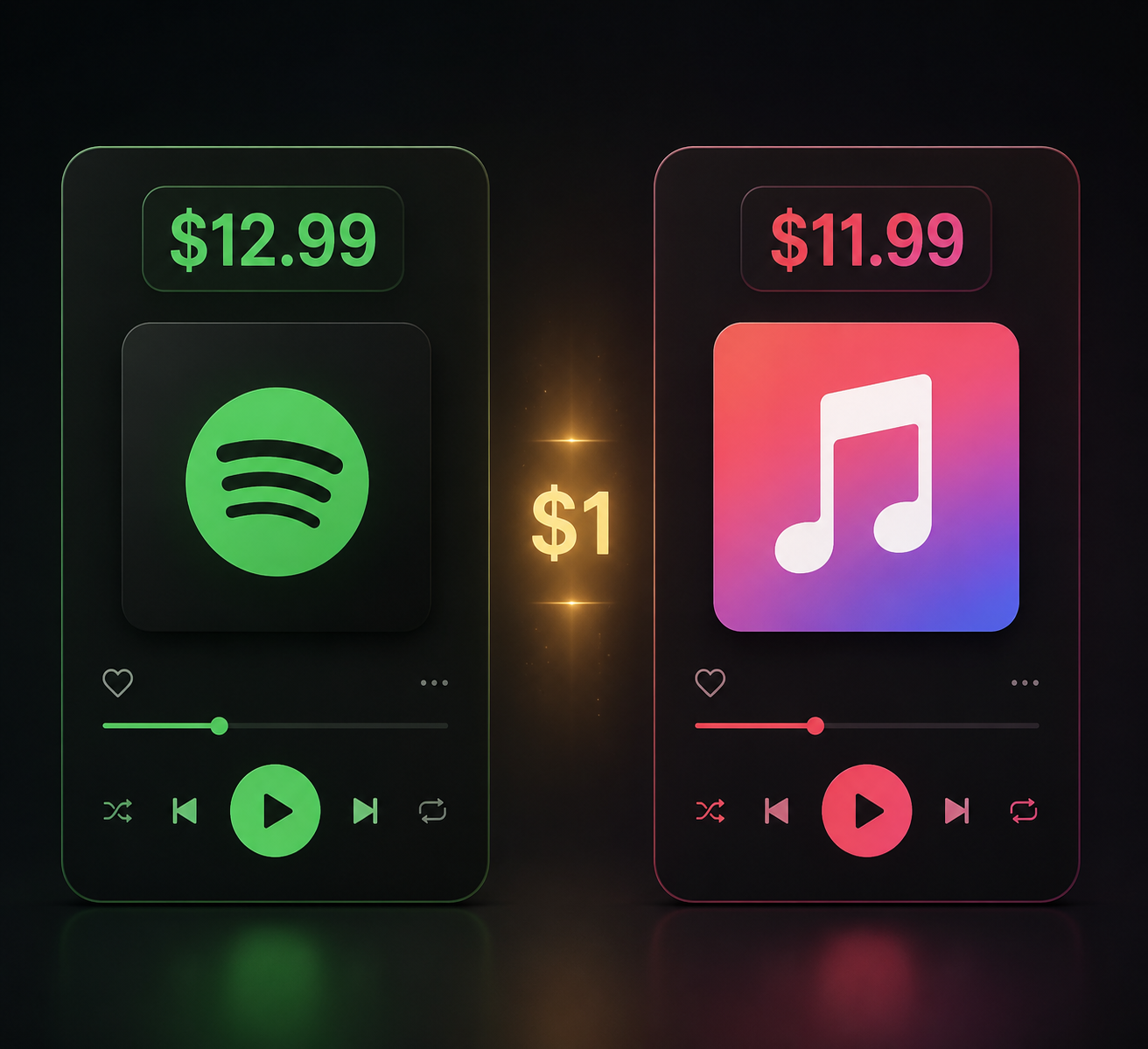
Apple Music's July 2026 price increase starts with a clean pricing board: Apple Music at $11.99 for an individual plan while Spotify sits at $12.99, Apple Music Family at $17.99 while Spotify Family sits at $19.99, and Apple Music Student at $6.99 with Apple TV+ included while Spotify Student is $5.99 with Hulu and Shows included. The move did not make Apple Music cheap. It made Apple Music visibly lower in the one place customers, reporters, and competitors could understand in a second: the monthly subscription line item.[1]
That distinction matters. A price increase can be a cost recovery move, a margin move, a signal to investors, or a competitive positioning move. In this case, Apple Music’s increase still left the service below Spotify on the headline individual tier, and Apple did not allow that gap to remain buried in a pricing page. It turned the gap into a public comparison.
| Tier | Apple Music | Spotify | What the customer sees |
|---|---|---|---|
| Individual | $11.99 | $12.99 | Apple is $1 lower |
| Family | $17.99 | $19.99 | Apple is $2 lower |
| Student | $6.99 with Apple TV+ bundled | $5.99 with Hulu and Shows bundled | Spotify is lower, but Apple adds its own bundle logic |
The better case study is not “Apple raised prices.” Plenty of subscription brands have done that. The sharper lesson is that Apple raised into a position where it could still say, in effect, that Spotify moved higher first and Apple remained the better-value premium choice. That is the kind of move marketers inherit from finance and then have to make legible without making the brand sound defensive.
The $1 Gap Is Small Enough to Be Premium and Large Enough to Be Useful
A $1 monthly difference looks modest on a household budget. That is why it works as a positioning device. Apple is not trying to look like a bargain-bin alternative to Spotify. It is staying inside the premium set while giving customers one easy comparison to remember.
There is a practical reason marketers like gaps of this size. A large discount forces a brand to explain whether something is missing. A tiny difference disappears in the checkout flow. One dollar sits in the useful middle: repeatable in a social post, easy for journalists to summarize, and credible enough for a customer who already sees both products as mainstream choices.
The family tier strengthens the pattern because the gap widens to $2, from Apple Music at $17.99 to Spotify at $19.99.[1] That does not make Apple Music a low-price brand. It makes Spotify carry the burden of explaining why its family plan deserves the extra monthly spend. In a category where many households are not comparing audio quality charts or playlist mechanics every month, that burden is not trivial.
The student tier is messier, which makes it more useful to study. Spotify Student remains lower at $5.99, while Apple Music Student is $6.99. But Apple’s student plan includes Apple TV+, whose standalone price is $12.99, creating a value stack rather than a simple price cut.[2] That bundle does not erase Spotify’s lower student price. It changes the comparison from “which music app costs less?” to “which student subscription gives me more useful entertainment for the money?”
That is the part many brands miss when they try to copy a competitor’s undercut. The price gap has to be supported by something around the product. Apple can lean on device integration, account familiarity, family sharing habits, Apple One adjacency, and bundled services. The dollar is the hook; the ecosystem is what keeps the hook from looking like a coupon.
Apple Did Not Let the Spreadsheet Speak for Itself
A lower price only becomes positioning when the market notices it. Apple’s social campaign did the noticing on the customer’s behalf, publicly contrasting its price against Spotify’s increase and making the comparison part of the story rather than an accounting detail.[3]
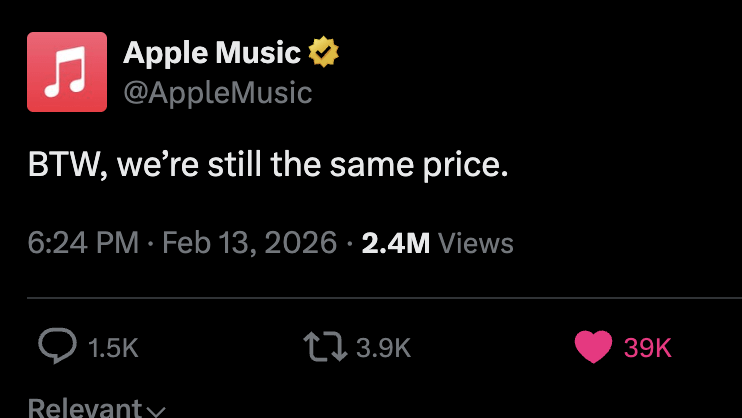
This is where the strategy becomes more than pricing. If Apple had quietly updated its plan pages, the gap would have mattered mostly to highly motivated switchers. By making the contrast public, Apple gave current users a retention script and prospective users a simple reason to reconsider. It also gave the press a headline-friendly frame: Spotify raised; Apple is still lower.
There is a risk in this kind of move. A brand that mocks a competitor’s hike while raising its own prices can sound cute for a day and evasive by the next billing cycle. Apple’s version works because the comparison is anchored to a real tier-by-tier gap, not only to tone. The campaign is doing what good competitive messaging should do: compress a complicated market into a contrast that is true enough to survive scrutiny.
That last condition is non-negotiable. If the price table does not support the creative, the creative turns into a liability. Marketers can dramatize a gap; they cannot invent one and expect customers not to check.
Why Spotify Could Move First
Spotify’s move is not irrational just because Apple found a way to use it. Music streaming is a licensing-heavy business, and price increases are one of the few clean levers available when costs, margin expectations, and investor pressure tighten. The important strategic point is that Spotify appears to believe moderate hikes do not meaningfully damage its subscriber base.
Spotify executives have reported steady retention rates following price increases across more than 150 markets, according to MBW’s reporting on the company’s pricing actions.[4] That is not proof that every future hike will be painless. It is also not evidence that Apple’s July 2026 move has already affected churn. The announcement is too recent for credible subscriber-impact data. But it does explain why a market leader can raise without behaving as if one dollar will trigger mass cancellation.
For Spotify, the safer bet may be that most customers do not want to rebuild playlists, retrain recommendations, reconnect smart speakers, or renegotiate a family account over $1. For Apple, the opportunity is that enough customers still notice the gap when it is made visible. Both things can be true at the same time.
The Game Is Sequential, Not Simultaneous
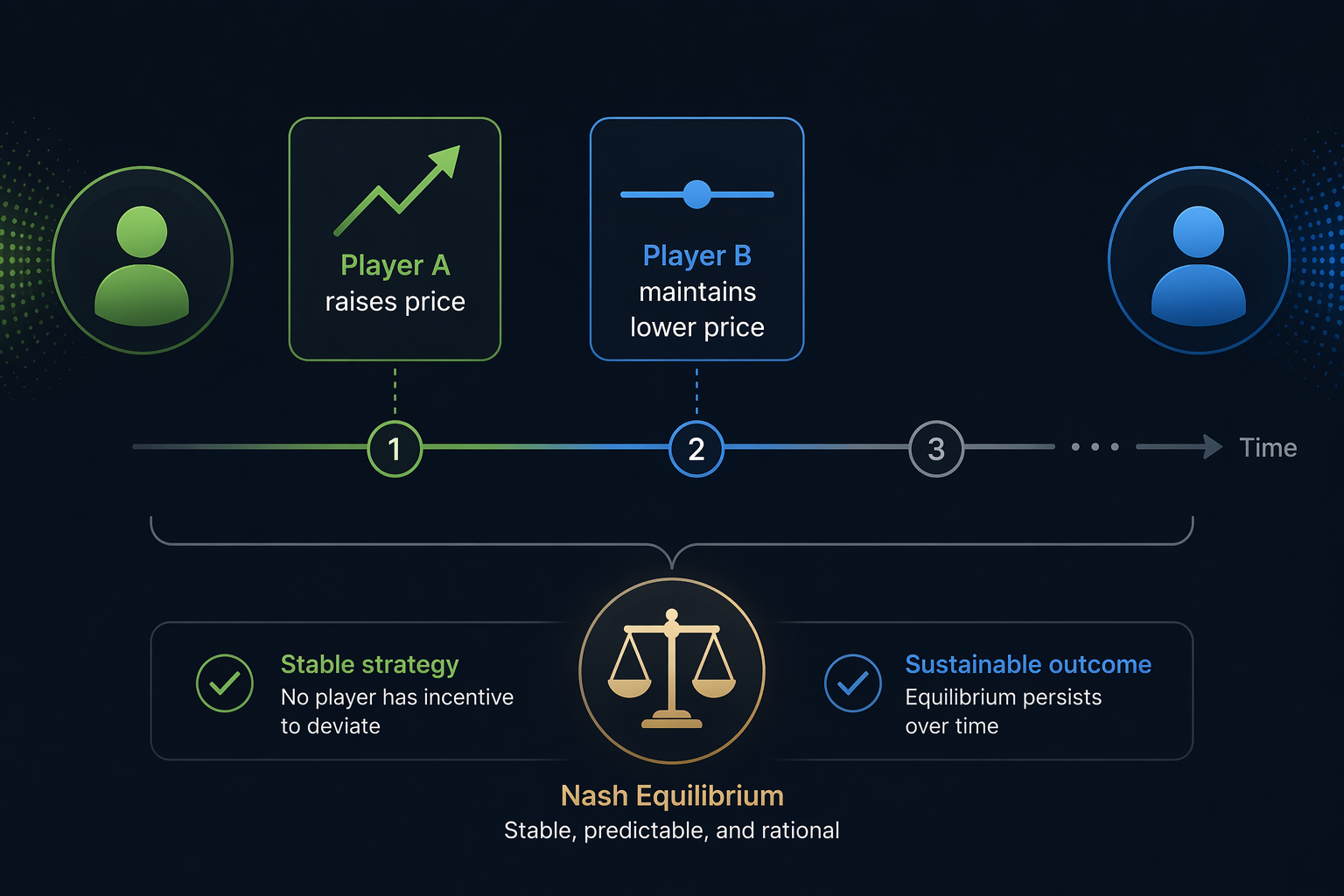
The Econ Eye analysis frames the Apple-Spotify pricing contest as a sequential repeated game: one player moves, the other observes, and both expect to meet again in future pricing rounds. Its illustrative payoff figures should not be read as Apple or Spotify financial data. The useful part is the structure: Spotify raises; Apple can either follow fully, undercut more aggressively, or hold a lower promotional position; then both companies learn from customer response and repeat the game.[5]
In marketer language, this is not a price war. A price war would push both brands toward bigger and bigger concessions until the category teaches customers to wait for deals. Apple is not doing that. It is staying close enough to Spotify to preserve category value while leaving enough daylight to own a specific comparison.
That is why the equilibrium described by Econ Eye is commercially plausible: Spotify raises, and Apple maintains a lower promotional position rather than matching dollar for dollar or slashing price.[5] The move stabilizes because each side gets something it can live with. Spotify captures more revenue per retained user. Apple gets a crisp acquisition and retention message. Customers see a simple contrast instead of a dense feature spreadsheet.
The market structure helps. Econ Eye cites a U.S. streaming market snapshot in which Spotify holds 37%, Apple Music 31.5%, Amazon Music 21.6%, and YouTube 7.1% through mid-2026.[5] That is a contest between major players, not a small challenger trying to buy attention with unsustainable pricing. When the second player is strong enough to be credible, a modest gap can look like confidence rather than desperation.
Apple Entered the Moment With Momentum
The cleaner pricing story would be weaker if Apple Music looked stalled. It does not. Apple told Variety that Apple Music reached all-time highs in listenership and new subscribers in 2025, while also noting that it had not changed price since 2022.[6] Apple did not disclose precise subscriber figures, and third-party estimates should not be treated as official. The supported claim is narrower but still strategically meaningful: Apple said the service was growing from a position of momentum.
Momentum changes how a price message lands. If a brand is losing relevance, a lower price can look like a rescue attempt. If a brand is gaining usage, the same lower price can look like an advantage customers have not fully noticed yet. Apple’s social comparison depends on the second reading.
This also explains why broad feature comparisons should stay in the background. Apple Music and Spotify still differ on discovery, ecosystem fit, audio features, social behavior, library management, and cross-platform habits; Soundiiz’s March 2026 comparison lays out many of those product-level differences.[7] But the July 2026 strategy does not require Apple to win every feature argument. It needs enough parity and enough Apple-specific value for the price gap to feel believable.
The Decision Is Not Follow, Undercut, or Hold
When a competitor raises price, the tempting internal meeting question is too narrow: do we follow, undercut, or hold? Apple’s move suggests a better sequence of questions.
- Can customers understand the gap quickly without a salesperson, calculator, or comparison grid?
- Is the gap large enough to repeat in messaging but small enough to preserve the brand’s premium position?
- Does the product have surrounding value that makes the lower price feel earned rather than cheap?
- Can the brand make the comparison public without inviting an obvious counterattack?
- Will the economics still work if customers revisit the decision every month, quarter, or renewal cycle?
A brand that fails the first test should not build a campaign around the gap. If customers need three caveats to understand why the offer is better, the competitor’s higher price may not create a usable opening. A brand that fails the second test risks training the market to see it as the cheaper substitute. A brand that fails the third test may win clicks and lose margin.
The public-comparison test is especially unforgiving. Apple can say “we are lower” because the core individual and family tiers support that claim. In another category, a competitor may respond with service levels, contract terms, implementation fees, bundle exclusions, or switching costs that make the lower headline price look incomplete. The marketer’s job is to know the likely counter-message before launching the first post.
What Transfers Beyond Music Streaming
The transferable lesson is not “price $1 below the leader.” That number works here because of the category’s monthly billing rhythm, the similarity of the core product promise, and the scale of the two brands. In B2B software, meal delivery, fitness apps, cloud tools, or paid communities, the useful gap may be a seat price, a usage allowance, a bundled feature, a support tier, or a renewal term.
The pattern is more durable than the number: let the competitor absorb the risk of moving first, preserve enough price distance to make the difference visible, and stack value so the brand is not judged on price alone. Then decide whether the comparison deserves a campaign or only a quiet sales enablement point.
There are limits. Apple’s ecosystem moat is unusually strong. Its customers may already have Apple IDs, iPhones, AirPods, family sharing, Apple TV+, or Apple One in the consideration set. A narrower subscription brand cannot assume the same trust or switching convenience. If the product has weak differentiation, a public undercut may invite matching, compress margins, and leave both sides worse off.
The disciplined version of the Apple playbook is therefore conditional: use a competitor’s price increase only when the gap is meaningful, believable, and profitable over repeated decisions. Apple Music’s July 2026 positioning is strong because the price difference is visible, the campaign makes it salient, and the surrounding ecosystem gives the lower price something to stand on.
References
- Apple Music hikes subscription prices as a result of rising licensing costs, Music Business Worldwide
- Apple Music Pricing Teardown, SBI Growth
- Spotify-Apple Strategic Divergence, Nik Bear Brown
- Spotify hikes price for Premium subscribers in the US, other markets, Music Business Worldwide
- A Game in the Market for Music Streaming, Econ Eye
- Apple Music Raises Prices, Licensing Fees, Variety
- Apple Music vs Spotify: Which One Is the Best in 2026?, Soundiiz, March 2026

Comments
Join the discussion with an anonymous comment.