

What Apple's Alibaba-Baidu AI Deals Mean for China Marketing
With Apple Intelligence approved in China using Alibaba's Qwen and Baidu, brands gain new AI-powered iOS surfaces, a visual search discovery channel, and a premium upgrade cycle to target. This article breaks down the specific marketing opportunities and the regulatory template Apple's multi-partner model sets for foreign tech in China.
Apple Intelligence clearing China’s cyberspace regulator on July 15, 2026 gives brands a planning signal they did not have a week earlier: Apple’s AI layer for China is no longer only a delayed global feature waiting outside the market. It is now an approved, domestic-partnered service architecture, with Alibaba’s Qwen and Baidu attached to different parts of the stack. The practical change is not that marketers suddenly have a new ad product to buy. It is that premium iOS surfaces in China can now be planned around AI-mediated content, visual discovery, and a sharper upgrade segment.
The approval matters because it compresses three marketing questions into the same Q3–Q4 planning window: how brand content will appear inside system-level AI experiences, how visual search may route users from objects and images to brand information, and which iPhone owners are likely to become reachable through full on-device Apple Intelligence first. The fourth question is broader but just as important for China strategy: Apple appears to have entered through a multi-partner compliance model that other foreign AI services will need to study closely.
What was approved, and what was not
Reuters reported that Apple Intelligence was registered with the Cyberspace Administration of China on July 15, 2026, after about 22 months of delay; Apple was one of seven on-device AI services approved in the same batch, alongside Samsung, Huawei, Xiaomi, OPPO, vivo, and ZTE.[1] That is a real regulatory milestone. It is not the same thing as a confirmed consumer launch date, a confirmed feature list, or a confirmed media product.
The China version is being built around domestic AI partners rather than a direct copy of Apple Intelligence elsewhere. TechCrunch reported that Alibaba’s Qwen will support text and image generation across iOS, iPadOS, macOS, and visionOS, while South China Morning Post described Baidu’s role around AI-powered visual search, image-based information retrieval, and camera recognition.[2][3] That split is the center of the marketing story. It suggests that brands should prepare for Apple Intelligence in China as a system architecture with multiple discovery surfaces, not as one chatbot-like destination.
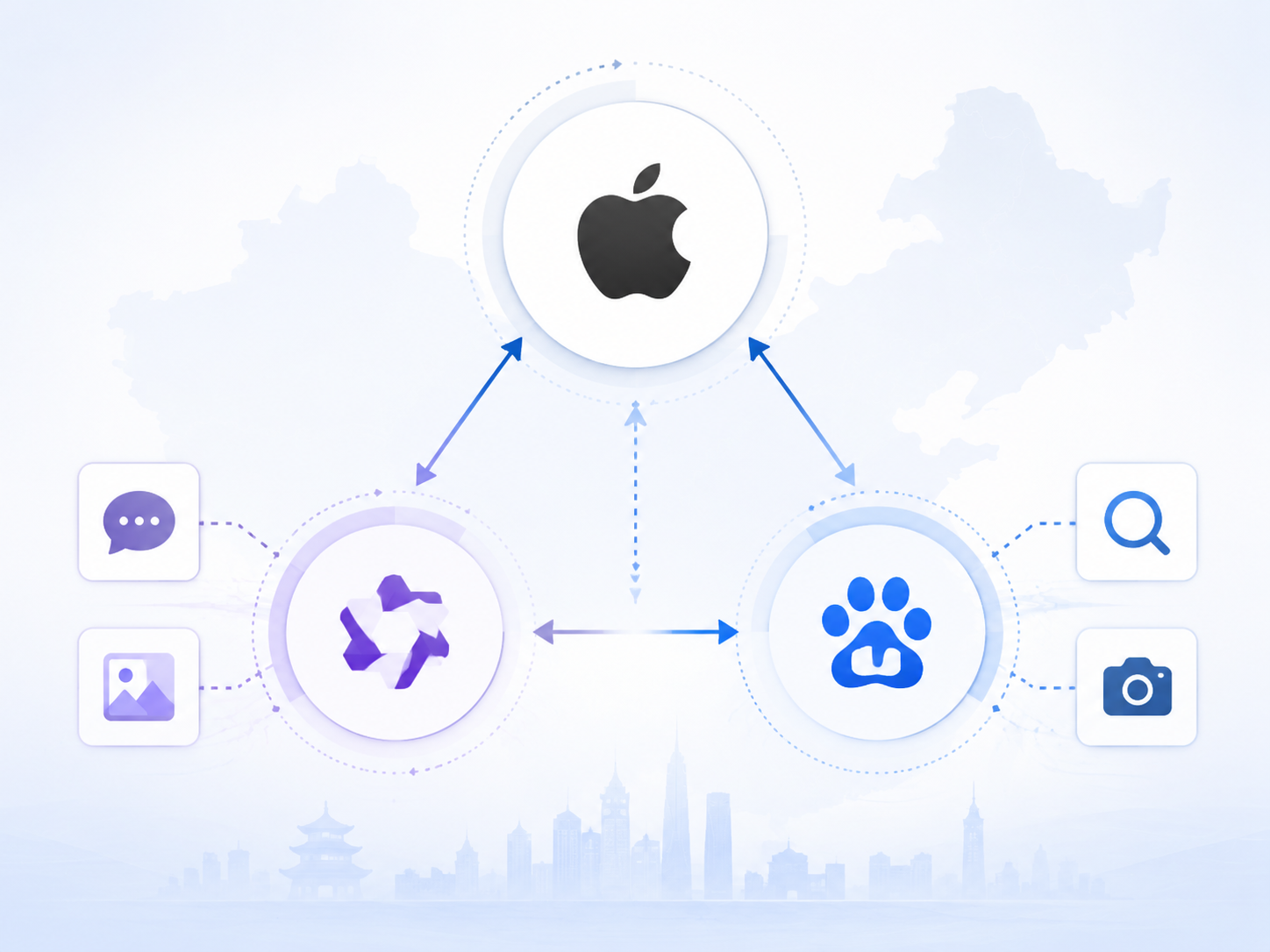
The most useful way to brief leadership is to separate what is known from what is only probable. Approval is known. Alibaba and Baidu participation is known at a high level. The exact Qwen build, the precise Baidu feature scope, launch timing, and brand-facing controls are not yet public enough to support campaign promises.
| Planning area | What brands can treat as known | What still needs monitoring |
|---|---|---|
| System-level generative AI | Alibaba Qwen is tied to text and image generation across Apple operating systems in China. | The specific Qwen variant, feature behavior, ranking logic, and brand controls. |
| Visual search and camera recognition | Baidu is attached to image-based retrieval and computer vision functions. | How results are sourced, whether commercial pages surface, and how product data is interpreted. |
| Premium-device audience | Full on-device capability is expected to concentrate around higher-end iPhones with sufficient RAM. | Actual adoption speed after launch and which older users upgrade. |
| Regulatory precedent | A domestic multi-partner model is visible in Apple’s and Samsung’s approved China AI stacks. | Whether regulators keep applying the same architecture to later foreign services. |
The Alibaba-Qwen layer creates new system surfaces, not a ready-made ad channel
For marketers, the Qwen part of the Apple arrangement is interesting because it sits close to the operating system. If text and image generation run across iPhone, iPad, Mac, and Vision Pro environments in China, then brand assets may increasingly be encountered through summaries, rewritten text, generated images, message assistance, productivity flows, and other system-mediated contexts rather than only through an app feed or search results page.[2]
That changes the preparation work. A brand manager cannot yet buy placement inside Apple Intelligence in China based on the public information available. But they can audit whether their product descriptions, service pages, app metadata, retail information, FAQs, customer support copy, and Chinese-language brand vocabulary are structured clearly enough to survive AI summarization. AI surfaces tend to punish ambiguity in a very ordinary way: if the source material is inconsistent, the generated answer has less reliable material to work with.
The unknown Qwen variant matters here. The public reporting supports a Qwen-powered Apple Intelligence stack in China; it does not justify importing benchmark claims about Alibaba’s largest model into assumptions about the iPhone implementation. A compressed or adapted model used for Apple’s on-device and hybrid experience may behave differently from a flagship model marketed by Alibaba. Creative testing should therefore be prepared around observable output quality after launch, not around vendor model reputation.
By Q4 2026 planning standards, the near-term work is unglamorous but valuable: tighten Chinese product schemas, standardize naming across owned channels, remove conflicting claims from app store copy and official pages, and prepare shorter content modules that can be summarized without losing eligibility rules, price, location, warranty, or use-case detail. If system AI begins mediating more user tasks, the brands with cleaner source material will have fewer preventable errors to chase later.
Baidu’s role points to visual search as the discovery surface to watch
Baidu’s reported role is narrower and potentially more commercially direct: visual search, image-based information retrieval, and camera recognition inside the China Apple Intelligence setup.[3] If that behavior becomes prominent in iOS camera or image workflows, discovery can begin with a photo, a package, a storefront, a garment, a menu, a product in a livestream screenshot, or an object in a user’s environment.
This is where brands should be careful not to over-claim. Public reporting does not yet explain exactly how Alibaba and Baidu divide every image-related function, how Apple will display retrieved information, whether paid or organic Baidu assets will be used, or how commercial intent will be inferred. It is enough to say that Baidu creates a plausible discovery path from camera recognition to brand information. It is not enough to say that Apple has created a new Baidu ad inventory inside the iPhone.
The preparation is still concrete. Brands with physical products, retail locations, packaging, out-of-home media, menu items, apparel, consumer electronics, cosmetics, auto showrooms, travel assets, or luxury goods should check how their visual identity is represented in Baidu-indexed environments. Product imagery should be clean, current, and consistently labeled. Storefront and packaging images should match what a user may actually point a camera at. If the visual search layer pulls from image recognition plus web-scale retrieval, mismatched or stale image assets become a discovery problem, not just a brand governance issue.
At launch, the useful tests are behavioral rather than theoretical: what happens when users scan a product package, a logo, a retail sign, or a category object; whether the returned information favors official brand pages, Baidu properties, marketplaces, maps, reviews, or generic category explainers; and whether competitors appear in the same answer path. Those observations will tell marketers far more than pre-launch speculation about how Apple, Alibaba, and Baidu have allocated technical responsibilities.
The 12GB RAM threshold makes this a premium-user segmentation event
The hardware threshold turns Apple Intelligence in China into more than a software rollout. Digital Applied reported that only the iPhone 17 Pro and Pro Max, with 12GB RAM, and the upcoming iPhone 18 Pro and Pro Max meet the RAM requirement for full on-device Apple Intelligence, concentrating the full experience in the premium segment and creating an upgrade path from iPhone 14, 15, and 16 owners.[4]

That matters because marketers do not need the entire iPhone base to move at once for the segment to be commercially meaningful. The first full Apple Intelligence users in China are likely to be higher-income, higher-intent, newer-device owners or upgraders. For luxury, travel, financial services, autos, premium beauty, high-end electronics, education, and health-adjacent consumer services, this group is often more important than raw reach.
Apple also enters this approval window with momentum rather than trying to manufacture interest from a cold start. Apple’s China revenue was reported at $20.5 billion in Q2 2026, up 28% year over year; iPhone shipments grew 24.4% year over year in Q2, and Apple was already number two in China smartphone market share before the AI approval.[5][6] That does not prove Apple Intelligence will drive conversions for advertisers. It does mean the AI feature set is landing into an already active premium replacement cycle.
The contrast with the broader handset market is useful for planning. Huawei led China at 20% share, its highest position since Q4 2020, while China’s overall smartphone market declined 4% year over year in Q1 2026 and was forecast to decline 9% for the full year.[5] Apple’s AI-capable segment is therefore not a generic smartphone-market bet. It is a premium counter-cycle inside a contracting market.
The immediate segmentation work is straightforward: separate iOS users by likely AI eligibility, device recency, purchase value, app engagement, and upgrade propensity. Brands with first-party data should not wait for Apple to disclose every feature detail before building these audience views. A user moving from an iPhone 14 or 15 into a Pro-tier AI-capable device may be entering a new behavior window: more system assistance, more camera-mediated discovery, more generated content, and more premium-service consideration.
Chinese advertisers are ready for AI-assisted creative, but Apple performance is still unproven
The broader China marketing market is not waiting to learn what generative AI is. China’s AIGC market reached RMB 25.7 billion, about $3.5 billion, in 2025, with a 60% CAGR forecast, and 53.1% of Chinese advertisers had already used AIGC in creative content.[7] That makes Apple Intelligence easier for marketing teams to operationalize once it appears: creative, ecommerce, social, CRM, and content teams are already experimenting with AI-assisted production.
Those figures should be used as readiness context, not as Apple-specific proof. They show that Chinese marketers have experience with AI tools and that the supplier ecosystem is active. They do not show that Apple Intelligence will improve campaign performance, increase conversion rates, or give brands new paid reach. The better assumption is that Apple’s entry will add another AI-mediated layer to an already AI-literate market.
Creative teams can prepare modular Chinese copy, image variants, product explainers, and customer-service language for testing across AI-shaped contexts. Measurement teams should be ready to separate three effects that are often blurred together: iPhone upgrade behavior, AI feature adoption, and marketing performance. A campaign may benefit from a premium upgrade wave even if users barely touch one specific Apple Intelligence feature; the reverse is also possible.
The Samsung precedent shows this is becoming a compliance pattern
Apple is not the only foreign device company using a domestic multi-partner model. Samsung’s Galaxy AI was approved in the same CAC batch using Baidu ERNIE for natural-language generation, Meitu for imaging, and ByteDance Doubao for portraits.[8] That matters because it makes Apple’s arrangement look less like a one-off negotiation and more like a China-market template: foreign AI services attach approved domestic models to specific functions.
For foreign tech brands, the lesson is not simply “find one Chinese partner.” The emerging model is more granular. Text generation, image generation, visual search, portrait features, moderation, data handling, and retrieval may each create different partner and approval requirements. That has commercial consequences: feature parity with global products will be slower, product roadmaps will be more localized, and marketing teams will need China-specific claims rather than translated global launch copy.
There is also a governance complication that should not be ignored in leadership briefings. Alibaba and Baidu were both added to the U.S. Section 1260H Chinese Military Companies List in June 2026, according to Geopolitechs.[8] That does not cancel the CAC approval, and it does not by itself tell marketers to stop planning. It does mean Apple’s China AI stack sits inside a more complicated cross-border governance environment than a normal app feature rollout.
What to do before China launch details are public
Smart Analytics Global expects Apple Intelligence to launch in China as early as September 2026 alongside iOS 27 and the iPhone 18 series.[9] That should be treated as a forecast, not a date to put into a campaign calendar as confirmed. The better Q3 posture is readiness without dependency: prepare assets and segmentation now, but avoid tying revenue commitments to an unannounced Apple release schedule.
- Audit premium iOS exposure: identify how much revenue, app activity, CRM value, and repeat purchase behavior comes from likely Pro-tier or recent iPhone users.
- Clean source content for AI interpretation: product names, category labels, feature claims, store information, warranties, eligibility rules, and Chinese-language FAQs should be consistent across official channels.
- Prepare for visual search testing: update product imagery, packaging references, logo use, storefront photos, and Baidu-visible assets so camera-driven recognition has cleaner material to work with.
- Separate launch monitoring from campaign assumptions: observe actual Apple Intelligence behavior in China before promising placements, rankings, or conversion effects.
- Track the compliance model: use Apple and Samsung as reference cases for how foreign AI features may need domestic partners by function, not only by brand.
The July approval is best read as a near-term readiness signal. It gives China marketing teams enough confidence to prepare premium iOS segmentation, AI-readable content, and visual-search monitoring. It does not yet give them enough evidence to promise a September launch, assume a specific Qwen model behavior, or treat Baidu’s role as a finished marketing channel. The brands that handle that distinction well will be ready earlier without having to unwind overconfident plans later.
References
- Apple Intelligence AI service registered with China's cyberspace regulator — Reuters — July 15, 2026 — link
- Apple Intelligence approved for launch in China with Alibaba’s Qwen AI — TechCrunch — July 16, 2026 — link
- China approves Apple Intelligence for iPhones, with Alibaba, Baidu emerging as partners — South China Morning Post — link
- Apple Intelligence China Approval Alibaba Qwen 2026 — Digital Applied — link
- Apple Leads Top Brands for China Smartphone Growth — MacRumors — April 17, 2026 — link
- Apple AI in China: Competition Heats Up — Counterpoint Research — link
- 2026 AI Marketing Casebook: How Brands in China Are Turning AI from a Tool into a Storytelling Engine — China Trading Desk — link
- Apple wins Chinese approval to roll — Geopolitechs — link
- Apple Intelligence China Approval iPhone Sales 2H 2026 — Smart Analytics Global — link

Comments
Join the discussion with an anonymous comment.