

Apple's $1B AI Revenue: Platform Tax Case Study for Marketers
Apple is on track to generate over $1 billion in AI revenue in 2026 without building its own large language model. This case study explains how the App Store commission model creates a 'platform tax' on AI subscriptions and what that means for marketers allocating budgets across iOS, Android, and web channels.
Apple can look late to frontier AI and still be positioned to clear more than $1 billion in AI-related revenue in 2026. The reason is not that Apple suddenly built the model everyone else has to license. It is that rival AI subscriptions sold through iOS can become Apple Services revenue. When a user pays for an AI app inside the App Store, Apple is not competing for the whole subscription. It is taking the toll.
That distinction matters for anyone searching for the Apple market cap and AI marketing impact story. The useful question is not whether Apple has the strongest chatbot. It is whether Apple controls enough high-intent distribution, checkout trust, and subscription infrastructure to tax AI demand as it moves through the iPhone.
In 2025, generative AI apps generated roughly $900 million in App Store revenue, according to Entrepreneur’s summary of reporting that cited The Wall Street Journal and Sherwood. Monthly revenue from the category nearly tripled from about $35 million in January 2025 to a peak of about $101 million in August 2025, with ChatGPT identified as a major driver of that trajectory.[1] Sherwood separately reported that Apple is on pace to bring in more than $1 billion in AI revenue in 2026, largely through App Store commissions on other companies’ AI apps rather than through a standalone Apple AI product.[2]
This is why investors care even when Apple’s AI product narrative looks uneven. In mid-July 2026, CNBC reported that Apple and Nvidia were vying for the title of the world’s most valuable company, with Apple at about $4.88 trillion after a 23% year-to-date gain.[3] Market cap moves quickly, and it should not be treated as proof of product leadership. But it does show that the market is willing to reward a monetization model that turns someone else’s AI demand into Apple margin.
The AI revenue is mostly a commission story
Apple’s AI revenue case starts with a simple separation that is easy to blur: Apple’s own AI product revenue is not the same thing as Apple’s revenue from AI activity on its platform. The first depends on Apple selling or bundling AI features directly. The second depends on users buying AI subscriptions through channels Apple controls.
The second bucket is already visible. App Store rules can give Apple a 15% to 30% commission on qualifying in-app subscriptions. When AI apps convert iOS users into paid subscribers through that flow, Apple participates in the economics without bearing the same product-development burden as the app developer or model provider. Apple does not need to win every user interaction. It needs the paid relationship to pass through its toll booth.
That is what makes the 2025 generative AI App Store trajectory more useful than a generic statement that “Apple benefits from AI.” The category moved from roughly $35 million in monthly App Store revenue in January 2025 to an August 2025 peak of roughly $101 million, with annual revenue near $900 million.[1] Those numbers do not say Apple captured all of that money as net revenue. They say the taxable base for AI subscriptions inside the App Store became large enough to matter.
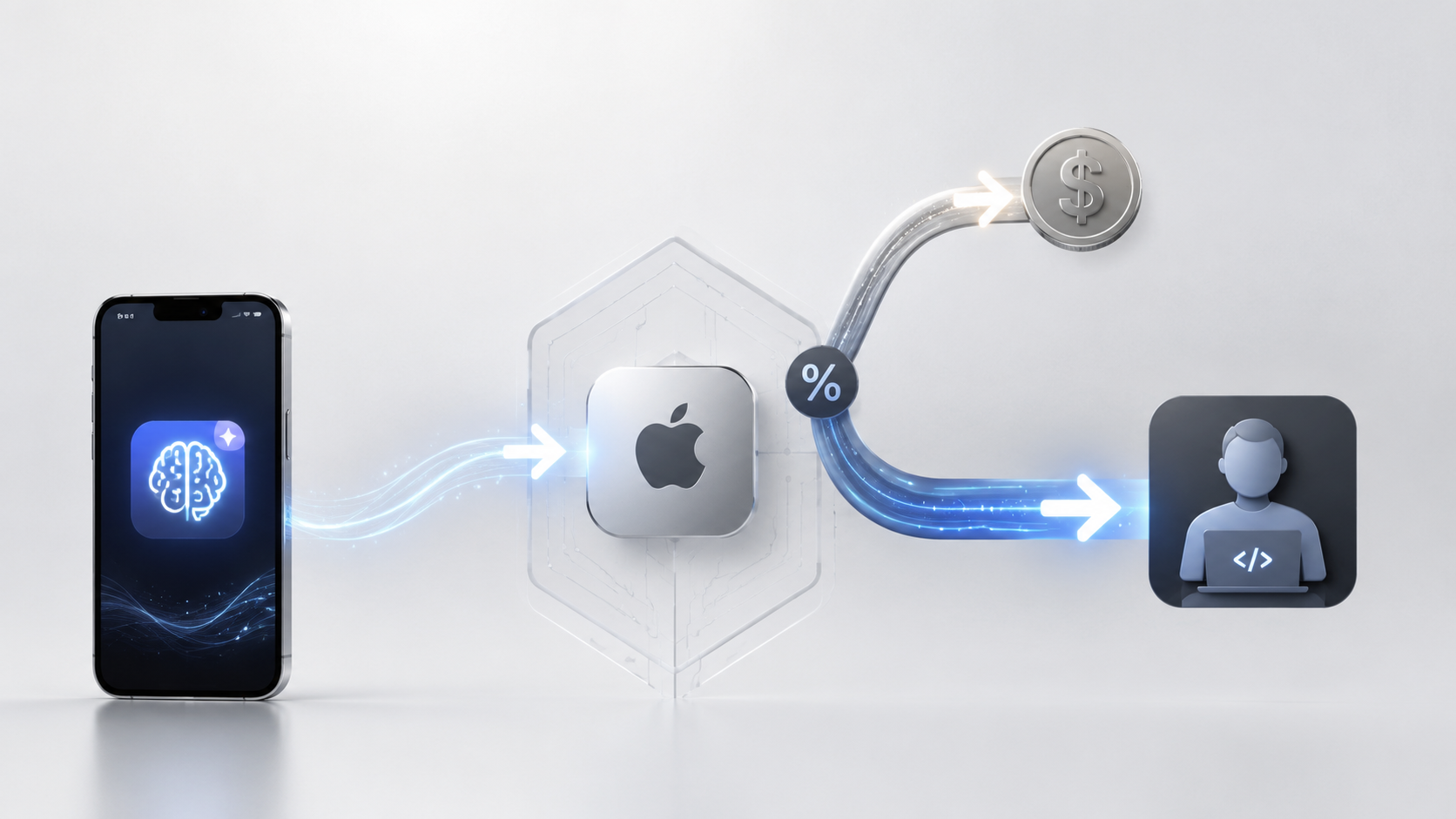
For marketers, the word “tax” is not moral language. It is unit economics. If the customer is acquired into an iOS in-app subscription flow, the revenue share changes the payback period. A campaign that looks profitable on gross subscription revenue can look thinner once the platform commission, media cost, creative cost, trial behavior, refunds, and churn are modeled together.
This is also why Apple’s AI revenue should not be compared too casually with OpenAI-style product revenue. An AI app developer has to fund model access, product work, support, retention, and acquisition. Apple’s role is different: it supplies distribution, trust, billing, device integration, and policy control. Those are expensive assets to build, but once they exist, the marginal revenue from a successful subscription category can be unusually attractive.
What the platform tax changes in a marketing plan
The strategic mistake is treating iOS, Android, and web as interchangeable acquisition surfaces with different creative specs. They are different economic systems. The same user intent can produce different margins depending on where checkout happens and who owns the customer relationship.
| Channel path | What the marketer is buying | Economic consequence to model |
|---|---|---|
| Paid acquisition into iOS App Store subscription | Premium distribution, App Store trust, familiar checkout, strong mobile intent | Subscription revenue may carry a 15%–30% platform commission before the developer sees the remaining economics |
| Paid acquisition into Android app subscription | Mobile reach outside Apple’s ecosystem, different platform rules, different audience mix | The channel can change both conversion behavior and revenue share assumptions |
| Paid acquisition into web subscription | More direct checkout control and more ownership of the customer relationship | Lower platform toll exposure may come with more friction, more trust-building work, and different attribution gaps |
| Owned-channel conversion | Email, lifecycle, community, content, referrals, and other surfaces where the brand already has attention | Less dependence on platform discovery, but slower scale if the owned audience is shallow |
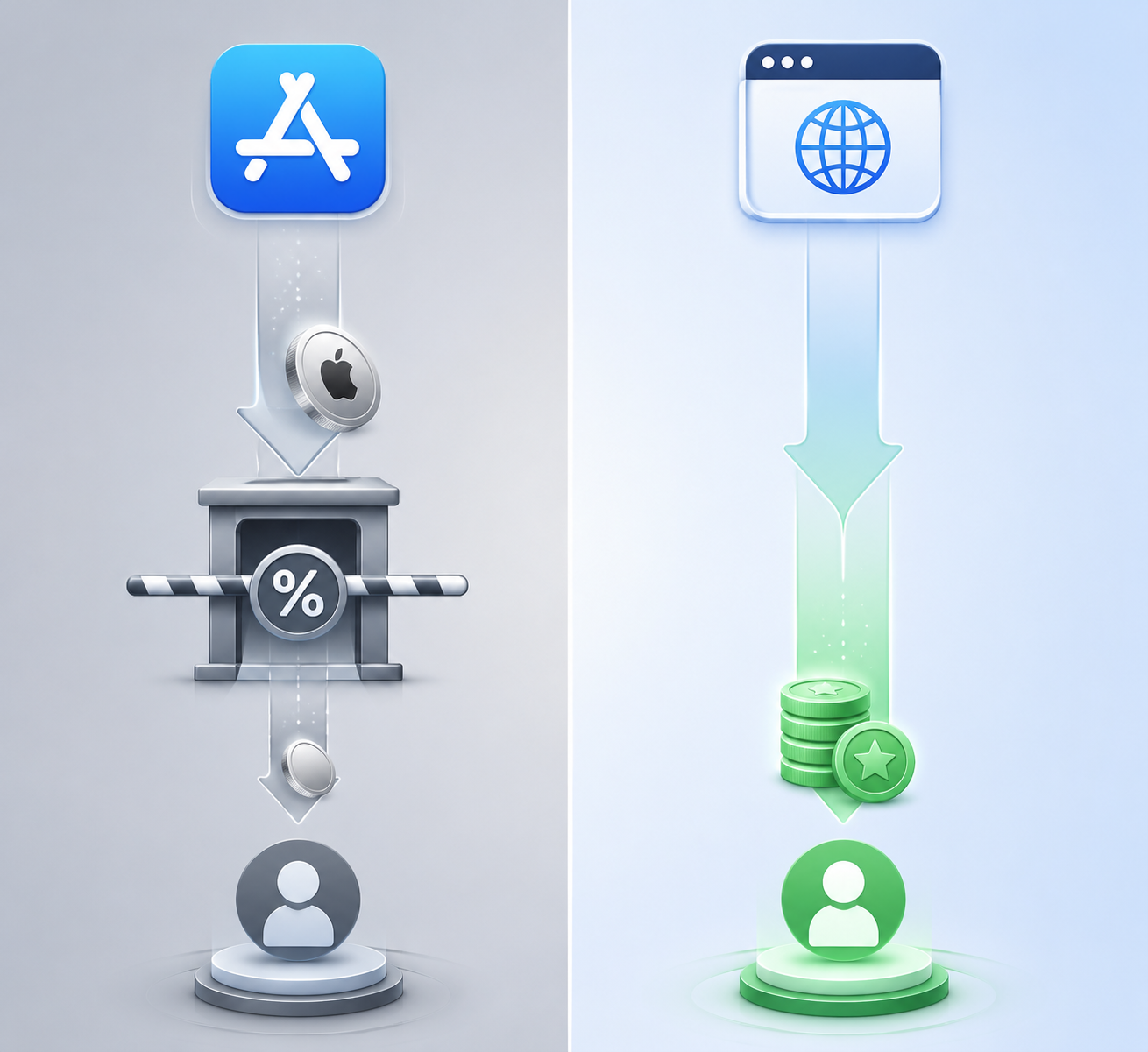
The iOS path may still be the right answer. A high-trust App Store checkout can lift conversion enough to justify the commission. For some subscription products, especially those bought in moments of mobile urgency, reducing purchase friction can be worth more than the lost margin. The problem starts when teams compare channels on cost per install or trial-start volume while ignoring the revenue share attached to the conversion path.
A useful budget review should force the channel question earlier. If the campaign is for an AI productivity app, is the goal to maximize iOS subscription starts, build a direct subscriber base on the web, or use iOS as a discovery layer while shifting high-value users toward owned lifecycle channels where rules allow? Those are not minor landing-page choices. They determine how much margin is available to fund the next acquisition cycle.
This is where App Store Optimization also stops being a narrow keyword exercise. If iOS converts well and carries a commission, then the store page is part of the finance model. Better screenshots, clearer plan positioning, stronger review management, and cleaner onboarding do not merely improve conversion rate. They can help offset a structural margin haircut. The marketer’s job is not to complain about the toll; it is to know whether the toll road gets the company to profitable subscribers faster than the alternatives.
Apple’s advantage is distribution, not proof of AI superiority
Apple’s position is elegant because it does not require Apple to be first in every model benchmark. The company can monetize demand for ChatGPT and other generative AI apps while continuing to improve Apple Intelligence, negotiate model partnerships, and decide later how aggressively it wants to package paid AI features under its own brand.
That asset-light quality separates Apple’s incentives from those of infrastructure-heavy AI players. Google and other hyperscalers have to justify enormous AI infrastructure spending through cloud revenue, ads, productivity subscriptions, search retention, and model distribution. Apple has AI investment needs too, but it also has a Services machine that can collect value from third-party demand already flowing through its devices. For a deeper contrast on the Google side, see What Alphabet's $175B AI CapEx Signals for Google Ads Strategy.
The Services economics explain why the commission story is so powerful. Apple’s Services segment was reported at about $30 billion in quarterly revenue with 76.5% gross margin in Q1 2026.[2] A dollar of commission revenue inside that broader Services engine is not the same as a dollar earned by a model provider that must continuously pay for compute, data center expansion, research talent, and inference costs.
None of this means Apple can neglect the product layer. If Apple Intelligence disappoints users, upgrade demand and platform loyalty can weaken. If developers steer more aggressively toward web checkout, Apple’s take rate exposure becomes a bigger strategic debate. If regulators or platform rules change, the toll road could be rerouted. But the current case does not require a clean “Apple wins AI” narrative. It requires only that high-value AI demand continues to pass through Apple-controlled surfaces.
The supporting signals are real, but they are not the center
There are other reasons marketers and investors watch Apple’s AI posture. Some consumers appear receptive to paid AI features. TechRadar reported on a Morgan Stanley survey of about 3,300 consumers conducted in April 2025, in which 80% said they would be willing to pay for Apple Intelligence and 52% said they would pay $10 or more per month.[4]
That is an interesting pricing signal, not a revenue model. Stated willingness to pay is not paid retention. Consumers often approve of a hypothetical bundle and then behave differently when the charge appears, the free trial ends, or a competing product is already embedded in their workflow. Until Apple announces pricing and customers renew, Apple Intelligence subscription revenue remains speculative.
Apple is also spending more heavily on research and development. CNBC reported that Apple’s R&D reached 10.3% of revenue in the March 2026 quarter, up from 7.6%, its highest level in more than 30 years, with R&D spending growing 34% year over year.[5] That undercuts the lazy version of the story in which Apple simply collects rent while others build the future. Apple is investing; it is just not forced to monetize AI through the same path as companies whose revenue depends directly on frontier-model usage.
The device-upgrade angle belongs in the same supporting category. If Apple Intelligence makes newer iPhones feel meaningfully more useful, it can help hardware demand and widen the reachable audience for AI-enabled services. But for marketing allocation, the more immediate issue is still checkout economics. Upgrade intent can expand the audience. The App Store commission determines how much of a paid AI subscription Apple can capture when that audience buys through iOS.
Investor reaction has not been uniformly enthusiastic, either. The broader narrative includes moments when Apple’s AI announcements failed to satisfy the market, including a reported post-WWDC 2026 stock drop of more than 5%. That tension is useful. It keeps the analysis from collapsing product perception, stock momentum, and platform monetization into one vague claim. Apple can be questioned on AI features and still have a strong platform-tax business.
A marketer’s model should treat Apple as a paid distribution layer
The practical planning lens is straightforward: model Apple less like an AI vendor and more like a premium distribution layer that can improve conversion, capture margin, and reshape subscriber acquisition cost.
That means separating four numbers that often get blended together in campaign reviews:
- Gross subscription revenue: what the user pays before platform fees and operating costs.
- Net revenue after platform commission: what remains after the App Store or another platform takes its share.
- Acquisition cost by channel: what it costs to get the install, trial, account creation, or paid conversion.
- Retained customer value: what the subscriber is worth after churn, support, payment behavior, and expansion are visible.
For an AI subscription business, iOS may deserve a larger budget if App Store trust and mobile context produce higher paid conversion or better retention. Web may deserve more investment if direct checkout materially improves margin and the brand can handle the extra trust-building burden. Android may become more attractive if reach, acquisition cost, or audience behavior offsets weaker performance elsewhere. Owned channels may be the best place to protect economics once the initial demand has been created.
The Apple case is therefore not a reason to blindly move more AI marketing budget into iOS. It is a reason to stop evaluating iOS only as an audience pool. Apple’s role in AI monetization is the role of a platform that can sit between demand and revenue. Sometimes that platform increases conversion enough to earn its fee. Sometimes it absorbs margin that the marketer needed for payback. The difference has to be modeled before the budget is spent.
That is the real marketing impact of Apple’s AI market-cap story. Apple does not need to own the best frontier model to shape the economics of AI subscription growth. It owns a high-trust, high-margin distribution layer where AI demand can be converted, billed, and taxed.
References
- Apple Raked in Almost $1 Billion From AI Last Year — Entrepreneur
- Apple to bring in $1 billion in AI revenue — without big AI spending — Sherwood News
- Apple, Nvidia vie for title of world's most valuable company — CNBC
- A surprising 80% of people would pay for Apple Intelligence — TechRadar
- Apple's R&D spending climbs to 10% of revenue on AI investments — CNBC

Comments
Join the discussion with an anonymous comment.