
Evidence-Based AI Deployments in Airline Lounges
A survey of real AI use cases in airline lounges — including occupancy management, personalization, loyalty, and biometric entry — with sourced outcomes and metrics for marketing managers building investment cases.
Not every lounge AI bet is equally mature
AI in airline lounge customer experience has moved from a nice-to-have talking point to a practical budget question. The catch is that not every deployment earns the same level of confidence. The clearest evidence sits in occupancy management and permission-based personalization; loyalty automation and biometric infrastructure are real, but the lounge-specific proof is thinner.
| Category | Evidence maturity | What is actually proven |
|---|---|---|
| Occupancy and flow management | Strong | Systems can count visitors, surface live crowding, and support staffing decisions. |
| Personalized pre-flight experience | Strong | Permission-based data can adapt offers and handoffs in real time. |
| Loyalty automation | Emerging | Useful for profile unification and retention workflows, but lounge-specific outcome proof is thinner. |
| Biometric and operational backbone | Emerging | Good for reducing friction at the door; marketing ROI is indirect. |
That matters because lounges are no longer just a prestige line item. They influence itinerary choice, but the business case for AI still needs to be anchored in operations that can be measured, staffed, and defended after the pilot ends.
Occupancy and flow management is where the evidence gets concrete
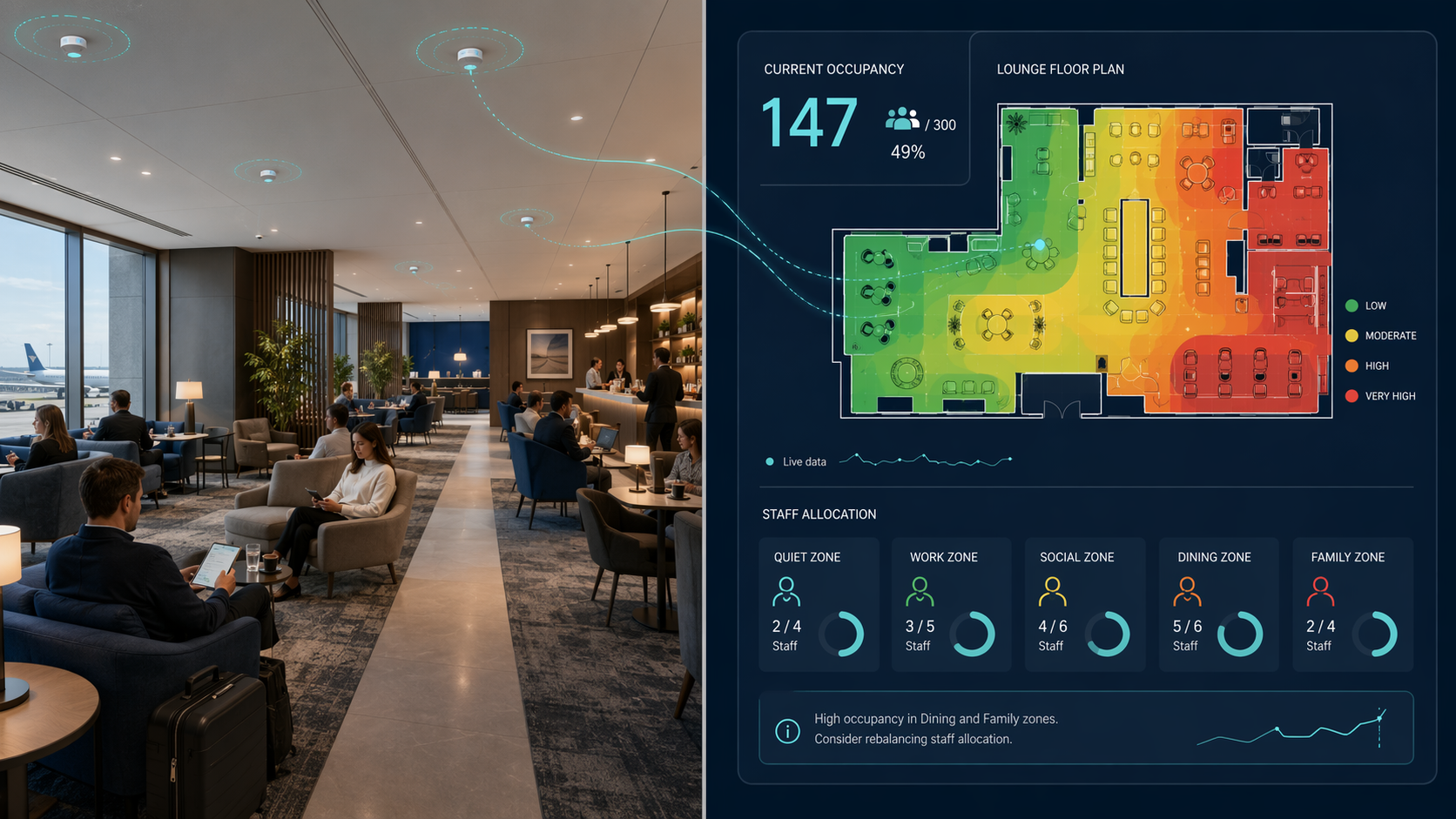
Luxoft's O'Hare prototype is the cleanest example of what better sensing can do before any grand AI narrative takes over. It used computer vision to track more than 9,500 lounge visitors across six weeks with 90%+ accuracy for a global airline operating 50+ lounges in 31 airports.[1] That is not a vanity metric. It is the kind of measurement that lets an operator decide whether the next dollar should go to another agent, a different queue pattern, or a different message in the app.
Density moves the same logic from pilot to operating model. Its sensors were deployed across 37 U.S. airports serving roughly 20 million lounge visitors a year, and the case study says the airline used those signals to match staffing to real-time demand.[2] That is the kind of proof marketing and CX leaders can take upstairs without overpromising: the system is not merely counting heads, it is helping managers place labor where the crowd actually is.
IAG pushed the idea one step farther at Heathrow Terminal 5 by putting live lounge busyness into the passenger app, so travelers could choose the least crowded option before they arrived.[3] That is the useful bridge between back-of-house sensing and customer-facing experience design. Once the airline can see crowding accurately, it can staff better, redirect better, and communicate better.
Taken together, these cases show a progression rather than three separate novelty stories. Luxoft demonstrates measurement accuracy. Density shows scaled staffing logic. IAG shows how the same data can become a traveler decision aid instead of a complaint waiting to happen.
Personalization works best when the traveler actually volunteers the data
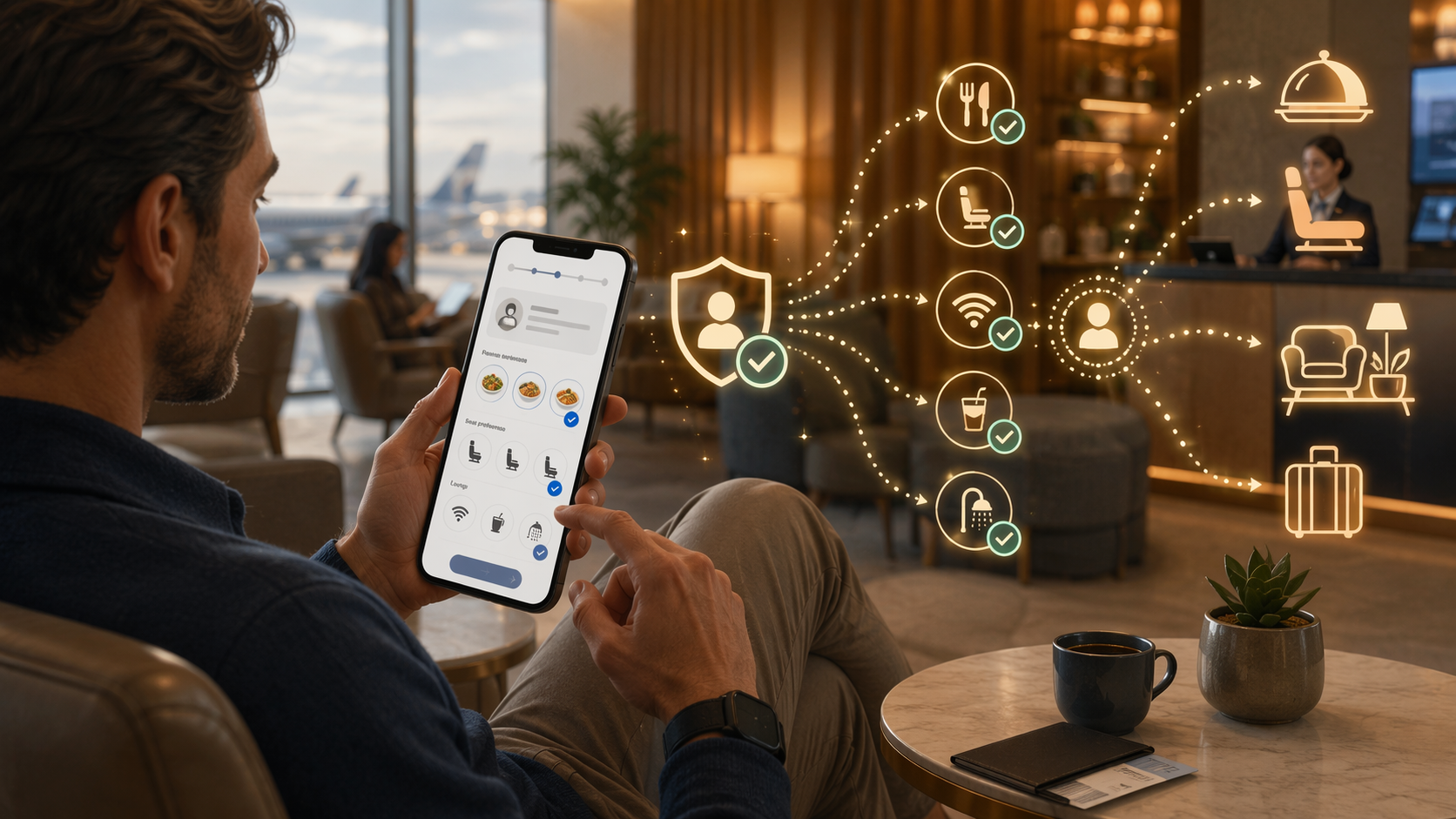
The most credible personalization work in lounges and pre-flight services starts with zero-party data and live trip context, not with vague claims that the airline "knows" the traveler. Delta Concierge, launched in beta in October 2025, blends real-time flight data with SkyMiles personalization and hands complex issues off to live agents instead of pretending a bot can solve everything.[4] That handoff matters. In premium travel, the worst automation is the kind that keeps easy cases and dumps the exceptions on the front line.
American Airlines' destination-preference quiz belongs in the same conversation, with a reported 84% completion rate, even though the public sourcing is limited to a Marigold LinkedIn post and a redirected case-study URL.[5] The point is not the quiz itself; it is the permission structure behind it. When a traveler answers a few direct questions about destination interest, the airline gets a cleaner basis for offers than it does from inferred intent stitched together from behavior it never explicitly earned.
United's app-based journey features fit the same pattern.[4] They are better read as evidence that the pre-flight experience can become more adaptive than as proof of lounge AI ROI on their own. The practical value is in reducing small bits of friction that accumulate before a traveler ever reaches the door: less guessing, fewer dead-end touches, and a cleaner path from booking to boarding.
That is why broader AI marketing ROI evidence is a useful benchmark here. Lounge use cases are more credible when they show the same pattern seen elsewhere in marketing: value tends to come from well-scoped personalization, not from a generic layer of automation slapped on top of an old journey.
Loyalty automation is useful, but it still looks more like infrastructure than proof
Braze's airline-loyalty material and Pariveda's entity-resolution work are both relevant, but they sit one level farther from the lounge floor.[6][7] Braze frames AI around personalization and retention workflows; Pariveda focuses on unifying customer profiles across travel touchpoints. Those are exactly the systems a lounge operator needs if it wants to connect visit history, service recovery, and downstream renewal logic.
Still, frameworks are not the same thing as lounge-specific outcome evidence. A unified profile can make a loyalty program smarter, but that does not automatically prove that a lounge campaign lifted spend, membership renewal, or share of wallet. For investment memos, that distinction matters.
Biometric entry and other backbone systems reduce friction, but the marketing case is indirect
Biometric facial recognition entry has been documented at Lufthansa's Frankfurt and Munich hubs, and it belongs in the same conversation because it removes one of the most visible friction points at the door.[4] The operational upside is obvious: faster entry, fewer bottlenecks, and less staff time spent on repetitive checks. The marketing upside is less direct. Better throughput is useful, but it should not be confused with proof that the lounge itself is now a stronger acquisition lever.
Cisco's RTLS-based retail targeting example sits in a similar adjacent-airport category: real-time location data can support more timely concessions offers, but that is not the same as a proven lounge marketing outcome.[8]
The practical read is straightforward. If a leadership team needs evidence now, start with occupancy intelligence and permission-based personalization. Those are the areas where airlines can show measurable movement and a plausible path from AI to visible traveler friction reduction. Loyalty automation and biometric infrastructure still belong in the plan, but they deserve more internal validation before they carry the investment case.
References
- Using Computer Vision to Improve the Airport Lounge Experience — Luxoft
- Case Study: How a major US airline restored premium service to its lounges with Density occupancy sensors — Density
- Airport lounges spotlight: FTE EMEA 2024 — APEX
- How AI is raising the standard of passenger experience in aviation — APEX
- American Airlines destination-preference quiz completion rate — Marigold/LinkedIn post; original case study URL behind redirect
- AI-driven airline loyalty — Braze
- Beyond Loyalty: How AI-Powered Personalization Is Transforming Travel Profitability — Pariveda
- How Wi-Fi, Location, and AI Are Transforming Airport Retail — Cisco

Comments
Join the discussion with an anonymous comment.