
How AI Research Funding Shapes Marketing Technology Buying
Tracing how $725B in hyperscaler AI capex and $226B in venture capital cascade into marketing technology, and offering a framework to distinguish durable martech categories from funding-driven fads.
The confusing part of the 2026 AI budget cycle is not that money is flooding into AI. It is that the money and the marketing outcome do not line up cleanly. Hyperscalers are preparing hundreds of billions of dollars in capital expenditure, AI venture funding has already set records, enterprise AI budgets are growing quickly, and yet only a small share of day-to-day marketing activity is using generative AI while many martech stacks remain underused.
That gap matters for anyone signing a renewal or defending a new platform. The useful question is not whether AI research funding affects marketing technology. It does. The useful question is where the money narrows, what survives the narrowing, and which signals should actually change a 2026 martech buying decision.
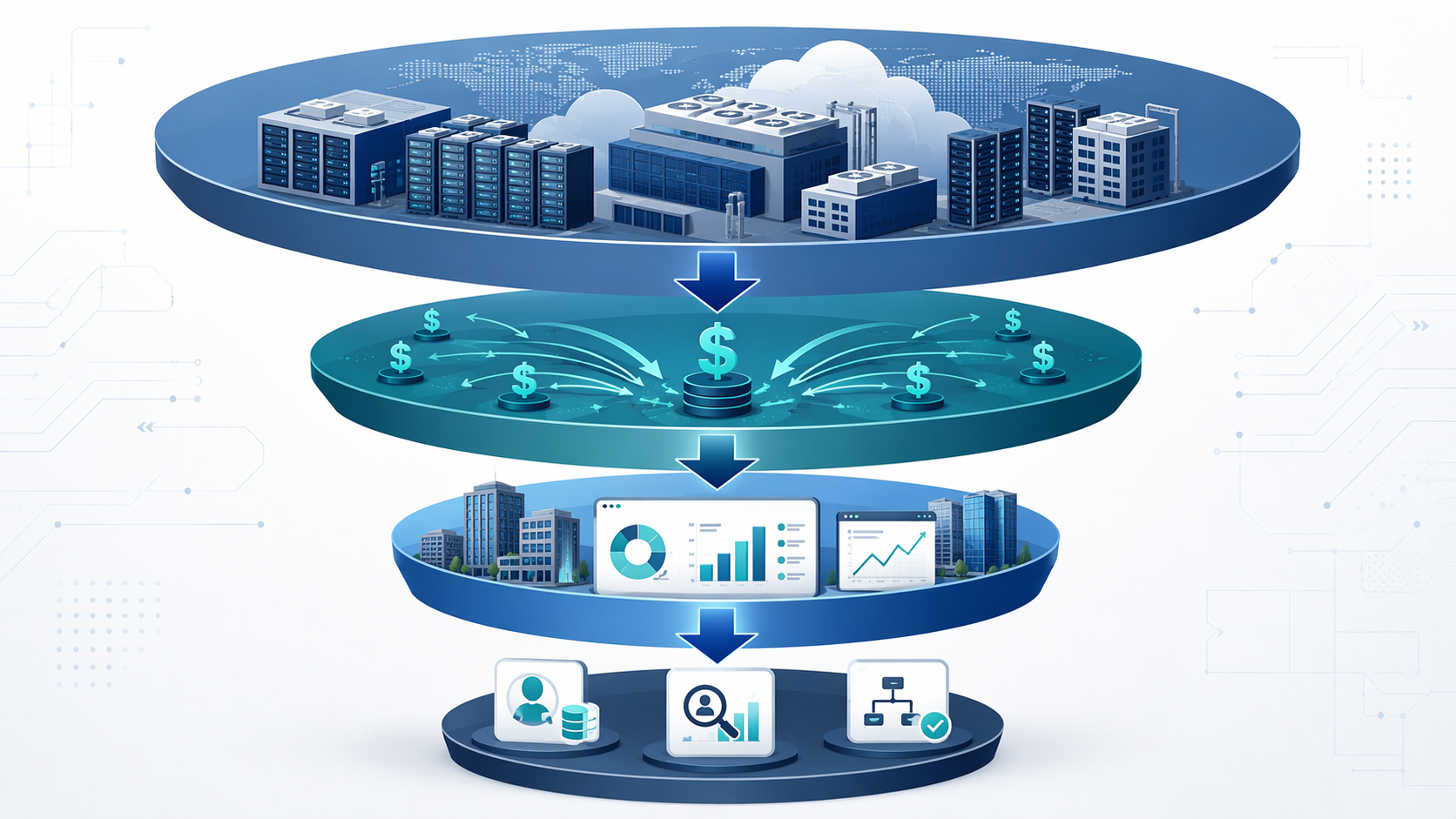
| Layer | What the money funds | What marketers should read from it |
|---|---|---|
| Hyperscaler infrastructure | Data centers, GPUs, custom silicon, power infrastructure, model-serving capacity | A capability signal: cheaper and more available inference makes AI-native martech economically possible |
| VC allocation | Model companies, infrastructure, horizontal AI apps, and a smaller sales/marketing slice | A category signal only after the scope narrows to marketing-adjacent companies |
| Enterprise AI budgets | SaaS AI tools, governance, internal enablement, security, data work | A throughput constraint: budget growth does not mean adoption is keeping up |
| Marketing applications | CDPs, sales intelligence, content AI, agentic workflow platforms, ad optimization | A workflow-control test: durable categories tend to own data, context, or revenue process |
The $725B number is infrastructure gravity, not a martech budget
The biggest number in the cascade sits far upstream. Amazon, Microsoft, Alphabet, and Meta are expected to spend about $725 billion in combined capital expenditure in 2026, up roughly 77% from 2025, according to Value Add VC’s analysis of earnings guidance and public filings.[1]
That figure should not be treated as a disclosed AI R&D line item. It is total capex. The companies do not cleanly break out an AI-only allocation, and the exact mix can shift as guidance changes. Still, the spending profile points to the machinery that matters for downstream software: GPUs, data centers, custom silicon, and power infrastructure.[1]
For marketing technology, the most important part is not the headline spend. It is the cost curve. Value Add VC estimates that GPT-4-class inference costs dropped about 95% between 2023 and 2025, and the 2026 infrastructure cycle is expected to push costs down further.[1] That is the mechanism that can turn a demo feature into a product feature. A vendor can only put AI into audience building, lead scoring, sales research, creative testing, or workflow orchestration at scale if the unit economics work when thousands of users run the function repeatedly.
This is why infrastructure spending is worth watching even when it is not marketing-specific. It changes what can be bundled into ordinary software. A capability that was too expensive to run across an entire customer file in 2023 can become plausible inside a CDP, CRM, or lifecycle platform once inference is cheap enough. The buyer implication is narrow but real: hyperscaler capex does not tell you which martech vendor will win, but it does explain why more vendors can afford to ship AI features that operate continuously rather than occasionally.
VC totals become useful only after the scope narrows
The venture layer is where sloppy comparisons start to mislead buyers. CB Insights reported that global AI venture funding reached a record $226 billion in 2025, with LLM developers including OpenAI, Anthropic, and xAI capturing 41%, or $86.3 billion.[2] That number describes the AI market broadly. It does not describe martech.
A much smaller pool reaches dedicated sales, marketing, and CRM startups. PPC Land, using Crunchbase data, reported about $3.7 billion raised globally by AI sales and marketing startups in early 2026, with concentration in agentic platforms.[3] New Market Pitch tracks a still narrower pure-play AI sales and marketing equity scope, reporting $173.1 million year to date in 2026.[4] Those figures are not interchangeable. They use different inclusion criteria, and treating them as a single trend line would overstate precision.
Once the scope is separated, the signal gets more useful. The median AI sales and marketing round fell from $22.5 million in early 2025 to $10.75 million in early 2026, according to New Market Pitch.[4] That does not mean investor interest disappeared. It suggests a sorting phase: fewer blank checks for experimental features, more pressure to show where the product touches revenue workflow, data access, or operational control.
For a martech buyer, VC money is not proof of product-market fit. It is a clue about where founders and investors believe the next control points may sit. The clue becomes more reliable when it moves from broad AI enthusiasm into categories that marketers already depend on for customer data, account context, campaign activation, and revenue handoffs.
Enterprise budgets are growing faster than adoption throughput
The enterprise layer creates the tension every marketing operations team recognizes. Presenc AI reports that enterprise AI budgets grew 3x to 5x from 2023 to 2026, with 30% to 40% going to SaaS AI tools and governance becoming the fastest-growing line item at 8% to 12%.[5] At the same time, the CMO Survey reported that only 7% of marketing activities use generative AI, and Gartner’s 2025 martech utilization benchmark sits in the 49% to 56% range as summarized in Signal & Convert’s Gartner AI marketing technology forecast.[6]
That gap is not a footnote. It is the buying environment. Companies are allocating more money to AI while the organization is still learning how to absorb the tools it already owns. Governance growing as a budget line is especially telling: enterprises are not only buying features; they are paying for permissioning, review, policy, security, compliance, and operating models that let those features be used without creating new risk.[5]
This is where many AI martech business cases fail. The vendor sells capability. The buyer inherits throughput. Someone has to connect the tool to data, decide who can use it, train teams, update measurement, manage legal review, and explain why adoption is still low six months later. Budget growth can make the purchase possible. It does not make usage automatic.
The implication for 2026 buying is blunt: a category can be well funded and still be hard to renew if it adds another surface area without removing work from a revenue process. The stronger case is not “AI is in the roadmap.” It is “this tool changes who does which task, what system records the result, and which downstream step gets faster or more accurate.”
The application layer favors control points
The category-level funding pattern is where AI research funding’s impact on marketing technology becomes visible. New Market Pitch reported that Customer Data Platforms moved from $0 to $203.5 million in funding over the measured period, Sales Intelligence Tools rose from $20.3 million to $161 million, and Marketing Content AI increased from $22.3 million to $131.5 million.[4] Ad Optimization AI moved the other direction, falling from $43.4 million to $20 million while deal count dropped from four to one.[4]

The stronger categories share a common position in the stack. They are closer to owned data, context, and revenue workflow control. That does not make every company in those categories a good buy. It does mean the category has a clearer route from AI capability to operational value.
Customer Data Platforms: AI gets more valuable when it sits on governed customer data
CDP funding is not interesting because “AI CDP” is a fashionable label. It is interesting because customer data is one of the few assets a marketer can use to make AI outputs specific to the business. Cheaper inference lets vendors classify, enrich, segment, predict, and recommend across larger datasets. But the durable part is still the governed customer record: identity resolution, consent, event history, lifecycle state, and activation destinations.
When AI is attached to that layer, the use case is less about generating text and more about deciding what should happen next for a customer or account. A CDP that can improve audience construction, suppression logic, personalization triggers, or handoff quality sits closer to budget defense than a disconnected assistant that drafts campaign copy.
Sales Intelligence Tools: context is the product
Sales intelligence funding follows a similar logic. The category owns account context: firmographic data, buying signals, contact relationships, intent indicators, account changes, and CRM-adjacent research. AI can summarize and prioritize that context, but the structural value comes from access to the context itself.
That distinction matters in a buying committee. A generic model can write an outreach draft. A sales intelligence platform can decide which account event matters, which stakeholder changed roles, which segment looks active, and where the rep should spend time. The second job is harder to replace with a feature copied into every suite because it depends on data coverage, freshness, workflow placement, and CRM integration.
Agentic workflow platforms: promising, but renewal-risky
Agentic platforms sit at the center of the next funding cycle because they promise to move beyond assistive generation into task execution. The examples are large enough to deserve attention: Hightouch raised a $150 million Series D at a $2.75 billion valuation, Sierra raised $950 million at a $15 billion valuation, and Actively AI raised a $45 million Series B.[7]
The buying risk is equally large. Gartner forecasts that more than 40% of agentic AI projects will be canceled by the end of 2027 because of unclear value and cost.[4] That is a forecast, not measured cancellation data, and market conditions can change. Still, it matches how workflow automation tends to be punished in real organizations: if the agent does not own a well-defined task, integrate with the system of record, and produce an auditable result, it becomes another experimental layer.
The right buying question is not whether the platform is “agentic.” It is what the agent is allowed to do. Can it update a record, route an account, trigger a sequence, enrich a profile, open a support handoff, or recommend a next best action inside an approved workflow? Who reviews exceptions? What happens when confidence is low? How is success measured against the old process? Agentic funding is meaningful when it attaches to these operational answers.
Marketing Content AI: funded, useful, less protected
Marketing Content AI is receiving funding, and it would be too simple to dismiss it. Content drafting, repurposing, creative variation, localization, and message testing can save time when they are tied to review workflows and performance data. Signal & Convert’s separate analysis of AI marketing use cases ranked by ROI is the better place to evaluate those use cases against practical returns.
The structural concern is that standalone generation is easier to copy than data ownership or workflow control. If the product mainly produces copy, images, variants, or summaries without a privileged data layer or embedded approval and activation path, it competes against model improvements, suite bundling, and internal experimentation. The category can still be productive. It is just less protected by its position in the stack.
Ad Optimization AI is a useful counter-signal
The decline in Ad Optimization AI funding is worth noting precisely because it cuts against the general AI enthusiasm. Funding fell from $43.4 million to $20 million, and deal count dropped from four to one in New Market Pitch’s category analysis.[4] One category movement does not prove a permanent decline, but it does suggest investor caution around narrow optimization tools that may be absorbed by major ad platforms or fail to control enough differentiated data.
The upstream pipeline is concentrated
There is another buying-relevant fact sitting behind the cascade: the AI research pipeline is concentrated. A Brookings/MIT analysis found that 70% of AI PhDs now go to industry, industry models are 29 times larger than academic counterparts, and industry leads 90% of key AI benchmarks.[8] The same analysis noted that Google spent about $1.5 billion on DeepMind, roughly equal to total EU plus U.S. federal AI spending combined.[8]
The data in that analysis runs through 2022 and 2023, so it does not fully capture the 2025 and 2026 investment wave.[8] Even with that caveat, the direction is clear enough for martech buyers: many application vendors are packaging capabilities shaped by a small number of model and infrastructure companies. Their roadmaps depend on model access, cloud economics, API pricing, latency, safety policies, and commercial priorities they do not fully control.
That does not make vendor roadmaps untrustworthy. It means due diligence should include dependency questions. Which model providers are used? Can the vendor switch models? What happens if inference pricing changes? Where is customer data stored and processed? Which capabilities are proprietary, and which are thin wrappers around upstream APIs? These questions matter more as AI features become embedded in core marketing systems.
A 2026 buying framework for reading AI funding signals
The cascade helps separate heat from signal. Most of the headline money never reaches marketing directly. It changes the cost and capability base, then narrows through venture allocation, enterprise budget constraints, and application-layer competition. By the time it affects a buying decision, the question is no longer “How much money is going into AI?” It is “What kind of control does this product gain because AI is cheaper, better funded, and easier to deploy?”
- Treat hyperscaler capex as a capability signal. It supports cheaper, more available inference, but it does not validate a specific martech category or vendor.
- Treat broad AI VC totals as upstream heat until the scope narrows. The $226 billion global AI figure is not the same as the sales, marketing, and CRM slice.
- Treat enterprise AI budget growth as a governance and adoption constraint. More budget can still produce weak utilization if workflows, data access, review, and measurement are unresolved.
- Treat marketing application funding as a workflow-control test. The more a category owns customer data, account context, or revenue execution, the more durable the funding signal becomes.
- Treat standalone generation features cautiously. They can be useful, but usefulness is not the same as structural protection.
That framework does not name winners. It narrows the search. CDPs, sales intelligence tools, and agentic workflow platforms deserve attention because they sit near data, context, and revenue process. Marketing Content AI deserves a more use-case-specific review. Ad Optimization AI, at least in the funding pattern available now, looks less favored. The budget decision still comes down to whether the product changes a real workflow that the organization can adopt, govern, and measure.
References
- Big Tech AI Capex in 2025: Microsoft, Google, Meta, Amazon and the Spending Race, Value Add VC
- State of AI 2025, CB Insights
- AI sales and marketing startups raised $3.7B globally in 2026, PPC Land
- AI Sales and Marketing Funding Trends, New Market Pitch
- Enterprise AI Budget Allocation 2026, Presenc AI
- Marketers Spend on New Technologies While Battling Usage and Impact Challenges, CMO Survey
- 2026 AI predictions, PwC
- What should be done about the growing influence of industry in AI research?, Brookings

Comments
Join the discussion with an anonymous comment.