

Why 68% of Agents Use AI but Only 17% See Real Results
Despite widespread AI adoption, most real estate agents aren't seeing meaningful business impact. This article examines the data behind the gap and identifies the use cases — lead qualification, predictive outreach, and listing-specific content — that actually drive conversions and ROI.
The useful starting point for AI real estate marketing trends in Q3 2026 is not whether agents have discovered AI. They have. In the National Association of Realtors’ 2025 Technology Survey, 68% of real estate professionals said they use AI tools, but only 17% reported a significant positive impact; another 46% said they saw no noticeable difference. The survey was conducted in July 2025 and published in September 2025, so it is best read as the most recent authoritative baseline, not a final verdict on the market. Still, it names the operating problem clearly: adoption has outrun measurable lift.[1]
That gap does not prove AI is useless in real estate marketing. It proves that “using AI” is too loose a category to guide spending. One agent may be using a CRM-integrated scoring model to identify likely sellers. Another may be asking a chatbot for three Instagram captions after a listing goes live. Both count as adoption. Only one has a clean path to revenue.
The practical question is narrower than the market language usually makes it: which AI use cases create conversion advantage, and which ones merely create more marketing activity for someone to review?
The Gap Is a Use-Case Problem
A brokerage can be “AI-enabled” and still leave agents with the same old bottleneck: too many names, too many alerts, too many stale contacts, and no reliable signal telling them who deserves a call today. In that environment, AI often becomes another surface area. A dashboard appears. A weekly email summary arrives. A chatbot answers basic questions. The agent still has to remember the relationship, judge urgency, and decide where to spend the next hour.
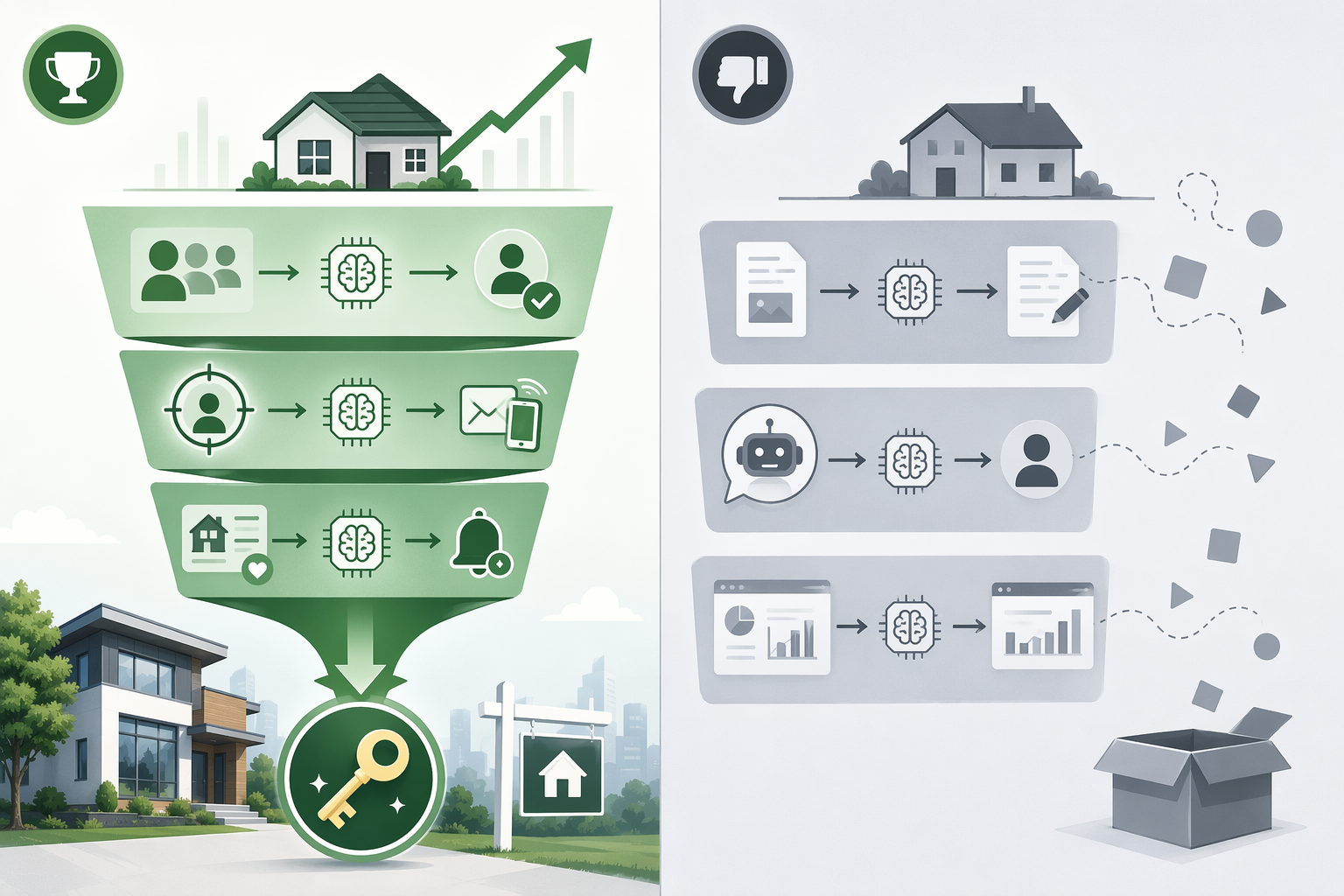
The stronger use cases behave differently. They reduce the number of judgment calls an agent has to make before meaningful follow-up happens. They notice demonstrated need, rank prospects, connect outreach to a property or life event, and put the opportunity where the agent already works. That is a different job than producing more copy.
| AI use case | What it changes | Revenue signal |
|---|---|---|
| Lead qualification | Separates high-intent prospects from broad lead volume | Who is most likely to need outreach now |
| Predictive outreach | Ranks contacts by likelihood of a real estate action | Which relationship deserves attention before a competitor appears |
| CRM-triggered property alerts | Connects saved searches, listings, and client behavior to follow-up | Which buyer or seller is showing fresh intent |
| Listing-specific content | Turns one live property into tailored ads, emails, and descriptions | Which message supports an active listing workflow |
| Generic content generation | Increases the amount of text or creative output | Often unclear unless tied to a campaign, listing, or audience signal |
This is also where broader AI marketing lessons apply. Across categories, the spread between useful automation and noisy automation is usually about whether the tool is attached to a measurable commercial action. A general framework for AI marketing use cases ranked by ROI is helpful, but real estate adds its own pressure: timing, inventory, relationship memory, and local context matter more than sheer publishing volume.
Lead Qualification Is Where the Math Starts to Look Different
Lead volume has always been a seductive metric in real estate marketing because it is easy to buy, count, and show in a report. It is also where teams waste an enormous amount of agent time. A list of weak leads creates the appearance of pipeline while pushing follow-up work onto the person least able to manually investigate every contact.
ATTOM describes AI-qualified lead lists as a way to move beyond that volume trap. In its published real estate marketing use-case analysis, ATTOM says AI-qualified lists can lift conversion rates from an industry baseline of 0.4% to 1.2% up to 25% by focusing on prospects with demonstrated need and intent.[2]
That is a vendor-published claim, so it should not be treated as a universal promise. The useful part is the mechanism. AI is not creating conversion lift because it sounds more polished in an email. It is doing the commercially valuable work before the email: filtering for signals that suggest a person may actually need to buy, sell, move, refinance, downsize, invest, or respond to a specific property opportunity.
For a brokerage marketing manager, that changes the budget question. The first question is not, “Can this tool generate campaigns?” It is, “What does it know before it asks an agent to act?” If the model can only score a lead after an agent manually enters context, the workflow still depends on human memory. If it combines contact behavior, property interest, campaign engagement, and CRM history into a prioritized queue, it starts to remove a real operating constraint.
Predictive Outreach Works When It Finds the Moment, Not Just the Name
Predictive outreach is easy to overstate because the language around it can sound cleaner than the work. A model does not need to “know” that someone will list in three months to be useful. It needs to make a better next-call list than a human can create from memory, birthdays, old notes, and whatever happened to be visible in the CRM that morning.
The highest-value version of this work is not a generic drip campaign. It is triggered follow-up around a change in intent. A past buyer starts viewing homes in a different price band. A homeowner engages with valuation content. A buyer who went quiet reopens listing alerts. A seller lead returns to a market report after weeks of silence. The agent does not need another newsletter template; the agent needs the system to say, “This person moved from passive to active enough that follow-up is worth interrupting your day.”
This is where personalization has economic logic. ATTOM cites McKinsey figures that AI-powered personalization can cut customer acquisition costs by half, increase marketing ROI by 10% to 30%, and boost revenues by 15%.[2] Those figures are not real-estate-specific proof that every brokerage will see the same result. They do explain why the better AI investments tend to sit near segmentation, timing, and message relevance rather than at the outer edge of content production.
A useful property alert is not just “new homes matching your search.” It reflects what the contact has done, what inventory has changed, how the relationship has developed, and whether the agent should intervene. A buyer who saves three homes near the same school boundary needs a different follow-up than a buyer who casually opens a monthly market email. The first may need speed. The second may need patience. AI earns its keep when it helps the system tell the difference.
The Repeat-Business Gap Is a Relationship Memory Problem
The most overlooked AI marketing opportunity in real estate may not be new leads at all. A NAR benchmark cited by MoxiWorks and Zillow captures the mismatch: 88% of buyers say they would use their agent again, but only 13% actually do. The numbers point to a failure of continuity, not affection. Many clients are satisfied at closing and still drift away before the next transaction.
That gap is painful because it sits inside a relationship agents already paid to earn. It also exposes the weakness of generic AI content. A quarterly home-maintenance email may be better than silence, but it does not know that a former client has started browsing larger homes, clicked a valuation page twice, or owns a property in a neighborhood where inventory has tightened. The tool may be “nurturing” the database while missing the moment that should trigger a call.

For repeat business, the more valuable AI function is relationship intelligence. The system should recognize that a past client is no longer just a closed contact. It should connect ownership tenure, prior transaction history, engagement with market content, search behavior, and life-event hints where available. Then it should put that opportunity into the agent’s working rhythm with enough context to make the outreach feel remembered rather than automated.
This is also where brokerage marketing teams can set a higher standard than “we sent the database something.” The better test is whether AI increased the number of timely, context-aware human touches with people who already trust the brand. If the tool cannot surface those moments, it may be helping the team look active while leaving repeat revenue exposed.
Content Generation Helps Most When a Listing Is the Anchor
Content generation is not worthless. It is just over-credited when treated as a result by itself. Listing descriptions, short-form ads, property emails, neighborhood blurbs, and social captions can all save time. The problem starts when the team measures the volume of generated assets instead of the listing workflow those assets support.
The commercially useful version is listing-specific. A new property goes live, and AI helps turn the core details into different messages for different audiences: move-up buyers, investors, relocating families, open-house registrants, or past clients who have shown interest in the neighborhood. The output is still content, but the content is attached to inventory, audience, and timing.
Virtual staging belongs in this discussion, but with the same discipline. Blott’s AI real estate report describes virtual staging as one of the commercially adopted use cases and contrasts traditional physical staging costs of $1,500 to $10,000 with AI staging around $16 per image.[3] That cost comparison is meaningful for listing operations. It does not automatically prove more showings, better offers, or faster days on market. The value depends on whether better visuals are used in a live listing strategy that reaches the right buyers.
The same caution applies to AI-generated listing descriptions. If a tool helps an agent turn property facts into a compliant, polished description faster, that is a real workflow improvement. If it creates generic copy that could describe any renovated kitchen in any suburb, it may save minutes while doing little for positioning. In real estate marketing, specificity is not decoration. It is how the buyer recognizes that the property fits a real need.
Market Growth Does Not Set the Investment Case
The AI real estate market is large enough that no one needs to prove vendors will keep selling into it. Blott reports that the global AI in real estate market reached $303 billion in 2025 and projects it to reach $989 billion by 2029, a 34.4% compound annual growth rate. The same report says PropTech investment hit $16.7 billion in 2025, a 67.9% year-over-year increase.[3]
Those figures are useful as directional context, especially because paid-report summaries do not always expose enough methodology to treat market sizing as settled fact. More spending does not tell a brokerage which workflow deserves budget. It only tells the buyer that the vendor market will be noisy.
That matters because real estate teams rarely suffer from a shortage of software promises. They suffer from fragmented execution. An AI tool that sits outside the CRM, does not connect to listings, and does not change follow-up priority may become one more tab an agent stops checking. A less glamorous tool that improves lead routing, ranks reactivation opportunities, and logs context back into the CRM may produce less demo excitement and more actual conversion discipline.
How to Judge an AI Marketing Tool Before It Becomes Shelfware
A practical evaluation should start with the moment of action. If the tool cannot answer who should be contacted, why now, with what context, and how that action will be tracked, it is probably not solving the adoption-impact gap.
- Does it identify intent, or does it only generate assets after a human decides what to do?
- Does it prioritize follow-up inside the agent’s existing workflow, or does it require another dashboard habit?
- Does it personalize around a property, search behavior, ownership history, or relationship signal?
- Does it reduce dependence on agent memory, especially for past clients and quiet leads?
- Does reporting connect AI activity to appointments, listing conversations, qualified leads, or closed transactions rather than output volume?
The NAR baseline gives the warning sign: most professionals are using AI, while a much smaller share sees significant impact.[1] The way through that gap is not more generic automation. It is tighter selection. Fund AI where it detects intent, prioritizes outreach, and ties content to a live listing or relationship signal. Be cautious where it only helps the team produce more marketing activity without surfacing the next best opportunity.
References
- Realtors® Embrace AI, Digital Tools to Enhance Client Service, NAR Survey Finds, National Association of Realtors, September 2025
- The Top 3 AI Use Cases Supercharging Real Estate Marketing Right Now, ATTOM
- AI Use Cases in Real Estate, Blott

Comments
Join the discussion with an anonymous comment.