

How to Market AI Prediction Tools Without Google or Meta Ads
When Google and Meta block ads for gambling-adjacent tools, content marketing becomes the primary acquisition channel. This playbook shows AI sports prediction marketers which content formats, SEO strategies, and distribution tactics actually convert users, with real examples from companies like Parlay Savant and Rithmm.
An AI sports prediction marketing strategy starts in a place most acquisition plans try to move past too quickly: the ad account. If the product sits anywhere near wagering, picks, odds, or betting recommendations, Google and Meta are not just expensive channels with extra compliance paperwork. For many campaigns, they are structurally unavailable. Track360’s 2026 sports betting acquisition playbook frames the operating reality plainly: roughly 80% of paid inventory is closed to gambling-adjacent products, while affiliate channels account for 35% to 55% of acquisition and SEO accounts for 10% to 25% of new players once rankings are earned.[1]
That last number matters more than it looks. SEO is not a consolation prize after paid media says no. In this category, it is one of the few scalable channels where a user can arrive with intent, evaluate the product’s reasoning, compare it against alternatives, and enter a trial without a media buyer renting every click. The economics are not identical to sportsbook acquisition: an AI prediction subscription, freemium model, or picks tool will not monetize like a deposit-based operator. But the constraint is similar enough to shape the playbook. If paid distribution is blocked, content has to do the jobs that ads, landing pages, sales demos, and trust signals normally split between themselves.
The strongest content systems for AI prediction tools do not begin with “we use machine learning” and hope the reader is impressed. They begin with the bettor’s actual uncertainty: which market is being predicted, what data is being used, how the model turns that data into a recommendation, where the tool is likely to be wrong, and what the user can test before paying.
The Channel Mix Makes Content the Product’s Front Door
In less restricted software categories, content often supports paid campaigns. It explains the category, captures some non-brand search, and gives retargeting audiences something useful to consume. AI sports prediction tools do not have that luxury. When the major ad platforms limit the addressable inventory, the first meaningful product experience often happens on a search result, a comparison page, a YouTube walkthrough, or a strategy article.
That changes the standard for what “content” has to be. A ranking page cannot simply introduce AI betting predictions in broad language and send users to a pricing page. It has to absorb skeptical intent. Serious bettors are already filtering for the same things a compliance-minded marketer should care about: sample size, sport and market coverage, stale data, overfitting, explainability, odds movement, bankroll assumptions, and whether the platform is selling a tool or pretending to sell certainty.
Track360’s channel mix is useful because it forces prioritization. Affiliates can still matter. Partnerships can still matter. Retention loops can still matter. But if SEO can drive 10% to 25% of new players at zero marginal cost after rankings are won, then search assets deserve product-level attention, not leftover copywriting time.[1] The page structure, evidence standard, and conversion path become acquisition infrastructure.
| Acquisition job | Content asset that can do it | What the asset must prove |
|---|---|---|
| Capture active demand | High-intent SEO guide | The product understands the bettor’s query and the market being evaluated |
| Build trust before signup | Data-led strategy article | The model’s reasoning can be inspected instead of taken on faith |
| Survive comparison shopping | Honest tool comparison | Strengths and weaknesses are stated clearly enough to feel credible |
| Show the product in motion | YouTube tutorial or walkthrough | A user can see how to move from question to pick to evaluation |
| Convert without overpromising | Free trial or freemium path | The user can test workflow fit before committing |
Start With Queries That Already Contain Evaluation Intent
The first SEO mistake in this category is chasing only the widest informational terms. A beginner guide to AI betting can be valuable, especially when the product still has to educate the market. But the pages with the strongest acquisition potential usually sit closer to evaluation: “best AI sports betting tools,” “AI NFL prediction model,” “how to use AI for parlays,” “AI betting picks explained,” “sports betting model vs expert picks,” and sport-specific strategy questions that imply a user is already comparing approaches.
Those pages need to answer the query early. If the user searched for a tool comparison, do not begin with a history of sports betting. If the user searched for a prediction model, do not hide the methodology behind brand language. If the user searched for parlay strategy, do not publish a thin odds explainer and call it AI education. The content has to reward intent quickly enough that the bettor keeps reading.
A practical publishing order usually looks like this: build a small group of evergreen pages for category education, then move quickly into sport and market-specific pages where the product can show its work. The evergreen pages earn relevance. The deeper pages earn trust. The conversion path belongs on both, but it should feel different depending on the reader’s stage.
- Beginner intent: define how AI predictions work, explain what the model does not know, and offer a low-risk way to explore the interface.
- Strategy intent: show examples, tables, assumptions, and decision rules that connect the model’s output to an actual betting workflow.
- Comparison intent: explain who each tool fits, where each tool is weak, and what a user should test during a trial.
- Brand intent: make signup, pricing, free trial terms, and supported sports easy to verify without forcing a sales conversation.
Parlay Savant Shows Why Thin Prediction Content Does Not Hold Up
Parlay Savant’s long-form strategy article on mastering AI sports betting predictions is a useful model because it behaves less like a tout page and more like a working document. The piece is positioned as a 16-minute read, uses NFL examples, and includes data tables rather than relying only on claims about smarter picks or proprietary intelligence.[2]
That format solves a specific marketing problem. A skeptical bettor does not merely need to hear that AI can process more variables than a human. They need to see how variables are selected, how scenarios are compared, and how an output might change the decision. Tables do that job better than adjectives. They slow the page down in a productive way: the reader has to inspect the evidence instead of being pushed straight to a signup button.
For an AI sports prediction product, the lesson is not “write long.” Length is only useful when it creates room for proof. A strategy article should make the product’s reasoning visible enough that a user can understand the shape of the recommendation. That can include historical performance tables, matchup variables, market context, confidence bands, or example decision trees, depending on what the product actually supports. If the model cannot support that level of explanation, the marketing team has found a product trust problem, not a copy problem.
The same standard applies to examples. A generic paragraph saying “AI can identify undervalued teams” is easy to write and easy to ignore. A better page walks through a specific type of decision: for example, a hypothetical NFL matchup where the model weighs injury uncertainty, team pace, recent defensive efficiency, and line movement. The example should be clearly labeled as hypothetical if it is not a real model output. It should avoid invented precision. The point is to teach the decision process, not manufacture a backtest that looks more real than it is.
What a Data-Led Strategy Page Should Include
The minimum viable version of this content is not a blog post with a screenshot pasted into the middle. It is a structured asset that answers the questions a user would ask before trusting the product with real wagering decisions.
- Market scope: specify whether the page covers moneyline, spread, totals, player props, parlays, futures, or another market.
- Data inputs: describe the categories of data the model considers without pretending to disclose proprietary details that are not actually being disclosed.
- Output interpretation: explain what a score, probability, edge rating, or recommendation means in user terms.
- Decision example: show how the output changes, supports, or rejects a possible bet.
- Failure conditions: state where the model is weaker, such as limited data, late injury news, volatile props, or markets that move before a user can act.
- Next action: connect the education to a trial, demo, free tool, or saved model workflow.
The failure-conditions section is not legal boilerplate. It is part of the conversion argument. People who buy prediction tools already know models miss. If the page acts as if misses are impossible, it signals that the product is either immature or intentionally vague. A page that explains where confidence should drop gives the user a more serious reason to test the product.
Comparison Pages Should Admit Who the Product Is Not For
Comparison content converts because serious users already compare tools. They may not trust vendor homepages, but they will read a page that helps them sort the market. Sports-AI.dev’s 2026 comparison guide is useful here because it categorizes AI sports betting tools into different types and states limitations for each option instead of presenting every platform as the universal best choice.[3]
That sounds basic until you look at how many SaaS comparison pages quietly refuse to compare. They rank themselves first, blur the differences between products, ignore pricing friction, and treat weaknesses as “considerations.” In sports prediction, that approach is especially weak. A bettor may be comparing automation, model transparency, sport coverage, betting-market support, price, trial availability, and whether the product is built for beginners or more advanced users. If the page hides those differences, it gives the user a reason to leave and find a less promotional source.
A strong comparison page uses categories only when they change the user’s decision. “AI betting tools” is too broad to be useful by itself. A model-building platform, a picks marketplace, a prop-analysis tool, and an educational prediction app may all use AI language, but they solve different problems. The comparison should make those boundaries visible.
| Comparison element | Weak version | Stronger version |
|---|---|---|
| Ranking logic | Lists tools with vague star ratings | Explains which user type each tool best fits |
| Limitations | Mentions drawbacks only for competitors | States the publisher’s own product constraints as well |
| Methodology | Claims tools were reviewed | Shows the criteria used to compare them |
| Conversion path | Pushes every reader to buy now | Invites users to test the workflow that matches their use case |
| Prediction claims | Promises better betting outcomes | Explains what the tool predicts and what the user still decides |
The page can still sell. It should sell by being more useful than the alternatives. If your platform is better for NFL and NBA pregame markets than niche props, say that. If it has a free trial but fewer advanced customization options, say that. If it is built for users who want guided picks rather than users who want to build their own model, say that too. A narrower promise often converts better because the right user recognizes themselves faster.
YouTube Tutorials Turn Methodology Into Proof
Search pages can explain the model. Tutorials can show whether the workflow is usable. That distinction matters for AI prediction tools because the user is not only buying outputs. They are buying a way to make faster or more disciplined decisions under uncertainty.
Rithmm is the clearest example in the research set. In a 2023 interview, the company described a growth strategy built around customer-centric content, YouTube tutorials, Instagram model breakdowns, strategic B2B partnerships, and a 7-day free trial. The same interview reported that Rithmm had raised $3.7 million and had more than 70,000 users at that time.[4] Those figures should not be treated as current in Q3 2026, but the acquisition pattern remains useful: teach the user how the product works, show the model in context, then reduce friction with a trial.
The tutorial format does work that written content struggles to do. It can show how a user selects a sport, filters a slate, interprets a model output, compares a pick to the market, and decides whether to act. It also reveals friction. If the workflow takes too long to explain on video, that is a product onboarding issue. If the host cannot explain why the model prefers one side, that is a methodology issue. If every tutorial ends in an aggressive pick without context, the channel starts to look like a tout operation rather than a software product.
The Tutorial-to-Trial Path
A good YouTube sequence does not need to be complicated. It needs to match the questions users already bring from search and social discovery.
- Show one common betting question, such as evaluating an NFL spread or comparing two player props.
- Open the product and show the exact screens a trial user will see.
- Explain the model output in plain language, including what it does not decide for the user.
- Point out a limitation or uncertainty that would make the user hesitate.
- Invite the viewer to test the same workflow in a free trial or freemium version.
The trial matters because it keeps the claim honest. The page and video do not have to persuade the user that the model is always right. They have to persuade the user that the workflow is worth testing. That is a much more credible conversion event for this category.
Use Social and Retention Mechanics After the Content Has Earned the Click
Social features and engagement loops should not be ignored, but they should not be asked to replace acquisition clarity. Liftoff’s sports betting research highlights daily engagement systems, including FanDuel’s Daily Shuffle, and social features such as betting groups and leaderboards as retention drivers.[5] For prediction products, those mechanics can help users return, compare views, and build habits around the tool.
They do not solve the blocked-channel problem by themselves. A leaderboard cannot compensate for a comparison page that hides weaknesses. A daily challenge cannot explain a model’s assumptions. A Discord community may keep advanced users engaged, but it rarely gives a first-time searcher the structured evidence they need before trying a prediction product. Retention features belong downstream of the first trust event.
The practical order is acquisition page, proof asset, activation path, then habit loop. A user finds a high-intent page, reads enough methodology to understand the product, watches or skims a workflow demonstration, starts a trial, and then encounters daily reminders, saved models, groups, or leaderboards after they have a reason to care.
Build the First Content Cluster Around Trust, Not Volume
A small AI sports prediction team does not need 200 generic articles. It needs a first cluster that can rank, answer high-intent questions, and move a skeptical user toward evaluation. The cluster should be narrow enough that the product can show expertise and broad enough that internal links create a path from education to trial.
| Asset | Primary keyword intent | Conversion role |
|---|---|---|
| How AI sports betting predictions work | Beginner education | Frames the category and explains what the product can and cannot predict |
| Best AI sports betting tools comparison | Vendor evaluation | Captures comparison shoppers and routes them to a trial or product demo |
| AI NFL prediction model guide | Sport-specific strategy | Shows methodology with examples, tables, and market-specific limitations |
| How to use AI for parlays | Workflow education | Connects a common betting behavior to the product’s decision process |
| Product tutorial video page | Activation support | Turns written interest into trial confidence |
The pages should link in the direction the user naturally evaluates. The beginner guide sends readers to sport-specific methodology. The methodology page sends readers to a tutorial. The comparison page sends readers to a trial page and to the methodology that supports the product’s claims. The tutorial page sends users back to the written guide when they need more explanation. This is not just internal linking for crawl depth. It is a controlled evaluation path.
Attribution needs to be planned before the pages go live. Track360’s playbook emphasizes acquisition infrastructure, not just channel selection, and that applies here as well.[1] If organic search, YouTube, affiliate traffic, and partner referrals all touch the same user, the team needs to know which assets start evaluation and which assets close activation. Otherwise, the content program will be judged by last-click signup alone, which usually undervalues the pages that created trust.
What Not to Copy From Sportsbook Marketing
Sportsbook acquisition logic does not transfer cleanly to AI prediction tools. A sportsbook can use promotions, deposit matches, app-store momentum, affiliate rankings, and state-by-state launches in ways that a subscription prediction product often cannot. Even when the same user is involved, the purchase decision is different. The bettor is not deciding where to place a wager. They are deciding whether to trust a tool that influences how they think about wagers.
That difference should change the content. Bonus language, urgency hooks, and “best picks today” pages may attract clicks, but they can also train the wrong user expectation. A prediction product needs users who understand uncertainty, know how to evaluate output, and can distinguish a model-assisted decision from a guarantee. If the content overpromises to improve conversion rate, support and churn will inherit the problem.
Vendor-claimed lift figures deserve the same caution. Track360’s playbook includes platform case-study figures such as a 47% engagement lift and 28% accuracy improvement, but those are vendor-claimed rather than independently verified.[1] A marketer can mention such figures when attribution is clear, but they should not become the backbone of the acquisition story. The stronger proof for a prediction tool is still visible methodology, user workflow, and trial-based evaluation.
The Ethical Line Is Also a Conversion Line
AI-curated betting content can become manipulative faster than a normal SaaS nurture sequence. If the system personalizes picks, pushes streak language, or repeatedly reinforces a user’s preferred betting style, it can create an echo chamber around risk. The problem is not that a product explains probabilities or helps users analyze markets. The problem is content that exploits cognitive bias while presenting itself as objective intelligence.
That line affects acquisition quality. A bettor who joins because the product promised certainty is more likely to churn, complain, or misuse the tool. A bettor who joins because the product made its assumptions clear is more likely to evaluate it like software. Marketing cannot eliminate gambling risk, but it can avoid building the funnel around illusion.
The Durable Strategy
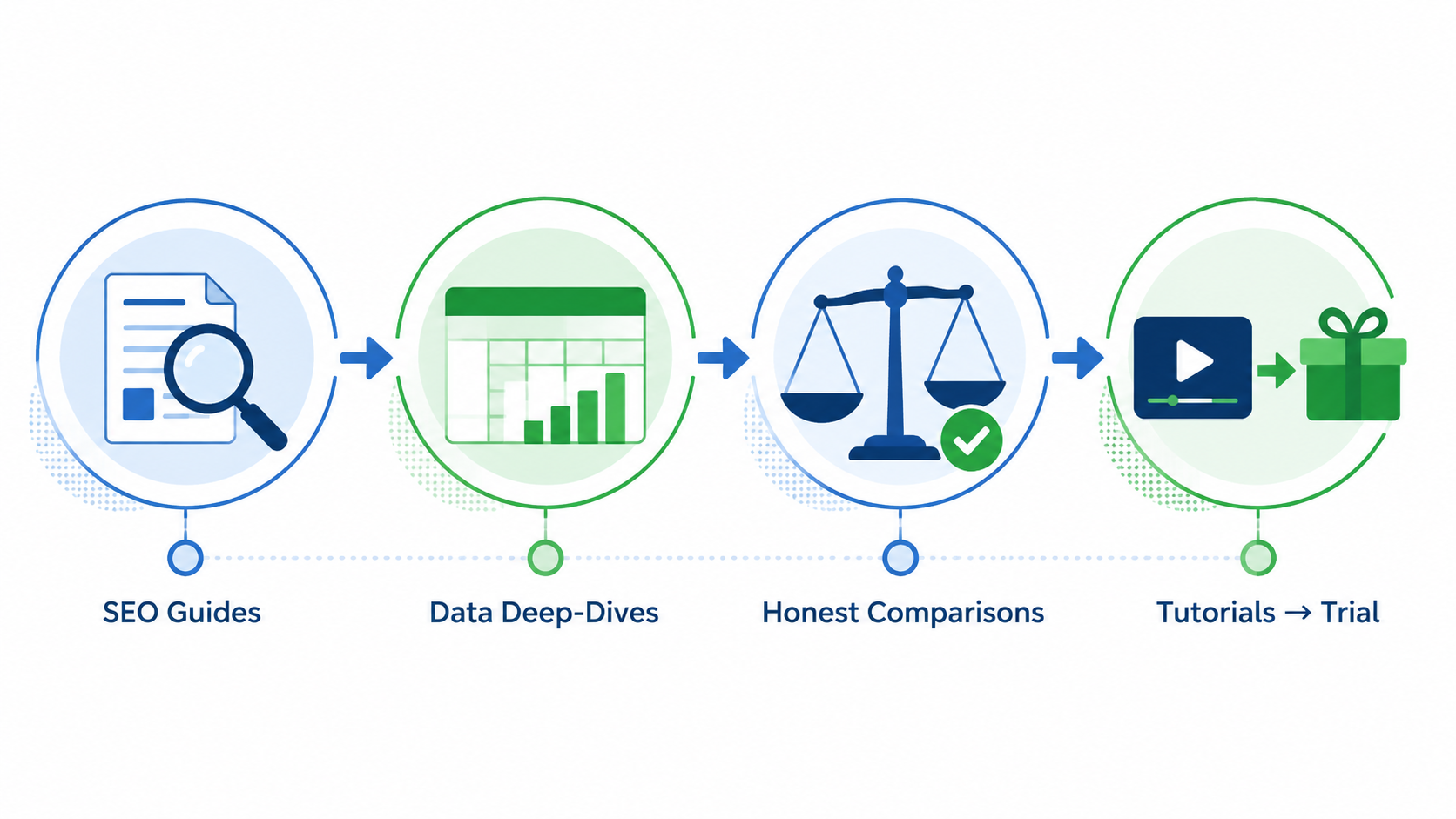
For AI sports prediction tools, the strongest non-paid acquisition strategy is a content system with a clear sequence: capture high-intent search, show methodology with real depth, compare honestly, demonstrate the product in tutorials, and convert through a trial or freemium path. Parlay Savant shows why data-led depth is more persuasive than thin prediction claims.[2] Sports-AI.dev shows why comparison content works better when limitations are visible.[3] Rithmm shows how tutorials and a low-friction trial can turn education into activation, with the caveat that its reported user and funding figures come from 2023.[4]
The paid-media wall is not a temporary inconvenience to route around with generic community advice. It is the condition that determines the marketing system. In this category, content has to rank, teach, prove, and convert. The teams that treat it that seriously have a better chance of acquiring users at margins that paid channels cannot offer, precisely because the serious bettor can see what is being predicted, what is being withheld, and where the model may fail.
References
- Sports Betting Marketing & User Acquisition Playbook 2026, Track360
- Mastering AI Sports Betting Predictions, Parlay Savant
- Best AI Sports Betting Tools & Platforms 2026 Comparison, Sports-AI.dev
- Rithmm CEO Interview, How She Started, 2023
- Sports Betting User Acquisition: Spike Engagement, Liftoff

Comments
Join the discussion with an anonymous comment.