
What the AI Image Backlash Means for Marketers
With consumer trust in AI-generated imagery declining, marketers need to understand the real data behind the backlash. This article analyzes the perception gap, conditional consumer responses, and practical implications for using AI photos in campaigns.
The most useful starting point for marketers worried about AI-generated photo backlash is not a single campaign that got dragged online. It is the distance between how comfortable advertising leaders think consumers are and how consumers say they actually feel.
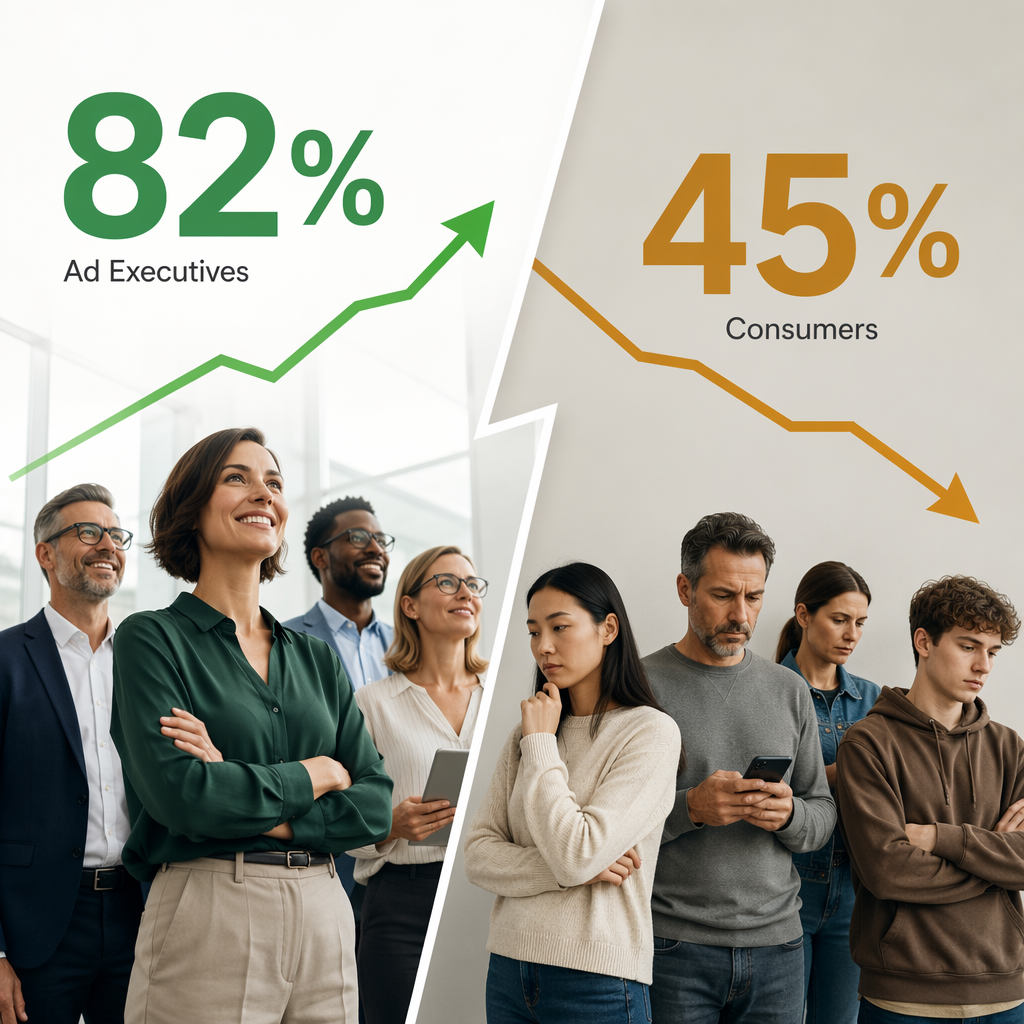
In IAB and Sonata’s survey of 505 consumers and 104 advertising executives, fielded from October 2025 to January 2026, 82% of ad executives said Gen Z and Millennial consumers feel positive about AI-generated ads. Only 45% of those consumers said they did. That 37-point gap is the working problem for brands: the room approving the work may be much more relaxed about AI imagery than the people expected to receive it. [1]
That does not mean every AI-generated photo is a brand crisis waiting to happen. It does mean the default internal argument — faster production, more variants, lower costs — is missing the part of the system where consumers decide whether the brand still feels honest. Efficiency can be real and still leave a trust debt behind.
The generational detail makes the gap harder to dismiss. In the same IAB/Sonata data, 39% of Gen Z consumers said they feel negative about AI-generated ads, nearly double the 20% of Millennials who said the same. [1] For brands that use Gen Z as the reason to move faster into synthetic creative, that is an awkward finding. Younger audiences may be fluent in AI tools without wanting every brand interaction to look like an automation exercise.
The backlash is not just about being caught
A tempting interpretation is that AI imagery is risky only when people can spot it. That is too narrow. Attest found that only 25% of consumers could correctly identify an AI-generated image when it was shown alongside genuine marketing images in a 2024 survey of 9,500 consumers across eight markets. [2] So the simple “everyone can tell” argument does not hold.
But the same research found that 71% of consumers worried about being able to trust what they see or hear because of AI. [2] That is the more important number for marketers. A consumer does not have to identify the exact synthetic asset to become more suspicious of the category, the claim, or the brand’s motives.
This is where “don’t get caught” becomes a bad operating principle. It treats consumer trust like a detection test, when the actual anxiety is broader: what was real, what was staged, what was altered, and whether the brand is hoping nobody asks. If the creative looks uncanny, over-polished, or emotionally manipulative, the damage can start before anyone proves how the image was made.
That distinction matters in review meetings. The right question is not only “Will they know this is AI?” It is “If they find out, will the use feel reasonable?” A synthetic background that helps show a product in a seasonal environment usually has a different trust profile than a synthetic person appearing to endorse, experience, or embody a promise.
Scenes carry a different kind of risk than people
The strongest boundary in the current evidence is not “AI or no AI.” It is what the AI is being asked to represent.
A Virginia Commonwealth University study published in July 2025 found that using AI for scenes, but not people, in service ads may retain consumer trust. The effect was largest in relationship-based industries, where the person in the ad carries more of the promise. [3]
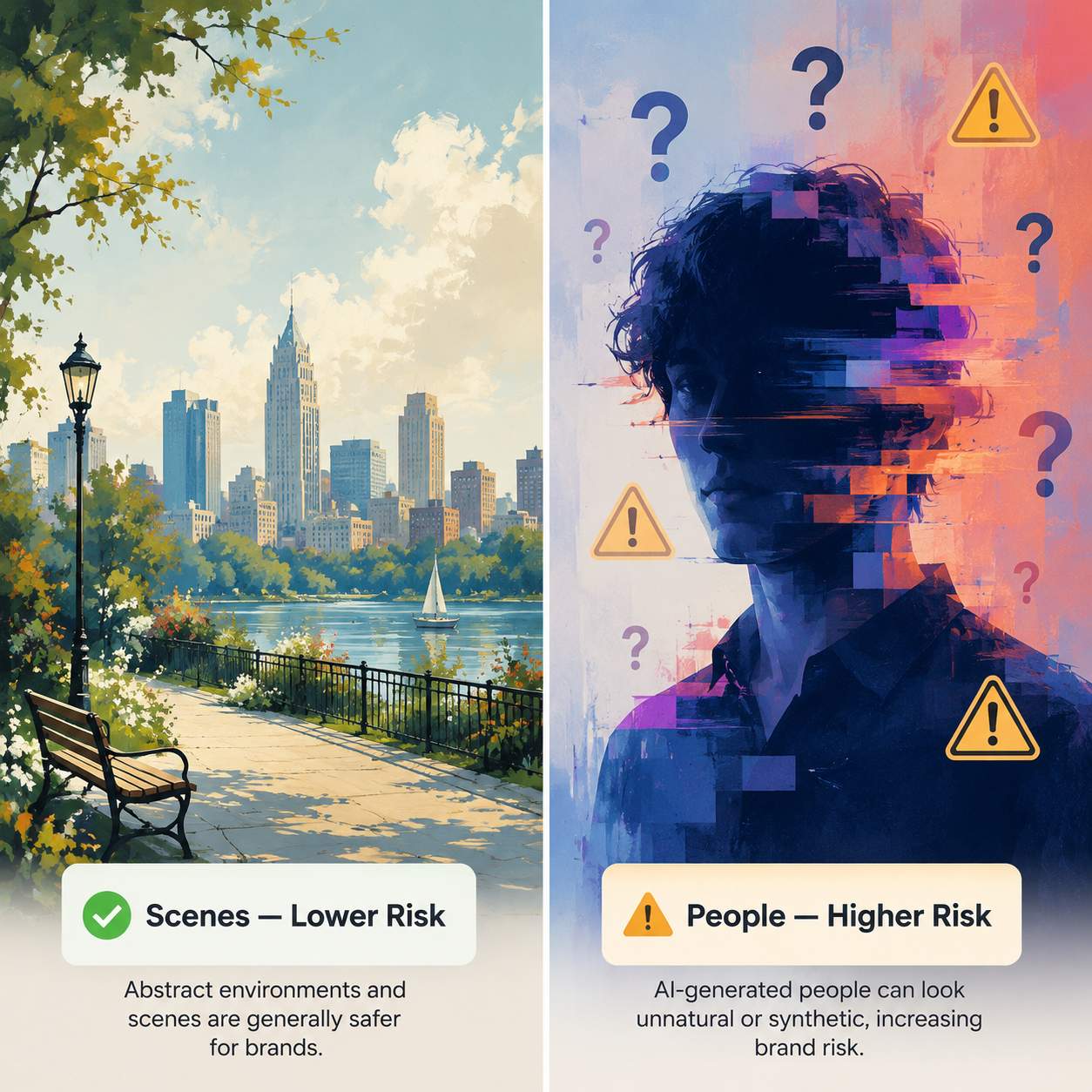
That finding should not be stretched into a universal rule for every product page, social post, or ecommerce layout. The study addressed service ads, and service categories depend heavily on perceived relationship, competence, and care. Still, the boundary is useful because it matches how people often read advertising images. A room, landscape, desk setup, or abstract environment usually functions as context. A human face functions as evidence.
When the person is synthetic, the viewer may not simply evaluate production quality. They may ask whether the brand invented a customer, a professional, a patient, a host, or a beneficiary. In categories where credibility depends on lived experience or expert care, that is a much more expensive question than whether the image saved a shoot day.
| AI use case | Likely trust question | Marketing implication |
|---|---|---|
| Backgrounds, settings, abstract scenes | Does this image create useful context without pretending to document reality? | Lower-risk starting point when quality control is strong |
| Synthetic people in service ads | Is the brand inventing a relationship, customer, or professional? | Higher scrutiny, especially in trust-heavy categories |
| Hyper-realistic human depictions | Would disclosure make the image feel less acceptable? | Avoid unless the rationale is clear and reviewable |
| Obviously AI-styled visuals | Is the style helping the idea or making the tool the message? | Use selectively; novelty wears out quickly |
The practical takeaway is restraint, not abstinence. AI can be very good at building worlds around an idea: weather, lighting, impossible sets, product-adjacent scenes, quick concept territories. It becomes more volatile when it starts substituting for the human proof a campaign wants consumers to believe.
Performance evidence deserves a real seat at the table
There is also a reason marketers keep testing AI imagery: it can work. In a 2026 study from Taboola with researchers from Columbia, Harvard, Technical University of Munich, and Carnegie Mellon, AI-generated ads achieved a 0.76% click-through rate compared with 0.65% for human-created ads across more than 500 million impressions. [4]
That result should not be waved away just because it complicates the backlash story. Paid media teams are judged on response, and variant generation is one of the most defensible uses of AI in marketing. If synthetic creative helps teams test more concepts, localize faster, or avoid spending a full production budget before an idea has earned it, that is a material advantage.
The nuance is in the next part of the finding: ads that did not “look like AI” outperformed both AI-generated and human-created groups. [4] That points back to taste, craft, and editing discipline. The winning condition was not that the audience admired automation. It was that the creative avoided the visual tells and generic gloss that make AI work feel cheap, uncanny, or interchangeable.
There are limits to how far a CTR study can carry the brand argument. Click-through rate is not trust, purchase satisfaction, customer lifetime value, or the tone of the comments after launch. The study is also platform-linked, which does not invalidate the metric but does mean marketers should avoid treating it as a neutral verdict on brand impact. [4]
The useful synthesis is uncomfortable but workable: AI images can drive response and still create brand risk. A campaign can clear the media dashboard and still make the brand feel less credible. A campaign can also use AI quietly, carefully, and effectively without turning into a public lesson in authenticity. The difference is usually not the tool. It is the judgment around what the tool is allowed to impersonate.
Disclosure is less dangerous than many teams assume
Disclosure is often treated as the thing that will kill performance: a small label that invites skepticism, slows the click, or gives critics something to quote. The available data is more forgiving than that fear.
IAB/Sonata found that 73% of Gen Z and Millennial consumers said clear AI disclosure would either increase or have no impact on purchase likelihood. [1] Attest also found that 83% of consumers said AI-generated content should be required by law to be labeled. [2] Those are not identical measures, but together they suggest disclosure is both expected and often commercially survivable.
That does not mean every caption needs to become a production diary. It means brands should stop assuming ambiguity is safer. If a label would make the creative feel embarrassing, the problem may be the creative choice rather than the label.
A useful disclosure standard is simple: tell people when AI materially shaped what they are being asked to believe. Synthetic snow in a holiday scene is not the same as a synthetic patient, synthetic founder, synthetic athlete, or synthetic “real customer.” The closer the image gets to testimony, identity, expertise, or lived experience, the stronger the case for visible disclosure and legal review.
Backlash examples are signals, not the whole evidence base
The public controversy around AI imagery has become familiar enough that many teams now enter the conversation through cautionary examples. Industry coverage has tracked marketers reconsidering AI use as backlash builds, while brand-focused commentary has pointed to AI-first creative that starts to feel thin when novelty carries more weight than substance. [5][6]
Those examples matter, but they are not a measurement system. Social reaction can overrepresent the angriest viewers, and a badly received campaign may have more than one problem: weak concept, poor fit with brand codes, bad disclosure, uncanny execution, insensitive timing, or a mismatch between premium positioning and cheap-looking production.
Still, the market context is moving in a direction that rewards caution. Gartner has predicted that 20% of brands will differentiate based on the absence of AI by 2027, as reported by Digiday. [5] Whether that becomes a durable positioning strategy or a short-term trust badge, it shows that “made without AI” is now legible enough to become part of brand competition.
How to make the call before the campaign ships
The decision does not need to start with a philosophical debate about authenticity. It can start with a campaign review that treats AI imagery like any other brand-safety variable: targeting, claims, influencer fit, talent usage, music rights, and regulated language. The point is not to slow every asset down. It is to know which assets deserve more scrutiny before the comments section becomes the review board.
- Use AI first where it expands context rather than inventing proof: environments, mood boards, concept territories, versioning, and backgrounds.
- Treat synthetic people as high-risk when the campaign depends on trust, relationship, identity, expertise, care, or real-world experience.
- Judge AI images by whether they look like finished brand work, not by whether the team produced them quickly.
- Disclose AI use when it materially affects what the audience might assume is real, especially around people or testimonial-like scenes.
- Keep CTR evidence in the conversation, but do not let it replace trust, sentiment, complaint risk, or long-term brand fit.
The cheapest version of AI creative is often the most expensive one after launch. If the image saves money by removing craft, review, taste, or disclosure, the cost has only been moved to another line item: customer support, community management, PR, legal, or the next campaign’s credibility.
A better standard is selective use with a clear burden of proof. If AI helps the campaign show an idea faster, test variants responsibly, or create a setting that would be wasteful to produce physically, it belongs in the toolkit. If it fabricates the human evidence the brand wants consumers to trust, it deserves a much harder review.
AI-generated photos are not automatically disqualifying. They are also no longer a harmless production shortcut. They now require the same discipline marketers already apply to claims, targeting, partnerships, and brand safety: know what the audience is likely to believe, know what you are comfortable defending, and do not confuse internal efficiency with external trust.
References
- The AI Ad Gap Widens, IAB
- Consumer trust: Will AI erode authenticity in marketing, Quirks
- In creating an ad, using AI for scenes — but not people — may retain consumer trust, VCU News, July 2025
- GenAI Ads Study 2026, Taboola, 2026
- With AI backlash building, marketers reconsider their approach, Digiday
- The AI Marketing Backlash: Why AI-First Brands Are Starting to Fall Flat, Breef

Comments
Join the discussion with an anonymous comment.