

How to Use AI to Reduce Gender Bias in Marketing Content
This article provides a repeatable workflow for marketing teams to prevent AI-generated content from reproducing gender stereotypes. By combining inclusive prompt engineering, human review, brand guidelines, and fairness testing, teams can produce content at AI speed without embedding bias.
Most marketing teams are already past the clean debate about whether generative AI belongs in the creative workflow. Someone is using ChatGPT to draft email subject lines, Gemini to reshape a campaign brief, Midjourney to explore visual territories, or DALL-E to mock up social concepts. The practical question is how to keep gender stereotypes from moving at the same speed as the tools.
That is the working problem behind using AI for gender equality in media marketing: not proving that AI can be ethical in theory, but building a production routine that catches the "doctor dad / nurse mom" pattern before it becomes a paid placement, an executive deck, or a global asset library.
The oversight gap is still too large. UN Women reported in June 2026 that only 51% of marketers test AI-generated creative before release. The same reporting points to UNESCO findings that large language models associate women with terms such as "home," "family," and "children," while associating men with "business," "executive," "salary," and "career"; it also cites findings that about 20% of sentence completions showed sexist or misogynistic attitudes.[1]
This is not a brand-safety footnote. A 2020 Berkeley Haas Center for Equity, Gender and Leadership study, cited by UN Women, found gender bias in 44% of 133 AI systems and both gender and racial bias in 25% to 26% of those systems.[2] The date matters: those were older systems, and current models may behave differently. But the operational lesson has not expired. First-draft AI output should not be treated as neutral simply because it arrived quickly.
Start Before the Prompt Box
The easiest bias to catch is the one that never gets generated. That starts with treating the prompt as part of the creative brief, not as a private scratchpad where one person improvises under deadline pressure.
The Unstereotype Alliance's open-sourced 3Cs framework, launched in June 2026, gives teams a useful production shape: Curate the inputs and references, Craft the prompt or creative direction, and Control the outputs through review and testing.[3] It works because it places responsibility at the same points where marketing work already changes hands.
| Workflow moment | What the team does | What it prevents |
|---|---|---|
| Curate | Select reference images, audience assumptions, examples, and brand language before generation | Defaulting to stock stereotypes because the model is given vague or narrow cues |
| Craft | Write prompts that specify role diversity, agency, context, and representation standards | Generating polished but unequal scenes, job roles, body types, or family dynamics |
| Control | Review outputs with human signoff and recurring fairness checks | Shipping biased assets because no one owned the final inclusion decision |
For a real campaign team, this means the inclusion work cannot begin at legal review or after the client has fallen in love with a layout. It belongs in the brief, the prompt template, the image reference folder, the review checklist, and the post-campaign learning doc.
Curate: Clean Up the Inputs That Steer the Tool
Generative tools respond to what teams hand them: sample copy, mood boards, role descriptions, demographic shorthand, past campaign lines, and reference images. If those inputs repeatedly show men as founders, women as caregivers, fathers as comic relief, or mothers as the only household decision-makers, the prompt can ask for "inclusive" work and still drag old patterns into new assets.
Before anyone opens the tool, the campaign owner should remove or annotate biased reference material. That does not mean deleting every imperfect legacy asset from the archive. It means labeling what should not be repeated, adding better examples, and making the creative target explicit enough for a social manager or designer to use without guessing.
- Replace vague audience labels such as "busy moms" with behavior-based descriptions such as "parents managing weekday meal decisions."
- Balance professional and domestic roles across genders in image references, not just in final copy.
- Flag inherited brand phrases that imply gendered competence, authority, care, beauty, or household responsibility.
- Keep a small approved reference set for common categories: leadership, care, technology use, financial decisions, fitness, beauty, travel, and family life.
This is unglamorous work, but it saves time later. A reviewer should not have to explain, asset by asset, why the only woman in the launch concept is taking notes while men present the strategy.
Craft: Write Prompts That Assign Agency, Not Just Appearance
A weak inclusive prompt asks for "diverse people" and hopes the model knows what the brand means. A stronger prompt defines the scene, the roles, the distribution of authority, and the stereotypes to avoid. It tells the tool who is leading, who is deciding, who is caring, who is learning, who is being helped, and who is being treated as competent.
That distinction matters because many stereotypes are not only about who appears. They are about what each person is allowed to do. A campaign image can include women and still make them passive. A product explainer can feature men and women and still give every technical line to a male voice. A family ad can look balanced at first glance and still make one parent responsible for all care work.
Dove's Real Beauty Prompt Playbook is useful here because it treats prompt language as a practical creative lever, especially for image generation in tools such as Midjourney and DALL-E. Its approach is to make representation explicit: broader bodies, ages, skin tones, beauty cues, and visual contexts are specified rather than left to the model's default imagination.[4] Teams do not need to copy Dove's beauty category language into unrelated campaigns, but they can borrow the operating habit.
A Better Prompt Brief Has Four Parts
- Role instruction: define who is expert, who is leading, who is deciding, and who is receiving support.
- Representation instruction: specify gender balance and avoid reducing inclusion to one visible trait.
- Context instruction: place people in settings that do not default to gendered labor or authority.
- Exclusion instruction: name the stereotypes the output must avoid, especially in recurring campaign categories.
For example, a hypothetical prompt for a small-business banking campaign should not stop at "show diverse entrepreneurs." It should define a mix of founders making financial decisions, reviewing data, negotiating with partners, using the product, and advising others. If the desired output includes family-owned businesses, the prompt should avoid quietly assigning the books to a man and the service counter to a woman unless the campaign has a specific reason to show that scene.
The same applies to copy. When asking an LLM for ad variants, do not only request "inclusive language." Ask it to produce options where care, ambition, technical skill, financial confidence, emotional intelligence, and leadership are not distributed by gender. Then ask for a stereotype scan as a separate pass, because generation and critique are different jobs.
Control: Make Human Review a Gate, Not a Courtesy
Human review cannot be the person who happens to notice a problem in Slack. It has to be a named gate in the production path, with enough authority to send an asset back before media money, executive approval, or localization makes revision expensive.
The 51% testing figure should make teams uncomfortable because it describes a workflow failure, not a model failure alone.[1] If half of marketers are releasing AI-generated creative without testing, then many biased outputs are not slipping through because they are subtle. They are slipping through because nobody was assigned to stop them.
A workable review step should be short enough to survive a Friday deadline and specific enough to catch repeated patterns. The reviewer is not judging whether the campaign is virtuous. They are checking whether the output contradicts the brand's inclusion standard, reinforces a predictable stereotype, or assigns power and labor unevenly without creative intent.
- Role balance: Who leads, decides, explains, assists, cares, buys, fixes, earns, or waits?
- Language patterns: Are ambition, authority, warmth, beauty, competence, or risk described differently by gender?
- Visual framing: Who is centered, cropped, interrupted, shown at work, shown at home, or made decorative?
- Variant spread: Across the full asset set, do the same gendered roles repeat even if each single asset looks acceptable?
- Intersectional signals: Are gender, race, age, body type, disability, and class cues handled as real representation rather than token rotation?
One asset can pass in isolation and fail as part of a campaign. Ten social images where men explain the product and women react positively are still a pattern, even if each image has balanced casting. Reviewers need to look at the set, not only the hero execution.
Put the Standard in the Brand Guidelines
Inclusive prompting gets much easier when the brand has already defined what inclusive work means. Without that standard, every reviewer becomes the person arguing from personal taste during a deadline. That is how biased assets survive: not because nobody sees the issue, but because nobody can point to the rule.
The brand guideline does not need to become a textbook. It needs enough specificity to steer recurring choices. If the company often depicts household decisions, define how care work and financial authority should be distributed. If it sells software, define how technical expertise should appear across genders. If it works in beauty, health, finance, sports, or parenting, document the stereotypes the brand will not reproduce.
| Guideline area | Useful standard |
|---|---|
| Casting and roles | Representation must include decision-makers, experts, caregivers, learners, and leaders across genders. |
| Copy and voice | Descriptions of competence, confidence, emotion, care, and ambition should not change by gender unless there is a clear creative reason. |
| Image generation | Prompts must specify role agency and stereotype exclusions, not only demographic variety. |
| Approval | AI-generated assets require documented human review before release. |
| Measurement | Campaign sets should be checked for repeated role, language, and visual patterns after generation. |
This also protects the working team. A social manager should not have to invent the company's gender representation policy while resizing assets. A content strategist should not have to negotiate inclusion standards from scratch for every prompt template. A creative lead should be able to reject a biased output because it misses the brief, not because they personally dislike it.
Test the Outputs, Then Test Again Later
Fairness testing does not have to begin as a complex technical audit. For most marketing teams, the first version can be a structured comparison of outputs across prompts, audience profiles, markets, and asset types. The point is to look for repeatable differences, not one awkward sentence.
A simple test might ask the same tool to generate campaign concepts for founders, nurses, engineers, parents, athletes, retirees, students, and executives, then review who gets assigned authority, care, emotional labor, beauty language, technical skill, and purchasing power. Another test might compare image outputs when gender is specified, unspecified, or intentionally balanced. These are diagnostic exercises, not scientific claims, unless the team designs them with a valid sample and method.
The findings should feed back into prompt templates and brand guidance. If the model repeatedly makes women assistants in workplace scenes, update the workplace prompt. If it makes men absent from caregiving scenes, update the family prompt. If it gives different adjectives to male and female leaders, update the copy review checklist.
- Run bias checks on batches, not only final hero assets.
- Save prompts, outputs, review notes, and approved revisions.
- Retest when the tool changes, the campaign category changes, or the audience changes.
- Track patterns over time so the same issue is not rediscovered by every new campaign team.
This is where teams often want a universal pass-fail number. The better starting point is a record. What did the team ask the tool to create? What did it produce? What did reviewers flag? What changed before release? What should be tested before the next campaign?
Use Transparency Without Making It the Whole Story
Disclosure matters, especially when AI-generated imagery could affect how audiences understand real people, bodies, work, or communities. But transparency is not a substitute for quality control. Telling people that an image was AI-assisted does not make a stereotyped image less stereotyped.
A practical disclosure standard should sit beside the review standard. If a campaign uses AI-generated or AI-assisted visuals, the team should know when disclosure is required by platform policy, law, client agreement, or internal brand practice. That decision belongs in the campaign checklist, not in the caption field five minutes before publishing.
What a Shippable AI Workflow Looks Like
By the time an AI-assisted campaign reaches approval, the team should be able to show more than the final outputs. It should be able to show the working trail: the brief, the prompt, the reference set, the review notes, the changes made, and the checks that will be repeated next time.
| Before release, confirm | Evidence to keep |
|---|---|
| The brand defined the inclusion standard for this campaign category | Campaign brief or brand guideline excerpt |
| The prompt specified agency, role balance, and stereotype exclusions | Saved prompt template or generation log |
| A human reviewer checked the full asset set | Review checklist, comments, or approval record |
| Bias patterns were tested across variants | Batch review notes or comparison grid |
| Disclosure requirements were considered | Publishing checklist or legal/platform review note |
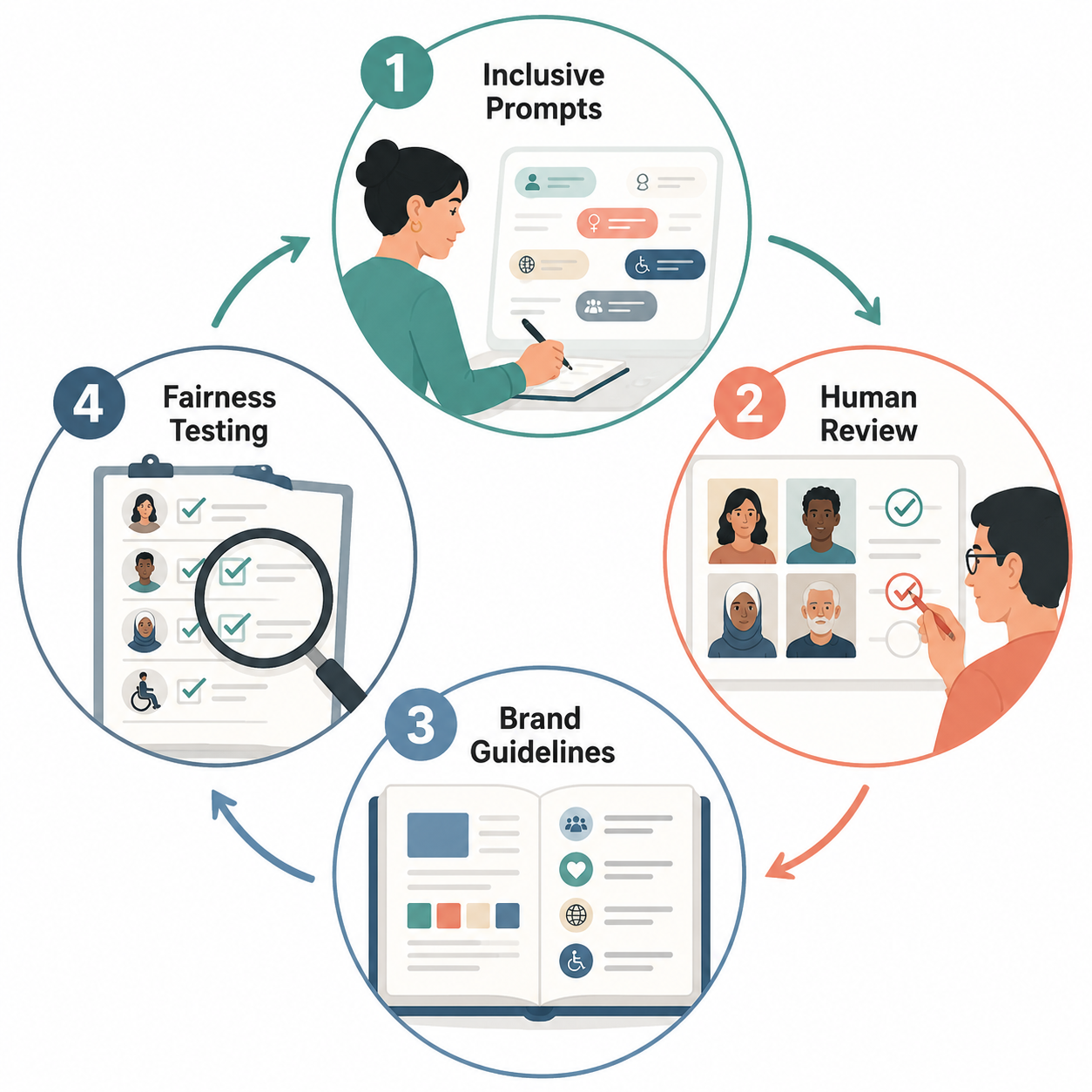
Inclusive prompts are necessary, but they are not enough. The prompt can reduce the chance of biased output; it cannot carry the whole responsibility for what the brand publishes. Human review must be mandatory, brand guidelines must define the standard before generation begins, and fairness testing has to recur because models, campaigns, and audiences keep changing.
AI speed is acceptable when the team can answer four production questions: what did we ask for, who reviewed it, what bias checks did we apply, and what will we retest next time?
References
- AI is already rewriting reality for billions of people. It is getting women wrong, UN Women, June 2026
- Artificial intelligence and gender equality, UN Women
- Research and tools, Unstereotype Alliance
- Keep Beauty Real, Dove

Comments
Join the discussion with an anonymous comment.