
AI-powered food recall crisis marketing playbook
This playbook provides food and CPG marketing teams with specific AI tools and workflows to deploy before, during, and after a food recall, drawing on the McDonald's 2024 E. coli response and recent consumer trust data to reduce brand damage and speed recovery.
In a food recall, the first race is no longer against the evening news cycle. It is against the first screenshot, the first creator explainer, the first search result, and now the first AI-generated answer that compresses all of it into what looks like a public record.
That matters because consumers are not politely waiting for the recall notice to clear legal review. In a 2025 IFIC/Belle Communication survey, 15% of consumers said they first learn about recalls through social media, compared with 6% who first learn from government sources. Belle Communication also reported that 35% of consumers expect a brand response within one hour.[1] Those two numbers should make every food marketing team uncomfortable in a useful way: the channel where consumers first hear the rumor is not the channel where the most complete facts usually live.
The old model assumed the brand could publish a statement, pitch reporters, update the website, and then monitor reactions. That sequence is too slow for a recall conversation shaped by social posts, syndicated headlines, retailer notices, Google results, and AI summaries. PR Daily’s 2025 coverage of AI search in food crises made the operational point clearly: structured FAQ pages, schema markup, and AI-optimized distribution now influence whether generative search systems surface the brand’s corrective information or a patchwork of speculation and secondary coverage.[2]
AI belongs in this system, but not as a magic copywriter for safety claims. The useful work is more specific: listening, routing, summarizing, detecting visibility gaps, organizing FAQs, checking AI-search outputs, accelerating media workflows, and tracking trust recovery. The dangerous work is letting a generative system invent certainty where quality assurance, legal, operations, and regulators have not supplied it.
The McDonald’s 2024 E. coli response is the case marketers should study
The most useful recent example is McDonald’s response to the 2024 E. coli outbreak connected to Quarter Pounders. The lesson is not that a large brand can outspend a crisis. It is that the brand gave consumers, journalists, search engines, and AI systems a structured destination quickly enough to compete with the speed of the story.
BERA.ai’s 2025 case study says McDonald’s launched its dedicated “Always Putting Food Safety First” webpage within hours of the CDC alert, used structured FAQ content, coordinated updates across owned, earned, and social channels, and saw only a 2-percentile BERA Score drop that recovered to pre-outbreak levels within months.[3] Because that score is vendor-produced, it should be treated as directional evidence rather than a neutral audit. But the visible behavior matters: McDonald’s public response did include a dedicated corporate page, executive messaging, food safety FAQs, and ongoing updates that gave stakeholders a single source to point to.[4]
That page did several jobs at once. It reduced the burden on customer service by answering obvious consumer questions. It gave reporters a current URL instead of a stale PDF. It gave social teams a linkable asset that did not require squeezing food safety nuance into a post. It gave search engines and AI systems structured material to parse. It also made the internal approval problem easier: instead of negotiating every update as a standalone public statement, the team could update a known crisis hub.
That is the piece many postmortems miss. “Transparency” is not a tone of voice. In a recall, it is a publishing system with owners, permissions, approved claims, dated updates, structured data, monitoring dashboards, and escalation paths. If those pieces are not built before the first public complaint, the brand is trying to construct plumbing while the kitchen is already flooding.
The AI recall stack by phase
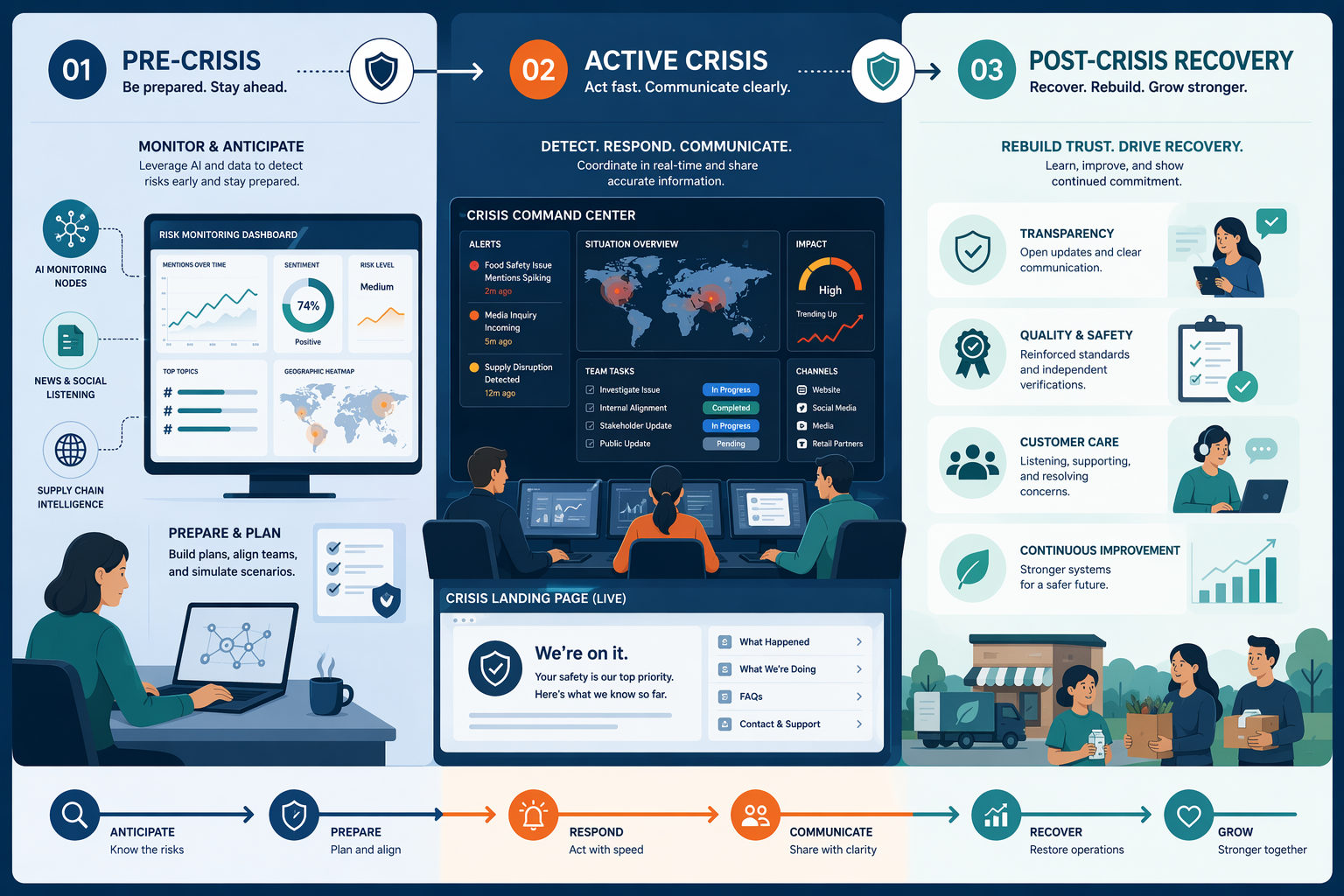
A workable food recall crisis marketing system has to be organized by phase. Tools that are useful before a recall are not the same as tools that should be touched during the first 24 hours, and neither group should be confused with post-crisis brand recovery measurement.
| Phase | AI-enabled use case | Tools named in current practice | Setup requirement | Failure risk if skipped |
|---|---|---|---|---|
| Pre-crisis | Always-on listening, anomaly detection, escalation routing | Sprout Social, Talkwalker, Brandwatch | Keyword libraries, risk taxonomy, owner matrix, alert thresholds | The team first sees the issue after consumers and reporters have already framed it |
| Pre-crisis | AI-search visibility benchmarking | Bluefish, Kai, SEMrush AI checker | Baseline prompts, branded query set, competitor and category query set | AI summaries pull from stale or third-party sources during the recall |
| Pre-crisis | Crisis content infrastructure | CMS templates, FAQ modules, schema-ready landing pages | Preapproved page architecture, legal review paths, QA claim bank | The first statement becomes a bottleneck instead of a publishable system |
| Active crisis | Crisis hub launch and structured updates | Crisis landing page, FAQ schema, organization schema, newswire distribution | Publishing permissions, dated update format, redirect and indexing checks | Consumers find screenshots and news recaps before the brand’s verified explanation |
| Active crisis | Media and stakeholder acceleration | Ottogrid and other agentic research tools | Approved media categories, outlet filters, human review before outreach | Teams waste critical hours manually building lists while misinformation spreads |
| Active crisis | Real-time message adjustment | Social listening and sentiment platforms | Dashboard by audience, claim, geography, channel, and recurring question | Messaging answers the internal statement, not the consumer’s actual concern |
| Post-crisis | Trust and brand-equity recovery tracking | Edelman Archie, BERA.ai | Baseline trust measures, post-event cohorts, sentiment and search visibility history | The brand declares recovery before consumers, retailers, or search results agree |
Pre-crisis: build the system before anyone needs a statement
The pre-crisis phase is where AI has the most leverage because no one is yet arguing over an active incident. This is when marketing can get legal, QA, regulatory, customer service, ecommerce, and leadership to agree on the workflow without the extra pressure of a live recall.
Start with listening, not copy. In Sprout Social, Talkwalker, or Brandwatch, the recall monitoring environment should include the brand name, product names, retailer names, common misspellings, plant or facility references where appropriate, “sick after eating” language, allergen terms, foreign-object terms, lot-code language, and regulator names. The goal is not to turn marketing into food safety surveillance. The goal is to make sure marketing is not the last team to see a public signal.
- Create alert tiers that separate routine complaints from possible safety signals.
- Route possible safety signals to QA and legal before any public reply is drafted.
- Define who can approve holding statements after hours, on weekends, and during holidays.
- Tag recurring questions by consumer concern: illness, refunds, product identification, availability, cross-contamination, and corrective action.
- Track the time from first public signal to internal escalation as a performance metric.
This is also where AI-search visibility work belongs. Before a crisis, use Bluefish, Kai, or SEMrush’s AI checker to see what generative search tools already say about the brand’s safety standards, manufacturing practices, ingredient sourcing, and customer support. The point is not to chase every AI answer. It is to identify which pages, FAQs, and third-party sources are likely to be summarized when consumers ask, “Is this brand safe?” or “What happened with this recall?”
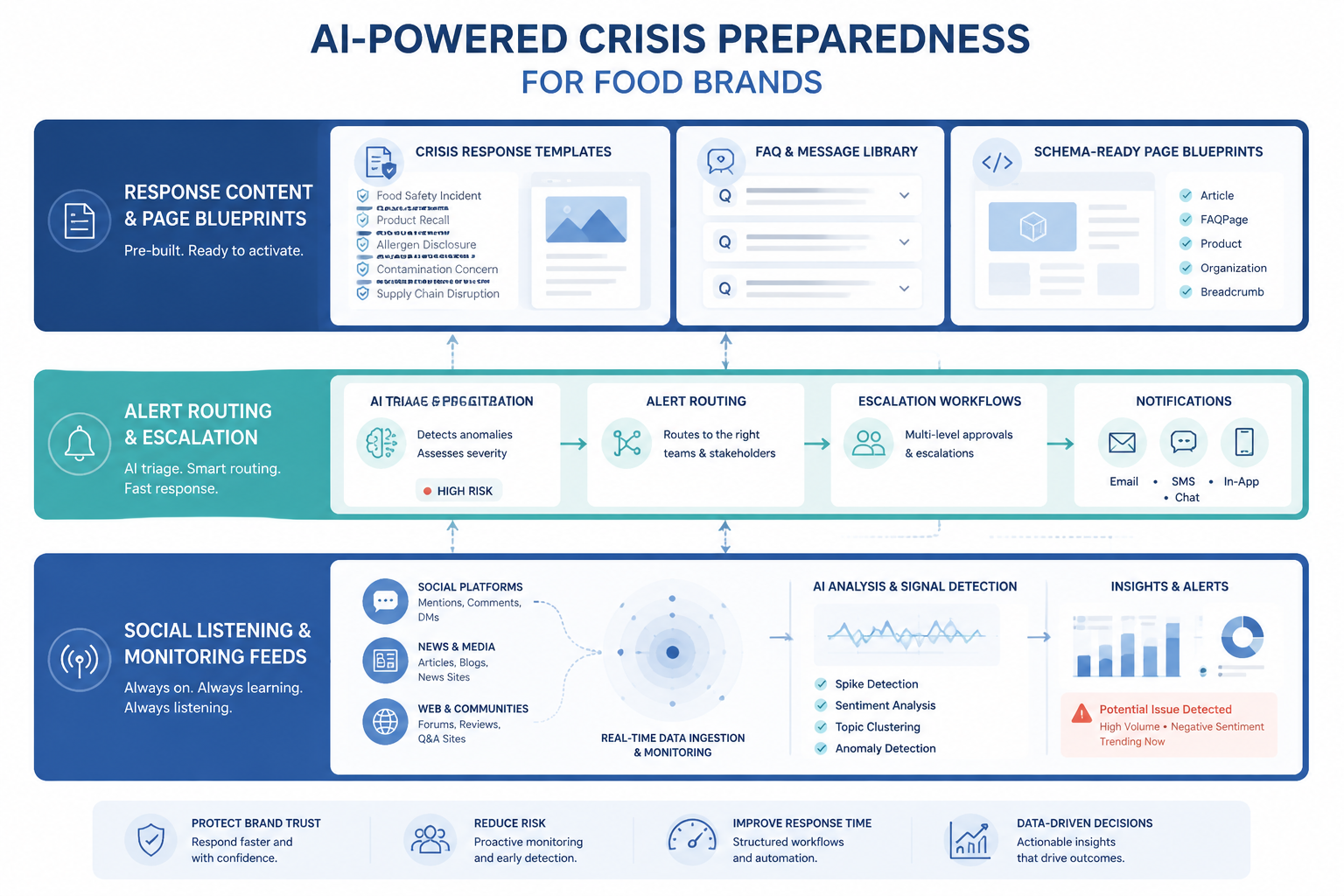
Prebuilt content matters, but it has to be built around blanks that only the incident team can fill. A useful recall FAQ template should already have approved sections for affected products, lot codes, symptoms or exposure language if supplied by authorities, refund steps, retailer instructions, corrective actions, contact channels, and update timestamps. It should not have prewritten claims that imply causality, safety clearance, or regulatory conclusions before those facts exist.
The page template should be schema-ready before it is needed. Marketing does not need to wait for an outbreak to decide whether the crisis hub will use FAQ schema, organization markup, article markup for dated updates, and clear canonical URLs. Those are implementation decisions that should be tested quietly during normal operations, because search visibility problems discovered during a recall are rarely fixed gracefully.
The approval path is part of the technology
A dashboard without an approval path is just a more expensive way to panic. The pre-crisis workflow should name the owner for each action: who validates the product facts, who approves legal language, who updates the page, who posts on social, who briefs customer service, who monitors AI summaries, and who tells ecommerce or retail partners when consumer-facing copy changes.
Marketing should maintain a claim bank with three categories: approved evergreen safety language, conditional language that requires QA or legal confirmation, and prohibited language that cannot be used without regulator or executive approval. AI tools can help summarize and retrieve from that bank. They should not be allowed to generate new safety claims from scratch in the middle of an incident.
Active crisis: publish the verified center of gravity
Once a recall or outbreak is public, the first marketing job is to publish a verified center of gravity. That does not mean every fact is final. It means there is one place where consumers can see what is known, what is being investigated, what they should do, when the page was updated, and where they can get help.
The landing page should go live quickly with a timestamped holding structure if full details are still moving through review. It should use plain language for consumers and structured sections for machines: affected product information, action steps, customer support options, official updates, and FAQ entries that match the questions people are actually typing into search and social.
- Launch or update the crisis landing page with a clear timestamp and a short statement of what is known.
- Add FAQ schema and other relevant structured markup so search and AI systems can parse the page.
- Pin the crisis hub across owned social channels and customer support surfaces.
- Distribute an AI-optimized release through the appropriate wire or newsroom system, using the same verified language.
- Monitor social questions, search snippets, and AI summaries hourly during the first response window.
This is where the McDonald’s example is most useful. Its dedicated food safety page gave the company a current destination for updates, FAQs, and executive communication rather than scattering the response across disconnected statements.[3][4] A smaller brand can use the same architecture even without the same scale: one canonical page, one approved FAQ structure, one update log, and one routing path for corrections.
AI can help the team see what the public is asking before the next executive meeting. Social listening tools should surface question clusters, not just sentiment. If hundreds of comments are about refunds while the homepage leads with corporate concern, the content sequence is wrong. If consumers are asking whether a related product is affected, the FAQ needs a direct answer or a direct statement that the answer is not yet available.
Agentic tools such as Ottogrid can speed up media-list building and stakeholder research, especially for regional outlets, trade reporters, retail newsletters, and category-specific writers. That work still needs human review. In a recall, bad targeting is not just inefficient; it can put incomplete information in front of the wrong audience or miss the community most affected by the product.
Message adjustment should follow evidence, not internal preference
During the first 24 to 72 hours, the dashboard should track more than volume. Useful views include recurring consumer questions, misinformation themes, outlet pickup, retailer mentions, geography, customer service wait issues, search result changes, and AI-summary language. The practical question is simple: when a consumer asks about the recall, does the answer they find match the verified facts the brand is trying to communicate?
If AI-generated search summaries are repeating an outdated product list, the fix may be a clearer FAQ entry, a dated correction, a refreshed release, or outreach to publications still carrying older information. If social posts keep misidentifying unaffected products, the fix may be a visual product guide. If customer service is receiving the same question every hour, the page copy has failed at least one audience.
None of this requires marketing to overstate certainty. The best active-crisis language is often restrained: “We are removing the affected product from sale,” “We are cooperating with regulators,” “Consumers with this lot code should take the following steps,” or “We will update this page when additional information is confirmed.” AI can help find the question. People accountable for the facts must own the answer.
Why the urgency has become harder to ignore
The recall environment is not getting quieter. PIRG reported that FDA and USDA announced 320 food recalls in 2025.[5] Trace One reported that total U.S. food recalls grew 21.4% from 2021 to 2025, from 505 to 613 events.[6] Sedgwick data cited by Food Safety News showed FDA recall unit volumes rising 75.8% in Q3 2025 to 25.17 million units.[7]
The consumer consequence is also measurable. A GS1 US survey reported by Food Safety News found that 59% of consumers are hesitant to buy the same brand after a recall, with Millennials at 65%, Gen Z at 64%, and Boomers at 53%.[8] YouGov’s 2025 data found that 31% of consumers report moderate trust loss after a recall and 16% report a strong impact.[9] These are attitude measures, not guaranteed purchase behavior, but they describe the pool of consumers marketing has to win back.
The financial context explains why recall communication belongs in a growth conversation, not just a legal or compliance folder. The widely cited FMI/GMA estimate puts the average direct cost of a recall at about $10 million, though the original study is not easily accessible and the figure should be treated as a directional industry benchmark rather than a current audited average.[10] That number does not capture every lost cart, retailer conversation, search result, or category switch triggered by weak communication.
Post-crisis: measure recovery before declaring it
Post-crisis work begins when the immediate consumer safety instructions are stable, not when the brand is tired of talking about the incident. The marketing team’s job shifts from response speed to evidence of recovery: trust, search visibility, sentiment, retailer confidence, customer service volume, and whether AI summaries still treat the recall as the dominant fact about the brand.
Edelman Archie can be used for trust tracking, while BERA.ai can monitor brand-equity movement over time. BERA’s McDonald’s case study is useful here because it ties a recall response to a brand-equity recovery claim, but the source is still a vendor analyzing through its own metric.[3] A careful team should pair any vendor score with observable signals: branded search queries, retailer feedback, customer service topics, social sentiment, review language, and the content appearing in AI-generated answers.
The content strategy after a recall should not be treated as reputation laundering. Publishing safety updates, corrective-action explainers, supplier or quality process content, CSR material, and credible executive thought leadership can help rebalance search and AI-summary environments, but only if the content is connected to accountable action. Trying to bury the recall with cheerful unrelated content is a short-term search tactic with a long-term trust cost.
- Keep the crisis page live with a final update rather than deleting the public record.
- Publish corrective-action content only after operations and legal confirm what can be said.
- Check AI summaries for branded recall queries weekly until outdated or inaccurate language stops recurring.
- Compare post-crisis trust and sentiment against the pre-crisis baseline, not against the worst week of the incident.
- Feed recurring customer questions back into product, QA, ecommerce, and customer service documentation.
A useful recovery dashboard does not need to be theatrical. It should show whether negative recall queries are declining, whether AI summaries include current corrective information, whether consumer questions are shifting from safety to availability, whether retailer pages are updated, and whether customer service can handle remaining concerns without improvising.
The operating rule for AI in recall marketing
The safest way to use AI in food recall crisis marketing is to let it accelerate the system around the facts, not manufacture the facts themselves. It can listen faster than a team can manually scan. It can cluster questions faster than a war room can read every comment. It can identify AI-search visibility gaps before executives realize the public record has drifted. It can help a prepared team move from approved facts to findable answers.
It cannot replace food safety work, regulator cooperation, legal review, or accountability to consumers. But in the current recall environment, it increasingly determines whether the brand’s verified corrective narrative becomes visible quickly enough to compete with misinformation, AI summaries, and consumer abandonment.
References
- IFIC/Belle Communication food recall consumer survey, Belle Communication, September 2025, link
- How AI Is Changing Food Recall Communications, PR Daily, August 2025, link
- McDonald’s E. coli Outbreak Response Case Study, BERA.ai, 2025, link
- Always Putting Food Safety First, McDonald’s Corporation, 2024, link
- Food for Thought 2026, U.S. PIRG Education Fund, 2026, link
- U.S. Food Recalls Report, Trace One, 2026, link
- Sedgwick: FDA recall unit volumes surged in Q3 2025, Food Safety News, December 2025, link
- GS1 US survey: Consumers hesitant to buy same brand after recall, Food Safety News, October 2025, link
- Food recalls and consumer trust, YouGov, 2025, link
- Capturing Recall Costs: Measuring and Recovering the Losses, Food Marketing Institute and Grocery Manufacturers Association, link

Comments
Join the discussion with an anonymous comment.