
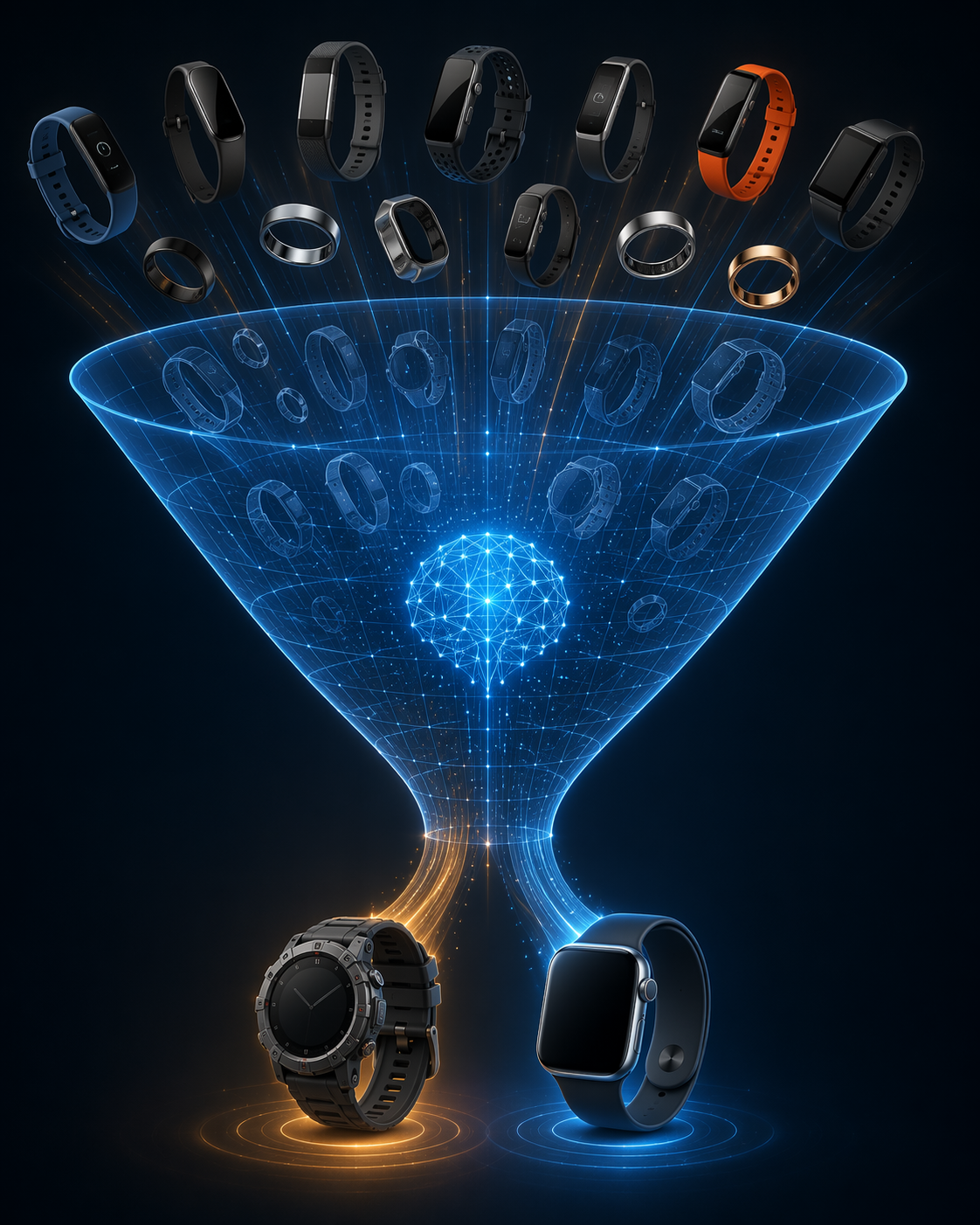
AI Platforms Narrow the Fitness Tracker Shortlist to Two
AI platforms like ChatGPT and Perplexity are compressing the fitness tracker recommendation market into a two-brand race between Garmin and Apple Watch. This analysis shows why traditional brand awareness metrics miss this gap and what brands outside the top two should do.
A fitness tracker comparison no longer behaves like a comparison when the interface quietly narrows the field before the buyer sees it. In June 2026, CiteWorks Studio’s LLM Authority Index estimated about $41.6 million in monthly AI Authority Value across fitness tracker recommendation moments, with Garmin and Apple Watch capturing 74% of that modeled opportunity. Garmin led with a 15.7% top-three recommendation rate, an 8.4% rank-one rate, an average recommended rank of 2.0, and $1.67 million in monthly AI Authority Value.[1]
That is the part marketers should sit with. The market still contains Fitbit, Samsung Galaxy Watch, Oura Ring, Amazfit, and other recognizable names. Retail shelves, paid media plans, review roundups, and brand trackers may still show a wide competitive set. But when a consumer asks an AI platform for the “best fitness tracker for running” or the “best affordable fitness tracker,” the answer increasingly acts like a pre-sorted shortlist. In this benchmark, the shortlist is mostly Garmin and Apple.
The benchmark behind that claim is not a loose read of “AI visibility.” CiteWorks measured 1,621 observations across six AI platforms: ChatGPT, Perplexity, Gemini, Copilot, Claude, and Google AI Overviews. It covered ten fitness tracker brands and three public high-intent buyer prompt clusters: brand-name, activity-specific, and price-sensitive queries.[1]
There are limits. The study is a point-in-time measurement from June 2026. AI outputs move as models, retrieval layers, and source ecosystems change. The $41.6 million figure is modeled AI Authority Value, not booked revenue. And the public analysis covers three high-intent prompt clusters, not every possible buying moment. Those caveats do not make the signal useless. They make it usable in the way a serious growth team would use it: as a ranking system for where AI-mediated discovery is already turning brand memory into commercial preference, or failing to.
The shortlist forms before the buyer reaches the brand site
The useful distinction is not between “visible” and “invisible.” It is between brands that AI systems mention and brands they trust enough to recommend in a position that can shape a purchase.
Garmin’s lead is not resting on one heroic prompt. The brand wins across brand-name, activity-specific, and price-sensitive query clusters. That breadth matters because these prompt types carry different buyer states. Brand-name prompts test whether a company’s own demand gets reinforced or diluted. Activity-specific prompts test whether the brand is attached to use cases such as running. Price-sensitive prompts test whether the brand survives when the buyer is actively weighing tradeoffs.[1]
| Brand | What the benchmark shows | Marketing implication |
|---|---|---|
| Garmin | 15.7% top-three recommendation rate; 8.4% rank-one rate; average recommended rank of 2.0; $1.67M monthly AI Authority Value | The clearest category authority signal across the measured prompt clusters |
| Apple Watch | Part of the two-brand group capturing 74% of modeled value with Garmin; strongest in the pricing cluster | Especially dangerous near conversion, where buyers ask value-oriented questions |
| Samsung Galaxy Watch | $460K AI Authority Value | Recognized, but operating in a distant tier below the top two |
| Oura Ring | $491K AI Authority Value | Also present in the distant middle tier, without the same top-position strength |
| Fitbit | 19% citation presence but 6.7% valid recommendation coverage; $385K AI Authority Value | The clearest example of visibility failing to become influence |
Top-three rate deserves more attention than many brand teams give it. A brand that appears fourth, fifth, or in a general explanatory paragraph may still be “in the answer,” but it is not receiving the same commercial treatment as a brand placed in the first few recommendations. AI interfaces are not just citation surfaces. They are ranking surfaces.
Rank-one rate is sharper still. Garmin’s 8.4% rank-one rate means it is not merely recurring as an acceptable option; it is being selected as the lead answer often enough to separate itself from the rest of the category. Its average recommended rank of 2.0 reinforces the same point. The brand is not drifting into the back half of recommendation lists. It is usually close to the decision point when it appears.[1]
Apple Watch’s story is narrower but commercially important. The benchmark found Apple Watch captured $329,000 in the pricing cluster, the highest value among competitors in that segment. CiteWorks treats those pricing-cluster queries as 1.5x multiplier moments because buyers are closer to conversion.[1]
That pricing strength changes how marketers should read Apple’s position. Apple does not need to dominate every fitness tracker conversation equally if it is especially strong when buyers ask affordability, value, and purchase-tradeoff questions. A brand can lose some upper-funnel variety and still win disproportionately at the moment when the consumer is asking the interface to help choose.
Fitbit shows the cost of being present without being chosen
Fitbit is the most uncomfortable finding because it is not an unknown brand trying to break into the conversation. It appears in 19% of AI observations, yet earns only 6.7% valid recommendation coverage. Its monthly AI Authority Value is $385,000, compared with Garmin’s $1.67 million.[1]

That gap is exactly where traditional brand reporting can become comforting and misleading. A brand tracking deck might show awareness, familiarity, consideration, maybe even positive associations. An AI answer can still treat that same brand as background context: known enough to mention, not strong enough to recommend.
The sentiment layer makes the diagnosis more pointed. Fitbit’s net sentiment score was 0.49, the lowest among major brands in the benchmark, and nearly half of its mentions carried neutral or negative framing that disqualified them from recommendation credit.[1]
This is not a simple awareness problem. It is a recommendation-eligibility problem. The brand is visible enough for models to recognize it as part of the category, but the surrounding evidence and framing are not consistently strong enough to move it into decisive recommendation positions. In commercial terms, that is wasted visibility.
A human buyer may still have emotional loyalty to Fitbit. They may have years of app history, habit data, household familiarity, or a preference for the product experience. The CiteWorks data does not disprove any of that. It shows something narrower and more operational: in measured high-intent AI recommendation moments, Fitbit’s category presence is not converting into recommendation influence at a rate its brand familiarity might lead a team to expect.
The middle tier is real, but it is distant
Samsung Galaxy Watch and Oura Ring prevent this from looking like a category where only two brands exist. They do show up as meaningful AI entities. But their modeled authority values, $460,000 for Samsung Galaxy Watch and $491,000 for Oura Ring, place them well below Garmin and behind the combined force of the Garmin-Apple shortlist.[1]
That middle tier matters for competitive planning because it changes the first question. The issue is not simply, “How do we beat Garmin?” For many brands, the nearer task is, “Which prompt clusters can we realistically contest, and what evidence would make an AI system place us in the top three rather than mention us as an alternative?”
Amazfit adds a useful warning against another false comfort: positive sentiment. The benchmark gives Amazfit the highest net sentiment in the category at 0.75, but its average recommended rank is 3.84. Positive framing helps, but it does not do much commercial work if the brand appears too low in the list to shape the decision.[1]
This is where a lot of AI visibility reporting gets mushy. Mentions, sentiment, citations, and recommendation rank are related, but they are not interchangeable. A pleasant mention in a paragraph explaining budget alternatives is not the same asset as being named first for a high-intent running prompt. A cited source that confirms a specification is not the same as a source ecosystem that repeatedly supports the brand’s use-case authority.
Platform behavior changes the work
The benchmark also shows that AI platforms do not distribute recommendations in the same way. Perplexity had the most concentrated recommendation structure, with Garmin appearing in 50.4% of observations. Google AI Overviews showed the weakest recommendation structure for most brands.[1]
For a GEO team, that distinction changes the assignment. On a concentrated platform, the job may be to understand why one brand has become the default answer and which evidence sources reinforce that default. On a weaker recommendation surface, the job may be to identify whether the interface is avoiding firm recommendations altogether, relying on generic buying advice, or failing to connect category claims to specific brands.
This is also why the practical response cannot be reduced to “get more mentions.” More mentions can help if they appear in the right source types, attach the brand to the right use cases, and improve comparative clarity. More mentions can also inflate a dashboard while leaving the brand in the same weak position: known, cited, and skipped.
The broader wellness AI shift is real, but it is not the whole story
There is a larger reason this matters now. ABC Fitness reported in its 2026 Summer Wellness Watch Report that nearly 50% of consumers use AI-powered fitness and wellness apps daily.[2] Google’s AI Health Coach is also aimed specifically at Apple Watch users, a reminder that platform-level fitness guidance and wearable ecosystems are beginning to overlap more visibly.[3]
Agency-side wellness marketing commentary has been circling the same theme: AI is becoming part of personalization, engagement, and customer acquisition in fitness and wellness.[4] That context is useful, but it should not be allowed to flatten the more specific finding here. The commercial problem is not merely that consumers use AI. It is that AI recommendation surfaces can compress a familiar hardware category into a much smaller buying set.
What brands outside Garmin and Apple should audit first
The immediate marketing response is an audit, not a rebrand. Brands outside the top two need to separate four things that often get blended together in AI visibility discussions:
- Citation presence: whether the brand appears in AI-generated answers or cited sources.
- Recommendation coverage: whether the brand receives valid recommendation credit rather than passing mention credit.
- Rank position: whether the brand appears first, in the top three, or below the point where most buyers will act.
- Prompt-cluster value: whether the brand is competing in brand-name, activity-specific, price-sensitive, or other commercially meaningful query groups.
The next layer is source architecture. A brand trying to win “best fitness tracker for running” needs more than broad lifestyle content and review snippets. It needs consistent third-party and owned evidence that ties the device to the use case: comparative tests, durable product claims, expert review language, structured specifications, and pages that make tradeoffs clear enough for an AI system to reuse without hedging.
Price-sensitive prompts need a different evidence base. Apple Watch’s strength in that cluster should worry brands that have assumed premium pricing automatically weakens recommendation placement. AI systems may reward a product when the surrounding sources frame its ecosystem, features, resale logic, or value tradeoffs clearly. Competing there requires sharper comparative pages and citations, not just discount messaging.
The hygiene work matters too. If a brand is going to seed comparison pages, buying guides, partner content, expert quotes, and structured product information, it also needs to avoid creating low-quality AI-targeted pages that look like search spam. A practical place to pressure-test that risk is an internal AI spam policy audit checklist, especially before scaling GEO content across many prompt variants.
For a brand like Fitbit, the audit should start with the gap itself: where it is cited, how it is described, what neutral or negative framing recurs, and which prompts mention the brand without recommending it. For Samsung, Oura, Amazfit, and similar middle-tier brands, the question is more selective: which prompt clusters are close enough to contest, and what source evidence would change a fourth-position or passing mention into a top-three recommendation?
The budget implication is not that every brand should chase every AI platform equally. Perplexity’s concentrated Garmin pattern and Google AI Overviews’ weaker recommendation structure point to different kinds of work. Some platforms may require authority displacement. Others may require clearer eligibility signals. Some prompt clusters may not be worth the cost if the brand has no credible product proof for that use case.
The sober version of GEO for fitness wearables is not a promise that better citations will recover lost revenue. It is a resource-allocation discipline. Audit where AI platforms mention the brand. Measure whether those mentions become valid recommendations. Track rank position by prompt cluster. Then build the citation architecture and comparative evidence around the buying contexts worth contesting.
References
- AI Industry Market Discovery Reports: Fitness Tracker — CiteWorks Studio — https://citeworksstudio.com/case-studies/ai-industry-market-discovery-reports/fitness-tracker
- Summer Wellness Watch Report — ABC Fitness — 2026 — https://abcfitness.com/press-release/summer_wellness_watch_report/
- Google AI Health Coach — Seattle Medium — https://seattlemedium.com/google-ai-health-coach/
- The Role of AI in Wellness and Fitness Marketing — 5WPR — https://www.5wpr.com/new/the-role-of-ai-in-wellness-and-fitness-marketing/

Comments
Join the discussion with an anonymous comment.