
How AI Drone Light Shows Deliver Real Brand Activation Results
This article evaluates whether AI-powered drone light shows are a viable brand activation medium, with real cost benchmarks, campaign results from Netflix, Ford, and Mountain Dew, and the key factors that separate effective shows from expensive spectacles.
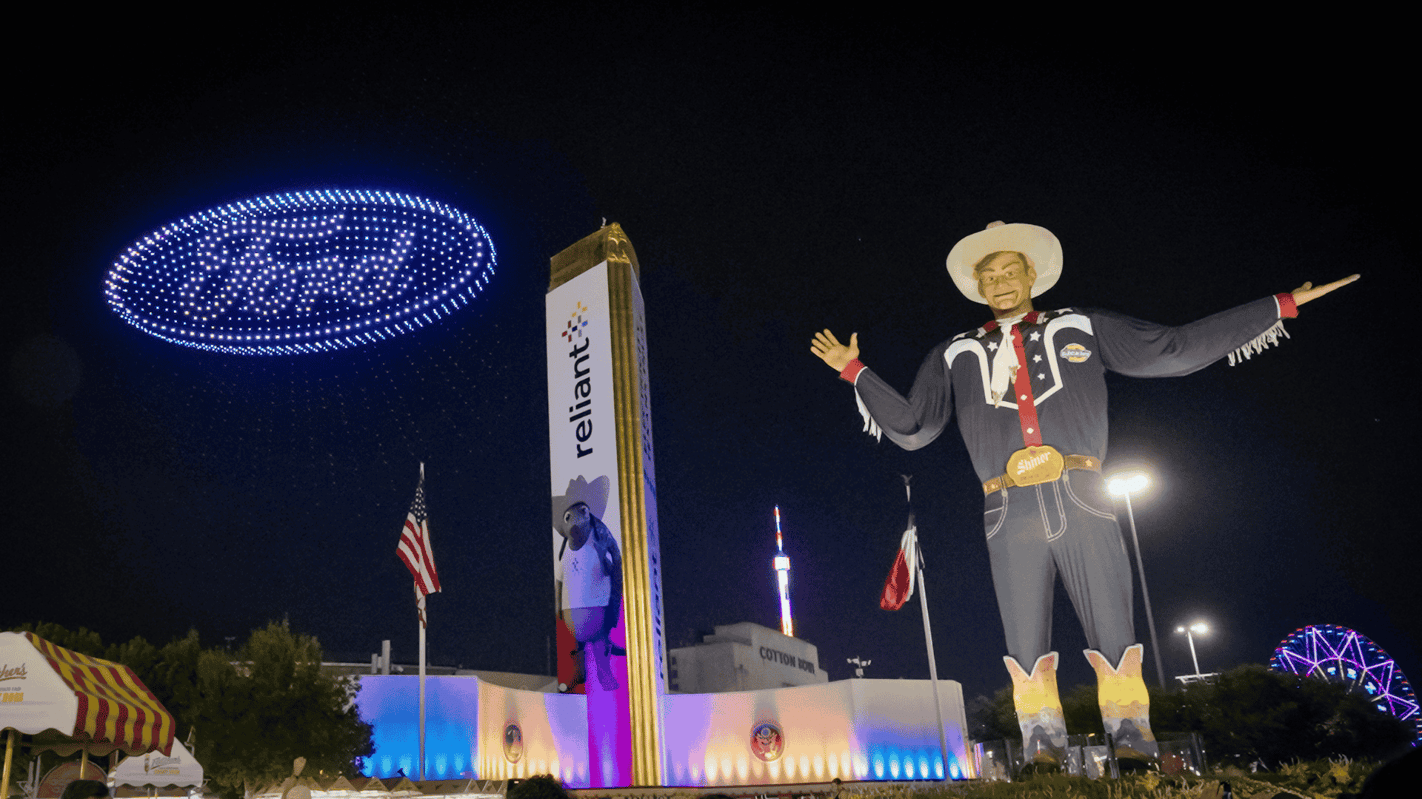
The cleanest argument for AI drone technology marketing applications is not a perfect logo floating above a skyline. It is a crowd looking up, phones recording, and then a measurable next action. Ford’s Expedition launch is useful for that reason: Sky Elements reports that a 1,500-drone show over Nashville reached more than 100,000 live attendees, generated more than 18 million social media views, and drove 102,917 attributable website visits through a QR code displayed in the drone formation.[1][2]
That last number is the one a budget meeting can actually use. It does not prove that every drone show converts, and it should be treated carefully because the figure comes from provider and marketing-industry reporting rather than an independent audit. But it does show what the medium can do when the creative is connected to an action instead of stopping at applause.
What the strongest cases actually prove
Drone shows tend to be sold through the language of scale: drone counts, skyline size, celebrity audience, record-setting formations. Those details matter operationally, but they are not the business result. The better question is which job the show performed.
| Case | What it demonstrates | Why it matters for activation planning |
|---|---|---|
| Ford Expedition launch | Attribution | The QR code created a direct bridge from live spectacle to website visits. |
| Netflix Stranger Things Season 4 | Earned media reach | The formation became social content at a scale most live events never approach. |
| Mountain Dew rebrand | Repeatability | The same campaign idea moved across multiple markets in a compressed tour. |
Netflix’s Stranger Things Season 4 launch is the reach case. Sky Elements says the show used 5,000 drones over Fort Worth, Texas, to form a 600-foot-tall Vecna in the night sky; Sprinklr reports that the activation generated more than 131 million video views within 72 hours across social platforms.[1][2]
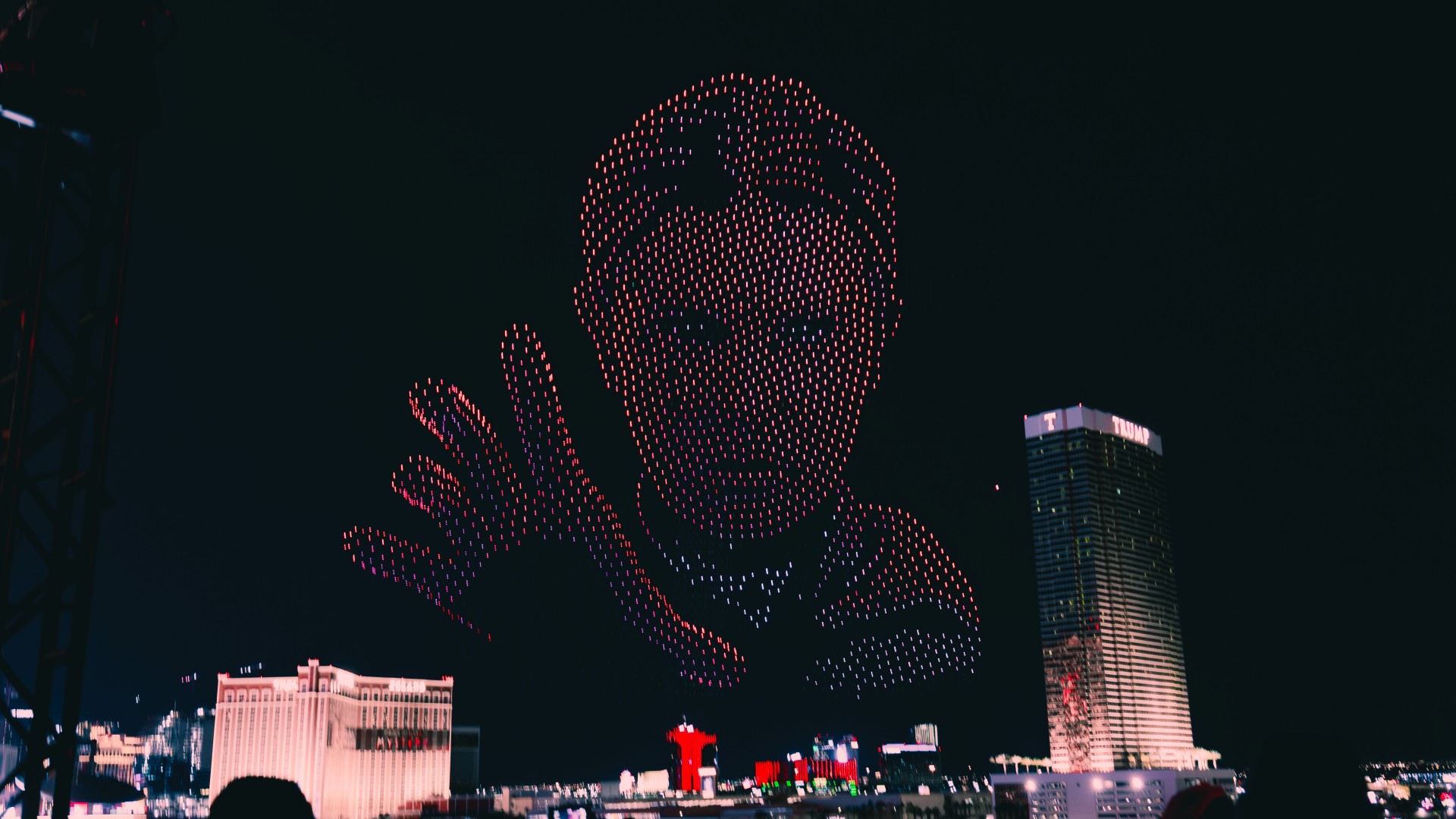
That is not a normal benchmark. It is a ceiling case, helped by a major entertainment property, a visually recognizable villain, and a built-in fan base already primed to share. The mistake would be to carry 131 million views into a forecast for a regional product launch. The useful lesson is narrower: when the aerial image is instantly legible and emotionally tied to existing demand, the show can become the media asset, not merely the event.
Mountain Dew’s rebrand points in a different direction. Sky Elements describes a four-city tour completed in seven days across Texas, Tennessee, Michigan, and Indiana, with state drone show records set in each location.[1] The strategic value here is less about novelty and more about repeatability. A national brand rarely needs one dazzling market if the rest of the launch plan cannot use the asset. A format that can be adapted city by city gives the activation team more than a single-night spike.
The medium is three different channels, depending on how it is built
A drone light show can work as a live event, an earned-media engine, or a conversion driver. Those are related outcomes, but they should not be blended into one soft claim about awareness.
- As a live event, the show earns attention by putting a shared visual moment above a crowd that is already gathered.
- As earned media, it has to be designed for capture: short sequences, vertical-friendly compositions, and one or two unmistakable images.
- As a conversion driver, it needs a next action that can be seen, scanned, remembered, or followed immediately.
Ford is valuable because the QR code made the action explicit. Netflix is valuable because the show was shaped around a character people already wanted to record. Mountain Dew is valuable because the activation was not trapped in one location. None of those cases suggests that simply increasing the drone count creates the business result.
This is where many proposals get slippery. “Viral” is not an outcome on its own; it is a distribution requirement. If the show is meant to travel beyond the live audience, the capture plan belongs in the creative brief from the start. That means preselected viewing angles, media crews positioned for the intended shot, a clip architecture that works without context, and a paid or owned-channel plan ready before the drones launch.
What AI actually contributes
The AI part of drone marketing is not magic dust sprinkled on aerial advertising. It is the coordination layer that makes readable branded formations possible at scale. Industry materials describe swarm intelligence algorithms coordinating large fleets autonomously, RTK GPS supporting centimeter-level positioning, and choreography software handling path optimization and collision avoidance so drones can move as a synchronized image rather than a loose cloud of lights.[1][3][4]
For marketers, that matters in practical terms. A product silhouette can resolve cleanly. A mascot can turn without becoming visual noise. A QR code can be held long enough for phones to recognize it. The brand does not need to understand the engineering in detail, but it does need to understand the constraint: the technology enables a short visual story, not a full presentation deck in the sky.
The strongest creative briefs tend to behave more like storyboards than media buys. They ask what the audience should notice first, what changes in the formation, what the final image asks them to do, and which three seconds will become the social clip. Event Marketer and Drone Show Software both emphasize brand storytelling and campaign integration rather than treating the drone fleet as a novelty display surface.[4][5]
Budget ranges that belong in the first planning conversation
The cost discussion should happen early, because the medium is not a cheap substitute for a social stunt. Flyby Guys gives operator-provided estimates of $60,000 to $80,000 for 100 to 150 drones, $150,000 to $200,000 for 300 to 500 drones, and $500,000 or more for shows using 1,000-plus drones.[3] These are not independent market benchmarks, and final pricing will depend on location, permitting, creative complexity, rehearsal requirements, travel, crew, and production capture.
| Drone count | Operator-provided cost range | Best fit |
|---|---|---|
| 100–150 drones | $60K–$80K | Local activations, compact logos, simple icons, smaller event moments |
| 300–500 drones | $150K–$200K | Product launches, more detailed transformations, stronger social capture |
| 1,000+ drones | $500K+ | National campaigns, entertainment launches, record-setting public moments |
Those ranges put drone shows closer to premium out-of-home, flagship experiential, or launch-event production than to a low-risk test channel. The comparison to premium OOH is useful only if the brand accounts for the difference in asset behavior. A billboard holds frequency in one place. A drone show concentrates attention into a short time window and depends on capture, sharing, and follow-through to extend its value.
That makes per-market planning especially important. A single $200,000 moment may be hard to defend if the only output is a logo reveal for people already attending an event. The same production logic becomes easier to argue when the show anchors a launch, supplies paid and organic social assets, gives PR a visual hook, and sends viewers toward a trackable destination.
Where the environmental claim is fair, and where it is too broad
Drone light shows are often positioned as a cleaner alternative to fireworks. The strongest version of that claim is specific: they have no combustion at the point of use, avoid the smoke and particulate burst associated with fireworks, and reduce fire risk in places where sparks and dry conditions are a real concern. Celestial and Flock Drone Art both frame drones as useful for brand activations partly because they can operate without fireworks-style pyrotechnic effects.[6][7]
The weaker version is the absolute “zero-emission” line. Charging fleets, manufacturing batteries, transporting crews, and powering production infrastructure still have environmental costs. For an activation recommendation, the defensible comparison is not “impact-free.” It is that drones can be safer and cleaner at the event site than fireworks, especially where air quality, noise, fire risk, or drought restrictions would make pyrotechnics difficult to approve.
The constraints are part of the creative medium
A drone show is not just a media format; it is an aviation operation with a theatrical deadline. Rain, high winds, and low cloud ceilings can cancel or compromise a show. The image needs darkness, which pushes the activation after sunset. Complex formations may require FAA approvals, with industry sources pointing to Section 333 exemption or Part 107 waiver planning and 90-plus-day lead times for complex formations.[6][7]
Message complexity is another hard limit. Viewers can only process so much text in the sky, and industry guidance warns that readable text at scale is limited to a few seconds.[6][7] That does not mean text is useless. It means the text has to behave like signage, not copywriting: a short URL, a QR code, a product name, a date, or a call to action simple enough to understand while the formation is still visible.
The approval path can also change the calendar. If the launch date is immovable and the venue is complicated, the activation team needs aviation feasibility before the creative is sold internally. A beautiful storyboard that cannot be flown is not a late-stage production issue; it is a strategy failure.
A practical decision rule
Use an AI drone light show when the campaign has a public moment worth amplifying, a short visual story, a realistic capture plan, and a measurable next action. The Ford example is the model for attribution, with the caveat that the reported result is provider-sourced. The Netflix example is the model for social reach, with the caveat that entertainment fandom changes the math. The Mountain Dew example is the model for repeatability, with the caveat that multi-market execution requires more planning discipline, not less.
Skip the format when the idea is only to put the logo in the sky. A logo can be part of the show, but it cannot be the whole strategy unless the only goal is a fleeting announcement. The better brief starts with the action after the crowd looks up: record this, scan this, share this, remember this launch, go here next.
Wonder still matters. The live crowd looking at the same impossible image is the reason the medium gets considered in the first place. But in a growth budget, wonder earns its place when it is attached to architecture: a story people can understand in seconds, assets the campaign can reuse, approvals the team can actually secure, and a result that survives the morning-after recap.
References
- Drone Shows for Marketing Campaigns, Branded Activations, Viral Advertising — Sky Elements
- How 3 Major Brands Are Using Drone Marketing to Reach New Heights — Sprinklr
- Drone Show Advertising: Aerial Solutions for Events and Brands — Flyby Guys
- Marketing with Drones: Branding, Launches & Experiences — Drone Show Software
- Drone Shows: The New Face of Brand Storytelling — Event Marketer
- The Benefits of Drone Light Shows for Brand Activation — Celestial
- The experiential marketing revolution for brands: drone shows — Flock Drone Art

Comments
Join the discussion with an anonymous comment.