
What the 2026 Data Actually Says About AI Copywriting ROI
Backed by 2026 survey data, this article maps where AI copywriting pays back fastest (drafting, personalization) and where it falls short, giving marketing managers the evidence they need to allocate budget and justify human editing as a non-negotiable cost.
The budget question around copywriting artificial intelligence tools has changed. In early 2024, a manager could still be asked whether generative AI belonged in the marketing workflow at all. By Q2 2026, that argument is mostly over: 87% of marketers use generative AI in at least one recurring workflow, up from 51% in early 2024.[1] The live question is now more uncomfortable and more useful: which copywriting jobs deserve funding, and which ones are being carried by the halo effect around AI?
A blended AI copywriting ROI number does not help much in a planning meeting. It hides the difference between using AI to draft a product education article, generate personalized email variants, summarize audience research, spin up paid social concepts, or produce video scripts and assets. Those are not the same activity, and the 2026 benchmarks show they do not return the same money.
The ROI Is Real, but It Is Not Evenly Distributed
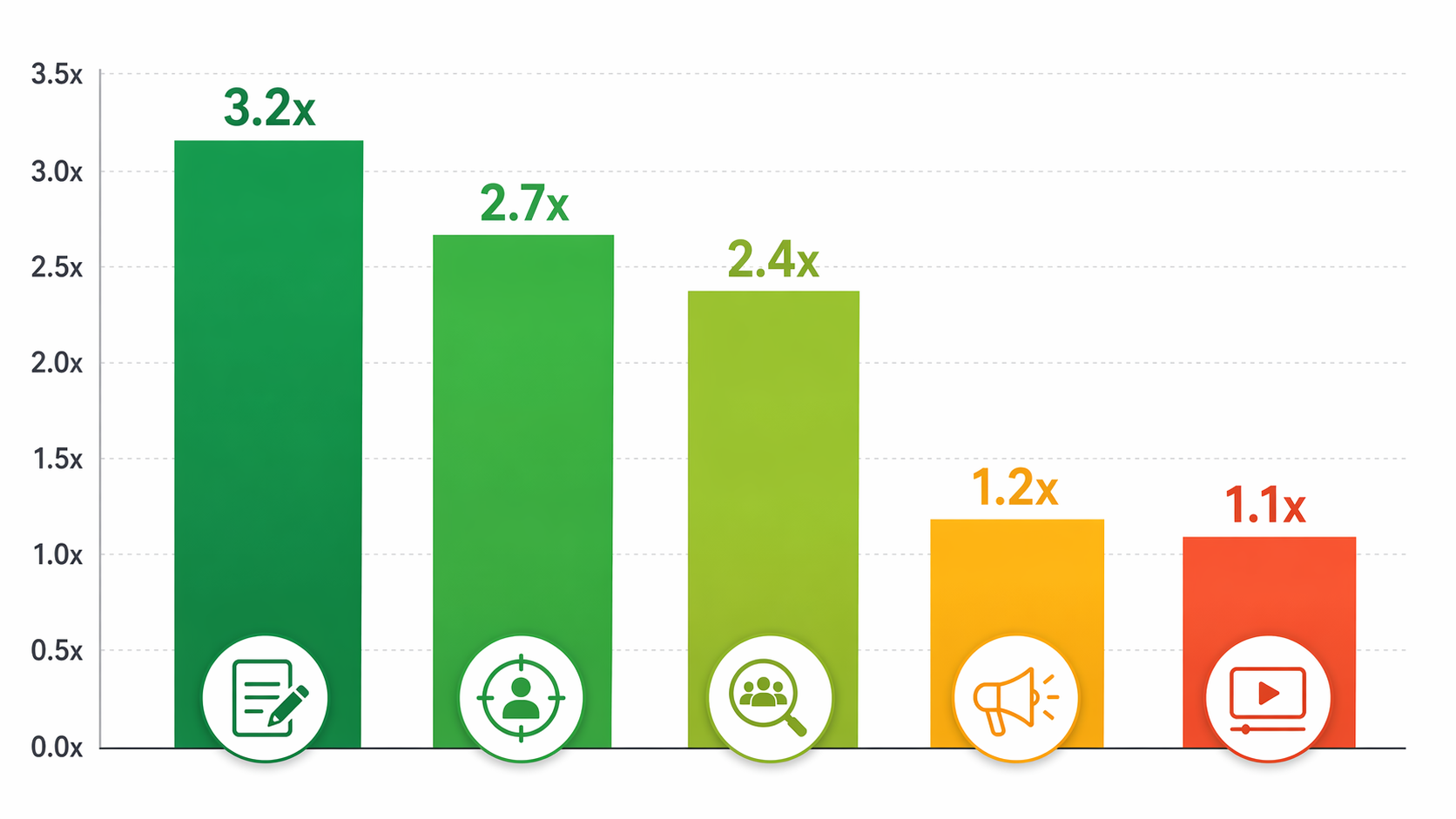
The cleanest starting point is the use-case split. McKinsey’s 2026 Global AI Survey data, as reported by Digital Applied, puts content drafting at a 3.2x median ROI, with an interquartile range of 2.4x to 4.1x. Personalization follows at 2.7x, and audience research at 2.4x. Paid social creative comes in at 1.2x, while AI video is reported in the 1.1x to 1.6x range.[2]
| AI copywriting use case | 2026 median ROI benchmark | Budget interpretation |
|---|---|---|
| Content drafting | 3.2x median ROI; IQR 2.4x-4.1x | Strongest candidate for core workflow funding |
| Personalization | 2.7x median ROI | High-priority use case when the team has enough audience or CRM data to make variants meaningful |
| Audience research | 2.4x median ROI | Useful support function, especially for briefs, message testing, and segmentation inputs |
| Paid social creative | 1.2x median ROI | Treat as narrowly scoped experimentation unless internal performance data says otherwise |
| AI video | 1.1x-1.6x median ROI range | Do not fund on the same payback expectations as drafting or personalization |
Those figures are self-reported survey benchmarks, not controlled experiments. That matters. A respondent’s ROI calculation can include different labor costs, different attribution assumptions, and different definitions of AI-assisted work. Still, the gap between the categories is too large to ignore. Even if every number is treated as directional rather than absolute, drafting and personalization sit in a different investment class from paid social creative and AI video.
The practical reason is not mysterious. Drafting usually removes hours from a visible production path: brief interpretation, angle development, first-pass copy, variant generation, and repurposing. Personalization removes friction from a different bottleneck: adapting the same message to segments, accounts, lifecycle stages, or channels. In both cases, the team can often point to work that used to consume paid human time and now begins faster.
Paid social creative and AI video are harder to defend with the same math. Creative volume does not automatically become profitable media performance. Video also introduces production, review, brand, legal, and channel-fit costs that can erase the apparent savings from asset generation. The benchmark does not say those use cases have no value. It says they should not inherit the ROI expectations of drafting just because the same AI platform is involved.
Payback Has Improved, but the Use Case Still Decides the Story
The payback-period data helps explain why the budget conversation has become more aggressive. Gartner’s 2026 CMO Spend Survey reports a median AI tool payback period of 4.2 months, down from 7.8 months in 2024. The same source reports that 81% of CMOs expect AI tool spend to grow, with a median planned increase of 47%.[3]
A 4.2-month median payback period is useful for internal justification, but it should not be pasted into every AI copywriting request. A team using AI to increase the throughput of evergreen article drafts has a different path to payback than a team using AI to generate more short-lived ad concepts. A mature content operation with clear briefs, editors, subject-matter reviewers, and performance reporting can absorb AI output differently from a team that is still deciding what “good” copy looks like.
The better budget model starts with the workflow, not the tool. For drafting, the return may come from fewer hours spent reaching a reviewable first version. For personalization, it may come from expanding campaign variants without increasing production headcount at the same rate. For audience research, it may come from faster synthesis and better briefs. For paid creative and video, the return has to be proven closer to the channel outcome, because production speed alone does not guarantee revenue impact.
Editing Is Not a Caveat; It Is Part of the Cost
The strongest ROI categories are also the ones most likely to be mis-modeled. If the business case counts AI-assisted drafting time but ignores editing time, it is not measuring the workflow that actually ships.
Digital Applied cites a composite of 2026 HubSpot, Semrush, and Ahrefs studies showing that teams editing AI content at 20% or more of word count see 2.7x better organic traffic outcomes than teams editing less than 5%. The same composite reports that unedited AI content wins top-3 rankings 3.1x less often.[4]

That evidence should be handled carefully. The editing and ranking figures come from a composite source, and the individual study methodologies were not separately verified here. It would be too strong to treat the numbers as a universal law of search performance. But the directional lesson is consistent with how serious content teams already work: AI can accelerate the first pass, while competitive organic outcomes still depend on restructuring, fact-checking, brand judgment, internal expertise, and search-quality refinement.
This changes the ROI calculation. Human editing is not a decorative polish layer added after the savings have been booked. It is one of the costs required to capture the upside. A budget that funds the software but leaves no time for editorial review is not a lean AI workflow; it is an underfunded publishing process with a faster draft generator.
The work inside that editing layer is not merely grammar cleanup. Editors decide whether the argument is useful, whether claims are supportable, whether examples are too generic, whether the page adds anything beyond the current search results, and whether the voice fits the company’s actual market position. Those decisions are exactly where a lot of AI copywriting ROI is either protected or lost.
The Productivity Gain Is Larger for People Who Already Know the Work
HubSpot’s 2026 State of Marketing data reports that content marketers save 7.8 hours per week on average with AI. The split by experience level is more revealing: senior practitioners save 8 to 10 hours per week, while juniors save 3 to 4 hours.[5]
That gap complicates one of the easier AI stories. The tool does not simply make less experienced writers fast enough to replace experienced judgment. In many workflows, it appears to give the largest advantage to people who can quickly evaluate the output, reject weak angles, repair structure, sharpen positioning, and recognize when a plausible sentence is not a useful sentence.
For managers, this points to a different staffing model than “buy software, reduce writers.” AI-assisted copywriting can reduce low-value production drag, but the hours saved are easiest to convert into business value when someone senior can redirect them toward strategy, distribution, testing, subject-matter development, or higher editorial standards. If those hours simply become more mediocre pages, the productivity gain may not survive contact with performance reporting.
Headcount Data Shows Where the Pressure Is Moving
Gartner’s workforce data shows that 23% of agencies reduced junior copywriting headcount in 2025, and 31% plan further cuts in 2026. At the same time, senior content strategist roles grew 18%.[3]
That is not a victory lap for AI efficiency. It is a warning about where the work is being pushed. If junior drafting work contracts while senior strategy demand grows, then some of the ROI is coming from a reshaped labor mix, not just faster software. The organization still needs people to choose topics, interrogate claims, manage risk, understand audiences, and decide what should not be published.
There is also a pipeline issue hiding inside the numbers. If junior roles shrink too quickly, companies may save money in the current budget cycle while weakening the path that develops future editors, strategists, and content leads. The 2026 data supports a shift away from purely manual first-draft production. It does not prove that companies can safely remove the training ground for editorial judgment.
A Defensible 2026 Allocation Rule
A practical AI copywriting budget should separate core workflow funding from experimental funding. Content drafting and personalization deserve the first serious allocation because the 2026 ROI benchmarks are strongest there. Audience research can sit close behind when it improves briefs, segmentation, or message development. Paid social creative and AI video should be funded with narrower tests, clearer channel metrics, and lower default payback expectations unless the company has stronger internal evidence.
- Fund drafting where the team can measure saved production hours and still maintain editorial review.
- Fund personalization where audience data, lifecycle stages, or account segments make variants commercially useful.
- Use audience research AI to improve briefs and synthesis, not as a substitute for market knowledge.
- Keep paid social creative and AI video in test budgets until internal performance data justifies broader spend.
- Include editing, fact-checking, and senior review time in the ROI model from the start.
This is also where AI copywriting should be separated from broader AI marketing ROI. A general AI program may include analytics, media optimization, sales enablement, service automation, and creative production. Copywriting has its own economics because the output still has to be judged by readers, reviewers, search systems, legal constraints, and brand standards. A fast draft is valuable only if the organization can turn it into useful published work.
The safest conclusion for 2026 is not that AI copywriting works everywhere or fails anywhere. The data supports a narrower and more durable rule: assign copywriting AI to the work where speed clearly reduces cost or expands useful variation, and measure the return with the human editing work still inside the cost.
References
- Salesforce State of Marketing 2026 — Salesforce
- McKinsey Global AI Survey 2026 — McKinsey via Digital Applied
- Gartner CMO Spend Survey 2026 — Gartner
- Composite of HubSpot, Semrush, Ahrefs 2026 studies — Digital Applied
- HubSpot State of Marketing 2026 — HubSpot

Comments
Join the discussion with an anonymous comment.