
5 AI-Powered Check-In Marketing Patterns That Drive Revenue
This article outlines five proven AI-driven marketing patterns for the airline check-in window, backed by real-world examples and sourced outcomes, to help travel marketers turn this high-intent moment into a revenue driver.
Why the check-in screen matters
Check-in is one of the few airline touchpoints where intent is already visible. The passenger has opened the app to complete a required task, not to browse, and most U.S. travelers already check in electronically, with more than half doing it on mobile [1]. That makes the check-in screen more useful than a generic home page: the airline can see timing, loyalty status, device context, disruption state, and consent choices before it asks for one more action. The question is not whether AI can personalize that moment, but which AI-powered pattern fits the data already in hand.
That is why check-in is different from broad in-app personalization. The traveler is not equally receptive at every minute of the journey, and recent airline app moves, such as Delta Concierge beta and American’s 2026 digital upgrades, point toward more decision points moving into the app even though they are still signals of direction rather than proof of outcome [10][4]. A practical check-in marketing program starts by matching the offer to the moment, then proving whether that moment actually changes behavior.
| Pattern | Check-in signal | What AI changes | Example source |
|---|---|---|---|
| Timing-based contextual offers | Early vs. late check-in | Surfaces premium add-ons only when the purchase context is still open | Mastercard case study [2] |
| Conversational upselling | How the traveler responds to an opener | Replaces a hard banner with a qualifying exchange | Hopper flow summary [3] |
| Loyalty mileage and status nudges | Mileage gap, boarding group, wallet status | Turns status into a concrete next action | American and Airship [4][5] |
| Proactive service recovery | Delay, misconnect, rebooking state | Bundles recovery with a relevant upgrade or compensation path | Amadeus, Air Canada, Icelandair [6][7] |
| Biometric consent gateway | Biometric opt-in and identity verification | Unlocks downstream personalization with explicit permission | Addepto, 1to1Media [8][9] |
Five AI-powered patterns, matched to the signal you have
1. Time the offer to the passenger’s purchase context
Mastercard’s Test & Learn analysis of a major airline found that passengers checking in three or more hours before departure were significantly more likely to buy lounge access than those checking in 90 minutes before departure [2]. That is useful because it splits one screen into two different contexts. Early check-in can still mean planning mode; late check-in usually means friction mode. AI does not need to infer the whole trip to use that distinction. It just needs to stop showing the same lounge offer to someone settled at home and to someone standing in security.
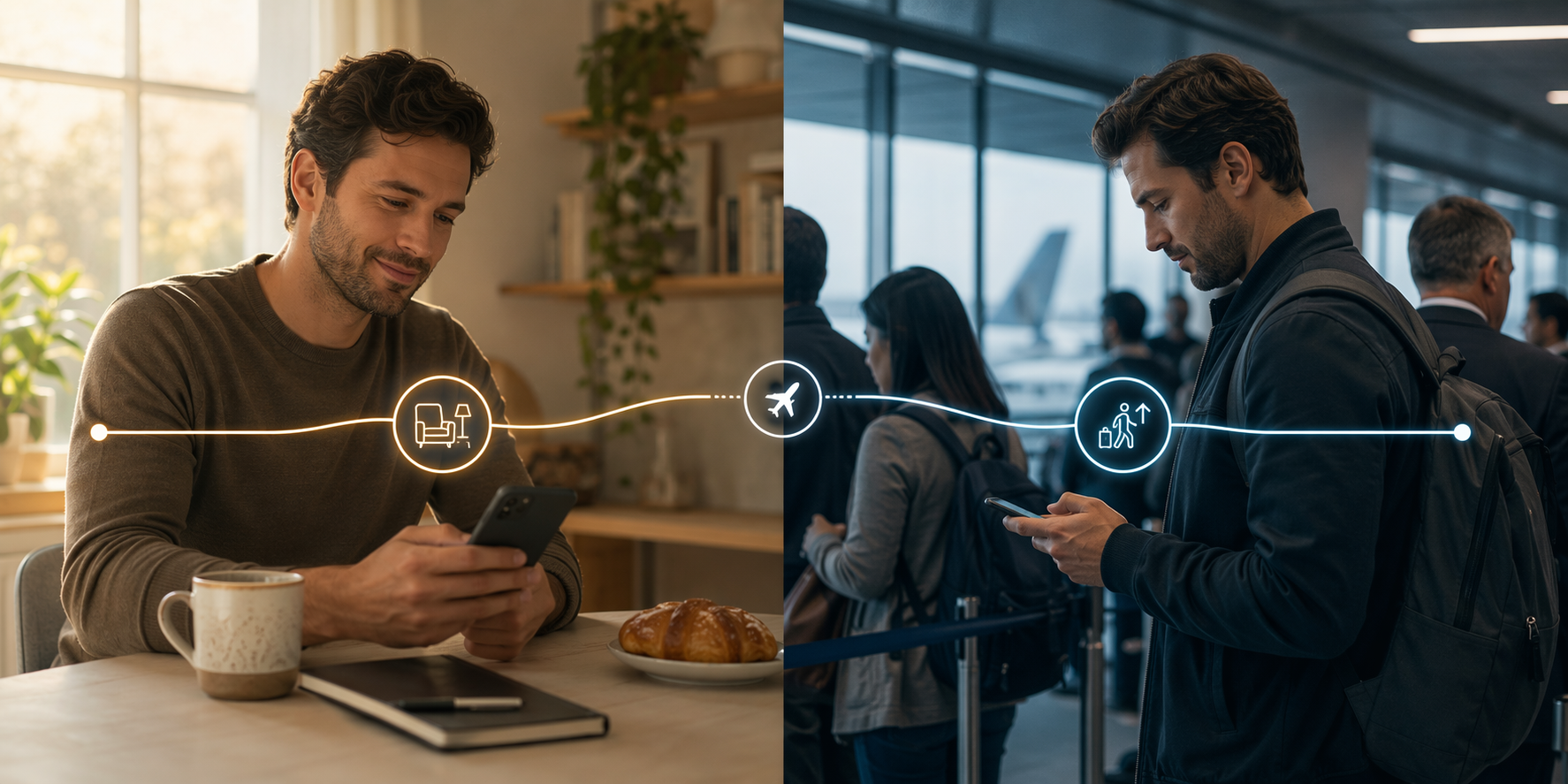
The operational move is to combine timing with the data already present in the flow: route, loyalty tier, device, recent behavior, and disruption state. Timing is the signal, not the whole explanation. Used that way, AI can decide whether to surface a premium add-on, suppress the offer, or route the traveler to help instead of pushing for a sale that no longer fits the moment.
2. Use a conversational opener before you use a direct upsell
Hopper’s conversational upsell flow is not an airline case, but it is a useful interaction pattern. In Diggintravel’s summary, conversational openers improved conversion by 40% and response rates by 200% over direct upsells, the overall flow achieved 3x higher conversion than user-initiated searches, and 15% of engaged users upgraded at about $50 per passenger [3]. Those figures come from a pre-COVID OTA context, so they should be treated as directional design insight rather than airline-equivalent ROI.
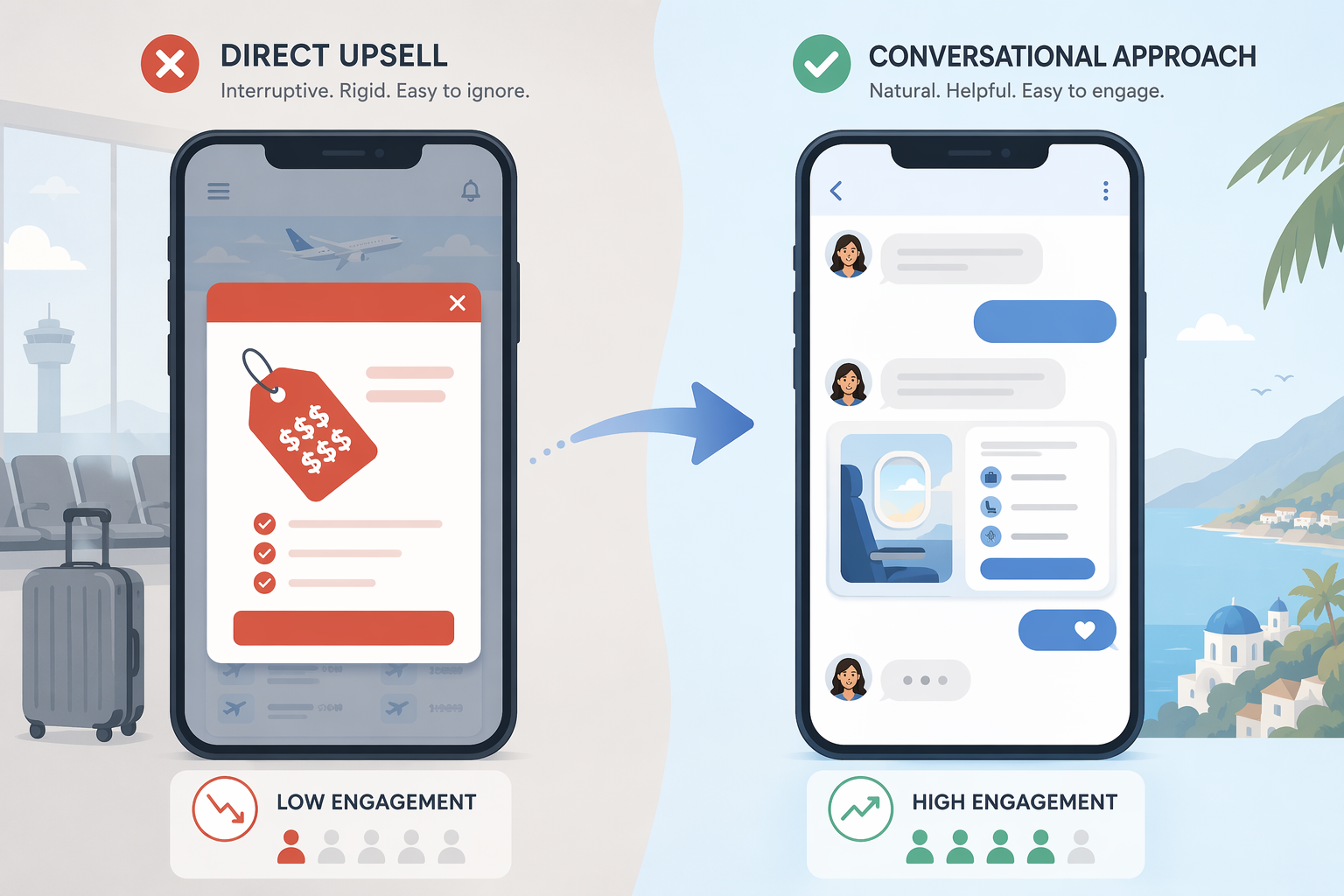
The lesson for airline check-in marketing is simple: earn the reply before asking for the purchase. A rigid banner that says buy now is usually competing with the task the traveler came to finish. A short, context-aware opener can qualify intent, reduce resistance, and move the passenger toward the right next step—seat, bag, lounge, or reassurance—without pretending every traveler is in a shopping mindset.
3. Turn loyalty status and mileage gaps into specific actions
American Airlines’ April 2026 mobile check-in changes let AAdvantage members buy miles at a lower cost and purchase Group 4 priority boarding inside the check-in flow [4]. Airship’s mobile wallet approach pushes the same logic one layer lower: keep the loyalty card current, deliver the offer in-wallet, and use check-in to surface a status or mileage action while the traveler is already looking at the trip [5].
This pattern works when the airline makes the ask feel specific. A mileage top-up is only relevant when the gap is small enough to matter. Priority boarding is only relevant when the traveler actually cares about boarding order. The value is not the number of offers shown; it is the fit between the status signal and the next action.
4. Bundle recovery before you bundle retail
This is the pattern that changes the tone of the whole discussion. When the system is disrupted, the airline is not dealing with a shopper first. Amadeus’ Passenger Recovery System, used by Air Canada, auto-rebooks 90% of disrupted passengers within 10 minutes versus up to 12 hours manually [6]. That speed creates room for relevant monetization, but only after the passenger has a stable plan again.
Icelandair’s head of ancillary revenue called day-of-travel a “critical retailing stage” where disruption-aware offers and intelligent upsell merge [7]. The practical reading is not to sell harder during chaos. It is to bundle rebooking, compensation, and a clearly useful upgrade or service option so the commercial move is attached to recovery rather than detached from it.
5. Treat biometric check-in as a permission layer, not a magic trick
One industry summary of the 2024 IATA Global Passenger Survey says 73% of travelers prefer biometric processing over manual checks, with the strongest willingness among under-25 passengers [8]. That does not mean travelers blindly trust AI. 1to1Media’s June 2026 report calls out the paradox directly: passengers may embrace biometric tools while still being skeptical of AI itself, which means the experience has to make opt-in, transparency, and escalation obvious [9].
Used well, biometric check-in is less a personalization engine than a consent gateway. It can make downstream retail more relevant, but only if the airline is explicit about what the biometric step unlocks and where the traveler can slow down, talk to a human, or opt out without losing control. A vendor-reported Singapore Airlines program summarized by Addepto, for example, says a 28-touchpoint personalization platform produced +23% customer satisfaction and +17.5% ancillary revenue, but those figures should be read as self-reported rather than independently verified [8].
The cleanest airline check-in marketing programs do not start with a model; they start with the signal already on the screen. Timing tells you whether to offer or suppress. Conversation tells you whether the traveler is open to dialogue. Loyalty tells you whether a small reward or a status nudge is enough. Disruption tells you whether the only sensible move is service recovery. Biometrics tell you whether the airline has earned enough permission to personalize the next step. The lift comes from matching the pattern to the moment, not from blanketing the flow with automation.
References
- “3 ways AI is improving airline apps” — Cognizant
- “Driving growth with airline ancillaries” — Mastercard
- “Personalization for airlines” — Diggintravel
- “American’s digital upgrades put more control at customers’ fingertips” — American Airlines Newsroom, Apr. 2026
- “Airline customer experience on mobile grows customer loyalty and revenue” — Airship
- “AI traveler journey” — TNMT, Feb. 2026
- “Top ancillary retailing trends to watch in 2026” — Future Travel Experience, Feb. 2026
- “Hyper-personalization in aviation and airline industry: AI use cases beyond basic recommendations” — Addepto / WJARR, 2025
- “Report: How AI is elevating the airline passenger experience” — 1to1Media, June 2026
- “Delta Concierge now beta rollout” — Delta News

Comments
Join the discussion with an anonymous comment.