

What AI Bat Tracking Means for Baseball Sponsorship Strategy
AI-powered bat tracking from Statcast, Blast Motion, and Theia is creating new sponsorship inventory and content marketing opportunities for brands. This article explains how to evaluate these data layers and build an activation strategy that outperforms traditional sponsorship approaches.
Baseball sponsorships have always had a measurement problem hiding inside a storytelling business. A brand can buy signage, receive broadcast exposure, collect social posts, and leave the season with a recap that says impressions were delivered. The harder question is whether the brand owned anything fans actually noticed at the moment baseball became interesting.
AI bat tracking changes that conversation because it creates a new class of sponsorable moments: not just a logo near the field, but a measurable swing event that broadcasters, teams, players, and fans can understand almost immediately. Bat speed, squared-up rate, blast rate, and swing length are not abstract analytics reserved for front offices. They describe the thing every fan is already watching: how violently and efficiently a hitter attacks the ball.
That does not mean brands are already lining up to sponsor every Statcast bat-tracking leaderboard. There is no documented public case yet of a brand directly owning an MLB Statcast bat-tracking metric as a named sponsorship asset. The opportunity is earlier than that. The useful work now is to understand which data layer a sponsor can access, what kind of inventory it can create, and how it improves the evidence behind a partnership recap.
The Sponsorship Problem Bat Tracking Actually Solves
Traditional exposure valuation tends to reward what is easy to count: how long a logo appeared, how large it was, whether a broadcast camera captured it, and how many viewers were estimated to be watching. Those inputs still matter. Finance teams will not stop asking for media value, and rights holders will not stop packaging visible inventory. But baseball’s newer measurement layer lets a brand attach to a performance event rather than only to the surface around it.
The reason that matters commercially is straightforward. A sponsor tied to a generic in-game read may need volume to justify the spend. A sponsor tied to the hardest swing of the night, the most efficient contact of the week, or a player’s swing adjustment across a homestand has a sharper reason to exist. The brand is not merely present during the game; it is helping package the moment fans want replayed, debated, clipped, and explained.
AI sponsorship measurement vendors are already making the broader argument that automated analysis can change valuation. Playbook Sports reports that AI-powered logo detection valued sponsorship exposure 42% higher than manual methods in a Premier League beverage brand case study, with 85% more accurate media value calculation; the same report says 67% of brands report better sponsorship decisions with AI insights and 53% see ROI increases from AI optimization.[1] Those numbers are useful directional evidence, not a universal law. They are vendor-sourced, tied to a non-baseball case, and should not be treated as proof that every deal becomes more valuable once AI appears in the deck.
Still, the sponsorship logic carries over. If automated systems can identify exposure more consistently, and baseball can now identify swing events more precisely, the next question for a brand is not whether bat tracking is interesting. It is whether the metric can be turned into sellable inventory, repeatable content, and a defensible post-season valuation model.
Three Data Layers, Three Different Commercial Uses
The mistake is to treat “bat tracking” as one product category. For marketers, the important distinction is not the technical elegance of the system. It is where the data appears, who controls the surface, and how close the brand can get to the player or fan experience.
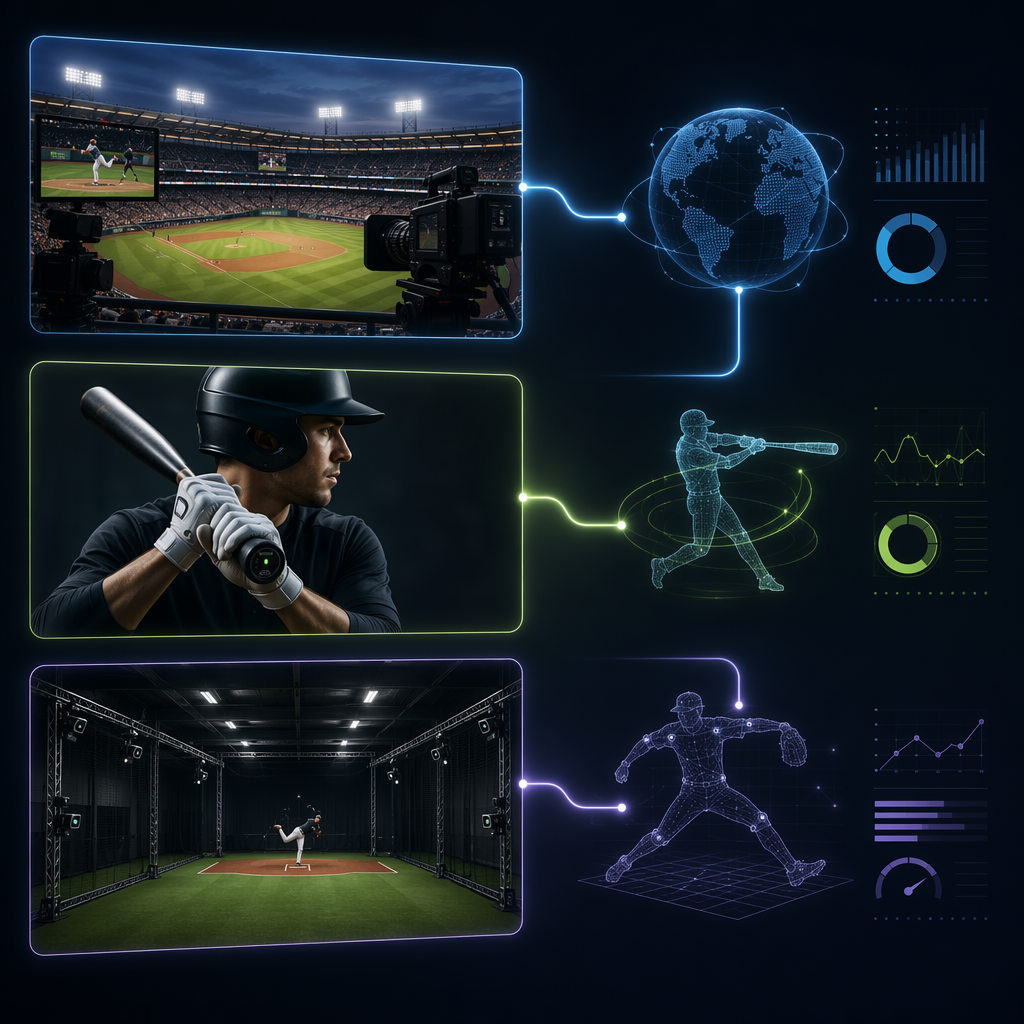
| Data layer | Best marketing use | Commercial maturity |
|---|---|---|
| League-wide Statcast bat tracking | Broadcast-adjacent segments, social content, leaderboards, sponsored in-game moments | Strongest for scalable MLB-facing content because metrics are public, daily, and already fan-facing |
| Blast Motion sensor data | Branded player development stories, youth baseball experiences, swing challenges, event activations | Proven activation pathway from sensor data to scoreboard and broadcast surfaces, though the original MLB deal dates to 2016 |
| Theia markerless facility tracking | Training-environment content, academy partnerships, biomechanics storytelling, future facility activations | Promising but early for baseball marketing; stronger today as a training and partner-content layer than a proven MLB sponsorship product |
Statcast: The Scalable Broadcast Layer
Statcast is the layer with the cleanest sponsorship logic because it already lives where fans are watching. MLB’s system captures 15 million data points per game across 30 ballparks using five Hawk-Eye cameras in each park, with data processed through Google Cloud infrastructure including BigQuery, Gemini, and Vertex AI.[2] MLB’s public bat-tracking metrics include bat speed, squared-up rate, blast rate, and swing length, and those metrics are updated daily on Baseball Savant.[3]
That scale matters more than novelty. A brand manager does not have to convince leadership that the data exists in a private pilot somewhere. The metrics are already part of MLB’s statistical language. They can support weekly social franchises, broadcast explainers, MLB.com-style editorial integrations, and rights-package clauses that define what happens when a sponsored threshold is hit.
A “blast rate” integration, for example, should not be sold as a magic new ad unit. It should be sold as a recurring content trigger. When a player combines high bat speed with squared-up contact, the sponsor has a reason to appear in the replay, the social cutdown, the postgame graphic, or the next-day leaderboard. The metric gives the activation a rule, and rules are what make sponsorship inventory easier to value.
Blast Motion: The Product and Participation Layer
Blast Motion offers a different kind of commercial lesson. MLB named Blast Motion its “Official Bat Sensor” partner in a deal dating to 2016, and the company’s swing metrics were integrated into All-Star Futures Game scoreboards and select television broadcasts.[4] The company has since been acquired by WIN Reality, so old deal terms should not be treated as current market guidance. The enduring point is structural: sensor data moved from a device to a fan-facing display.
That path is useful for brands that want more participation than a Statcast segment can provide. A bat sensor can power a youth clinic challenge, a retail demo, a spring training fan zone, or an athlete-led swing breakdown. The fan does not just watch a leaderboard. The fan takes a swing, sees a number, and compares it with a professional benchmark. For a sporting goods brand, training app, beverage, insurance company, or regional bank sponsoring youth baseball, that is a more tangible bridge between MLB performance and community activation.
Theia: The Training Environment Layer
Theia sits earlier in the commercial curve. Its markerless bat-tracking module was announced in January 2026 and tested on more than 300 athletes and more than 2,000 swings, with reported bat-plane error of less than 3 degrees.[5][6] Because the system does not require a sensor on the bat, the marketing promise is broader training-environment capture: facilities, academies, biomechanics labs, and development spaces where swing analysis can become content without asking the athlete to wear or attach hardware.
For now, that should be treated as an emerging partner-content layer rather than a mature MLB sponsorship product. A brand could imagine a sponsored training series showing how a prospect changes swing plane over an offseason, or a facility partnership where athletes receive branded reports after sessions. But those are opportunities to test, not documented mainstream baseball sponsorship formats.
How Bat Metrics Become Sponsorship Inventory
A metric only becomes inventory when someone can package it, repeat it, and sell it without making the audience feel like it has wandered into a product demo. Bat tracking is promising because its best metrics map cleanly to baseball moments fans already recognize.
- Bat speed can anchor “hardest swing” content, power-focused player comparisons, and real-time replay graphics.
- Squared-up rate can support efficiency storytelling, especially when a hitter is making better contact without necessarily chasing more home runs.
- Blast rate can identify the premium overlap between swing force and quality of contact, giving sponsors a cleaner trigger than raw exit velocity alone.
- Swing length can help explain adjustments, slumps, and player development without requiring fans to understand a full biomechanics model.
The activation design should start with the broadcast or content behavior the sponsor wants to own. A brand seeking national visibility would likely prefer Statcast because the metrics are league-wide and already updated daily.[3] A brand seeking hands-on engagement with young athletes may get more value from sensor-based experiences modeled on Blast Motion’s path from swing capture to scoreboard and broadcast display.[4] A brand trying to build credibility in performance training may watch Theia closely, but should not overstate current baseball sponsorship adoption.
The best use cases are usually simple. A “Swing of the Game” segment can be triggered when a batter reaches a defined bat-speed threshold. A weekly social leaderboard can rank the most efficient swings by squared-up rate. A player development series can show how a hitter shortened swing length over a month. A ballpark fan experience can let attendees take a swing and receive a branded comparison to an MLB benchmark. None of these needs to pretend the sponsor caused the performance. The brand’s role is to make the moment legible and repeatable.
That distinction protects the activation from the worst kind of analytics sponsorship: a brand logo pasted onto a number with no editorial purpose. The sponsor should own a question fans care about. Who generated the most explosive swing tonight? Which hitter is making the cleanest contact this month? Which prospect changed the shape of his swing? The metric gives the content discipline; the brand receives association with the answer.
What Changes in Valuation
For a sponsorship manager, the strongest argument for bat tracking is not that it sounds advanced. It is that it can make the recap less dependent on loose equivalency math. A rights package can define the content unit, the trigger, the distribution surface, and the measurement plan before the season begins.
| Traditional asset | Bat-tracking version | What improves in the recap |
|---|---|---|
| Sponsored replay | Replay appears when bat speed or blast rate crosses an agreed threshold | The sponsor can count qualified performance moments, not just total mentions |
| In-game feature | Segment explains a hitter’s squared-up rate or swing length trend | The content has a measurable subject and can be clipped for social distribution |
| Leaderboard | Daily or weekly Statcast bat-tracking leaderboard | The asset can be tracked across games and compared against engagement benchmarks |
| Fan activation | Sensor or facility experience gives fans their own swing metrics | The sponsor can measure participation, completion, opt-ins, and repeat use |
This is where AI measurement and baseball performance data can reinforce each other. Automated media valuation can help identify how often and where the sponsor appeared. Bat tracking can define why the sponsor appeared. The combination is more defensible than either layer alone: exposure analysis handles visibility, while the swing metric handles relevance.
The practical valuation model should separate at least four outputs: media exposure, content engagement, qualified event volume, and owned-data capture. A Statcast-sponsored social series may be judged on qualified swing events and engagement. A ballpark swing challenge may be judged on participation and opt-ins. A training facility partnership may be judged on athlete usage, content production, and coach or player endorsement rights. Lumping those together under “AI activation” makes the deal harder to defend, not easier.
The market context supports experimentation without requiring hype. The smart baseball bat sensor market was valued at $245.8 million in 2025 and is projected to reach $612.3 million by 2034, an 11.2% compound annual growth rate.[7] That growth does not prove that MLB sponsorship teams will immediately monetize bat tracking. It does suggest that swing measurement is moving beyond a niche coaching tool into a broader baseball technology category.
The Content Layer Is Getting Easier to Operate
One reason bat tracking deserves attention now is that the content operation around baseball is becoming more personalized and automated. Adobe’s expanded MLB Opening Day presenting sponsorship for 2026 through 2028 embeds GenStudio, Firefly Custom Models, and the LLM Optimizer into MLB’s marketing operations to generate personalized fan content at scale; eMarketer also cites Basis Technologies data that 12% of North American marketing and advertising professionals already use Adobe Firefly.[8]
That partnership is not a documented bat-tracking sponsorship. Its importance is operational. If MLB and its partners are building faster systems for personalized creative, then bat-tracking data becomes a plausible input into content templates: a local fan receives a highlight built around a home-team hitter’s hardest swing; a youth baseball audience receives a simplified swing-speed explainer; a sponsor receives versions of the same metric-led creative across email, social, app, and ballpark screens.
For agencies, this is where the activation stops being a one-off idea and becomes a repeatable operating model. The team needs a data trigger, a creative template, a rights-approved claim, a distribution plan, and a measurement dashboard. Bat tracking supplies the trigger. AI creative tools can help version the asset. Sponsorship analytics can evaluate whether the content delivered more than a standard post or broadcast read.
Choosing the Right Access Level
The cleanest decision framework begins with the sponsor’s commercial need, not the technology vendor. A national brand looking for scalable association with MLB performance should start with public, broadcast-visible Statcast concepts. A brand with a product, app, clinic, or youth participation strategy should examine sensor-based activation. A performance or training brand can explore markerless facility tracking, while acknowledging that the baseball marketing proof is still thin.
- Choose Statcast when the goal is reach, broadcast adjacency, social velocity, and rights-package clarity.
- Choose Blast-style sensor activation when the goal is participation, player development storytelling, or fan swing measurement.
- Choose markerless facility tracking when the goal is training credibility, athlete content, or a future-facing innovation platform.
- Avoid claiming a mature sponsorship category where only adjacent precedent exists.
Rights language should be just as specific. Instead of asking for “AI-powered baseball content,” a sponsor should ask for ownership of a defined metric, a defined content format, a defined number of posts or segments, and access to performance and distribution reporting. If the activation depends on a threshold, the agreement should say what happens when the threshold is not hit often enough. That protects both sides from make-good arguments built on vague expectations.
Measurement should also respect the difference between adoption and effectiveness. The fact that a metric is available daily does not mean fans will engage with it. The fact that a swing sensor can produce a number does not mean a sponsor has earned brand lift. The test is whether the data improves a specific sponsorship decision: what to buy, what to renew, what content to scale, which audience to target, or which asset to cut.
What to Test Before the Category Gets Expensive
The first pilots do not need to be large. A sponsor can test a Statcast-led weekly social feature with one team. An agency can compare engagement on a bat-speed explainer against a conventional player graphic. A ballpark activation can measure whether fans who take a sensor-based swing are more likely to opt into a sponsor offer than fans who pass a static display. A training partner can produce a short athlete-led swing series before committing to a larger facility buildout.
The useful tests will answer commercial questions, not technology questions. Did the metric create a repeatable content franchise? Did the sponsor receive enough qualified moments to justify ownership? Did the data help the sales team price the asset? Did the recap give finance something better than estimated impressions? Did fans understand the metric without a long explanation?
Bat tracking is not yet a mature sponsorship category with a shelf full of public brand case studies. That is exactly why it is worth careful attention now. Statcast has made swing metrics visible at league scale. Blast Motion showed that swing data can move from player-worn technology to scoreboard and broadcast surfaces. Theia points toward a training environment where markerless capture may expand the canvas. The brands that start testing valuation models, content triggers, and rights-package language now will be better prepared when this inventory becomes obvious enough for everyone else to price.
References
- Top 10 Metrics for Measuring Sponsorship ROI with AI, Playbook Sports, https://www.callplaybook.com/reports/top-10-metrics-for-measuring-sponsorship-roi-with-ai
- Major League Baseball uses Google Cloud to predict and display real-time, game-changing insights, Google Cloud, https://cloud.google.com/customers/major-league-baseball
- What you need to know about Statcast bat tracking, MLB.com, https://www.mlb.com/news/what-you-need-to-know-about-statcast-bat-tracking
- MLB names Blast Motion official bat sensor amid tech push, Fox Business, https://www.foxbusiness.com/features/mlb-names-blast-motion-official-bat-sensor-amid-tech-push
- Theia unveils AI bat tracking for 3D baseball swing analysis, IT Brief, https://itbrief.news/story/theia-unveils-ai-bat-tracking-for-3d-baseball-swing-analysis
- Theia introduces bat tracking product to better analyze batter biomechanics, Sports Business Journal, Dec. 11, 2025, https://www.sportsbusinessjournal.com/Articles/2025/12/11/theia-introduces-bat-tracking-product-to-better-analyze-batter-biomechanics/
- Smart Baseball Bat Sensor Market, DataIntelo, https://dataintelo.com/report/smart-baseball-bat-sensor-market
- How Adobe and MLB are using AI marketing tools to reshape the ballpark fan experience, eMarketer, https://www.emarketer.com/content/how-adobe-mlb-using-ai-marketing-tools-reshape-ballpark-fan-experience

Comments
Join the discussion with an anonymous comment.