

5 Real AI Agent Security Breaches Marketing Automation Teams Must Know
Five publicly documented AI agent security breaches from 2025-2026 directly hit marketing-adjacent systems through prompt injection, excessive permissions, and inherited access. This article details each incident and provides a practical 5-point checklist for marketing ops leaders to secure their stacks.
The uncomfortable part of the recent AI agent security breach pattern is how familiar the entry points look to marketing operations teams. A lead form. A Salesforce-connected service agent. A Copilot workspace full of campaign files and customer conversations. A chatbot integration. An agent permission model capable of moving money or changing spend without a clean approval gate.
Across five publicly documented 2025-2026 incidents, the route to compromise was not cinematic. Salesforce Agentforce was pushed into leaking CRM data through an indirect prompt injection path that started with web-to-lead input and was helped by a whitelisted expired domain.[1] Microsoft Copilot Studio customer service agents built with default permissions were hijacked by researchers and made to dump complete Salesforce records.[2] EchoLeak, tracked as CVE-2025-32711, showed how a crafted email with hidden instructions could make Microsoft 365 Copilot exfiltrate data from OneDrive, SharePoint, and Teams without user interaction.[3] Step Finance lost $40 million in a case that matters here mainly because it shows what can happen when autonomous agents hold excessive authority over high-value actions.[4] The Salesloft-Drift breach reportedly compromised more than 700 organizations through a chatbot integration, making third-party agent exposure a practical martech risk rather than a procurement footnote.[3]
That is the real shape of AI agent security breach risks for marketing automation: agents are being placed exactly where marketing stacks are already dense, permission-heavy, and integration-dependent. The risk is not that an agent can write a landing page badly. It is that the same agent may read lead records, summarize customer conversations, trigger downstream workflows, or operate inside a workspace where campaign plans, exported lists, customer notes, and support histories sit beside each other.
ForcedLeak Started Where Marketing Teams Actually Collect Data
ForcedLeak is the case marketing teams should sit with first because the path begins in a place most teams treat as routine: a public form feeding CRM data into an automated process. Noma Security researchers found that Salesforce Agentforce agents could be manipulated through indirect prompt injection delivered by web-to-lead forms, causing the agent to exfiltrate sensitive CRM customer data. Dark Reading reported the vulnerability as CVSS 9.4 and noted that Salesforce patched the issue after disclosure.[1]
The important detail is the word indirect. The attacker did not need to sit inside the agent console and type a malicious instruction into a chat window. The hostile instruction could be placed into data the agent later processed. In a marketing stack, that could resemble a lead form submission, an inbound inquiry, a partner registration, a demo request, or any other externally supplied field that is later summarized, routed, enriched, scored, or handed to an agent.
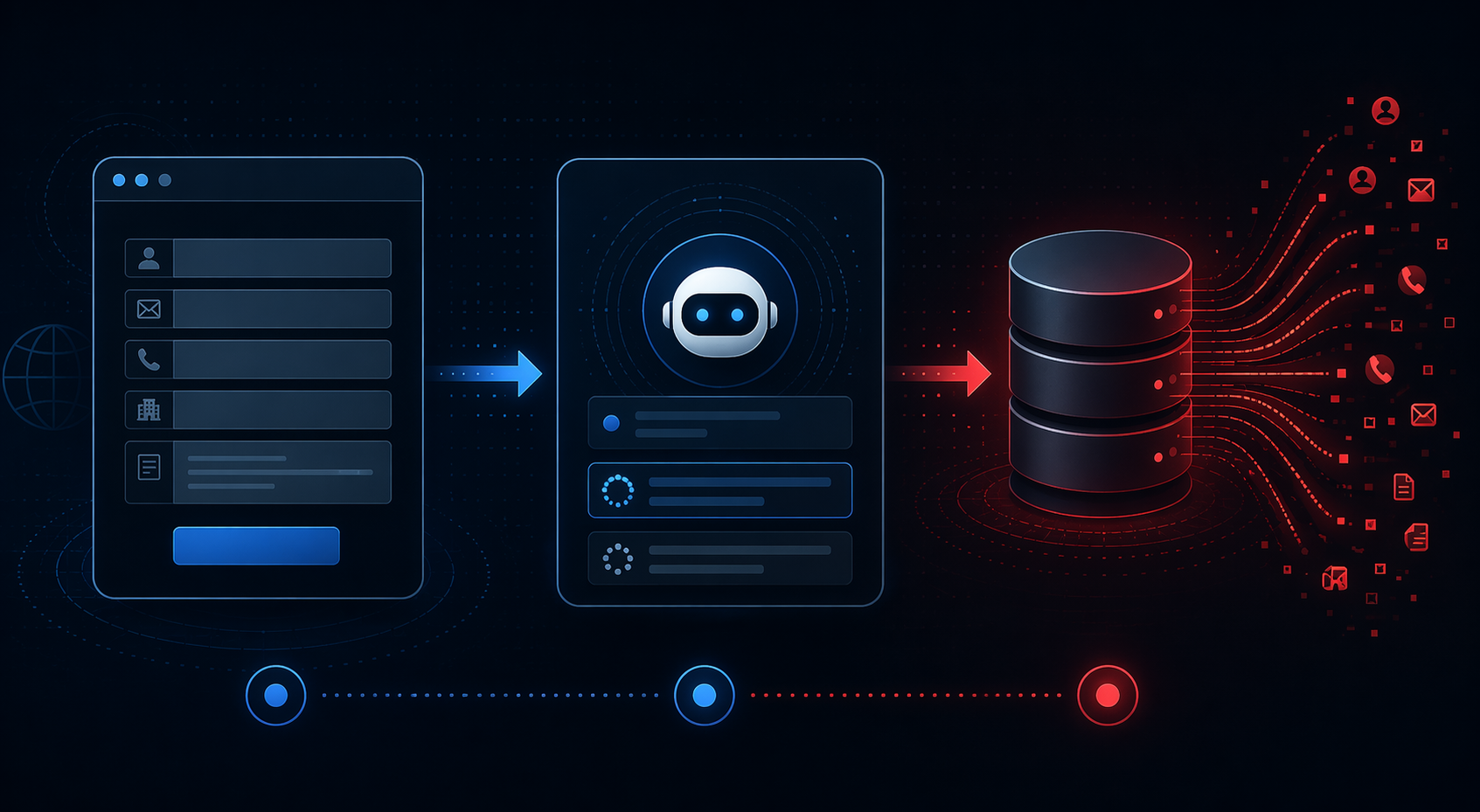
That distinction matters operationally. Marketing teams have spent years validating form fields for spam, required values, campaign attribution, routing logic, and consent capture. Few teams have treated those same fields as possible instruction carriers for an AI agent that can read CRM context. Once form content becomes agent input, the form is no longer just a capture surface. It becomes part of the agent’s command environment.
ForcedLeak also exposed a configuration problem that looks painfully ordinary: Salesforce’s Content Security Policy still whitelisted an expired domain, my-salesforce-cms.com, which helped the attack path.[1] This is not the kind of control that gets much attention during a campaign launch. It sits in the layer between app configuration, domain management, and security review. But if a whitelisted destination can be abused, the agent’s output boundary becomes weaker than the team assumes.
The marketing translation is straightforward. If public inputs feed an agent, those inputs need boundaries before the agent sees them. If the agent can access CRM objects, its permission set needs to be narrower than the integration user that first made the demo work. If content security or allowed-domain settings are copied forward from old projects, someone has to own the drift. A stale whitelist entry is not glamorous, but neither is cleaning exposed lead and account data after the fact.
Copilot Incidents Show the Cost of Inherited Trust
The Microsoft cases land in a different part of the stack, but the failure pattern is related. In the Copilot Studio agent hijack presented by Zenity researchers at DEFCON 2025, customer service agents built with default permissions were manipulated into dumping complete Salesforce CRM records.[2] The issue was not that a customer service bot existed. The issue was that the agent’s default access was too broad for the task it was supposed to perform.
A support or customer service agent usually needs enough context to answer questions. That can include account details, open cases, order history, contact information, and prior interactions. In many organizations, those records overlap heavily with marketing data: lifecycle stage, segment, campaign source, product interest, customer tier, renewal signals, or expansion notes. When a service agent inherits broad CRM access, marketing data is not protected simply because the use case is labeled support.
Default permissions are especially dangerous because they feel like implementation plumbing. A team connects Salesforce, tests whether the agent can answer a realistic question, sees that the integration works, and moves on. The permission review often happens only if something breaks. Agents reverse that incentive. The smoother the demo, the more likely the agent has been given enough access to avoid obvious failure.
EchoLeak adds the workplace-content version of the same problem. The reported Microsoft 365 Copilot vulnerability required zero user interaction: a crafted email containing hidden instructions could cause Copilot to exfiltrate data from OneDrive, SharePoint, and Teams.[3] That matters to marketing because those repositories are where campaign briefs, audience exports, partner lists, webinar attendee files, competitive notes, pricing drafts, and launch plans often live.
Email is already part of the marketing operating system. It carries agency feedback, event logistics, sales requests, lead-list discussions, customer references, budget approvals, creative files, and vendor handoffs. If an AI agent treats a malicious email as trusted context and can also reach connected file stores, the attack path no longer depends on a user clicking a link. It depends on the agent being allowed to read too much and act too freely inside a trusted workspace.
Patch status matters here. These incidents were disclosed by researchers and addressed by vendors, and mitigations will keep changing. But patching the named flaw does not remove the underlying operating question for marketing teams: which agent can read which workspace, which CRM records, which files, and under whose authority?
Spend Authority Is a Different Class of Agent Risk
Step Finance should not be treated as a marketing automation breach. It was a DeFi case, and the available material supports using it as a permission-model warning rather than as evidence of a marketing-specific attack. Unit 42 describes the broader threat of agentic AI systems that can act with too much autonomy, and the Step Finance case is reported as a $40 million loss tied to excessive agent permissions enabling unauthorized high-value transactions.[4]
The marketing parallel is narrower but important. Many teams are experimenting with agents that can adjust bids, reallocate budget, pause underperforming campaigns, generate audiences, push journeys live, or recommend spend shifts across channels. Those functions can be useful. They are also materially different from summarizing a call transcript or drafting a nurture email.
Any agent that can execute a spend-related action needs a hard approval boundary. Not a Slack message that someone might miss. Not an after-the-fact report. A real human approval gate before money moves, budgets change, campaigns launch, or data exports leave the environment. The Step Finance lesson is not that marketing agents will behave like DeFi agents. It is that once an agent has authority to execute high-value actions, permission design becomes loss prevention.
Third-Party Agents Expand the Blast Radius
The Salesloft-Drift breach is the incident that should make marketing teams look beyond the tools they administer directly. Beam.ai reports that more than 700 organizations were compromised through a compromised AI chatbot integration.[3] For teams that rely on chat, routing, enrichment, intent capture, meeting booking, and CRM sync tools, the lesson is not limited to one vendor relationship. It is about the number of agent-like systems now sitting between anonymous visitors, known leads, sales records, and downstream automation.
A chatbot integration often has more practical reach than its label suggests. It may capture email addresses, infer intent, route accounts, create or update CRM records, trigger notifications, enrich profiles, and hand transcripts to sales or customer success. If that integration is compromised, the exposure is not confined to chat transcripts. It can reach the connected systems the chatbot was allowed to touch.
This is where marketing procurement and marketing ops need to meet security earlier. A vendor security review that checks the box once at purchase is not enough for an embedded AI agent that changes behavior, permissions, model connections, or data flows over time. The integration needs an owner, a permission scope, a data-retention answer, and a process for re-review when the vendor adds agentic features.
The Survey Data Points in the Same Direction, With Caveats
The incident pattern is concrete enough to stand on its own. The survey data is useful because it suggests these are not isolated configuration mistakes inside unusually careless organizations, but it should be read as directional when vendor-published methodology is thin.
Token Security and the Cloud Security Alliance reported that 65% of enterprises had experienced an AI agent security incident in the past year, and that none of the respondents reporting incidents said there was “no material impact.” The same source reported that 82% of organizations discovered unknown shadow AI agents operating in their environments in the past year.[5] For a marketing team, the second number may be the more actionable one. Unknown agents are the ones no one scoped, no one permissioned carefully, and no one remembers to remove when the pilot ends.
Darktrace reported that 92% of security professionals are concerned about AI agents, while only 37% of organizations have a formal AI policy.[6] Bessemer Venture Partners cited 48% of cybersecurity professionals identifying agentic AI as the single most dangerous attack vector.[7] Okta and Aembit reported that only 10% of organizations have a well-developed strategy for non-human or agentic identities.[8] Those numbers do not prove that any one marketing stack is exposed, but they do match what the incidents show: agents are being deployed faster than identity, access, and inventory practices are being updated.
Obsidian Security’s agent-risk writeup adds two useful vendor-published signals: it says 90% of AI agents hold excessive privileges and that agents move 16 times more data than humans.[9] The exact ratios should be treated as vendor-reported, not universal law. The practical implication is still hard to ignore. If an agent has broader access than a person and moves more data than a person, then a bad instruction, weak integration, or stolen token can create more damage in less time.
Where These Breaches Map Onto a Marketing Automation Stack
Most marketing stacks already contain the conditions these incidents depended on. Public forms feed internal systems. CRM integrations run under service accounts. Workspaces mix sensitive files with everyday collaboration. Chatbot vendors sit on the edge of the website and sync into sales systems. Budget platforms can change real spend quickly. None of that is new. AI agents make the old weak points more consequential because they interpret, decide, and act across those connections.
| Incident | Control That Failed | Marketing Automation Equivalent |
|---|---|---|
| Salesforce Agentforce ForcedLeak | Untrusted external input reached an agent with CRM access; CSP allowed an expired whitelisted domain | Web-to-lead, demo, partner, or event forms feeding agent-assisted routing, scoring, enrichment, or follow-up |
| Microsoft Copilot Studio hijack | Default permissions allowed a service agent to expose complete Salesforce records | Support, sales, or concierge agents inheriting broad CRM access from an integration user |
| EchoLeak | Trusted workplace content became an instruction path for data exfiltration | Campaign files, lead exports, customer notes, and launch plans stored in Microsoft 365 workspaces |
| Step Finance | Excessive agent authority enabled unauthorized high-value action | Agents that can change bids, budgets, campaign status, audiences, or exports without approval |
| Salesloft-Drift | A third-party chatbot integration became the compromise path | Embedded chat, routing, enrichment, and meeting-booking tools connected to CRM and automation platforms |
This mapping is why generic AI-risk language is not enough. The control questions have to be asked at the level where marketing work actually happens: Which fields can become prompts? Which objects can the agent read? Which records can it update? Which files can it summarize? Which workflows can it trigger? Which budget actions can it execute? Which vendor agents are already connected through OAuth, API keys, service accounts, or marketplace packages?
The uncomfortable answer in many organizations will be that no single person knows. Marketing ops may know the routing logic. RevOps may know the Salesforce object model. Security may know the identity policy. Procurement may know the vendor contract. Demand gen may know the ad-platform workflow. The agent sits across all of them.
A Five-Point Marketing Agent Security Checklist
These breaches do not argue for avoiding AI agents altogether. They argue for treating agents that touch CRM, email, service, files, or budget systems with the same discipline marketers already apply to deliverability, attribution, consent, and campaign governance. Start with the controls that match the incidents.
- Enforce input boundaries on public forms that feed agents. Treat lead forms, demo requests, partner applications, event registrations, chatbot messages, and free-text fields as untrusted input when an agent will process them. Strip or isolate instruction-like content, constrain what the agent can do with submitted text, and test whether malicious instructions inside form fields can alter routing, retrieval, or response behavior.
- Review default and inherited permissions before deployment. Do not let a Copilot, service, chat, or CRM agent inherit broad access simply because the integration user already has it. Scope access by object, field, workspace, and action. If the agent only needs open-case context, it should not be able to retrieve complete CRM records or unrelated marketing attributes.
- Require human approval for data export or spend execution. Any agent that can export records, sync audiences, change campaign status, alter bids, move budget, or push journeys live needs an approval gate before the action happens. Recommendations can be automated; irreversible or high-value execution should not be silent.
- Audit CSP, domain allowlists, OAuth grants, API tokens, and configuration drift. ForcedLeak’s expired whitelisted domain is the kind of issue that survives because it looks like old plumbing. Assign ownership for allowed domains, connected apps, marketplace packages, service accounts, and “temporary” admin tokens, then review them on a schedule and after major campaign or platform changes.
- Maintain an inventory process for shadow and third-party agents. Track every AI agent, copilot, chatbot, workflow assistant, enrichment tool, and vendor feature that can read, write, summarize, route, or execute against marketing data. Include pilots, free trials, embedded vendor agents, and tools launched by regional teams. If the team cannot list the agents, it cannot scope their permissions or remove them when the use case ends.
References
- Salesforce AI Agents Forced to Leak Sensitive Data (ForcedLeak) — Dark Reading
- A Customer Service AI Agent Spits Out Complete Salesforce Records in an Attack by Security Researchers — CXToday
- 5 Real AI Agent Security Breaches in 2026 (And What Each One Teaches Us) — Beam.ai
- AI Agents Are Here. So Are the Threats. — Unit 42, Palo Alto Networks
- 65 Percent of Enterprises Have Already Experienced AI Agent Security Incidents — Token Security
- State of AI Cybersecurity 2026 — Darktrace
- Securing AI Agents: The Defining Cybersecurity Challenge of 2026 — Bessemer Venture Partners
- Agentic AI Cybersecurity Risks Security Guide — Okta/Aembit
- Top AI Agent Security Risks and How to Mitigate Them — Obsidian Security

Comments
Join the discussion with an anonymous comment.