
Why 2030 World Cup Multi-Continent Format Changes Marketing
The 2030 World Cup's unprecedented three-continent, six-country format fundamentally rewrites the marketing opportunity set. This article explains how sponsors, media buyers, and destination marketers should adjust their multi-year strategies around the new complexity of time zones, regulations, and audience cultures.
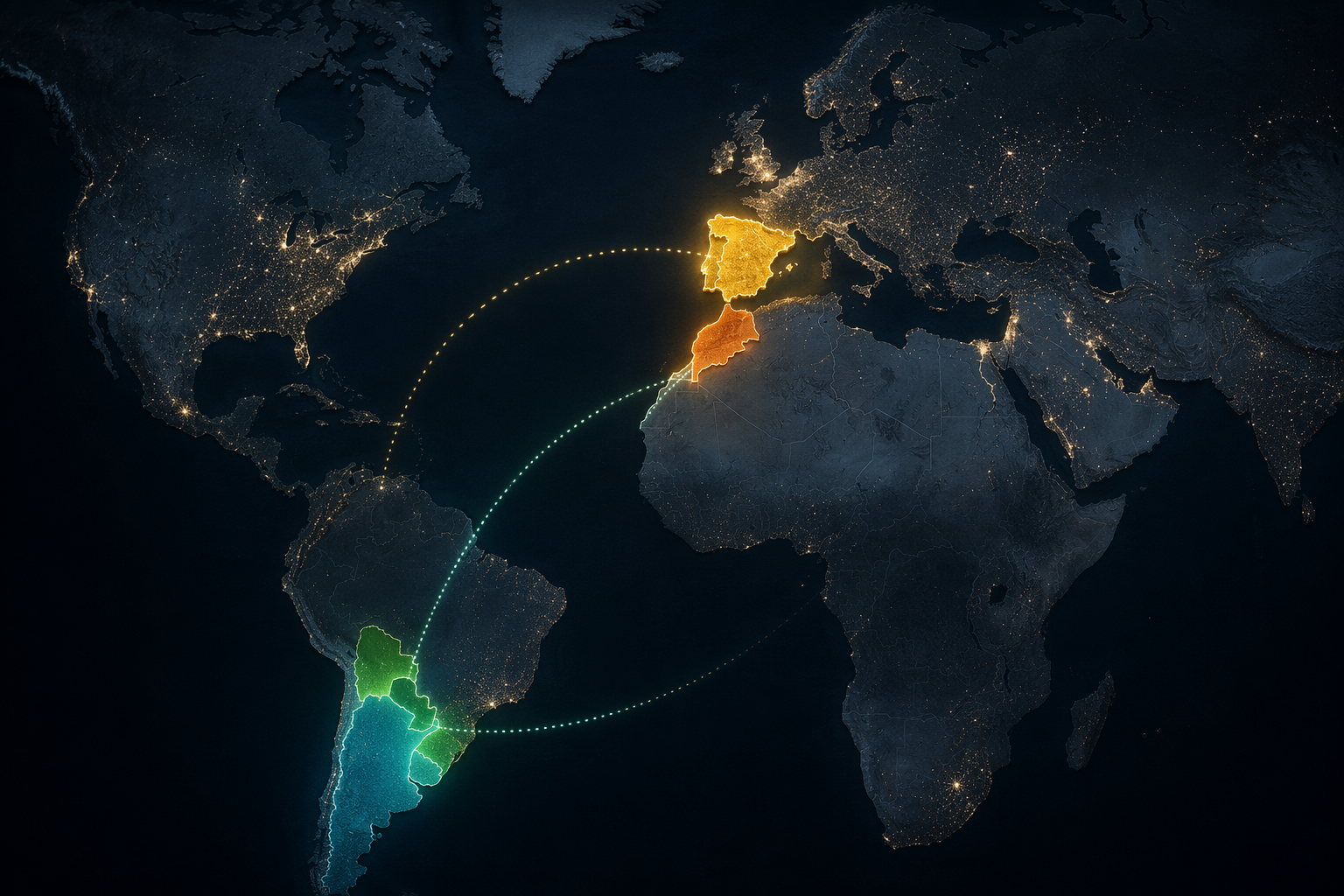
The 2030 World Cup is easy to describe badly. Six host nations, three continents, a centenary celebration, and a tournament that stretches from Morocco, Portugal, and Spain to opening commemorative matches in Uruguay, Argentina, and Paraguay. That sounds like a reach slide. It is actually a campaign architecture problem.
The tournament is scheduled for June 8 to July 21, 2030, with 17 or more host cities across the core European and African hosts, plus the South American centenary matches tied to the 100th anniversary of the first World Cup in Uruguay.[1] For marketers, the impact starts there: not with the romance of a global map, but with the number of operating environments that sit behind it.
A brand that buys into 2030 will not simply be buying association with football. It will be buying the right, or attempting to build the right, to operate across different approval cultures, languages, retail calendars, broadcast windows, alcohol rules, clean-zone enforcement models, tourism agendas, and local partner ecosystems. Geography is not decoration here. It changes the work.
That is why 2030 budget conversations should not wait for a finished sponsor rate card. Commitments will begin while several important pieces are still unsettled: official sponsorship pricing, media-rights winners, host-city operating rules, and the final interpretation of commercial restrictions across jurisdictions. The awkward part is that a brand can be too early on a package and still too late on the planning.
The Map Changes The Sponsorship Question
Reuters framed the 2030 format as an opportunity for sponsors to build reach across markets that do not usually sit inside one neat tournament story.[2] That is true, but “reach” is the least precise way to value the opportunity. The more useful question is which markets a sponsor can credibly activate, which audiences it can serve in language and context, and which local assets it needs before the global campaign film is even written.
| 2030 format feature | Marketing decision it forces |
|---|---|
| Morocco, Portugal, and Spain as main hosts | Build creative, retail, media, and local partnership plans that can flex across North Africa and Europe instead of treating the Iberian-Moroccan footprint as one region. |
| Centenary matches in Uruguay, Argentina, and Paraguay | Decide whether South America is a ceremonial extension, a serious activation market, or a targeted storytelling layer. |
| 17+ host cities | Move beyond national plans into city-level operations, outdoor rules, fan-zone access, hospitality, staffing, and retail proximity. |
| June 8 to July 21 window | Reserve media, production, creator, commerce, and customer-service capacity for a long tournament period rather than a launch-week burst. |
| Three continents | Plan time-zone coverage, regional messaging, regulatory review, and measurement dashboards as a portfolio, not as one global flight. |
The old temptation is to start with a tier: global partner, regional supporter, national advertiser, non-sponsor challenger. In 2030, the cleaner starting point is operating depth. A global partner that cannot get local approvals, retail execution, and culturally fluent assets into six host contexts may look powerful in the announcement and thin in-market. A non-sponsor with sharper local timing may win moments without owning the official mark, provided it stays inside the legal lines.
This is especially important because FIFA has not published official 2030-cycle sponsorship revenue projections. The best available commercial benchmark is still 2026, where sponsorship revenue reached $2.8 billion, 37% above Qatar 2022, according to SportsPro.[3] That number does not tell us what 2030 sponsorship will cost. It does tell us that the market is already expensive enough for sloppy rights valuation to become a board-level mistake.
The Budget Case Has To Arrive Before Certainty
The practical problem for marketing leaders is timing. A 2030 World Cup program that depends on retail partnerships, multilingual creative systems, hospitality, local influencers, CRM integrations, content production, and paid media cannot be built in the year before the tournament. But the 2027 budget case will likely be written before marketers have full certainty on rights pricing, media inventory, host-city activation rules, or local enforcement.
That makes 2030 less like buying a tentpole campaign and more like building options. One option is official sponsorship, with the access and protection that comes with it. Another is a regional partnership strategy that concentrates investment where the brand has distribution or growth priorities. A third is a non-sponsor plan that avoids protected marks but competes through creators, retail, cultural relevance, and speed. The expensive mistake is pretending those options can be evaluated only after FIFA and broadcasters finalize everything.
A useful 2027 budget proposal should therefore separate fixed commitments from flexible reserves. Fixed commitments might include audience research in Morocco, Iberia, and selected South American markets; creative platform development; legal review; local agency or partner discovery; and measurement architecture. Flexible reserves should cover media-price inflation, late inventory opportunities, host-city activation changes, and reactive content. The point is not to spend early for the sake of looking decisive. It is to avoid discovering in 2029 that every good option requires infrastructure the brand never funded.
Media Rights Will Not Behave Like A Single Broadcast Buy
The media-rights discussion may be the most consequential planning variable because it determines where attention can be bought, borrowed, and measured. CNBC reported in July 2026 that Netflix, Disney through ESPN and ABC, YouTube, Apple, and Amazon were expected to prepare bids for FIFA World Cup media rights, with U.S. rights expected to begin around $1 billion, more than double Fox’s $485 million rights fee for 2026.[4] Forbes reported a day later that U.S. bids could land in the $1.5 billion to $2 billion range.[5]

Those figures are not 2030 guarantees. They are pricing signals. If the next cycle becomes a more aggressive contest among streaming platforms, broadcast networks, and technology companies, then the media plan around the World Cup stops being a simple question of who carries the matches. It becomes a question of audience access, subscription environments, data visibility, ad formats, retail integration, and the degree to which a brand can connect tournament attention to its own customer base.
For a sponsor, this can complicate the cleanest version of the rights story. Official association may deliver category protection and access to FIFA-controlled assets, but the viewing environment may be split across platforms with different ad products, targeting rules, measurement standards, and commerce integrations. For a non-sponsor, fragmentation can create openings: creator-led viewing culture, second-screen content, regional social formats, and retail promotions that orbit the tournament without using protected intellectual property.
The time-zone spread also matters. A match in South America is not the same media product as a match in Morocco, Portugal, or Spain. U.S.-focused brands will have to model when live attention is strongest, when highlights travel, and when paid social or retail messaging should follow. European and African campaigns may find more natural live viewing windows around the main hosts, while South American centenary matches may function as high-emotion moments with different local media logic. None of that is solved by buying one global impressions package.
The stronger media plan will probably have layers: guaranteed inventory where live attention is essential, flexible social and video budgets for match outcomes and cultural moments, creator partnerships that can localize quickly, and owned-channel programs that collect the demand generated by paid media. The worst plan will be the one that spends the most money first and asks about platform behavior later.
Six Host Contexts Mean Six Approval Realities
The multi-continent format makes regulatory planning a creative issue, not a back-office issue. Alcohol brands, betting-adjacent brands, financial services companies, travel platforms, food and beverage marketers, and consumer tech companies will all face different local constraints depending on where and how they activate. Morocco is often described as more lenient than Qatar on alcohol, but the specific tournament operating restrictions across host nations and cities are not yet codified. That uncertainty should slow down any claim that a beer, hospitality, or fan-zone plan can simply be transferred from 2026.

The same applies to clean-stadium and debranding rules. Morgan Lewis has emphasized the legal boundaries around ambush marketing and World Cup sponsor rights, including the need for brands to avoid unauthorized use of protected marks and misleading association.[8] In a one-country tournament, that already requires discipline. Across Morocco, Portugal, Spain, Uruguay, Argentina, and Paraguay, the review process becomes more complex because enforcement, advertising standards, language, and local commercial customs may not line up neatly.
This is where operational readiness earns its budget. A campaign idea that depends on packaging, outdoor media, retail displays, venue proximity, player imagery, national-team references, or fan-zone sampling should be tested against local rules before production scales. Marketers should know which assets are globally safe, which need country-level adaptation, and which are too dependent on unresolved tournament rules to approve early.
That does not mean the creative should become timid. It means the creative system has to be modular. A brand may need one emotional platform, several language and cultural variants, different retail calls to action, and a legal matrix that keeps teams from improvising around protected tournament language at the last minute. The more markets a brand touches, the less useful it is to approve only the hero asset.
Non-Sponsors Will Not Wait Politely Outside The Stadium
The 2026 cycle has already made one thing uncomfortable for rights holders: attention does not stay neatly inside official sponsor lanes. Onclusive analyzed 47.9 million social mentions from June 11 to July 3, 2026, and reported that SoFi reached 12.94% share of voice after FIFA’s debranding policy drew attention to the stadium naming issue.[6] The time window matters; it covered the group stage through early knockout rounds, not the full tournament. Still, it is a useful warning that restriction can create curiosity when the audience notices the restriction.
CNBC also reported Meltwater data showing 61 million engagements for non-sponsor brands versus 33 million for sponsor brands in 2026 marketing examples involving companies such as Nike, Levi’s, and Taco Bell.[7] That does not prove non-sponsorship is more effective. Engagement is not sales, brand lift, category exclusivity, hospitality value, or long-term market access. But it does puncture the lazy assumption that official status automatically produces the strongest public-facing momentum.
For 2030, the non-sponsor opportunity set is likely to be broader because the tournament story has more edges. A brand can build around travel between continents, diaspora communities, food culture, watch parties, local retail, football fashion, creator commentary, or national pride without saying it is an official World Cup sponsor. The legal risk rises when the brand implies association, uses protected marks, or tries to trade too directly on tournament rights it did not buy. The strategic opening is not “ambush harder.” It is to build a campaign that knows exactly which cultural spaces are available without borrowing FIFA’s property.
Official sponsors should take the same data personally, but not defensively. If a non-sponsor can earn conversation through speed and cultural fit, then a sponsor has no excuse for behaving like a logo placement buyer. Rights should unlock better access, better content, better hospitality, better retail coordination, and better measurement. If they only unlock a badge, the badge will be forced to compete with every clever brand that can move faster.
Destination Marketing Gets A Bigger Stage And A Harder Brief
Tourism boards and destination brands may be tempted to treat 2030 as a once-in-a-generation visibility burst. That is understandable, but the better opportunity is itinerary design. Morocco, Portugal, and Spain can be framed not only as host countries but as connected travel routes, while Uruguay, Argentina, and Paraguay carry the centenary story. The marketing challenge is deciding whether the audience is being asked to attend matches, extend a trip, consider future travel, invest, study, or simply update its image of a place.
Those are different briefs. A host-city campaign built for match attendees needs transportation, accommodation, safety, local commerce, and real-time service information. A destination brand campaign built for global viewers needs memory structures: food, music, neighborhoods, landscapes, people, and reasons to care after the final whistle. South American centenary hosts may have fewer tournament dates than the main hosts, but they own a powerful origin story. That should not be wasted on generic “welcome to” advertising.
The destination opportunity also intersects with sponsor value. Airlines, payment brands, hotel groups, telecom companies, mobility platforms, and travel retailers can turn the format into utility if they solve actual friction: cross-border planning, local payments, roaming, language support, ticket-adjacent travel, and city navigation. The emotional halo becomes commercially useful when it reduces a fan’s next step.
Technology Will Raise The Standard For Fan Data
The 2026 tournament also points toward a more data-intensive operating model. Salesforce announced work with FIFA for the 2026 World Cup around fan engagement and tournament operations, including AI-enabled personalization.[9] That is not proof of what the 2030 fan stack will look like. It is a signal that tournament marketing is moving toward more personalized service, content, and operational communication.
For brands, this raises the bar for measurement. A 2030 plan should not rely only on media delivery and social engagement. It should define how the brand will measure market expansion, customer acquisition, retail lift, hospitality value, content performance, and long-term brand effects across different regions. The measurement model may need to compare countries that play very different roles in the tournament: main host, centenary host, high-viewing market, travel-origin market, or diaspora community.
That also means marketers need to be careful with comparability. A watch-party activation in Madrid, a retail promotion in Casablanca, a creator series in Buenos Aires, and a streaming ad buy in the United States will not produce the same kind of data. Folding them into one global dashboard may make the campaign look tidy while making the learning worse. The dashboard should preserve local differences where those differences explain performance.
What Marketers Can Decide Before The Market Settles
There are still hard unknowns. FIFA has not released official 2030 sponsorship revenue projections. The final media-rights winners are not known. Local alcohol and activation rules are not fully codified. FIFA’s clean-stadium approach across different jurisdictions remains uncertain. Some host-city operating details will arrive later than marketers would like. A serious plan should name those uncertainties rather than hide them in optimistic assumptions.
But uncertainty does not prevent useful decisions. It changes which decisions should be made now. Marketers can identify priority markets, decide whether 2030 is a growth-market platform or a brand-halo platform, build legal review paths, model sponsor and non-sponsor scenarios, reserve flexible media budgets, start cultural research, shortlist local partners, and design creative systems that can survive regulation and translation.
- If official sponsorship is likely, start with rights valuation by market and use case, not total global impressions.
- If regional partnerships are more realistic, decide which host contexts matter commercially and which only matter for storytelling.
- If a non-sponsor route is likely, build the legal guardrails before the creative team falls in love with a risky idea.
- If media buying is central, prepare for platform fragmentation and price pressure rather than assuming a familiar broadcast plan.
- If destination or retail activation matters, plan at city and partner level, not only at country level.
The 2030 World Cup rewards marketers who treat the format as a multi-year portfolio problem now. The teams that wait for finalized packages and then try to retrofit one global campaign across six countries will not be late because they missed the announcement. They will be late because they misunderstood what the announcement meant.
References
- 2030 FIFA World Cup, Wikipedia.
- World Cup 2030 an opportunity for sponsors to build reach, say experts, Reuters, 2023.
- Breaking down the business of the US$13bn 2026 Fifa World Cup, SportsPro, 2026.
- FIFA World Cup media rights: Netflix, Disney, YouTube prepare to bid, CNBC, July 7, 2026.
- World Cup Media Rights Poised To Start Billion-Dollar Bidding Frenzy, Forbes, July 8, 2026.
- FIFA Debranding Backfired, Onclusive, July 2026.
- World Cup marketing: How Nike, Levi's and Taco Bell are winning, CNBC, June 26, 2026.
- Brand Battle: Ambush Marketing and World Cup Sponsor Rights, Morgan Lewis, July 2026.
- Salesforce to Transform Fan Engagement and Tournament Operations at FIFA World Cup 2026, Salesforce Investor Relations, 2026.

Comments
Join the discussion with an anonymous comment.