
Will AI create more jobs in paid ads? Check the record
Paid-ad automation releases paired with the labor-market data that followed — which execution jobs AI removed, which new roles appeared a layer up, and why the 'will AI create more jobs' question is now a checkable record.
- Platform
- Google Ads
- Bid strategy
- Smart Bidding
- Last reviewed
- 0-08-03
No specific Benchmarks record is cited for this tactic yet — treat it as directional, not evidence-backed.
The release record starts in November 2021, when Performance Max moved Google campaign setup into a system that uses Google AI for bidding, budget optimization, audiences, creatives, and attribution. That was not a vague “AI is coming” moment. It removed named execution work from the buyer’s desk: bid adjustments, some budget pacing, audience assembly, asset mixing, and first-pass attribution routing all moved further inside the machine.[1]
That is why the question “will AI create more jobs in paid advertising?” is already answerable in a narrower, more useful way. The record does not show a clean swap where every automated task becomes a new execution job. It shows dated product releases taking away pieces of junior and operator work, while the new labor demand appears higher up: workflow design, creative-supply direction, measurement architecture, governance, and agent supervision.

The automation record is not theoretical anymore
Paid media has run this experiment in public. The useful unit is not “AI adoption.” It is a release, a task, and the person who no longer performs that task in the same way.
| Dated automation event | Execution work reduced or absorbed | What remained for the buyer or manager |
|---|---|---|
| Google Performance Max, launched in November 2021 | Bidding, budget optimization, audience discovery, creative assembly, and attribution were pulled into one automated campaign type. | Feed quality, conversion design, asset supply, exclusions, measurement interpretation, and performance explanation. |
| Meta Advantage+ Shopping, followed by broader Advantage+ migration work | Manual campaign structure, some audience setup, and parts of optimization moved into Meta’s automated sales-campaign system. | Account architecture decisions, creative testing volume, offer strategy, and migration risk management. |
| Amazon Performance+, Pinterest Performance+, TikTok Smart+, and LinkedIn Accelerate, with formal launches or expansion clustered in 2024 | The paid-social and retail-media pattern spread: fewer manual setup steps, more platform-led targeting and optimization. | Channel selection, incrementality questions, creative supply, and budget allocation across increasingly similar automated products. |
| Meta’s reported 2026 full-automation ambition | The target moves beyond optimization into full ad creation and targeting. | Briefing, brand control, approval workflows, testing boundaries, and accountability for outputs the buyer did not manually build. |
| Agentic tools inside ad workflows, including the reported Manus Ads Manager integration in 2026 | Report building, audience research, campaign analysis, and other analyst-layer work begin to move from tools to agents. | Prompting, validation, diagnosis, client explanation, and knowing when the agent’s answer is incomplete. |
The first row matters because it is platform documentation, not conference-stage optimism. Google says Performance Max uses Google AI across bidding, budget optimization, audiences, creatives, and attribution.[1] Those are exactly the areas where a junior paid-search operator used to learn the account by touching the controls. The platform did not remove the need for judgment. It removed some of the repetitions through which judgment was traditionally trained.
The same pattern then spread through paid social and retail media. The site’s Advantage+ automation profile is useful here because the product history is a job-change record as much as a media-buying record. When Advantage+ Shopping took over more of the campaign build and optimization loop, the buyer’s work shifted toward inputs, constraints, creative volume, and diagnosis. The person still owned performance. They just owned it with fewer visible levers.
By the 2024 wave, automation was no longer a Google-or-Meta story. Amazon Performance+, Pinterest Performance+, TikTok Smart+, and LinkedIn Accelerate extended the same operating model across more paid channels. The practical consequence for an agency or in-house team was not that every platform suddenly became easy. It was that the old execution menu became less differentiated: fewer hand-built audiences, fewer manual bid routines, more dependence on conversion signals, creative inputs, and platform learning systems.
That October 2024 cluster is worth reading beside the site’s paid-social automation benchmark record. The benchmark question is not merely which product spends more efficiently. It is which parts of the buying job each product makes less necessary.
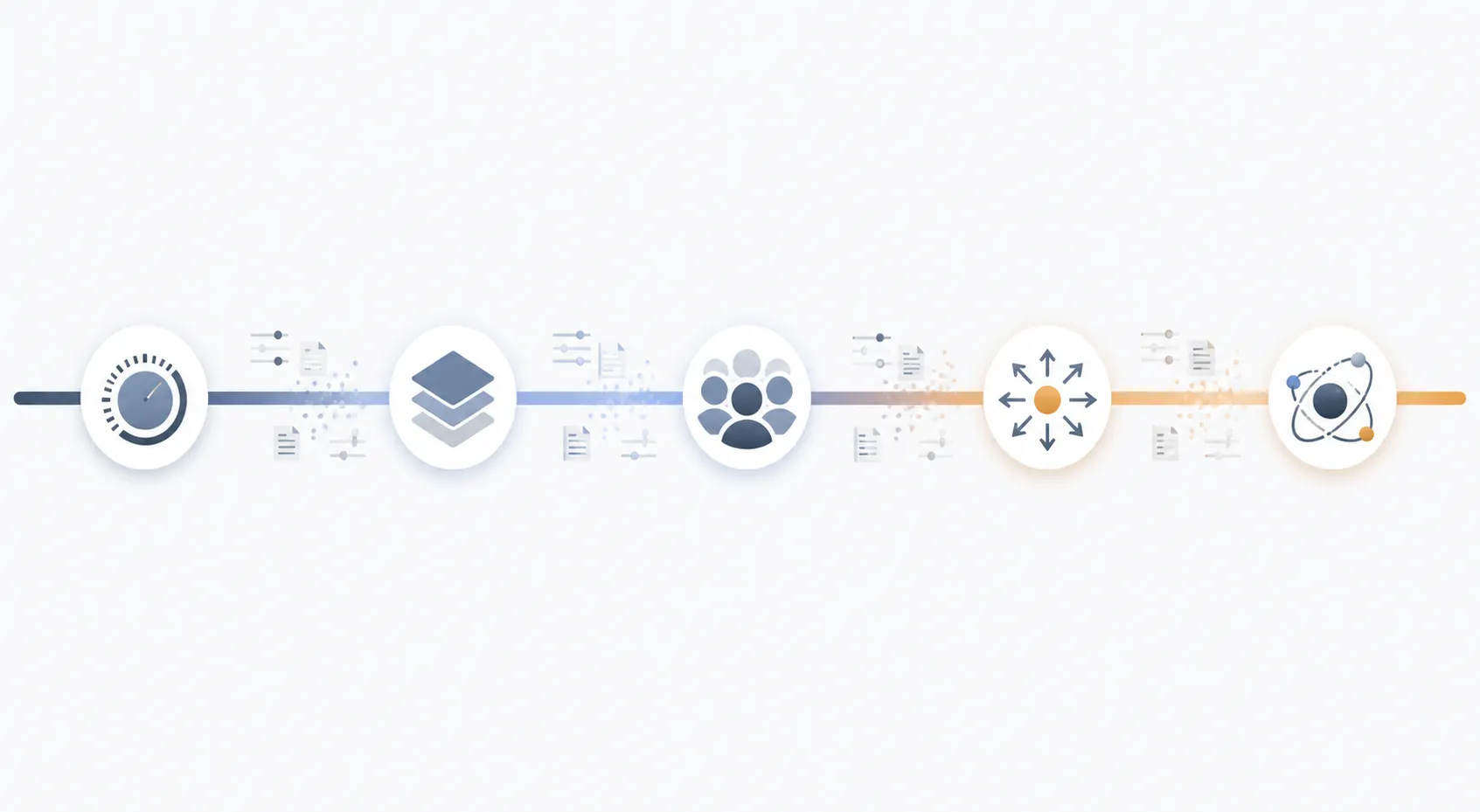
The 2026 line moves from optimization into production and analysis
Reuters reported in June 2025, citing The Wall Street Journal, that Meta aimed to let brands fully create and target ads using AI by the end of 2026.[2] If that target is reached, the removed task is not a bid tweak. It is campaign production itself: generating the ad, targeting it, and sending it into market with less human assembly between brief and launch.
That is a different labor question from the one paid media teams faced during the first Smart Bidding era. Early automation compressed optimization work. Full creative-and-targeting automation compresses the build. Agentic reporting compresses the analyst layer after launch. A buyer can be left with more responsibility for explanation while having touched fewer of the intermediate steps.
Nest Commerce, a vendor with a commercial interest in the automation story, framed the 2026 shift more aggressively: it said Meta embedded the Manus AI agent into Ads Manager in February 2026, automating report building, audience research, campaign analysis, and related work. The same source said Meta’s Andromeda system now evaluates tens of millions of ads per impression, compared with the few thousand it evaluated before.[3]
That vendor conflict matters. Nest Commerce sells into this market, so its framing should not carry the main labor-market claim. But the tasks it names are the right ones to watch: report building, audience research, campaign analysis. Those are not glamorous tasks, but they are how many people learn what a good account looks like before they are trusted with larger judgment calls.
The Meta AI creative record is the practical companion to this shift. If systems can evaluate vastly more creative variants, then the constraint moves toward creative supply, brand permission, offer clarity, and measurement design. That creates work. It just does not recreate the same work that was removed.
Where the new jobs are showing up
The labor-market data lines up with that shape, though it does not prove a one-for-one replacement story. Indeed Hiring Lab’s January 2026 update found that job postings mentioning AI ended 2025 at 134% above their February 2020 baseline, while total US job postings finished roughly 6% above baseline. Indeed’s AI Tracker reached 4.2% in December 2025.[4]
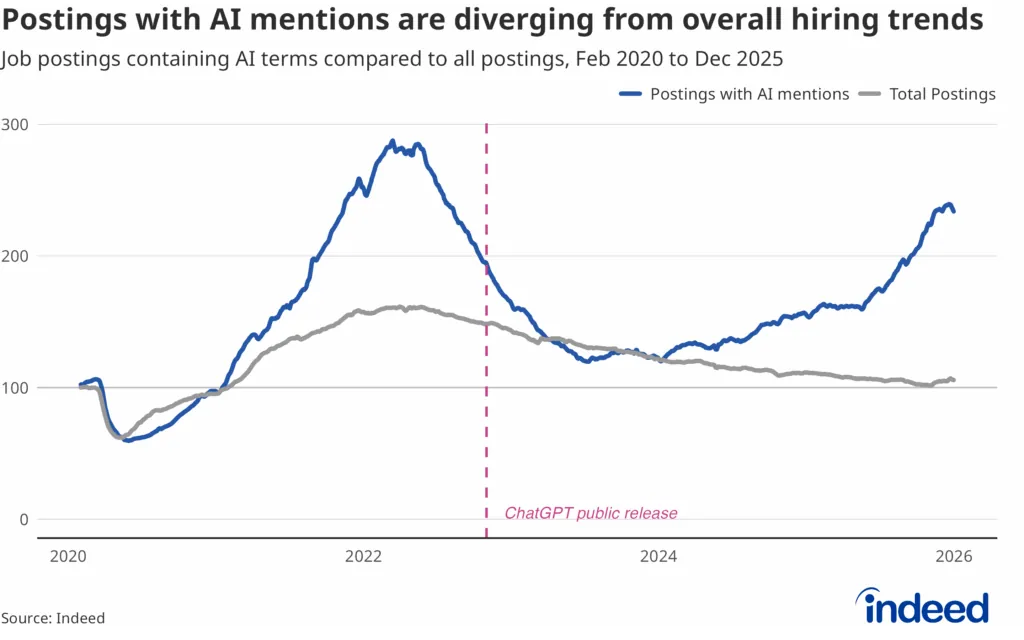
Read that carefully. It does not say AI created a broad hiring boom. It says AI-mentioned roles grew sharply while the overall postings market barely moved above its pre-pandemic baseline. For paid advertising, that is the important distinction. A company may add AI workflow responsibilities, AI tooling requirements, or an agentic-commerce brief without adding a new junior media-buyer seat.
The American Marketing Association’s 2026 career report gives names to the layer where some of that demand is appearing. It lists emerging roles that “did not exist five years ago,” including agentic commerce specialists and AI workflow designers, and places paid media in the most-disrupted bucket.[5] Those titles are not renamed bid managers. They are roles around system design, orchestration, workflow, and commercial application of automated agents.
PwC’s 2026 AI Jobs Barometer gives a broader explanation for why that feels uneven inside agencies and marketing teams. PwC found that professionalized jobs are growing roughly twice as fast as democratized jobs.[6] In plain terms, work that requires redesigning systems, making expert calls, or managing complexity is showing stronger growth than work made easier for more people to perform.
That is the paid-ad automation story in one labor-market sentence: AI is creating paid-adjacent work, but not mainly where the old execution work was removed.
The missing rung is the real management problem
The industry has an unhelpful habit of treating this as a morale issue for people who dislike automation. That is too easy. Most serious buyers are not asking to rebuild manual bidding spreadsheets for the sake of tradition. They are asking how someone becomes good at paid media when the platform has absorbed the dull work that used to expose them to account mechanics every day.
Report pulling taught pacing, naming discipline, metric definitions, and the difference between a real problem and a reporting delay. Audience research taught market structure and search intent. Manual bid and budget work taught trade-offs. Campaign assembly taught how targeting, creative, feed quality, and conversion events fit together. None of those tasks deserved to stay manual forever. But when they disappear, the training path needs a replacement.
That replacement is not “be more strategic.” It is more specific. Teams need people who can audit conversion inputs, define what an agent is allowed to change, review generated analysis, pressure-test creative supply, and explain why an automated campaign made money or wasted it. The site’s AI PPC tool-stack decision guide belongs in that conversation because tool choice has become part of the judgment layer, not a procurement footnote.
This is also where managers get squeezed. A platform release can remove a task overnight. It cannot automatically create a new apprenticeship model, a new QA process, or a client-facing explanation for why the team needs senior judgment even though the interface looks simpler.
What not to overclaim
The broad future-of-work numbers are useful context, but they should not be forced into an ad-industry proof. The World Economic Forum’s Future of Jobs Report 2025 projected 170 million jobs created and 92 million displaced by 2030, with 39% of workers’ core skills expected to change. That is a macro labor-market projection, not a paid-media staffing model.[7]
The same caution applies to agency-specific forecasts. Digiday reported Forrester’s expectation that AI could replace 15% of US agency jobs by the end of 2026.[8] That may be directionally important, but it is still a reported forecast, not a release-by-release account of which paid-ad tasks were removed inside a specific team.
The most defensible record is narrower and more operational: PMax automated specified Google Ads functions; Advantage+ and other paid-social products reduced manual setup and targeting work; Meta’s stated 2026 ambition moves toward full ad creation and targeting; agentic tools are entering reporting, research, and analysis. Labor-market data then shows AI-labeled demand rising much faster than total postings, while named new roles sit above the old execution layer.
For teams maintaining their own source trail, the useful habit is a dated changelog, not a prediction deck. The site’s Google, Meta, and HubSpot AI changelog is the better model: record the release, name the task affected, identify who now reviews the output, and then ask whether headcount, training, or workflow changed.
So, will AI create more jobs in paid ads?
Some, yes. But the record so far does not support the comforting version of that answer.
AI is creating paid-adjacent jobs around agentic commerce, workflow design, creative systems, measurement, and governance. It is also increasing the value of people who can supervise automated buying systems rather than merely operate them. But the dated platform record shows execution tasks being removed first: bid routines, audience assembly, campaign setup, reporting, research, and first-pass analysis.
By Q3 2026, the observable pattern is already clear enough: paid-ad automation has removed defined execution work in dated releases; new roles are appearing one layer above that work; and total hiring has not expanded in proportion to AI-labeled demand. The open question is not whether automation arrived. It is whether teams rebuild the training and review systems that used to be hidden inside the manual work.
References
- About Performance Max campaigns — Google Ads Help
- Meta aims to fully automate advertising with AI by 2026, WSJ reports — Reuters, June 2025
- Will AI replace media buyers? — Nest Commerce, January 2026
- January Labor Market Update: Jobs Mentioning AI Are Growing Amid Broader Hiring Weakness — Indeed Hiring Lab, January 2026
- 2026 Career Report — American Marketing Association
- 2026 AI Jobs Barometer — PwC
- Future of Jobs Report 2025: 78 Million New Job Opportunities by 2030 but Urgent Upskilling Needed to Prepare Workforces — World Economic Forum, January 2025
- As industry layoffs become the new normal, so does fear of AI’s impact on adland’s job market — Digiday