
What Waymo's expansion shows about AI Max location targeting
Waymo's 2026 Bay Area expansion is a live case study in location-bounded demand: real spend will follow the service-area map, not audience profiles. This piece pairs the dated expansion facts with an audit of Google AI Max's 'locations of interest' feature — how query and presence signals actually work, where the documented limits are, and why Google's +5% claim is a claim to verify, not a result to trust.
- Platform
- Google Ads
- Bid strategy
- AI Max
- Difficulty
- Advanced
- Last reviewed
- 0-08-28
Grounded in benchmark case file: Google 5% conversion lift (Travel/Real Estate/Education, 2022)
On August 14, 2026, the California Public Utilities Commission approved a Waymo expansion across 18 counties. The Northern California portion covers Alameda, Contra Costa, Marin, Napa, Sacramento, San Francisco, San Mateo, Santa Clara, Santa Cruz, Solano, Sonoma, and Yolo; the Southern California portion covers Los Angeles, Orange, Riverside, San Bernardino, San Diego, and Ventura. Waymo said deployment would proceed gradually under its safety framework.[1]
That final sentence controls how the announcement should be read. CPUC approval establishes where Waymo may expand; it does not mean every approved county, road, or pickup point became available on August 14. For anyone analyzing the Waymo Bay Area expansion alongside AI location targeting ads, the operative inventory is the live service area—not the largest boundary in the announcement.

Approved territory is not live territory
The distinction matters because three different Waymo milestones are easy to collapse into one timeless growth story. In November 2025, California’s Department of Motor Vehicles gave Waymo a green light to expand driverless operations into the North Bay, East Bay, and toward Sacramento.[2] In May 2026, Waymo reported a service area exceeding 1,400 square miles across 11 cities, a fleet of roughly 3,000 vehicles, and more than 20 million completed trips. The company also said it was targeting 1 million rides per week by the end of 2026.[3] Then came the August CPUC approval across 18 counties.
| Date | What changed | What it does not establish |
|---|---|---|
| November 2025 | DMV authorization supported expansion into additional Northern California territory.[2] | That all authorized territory was open to riders. |
| May 2026 | Waymo published a 1,400-square-mile, 11-city service-area snapshot and company fleet and trip totals.[3] | A permanent boundary or independent performance measurement. |
| August 14, 2026 | CPUC approval extended the authorized footprint across 18 California counties, with gradual rollout planned.[1] | Immediate service throughout every county. |
These events refer to different layers: regulatory permission, the service footprint at a dated moment, and subsequent deployment. A buyer who substitutes one for another can spend against demand that is theoretically relevant but not yet serviceable.
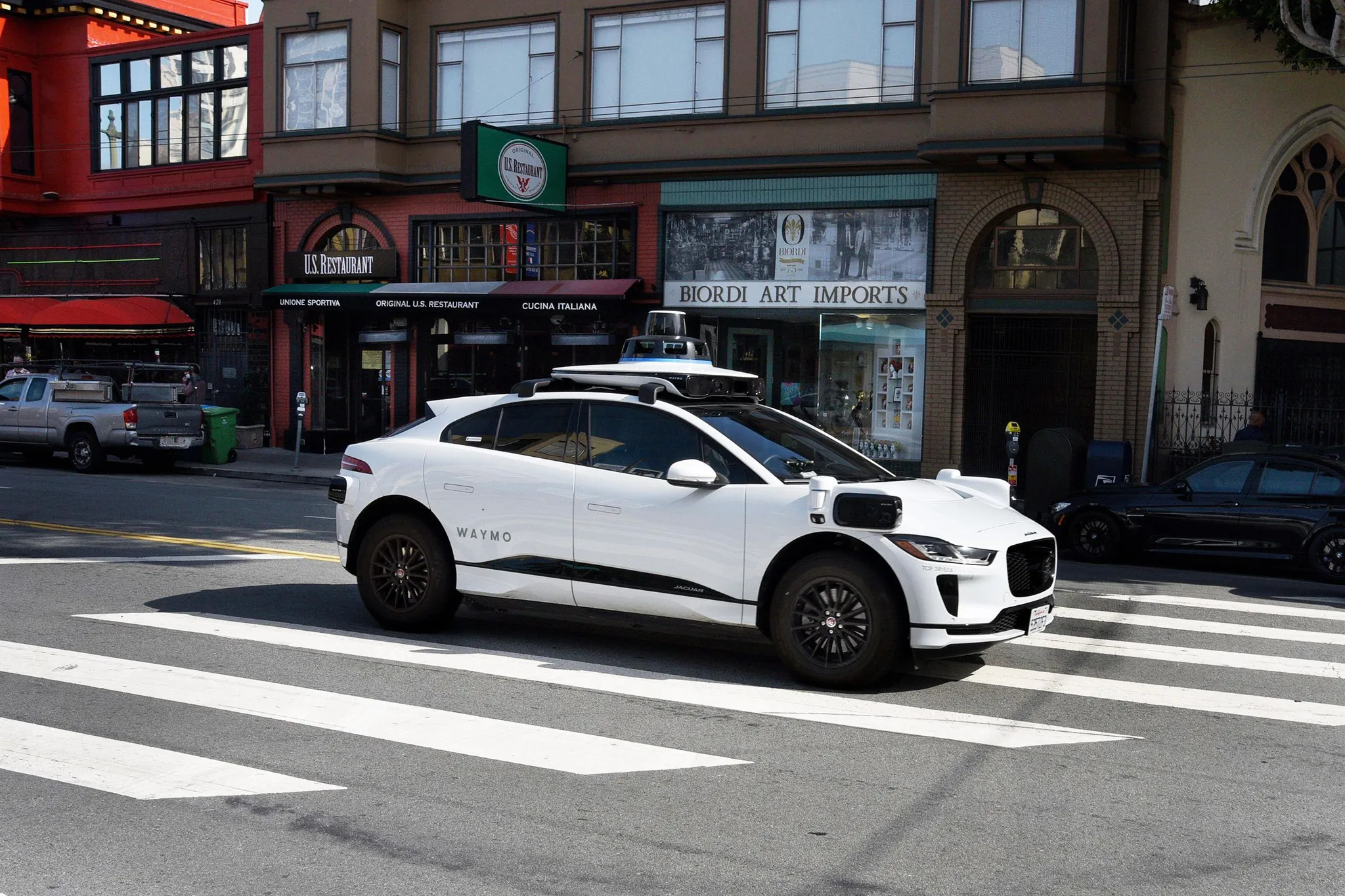
Waymo’s current service-area page is therefore more useful for an active campaign than an expansion headline. It shows where rides are presently offered and should be checked again whenever targeting, exclusions, or location-specific creative changes.[4] A county-level approval map can frame future opportunity, but it cannot confirm that a person at a particular address can request a ride today.
For a presence-only service, the map defines available demand
A rider can resemble Waymo’s ideal customer, read about the service, and search for it repeatedly. None of that creates an available ride if the pickup location sits outside the active service area. Geography is not merely a refinement layered onto an otherwise eligible audience. It is the boundary that determines whether demand can be fulfilled.
That changes how an expansion should be translated into paid-search work. Newly approved territory may justify research, forecasting, and campaign preparation. Newly activated territory can justify spend. Those are separate account events and should have separate dates in the change log.
The useful questions begin at the boundary: Which origins and destinations are actually covered? Are airport, freeway, or cross-county trips available under current operating conditions? Does a search name a serviceable city, an approved-but-not-live county, or a place outside both? Which negative locations prevent adjacent demand from leaking into the campaign? The answers determine whether an impression represents a possible transaction or only general interest.
What AI Max’s “locations of interest” actually routes
Google’s closest platform analogue is the ad-group-level locations-of-interest feature in AI Max for Search campaigns. Google says it can use geographic intent to reach users, including on keywordless matches. The documented eligibility sequence is narrower than the phrase “expanded reach” suggests: the system considers the location expressed in the query first; if the query contains no location, it can use the user’s presence location as a fallback. In either case, the user must still satisfy the campaign-level geographic targeting.[5]
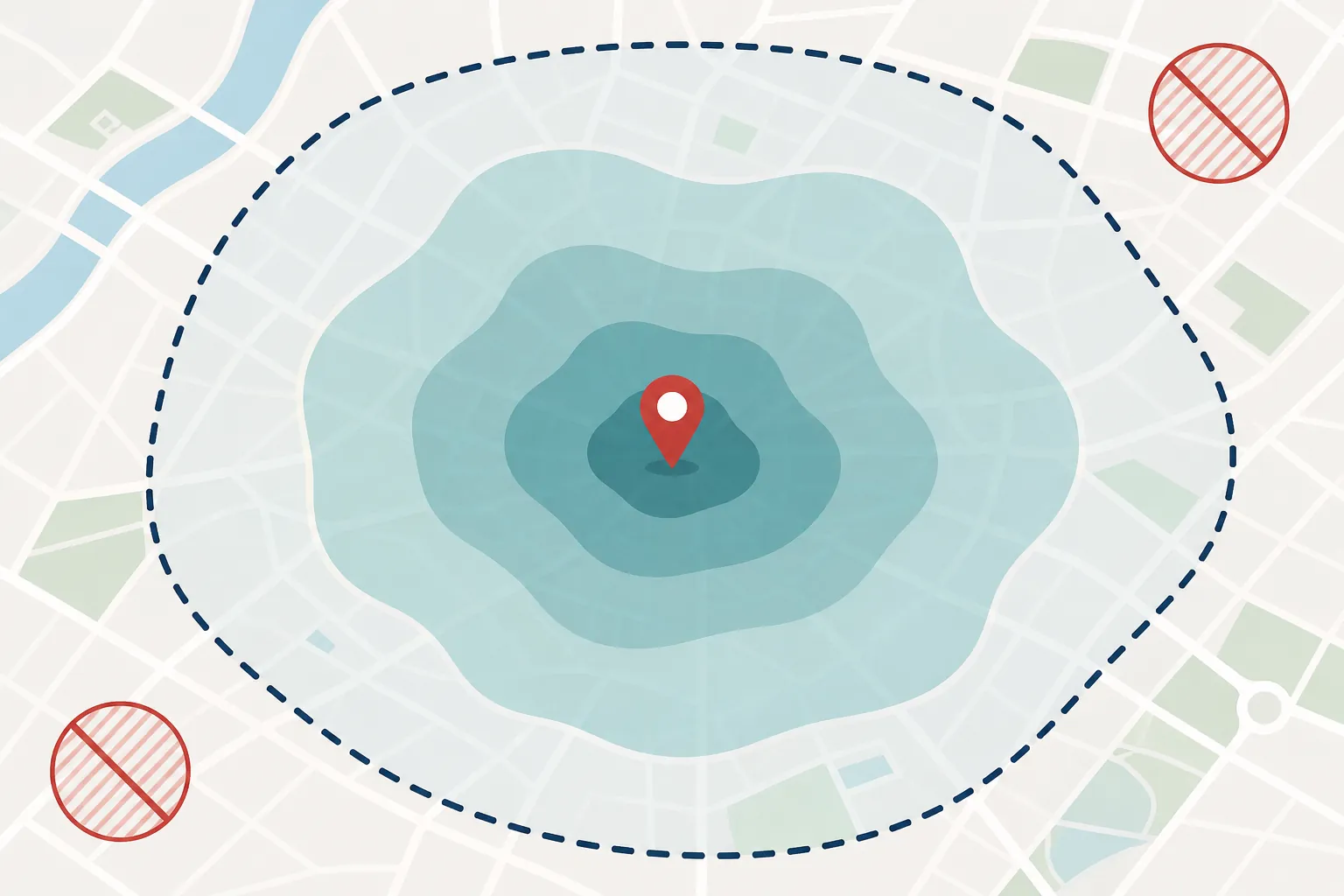
The sequence is easier to audit when each location concept is kept separate:
- Query location: The place expressed by the search, such as Madrid in “hotels in Madrid.” This signal is considered first.
- Presence location: The user’s inferred physical location. AI Max can use it when the query supplies no location.
- Ad-group location of interest: The geographic intent the ad group is configured to capture.
- Campaign-level geographic eligibility: The outer gate the user must still pass before the ad can serve.
- Exclusions: Locations that remain blocked rather than being reopened by the ad-group feature.
Google illustrates the mechanics with a U.S.-targeted campaign and an ad group configured for interest in Spain. A user in Chicago searching for “hotels in Madrid” can match because the user passes the campaign’s U.S. geographic gate and the query supplies the Spain-related location intent. A search for “hotels in Paris” does not satisfy that ad group’s Spain setting. Google also states that excluded locations are blocked.[5]
For a Waymo-like campaign, consider a hypothetical user physically inside a campaign’s eligible region who searches for service in a newly named county. AI Max may recognize the county in the query, but that does not prove the requested trip is available there. The advertising system can identify geographic intent; it does not validate a service map, operating hours, pickup rules, or the status of a gradual rollout. Those remain advertiser-side eligibility checks.
The reverse case also matters. A person may be physically present in a live service area but use a generic query with no place name. Presence can supply the fallback location signal, provided the campaign-level targeting permits that user. This is where the feature may recover useful demand omitted by a city-by-city keyword list, without making the campaign boundary irrelevant.
The accuracy limit belongs beside the targeting logic
Google describes location targeting as a best-effort system and explicitly says that “100% accuracy is not guaranteed in every situation.” Its location-targeting documentation also sets a minimum radius of 1 kilometer and says location targets must meet minimum privacy thresholds.[6] These are operating constraints, not footnotes to add after a campaign has spent.
Location signals can be inferred from several kinds of activity and can be imperfect. An account may therefore receive traffic that looks geographically eligible in aggregate while producing leads from an unusable pickup point, an excluded service zone, or a destination that the product cannot serve. Lead quality can change before top-line conversion volume makes the routing problem obvious.
A compact geo audit before treating expansion as inventory
The account review should follow the same order in which eligibility is decided, then compare delivery with the external service boundary.
- Date the service map: Record whether each targeted place is live, merely approved, or outside the announced footprint. Do not overwrite the distinction with a generic “Bay Area” label.
- Inspect campaign-level geography: Confirm which users can pass the outer geographic gate and whether the campaign is configured around presence, interest, or a combination.
- Review ad-group locations of interest: Check whether the selected places correspond to live service, future expansion research, or both. If both are needed, separate them so spend and lead quality remain interpretable.
- Rebuild the exclusion map: Look for counties, cities, airports, neighboring zones, and other places that should remain blocked. Verify exclusions after automated or inherited settings changes.
- Check radius feasibility and privacy limits: A desired micro-area may not be targetable as drawn because Google applies a 1-kilometer radius minimum and privacy thresholds.[6]
- Separate targeting from delivery: Check budgets, bid constraints, status alerts, and impression availability. A correctly configured location can still receive little delivery when the campaign is budget-limited or otherwise constrained.
- Read the location reports against outcomes: Compare query geography, matched locations, presence signals where available, conversion quality, and downstream serviceability. Conversion count alone will not reveal whether the requested trip or lead was usable.
- Inspect the change history: Identify when AI Max, location options, interests, radii, or exclusions changed. The person inheriting the account needs a dated explanation for any spend or lead-quality shift.
This audit does not assume that a Waymo advertising campaign has been observed, and it does not produce a new performance result for Waymo. The expansion serves as a test case for the eligibility problem: advertising reach can expand faster than the underlying product’s usable footprint.
How much weight should the claimed 5% lift carry?
Google reports that advertisers in Travel, Real Estate, and Education saw 5% more conversions after switching their campaign location option from “Presence” to “Presence or Interest.” The figure comes from Google internal data covering May 21 through June 1, 2022.[6]
The boundaries are substantial. It is a vendor-sourced result from three verticals, measured during a specific 2022 window, for a change from Presence to Presence or Interest. It is not a reported test of AI Max’s ad-group locations-of-interest feature in every account, and it does not establish that broader geographic eligibility improves qualified conversions for a presence-only service.
Even within the named verticals, additional conversions can carry different economic value. A hotel may be able to sell a future stay to someone searching from another state. A local pickup service cannot fulfill a request outside its live operating area merely because the query demonstrates interest. The same targeting change can therefore expand useful demand in one account and unserviceable demand in another.
The appropriate account-level test is narrower than “Did conversions rise?” It should ask which geographic path produced the conversion, whether the lead or transaction was serviceable, whether exclusions held, how cost per qualified outcome changed, and whether the campaign had enough budget to expose the new demand. The 5% figure is a benchmark to investigate, not a result to transfer.
Waymo’s August approval demonstrates why location can be the strongest signal for a geographically bounded product, but the approved map still has to be reconciled with the live one. AI Max offers a useful routing analogue when query geography is evaluated first, presence acts as the fallback, campaign-level targeting remains the gate, and exclusions remain intact. The expansion narrative becomes actionable only after those mechanics—and the resulting account outcomes—survive the same dated boundary check.
References
- Waymo gets CPUC approval for California expansion across 18 counties — Electrek, August 14, 2026
- DMV greenlights Waymo driverless taxis to expand services in Bay Area and beyond — ABC7 San Francisco, November 2025
- Growing to 1,400 square miles — Waymo, May 13, 2026
- Where can I ride with Waymo? — Waymo Help
- About locations of interest in AI Max for Search campaigns — Google Ads Help
- About location targeting — Google Ads Help