
Nvidia Stock Is Noise for AI Ad Bids. Capex Is the Signal.
Nvidia stock headlines raise a fair question for media buyers: does any of this change your CPMs? Dated evidence says daily quote moves are noise, while the capex cycle around Nvidia's earnings is a lagged leading indicator of AI ad platform cost structure — and grading the three real transmission channels produces a short watch-list of the numbers that actually belong on a paid-ads dashboard.
- Platform
- Cross-platform
- Bid strategy
- General automated bidding
- Last reviewed
- 0-07-31
No specific Benchmarks record is cited for this tactic yet — treat it as directional, not evidence-backed.
The practical answer is blunt: Nvidia’s stock price does not change your bids, your CPMs, your tCPA behavior, or the auction-clearing price in Meta, Google, TikTok, or any other major ad platform. There is no published auction mechanism that takes Nvidia’s stock price as an input. A green or red trading day is not a media-buying signal.
The earnings cycle is a different matter. Nvidia’s results can tell you something about the AI infrastructure cycle that sits underneath the platforms you buy from. That does not make the next earnings release a reason to pause campaigns tomorrow morning. It means the data-center and capex story may be useful context for platform economics several quarters later.

That distinction matters because Nvidia is not a minor supplier in this story. On Feb. 25, 2026, Nvidia reported Q4 FY26 revenue of $68.1 billion, up 73% year over year, with Data Center revenue of $62.3 billion, up 75% year over year.[1] Those are not small background numbers. They are evidence that AI infrastructure demand is real and large. They still do not create a same-day path into your ad account.
So the useful question is narrower than the headline version: not “Did NVDA move today?” but “Which Nvidia-linked signals could eventually affect the cost structure of AI-heavy ad platforms, and how directly?”
The stock price has no auction path
A paid-media auction needs bid inputs, quality or relevance signals, budget constraints, pacing rules, conversion modeling, inventory, and platform-specific optimization logic. Nvidia’s equity price is not one of those inputs. A stock move may change investor narratives. It may change how executives talk about AI investment. It may even affect the pressure public companies feel to defend margins. But that is not the same as an auction variable.
No major ad platform has announced an AI-compute pass-through where advertisers pay more because Nvidia shares rose. No auction system has publicly described NVDA’s quote as a bid, reserve-price, pacing, or ranking input. Without that mechanism, treating the stock ticker as a campaign control is just importing market noise into an account where there is already enough noise.
This is where the conversation usually gets sloppy. Compute cost pressure can exist. Platform economics can change. AI inference can become more or less expensive. None of that means your CPM changed because a semiconductor stock moved before lunch.
Earnings are not bids, but they can mark the infrastructure cycle
Nvidia earnings deserve more attention than the daily quote because they are closer to the thing ad platforms actually use: compute infrastructure. AI ad systems depend on model training, model serving, prediction, retrieval, creative generation, measurement, and automated decisioning. All of that has a cost structure. The largest platforms do not expose that cost structure neatly inside Ads Manager or Google Ads, but it exists.
The Feb. 25, 2026 Nvidia report is useful because it confirms scale in the infrastructure layer: record revenue and a Data Center segment vastly larger than any casual “AI hype” framing can ignore.[1] For a media buyer, the takeaway is not “raise bids.” It is “the AI infrastructure cycle is large enough that platform-margin decisions, product packaging, and automation incentives may eventually reflect it.”
Eventually is doing real work there. Ad auctions do not reprice every time a supplier reports earnings. Platforms buy capacity, deploy models, change product surfaces, alter optimization systems, and manage margins over time. The lag is measured in quarters, not trading sessions.
A graded transmission map for media buyers
The clean way to handle Nvidia-linked information is to grade the transmission channels. This framework is Signal & Convert’s analyst reasoning, not a conclusion stated by Nvidia, Google, Meta, TikTok, or any single source. It is a practical filter for deciding what belongs in a paid-ads discussion and what belongs in an investor-news tab.
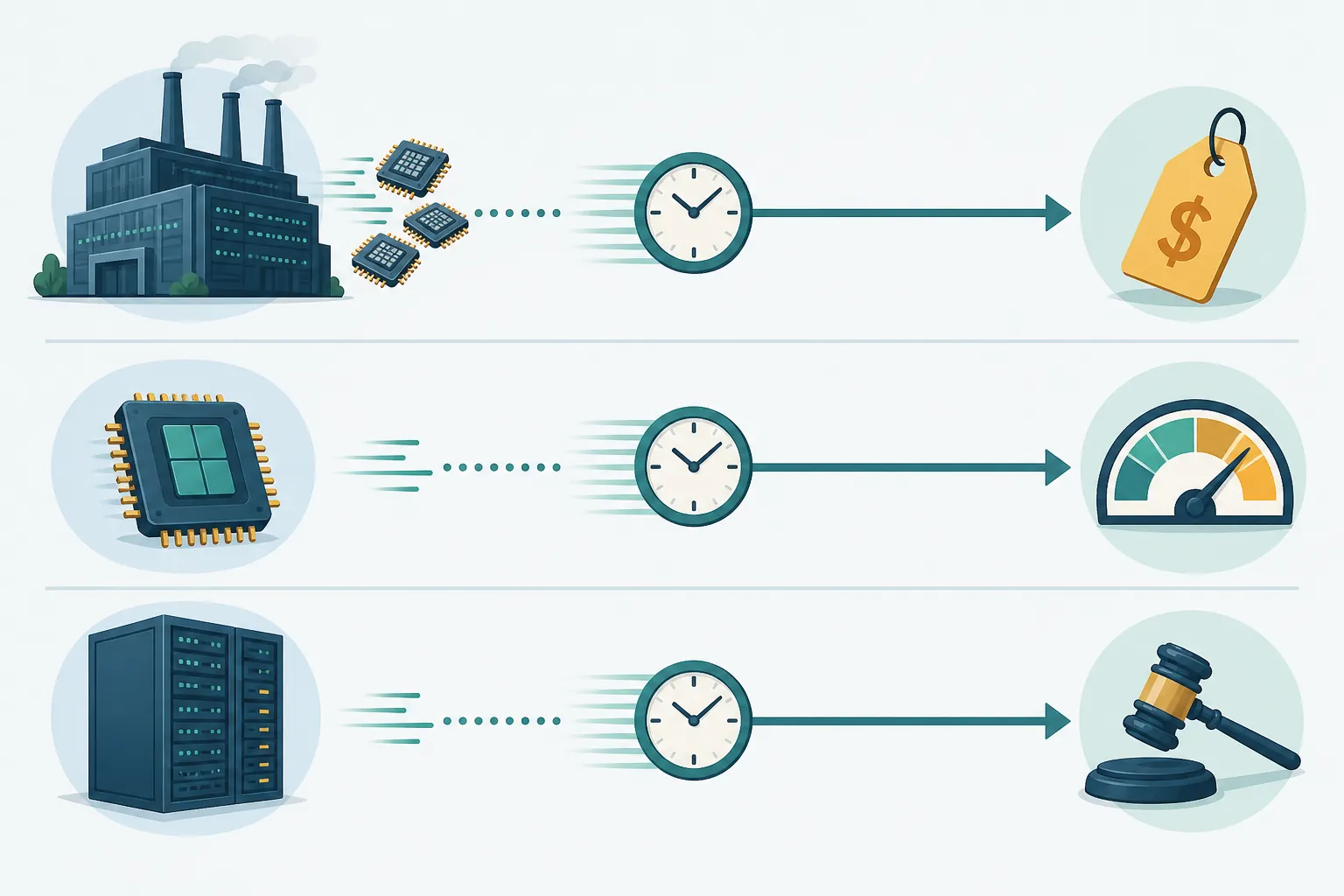
| Channel | What it can tell a media buyer | Directness to ad pricing | Useful timing |
|---|---|---|---|
| Hyperscaler capex and platform margin decisions | Whether AI infrastructure spending may pressure or reshape platform economics | Medium, but lagged and indirect | Quarters |
| GPU and inference spot pricing | The closest available proxy for AI unit-cost pressure | Closest to cost, still not an auction input | Ongoing watch item |
| Nvidia-linked ad-tech infrastructure deals | Whether supply-side efficiency or auction mechanics may change | Case-specific and indirect | Only when tied to actual product or infrastructure changes |
| Daily NVDA stock price | Investor sentiment and market expectations | None as a bid input | Not useful for campaign decisions |
Channel 1: hyperscaler capex into platform pricing and margin decisions
This is the strongest strategic signal, even though it is not the most operational one. If the companies operating major ad ecosystems are committing more capital to AI infrastructure, that can later show up in how they package automation, how aggressively they push AI-native campaign types, how they manage serving costs, and how they protect margins.
The mechanism is not “Nvidia sells more GPUs, so CPMs rise.” The mechanism is slower: infrastructure spend increases the cost base or changes the investment profile; platform leadership then makes product, pricing, or margin decisions; advertisers experience those decisions through auction density, automation defaults, measurement constraints, campaign-type incentives, or product packaging.
That is why earnings season can matter without creating a campaign action. Nvidia’s Q4 FY26 Data Center number is a sign that the infrastructure layer is absorbing enormous demand.[1] The buyer’s job is not to trade against that number. It is to watch whether the platforms and cloud providers connected to that demand describe higher AI infrastructure commitments, margin pressure, or changes in how AI products will be monetized.
This channel also carries the biggest interpretation risk. Executive narratives can influence pricing behavior indirectly, especially when investors reward AI growth and scrutinize margins. That influence is real enough to watch, but too soft to use as a bid rule. A founder asking whether Nvidia’s record quarter means Meta CPMs should be reforecast tomorrow is asking for a precision the evidence does not provide.
Channel 2: GPU and inference spot pricing as the closest unit-cost proxy
If one Nvidia-linked signal deserves a place near a paid-ads dashboard, it is not the stock price. It is the cost of GPU capacity and AI inference. That is the closest observable layer to the unit economics of running AI-heavy systems.
Even here, the translation is not direct. A platform’s internal cost to run prediction, ranking, generation, or measurement workloads is not the same as a public spot rate. Large platforms may own hardware, reserve capacity, optimize serving, shift workloads, or absorb costs for strategic reasons. A public GPU or inference price can be directionally informative while still being a bad substitute for the platform’s actual cost curve.
The reason to watch it is timing. If inference costs fall meaningfully, platforms may have more room to expand AI features without forcing near-term monetization pressure. If costs remain stubbornly high, the pressure to recover AI infrastructure investment somewhere in the product stack becomes easier to believe. That still does not identify the recovery point. It could be enterprise tools, creative products, measurement features, platform fees, automation defaults, or margin absorption rather than CPMs.
For campaign operations, this belongs in the same category as other upstream cost indicators: useful context, not a pacing lever. It can help explain why an ad platform is pushing certain AI workflows or monetization surfaces. It should not override account-level evidence such as auction insights, conversion quality, marginal CPA, impression share, or incrementality tests.
Channel 3: Nvidia-linked ad-tech infrastructure deals
Infrastructure deals are the easiest to overread because they sound close to the auction. A partnership involving AI infrastructure, ad delivery, creative systems, data processing, or supply-side optimization can matter. It matters only when it plausibly changes how inventory is processed, how auctions are run, how creative is generated, how models score impressions, or how supply is made available.
The better reading is supply-side efficiency, not immediate price input. If infrastructure makes ad serving cheaper or model execution faster, the first-order effect may be capacity, latency, targeting, ranking, or yield optimization. Whether that becomes lower costs for advertisers, higher platform margins, better performance, or higher clearing prices depends on competitive dynamics the announcement itself usually does not settle.
This channel deserves attention when the announcement is dated, specific, and tied to a real advertising function. A vague AI partnership is not enough. A disclosed change to auction mechanics, supply routing, model serving, creative generation at scale, or measurement infrastructure is more relevant. Even then, the campaign question is empirical: did delivery, match quality, conversion value, or clearing price move after the product change reached your account?
Where overinterpretation usually enters the budget meeting
The common mistake is compressing a long chain into one sentence: AI needs Nvidia chips; ad platforms use AI; therefore Nvidia’s stock price affects CPMs. The first two clauses are directionally reasonable. The last one skips every operational layer that matters.
A cleaner version keeps the layers separate. Nvidia earnings can indicate infrastructure demand. Infrastructure demand can influence capex. Capex can affect platform margin conversations. Platform margin conversations can shape product and pricing decisions. Product and pricing decisions can eventually affect the environment in which media buyers operate. At no point does that require the auction to read NVDA’s intraday chart.
This distinction also protects against bad timing. A stock headline is immediate. Platform economics are delayed. If a campaign’s CPM rises the day Nvidia reports earnings, the more likely explanations are still the normal ones: auction competition, seasonality, budget shifts, creative fatigue, audience expansion, product changes, measurement changes, or inventory mix. The Nvidia result may belong in the macro note. It does not belong as the first diagnosis in the account.
What should actually go on the watch-list
A media buyer does not need a semiconductor dashboard pretending to be a bid model. A short watch-list is enough.
- Nvidia earnings and Data Center direction: useful as infrastructure-cycle context, especially when results are large enough to confirm the scale of AI demand. Nvidia’s Q4 FY26 revenue and Data Center growth clear that threshold, but they still do not create direct auction impact.[1]
- Hyperscaler capex commentary: the stronger signal for platform-cost pressure because it is closer to the companies operating, hosting, or powering AI ad systems. Watch for dated comments about AI infrastructure commitments, margin pressure, and monetization plans.
- GPU and inference spot rates: the closest Nvidia-linked proxy for AI unit costs. Treat them as directional cost context, not as a CPM forecast.
- Platform and ad-tech infrastructure announcements: relevant only when they plausibly affect auction mechanics, supply routing, model serving, creative generation, measurement, or delivery efficiency.
- Account-level auction evidence: still the decision layer for bids and budgets. If platform costs are changing upstream, they need to show up downstream in measurable delivery, conversion, or marginal-return data before they justify action.
The working rule is simple enough to defend in a budget meeting: do not trade your bids off NVDA. Watch the capex cycle because it may show up in platform economics later. The delay and uncertainty are not footnotes; they are the whole mechanism.
References
- NVIDIA Q4 FY26 results, NVIDIA Newsroom, Feb. 25, 2026