
How Nebius and CoreWeave Diverge for Ad Tech Inference
Which AI cloud — Nebius or CoreWeave — better serves the inference workloads driving programmatic advertising? This analysis compares their architectures, financial health signals, and infrastructure fit for RTB, ad serving, and agentic bidding, showing that each cloud suits different segments of ad tech operations.
- Platform
- Nebius
- Bid strategy
- Agentic Bidding
- Last reviewed
- 0-07-29
Grounded in benchmark case file: PubMatic 1ms inference
The useful starting point for a Nebius vs CoreWeave AI cloud comparison in ad tech is not who has the louder GPU story. It is the auction clock. PubMatic reported in October 2025 that it cut AI inference latency from the common 5-10 millisecond range to about 1 millisecond using NVIDIA L40S GPUs and Triton Inference Server, and said that shift reduced auction timeouts by 85%.[1] That was PubMatic’s own infrastructure, not Nebius or CoreWeave. Still, it gives the comparison a concrete target: infrastructure decisions in programmatic are only as good as the bid decisions they keep inside the timeout window.
That matters because modern bidding is no longer one model scoring one impression in isolation. AWS’s 2026 guidance for accelerator-optimized agentic bidding shows DLRM, Wide & Deep, and Neural Collaborative Filtering models packaged as ARTF-compliant containers and served through NVIDIA Triton Inference Server.[2] In practice, that pattern means several inference calls may sit behind a single bid decision: predicted click or conversion value, user-item affinity, pacing logic, creative selection, brand-safety checks, fraud signals, or supply-path preferences. The cloud has to serve that mix continuously, not merely run an impressive benchmark when the cluster is full.

That is where the two clouds start to diverge. CoreWeave is easier to understand as a raw-performance machine: bare metal, large allocations, strong fit for training and high-volume batch inference. Nebius is more interesting when the problem is persistent inference with uneven model demand, because its managed stack and fractional GPU scheduling address a specific waste pattern that ad tech teams know well.
The operational pain is underutilization. V2Solutions describes 40-80% GPU utilization as typical in RTB stacks, which is a wide band but directionally familiar: capacity is reserved for peak auction pressure, while individual models do not all need a full accelerator all the time.[3] A bidder may keep the conversion model hot all day, spike a brand-safety model in particular supply environments, and run campaign optimization or embedding refreshes on a different rhythm. If each service is pinned to coarse GPU reservations, the invoice keeps running even when the model is waiting.
The Workload Is Multi-Model Inference, Not Generic AI Compute
A DSP or SSP evaluating GPU cloud capacity should separate three jobs that often get blurred in vendor decks: training, large-batch inference, and online inference. Training wants throughput and predictable access to large GPU pools. Large-batch inference can tolerate queueing and benefits from bulk processing economics. Online RTB inference is less forgiving. The model call is inside a transaction where the buyer, seller, exchange, verification layer, and ad server are all waiting on each other.
The AWS agentic bidding pattern is a useful proxy because it makes the serving topology visible. Triton becomes the common serving layer, but the infrastructure beneath it still determines how efficiently those containers share GPU capacity, how quickly they scale, and how much idle reservation is tolerated between bursts.[2] Once three or more models are part of the decision path, the question is no longer only whether H100, H200, or B200 GPUs are available. It is whether the cloud can keep many small, hot inference services resident without forcing every service into oversized allocations.
| Ad tech workload | What the infrastructure must protect | Why the Nebius/CoreWeave distinction matters |
|---|---|---|
| RTB bid scoring | Millisecond-level response consistency | Continuous inference benefits from fine-grained sharing and low idle waste |
| Brand safety and verification | Model availability across uneven traffic patterns | Many models may be active but not equally busy |
| Campaign optimization | Throughput and cost efficiency over repeated model runs | Batch and nearline jobs can favor larger allocations |
| Foundation-model training or embedding-heavy retraining | Large GPU pools and sustained throughput | Bare-metal and bulk capacity can matter more than fractional sharing |
This is also why a direct winner cannot be declared from public material. There is no published Nebius-versus-CoreWeave RTB latency benchmark. PubMatic’s 1 millisecond result establishes what a serious ad tech operator can target with NVIDIA GPUs and Triton, but it does not prove either cloud will reproduce that result for a particular bidder, region mix, model graph, or traffic profile.[1]
Where CoreWeave Fits Best
CoreWeave’s architecture is built around colocation and bare-metal performance. Daloopa’s Q1 2026 financial analysis describes CoreWeave as nearly 100% colocation, with no single landlord representing more than 17% of capacity, and notes that its first self-built site in Kenilworth, New Jersey, is targeted for late 2026.[4] For buyers who need large GPU pools quickly, that model has obvious appeal. It can bring capacity online without waiting for a fully owned data-center footprint to mature.
For hyperscaler-style ad platforms, that is not a minor point. A large platform retraining ranking models, refreshing embeddings, or running high-volume batch inference may care less about fractional slices and more about throughput, bare-metal access, and the ability to reserve serious GPU inventory. In that world, waste is measured at the cluster-job level, not the individual model-service level. The operator wants the job to finish faster, the next training run to start on time, and the data pipeline to avoid sitting idle while waiting for accelerators.
CoreWeave also supports NVIDIA Triton and offers H100, H200, and B200 GPUs, so it is not excluded from inference serving. The narrower point is that its strongest public fit is not the fragmented, always-on RTB model graph. It is the buyer who can keep large allocations busy: frontier-model customers, hyperscaler AI teams, and large platforms with enough batch or training demand to absorb bare-metal capacity efficiently.
Where Nebius Starts To Look More Natural
Nebius looks more aligned with the messy middle of ad tech inference: DSPs, SSPs, ad servers, and verification vendors that need GPU acceleration but do not necessarily have one giant job consuming each accelerator at full duty cycle. Daloopa describes Nebius as operating more than 75% owned data centers across Europe and North America.[4] Its Trust Center also lists six data centers and SOC 2 Type II, HIPAA, ISO 27001, ISO 27701, ISO 27018, and ISO 22301 audits by Deloitte.[5] Ownership and compliance badges do not make a bidder faster by themselves, but they do matter when long-running inference commitments depend on predictable operations, data location, and governance reviews.
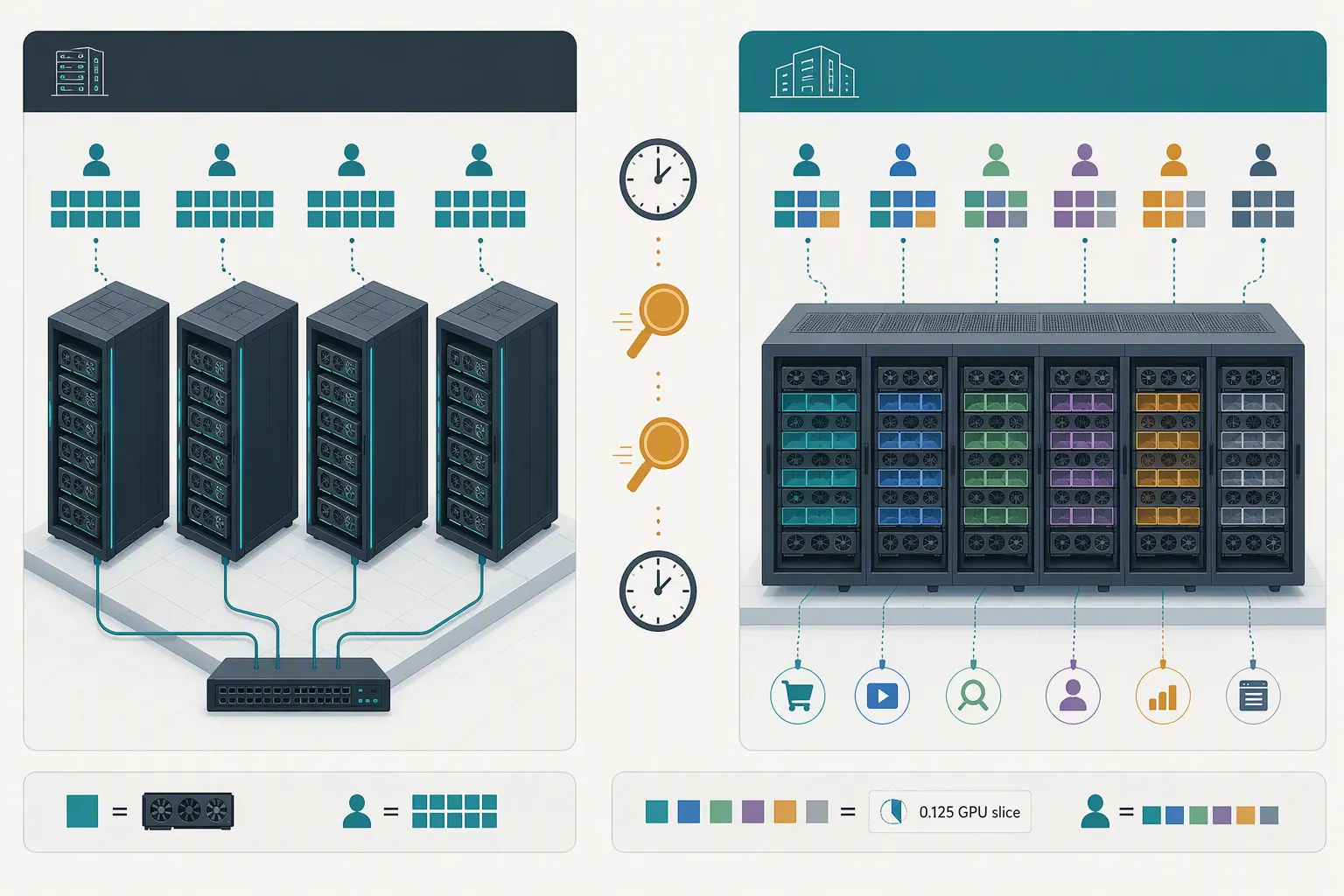
The sharper distinction is Nebius’s use of NVIDIA Run:ai for fractional GPU scheduling. Nebius says Run:ai allows allocation down to 0.125 GPU slices, letting multiple inference workloads share a physical GPU rather than reserving a full device for each service.[6] For RTB, that maps directly to the workload shape: several models are always warm, but their traffic curves are not identical. A full GPU per model can be clean from an ownership perspective and wasteful from an auction economics perspective.
A hypothetical bidder makes the difference easier to see. Suppose the conversion model is hit on nearly every bid request, the creative-selection model runs only when eligible creatives exceed a threshold, and the brand-safety model is invoked more heavily on open exchange traffic than on curated supply. If those services each reserve a full accelerator, capacity sits idle whenever traffic composition shifts. Fractional scheduling does not remove the need for load testing, model profiling, or tail-latency discipline, but it gives the infrastructure team another lever before it overbuys GPU inventory.
That lever is especially relevant when Triton is the common serving layer. Triton can serve multiple models, but the utilization outcome depends on the scheduler, instance configuration, batching settings, memory headroom, and placement policy underneath it. Nebius’s managed Kubernetes, PostgreSQL, Slurm, and Run:ai stack is not automatically superior for every model graph, but it is aimed at the kind of mixed serving environment where ad tech infrastructure teams spend most of their time.
Financial Health Matters Because It Eventually Becomes A Contract Term
GPU cloud finance can feel remote from bidstream operations until a provider changes reservation terms, tightens discounts, delays capacity, or pushes customers toward longer commitments. For ad tech buyers, financial health is not a stock-picking exercise. It is a pricing and continuity signal.
CoreWeave’s top-line growth is hard to ignore. Daloopa reports Q1 2026 revenue of $2.08 billion, up 112% year over year, with a 56% adjusted EBITDA margin.[4] But the same analysis shows why EBITDA alone is too flattering for an infrastructure-heavy provider: $1.147 billion in depreciation and amortization on $36.4 billion of property and equipment compressed adjusted operating income margin to 1%.[4] That does not mean CoreWeave is weak operationally. It means the economics of rapid capacity buildout are capital-intensive, and those costs have to be recovered through utilization, pricing, financing, or contract structure.
Nebius is smaller but shows a different profile in the same snapshot. Daloopa reports Q1 2026 revenue of $399 million, up 621% year over year, a 40% Core AI EBITDA margin, and $830 million in net cash.[4] For a buyer signing a long-term inference commitment, the net cash position and Core AI margin matter because they suggest more room to absorb buildout costs without immediately forcing every customer into aggressive pricing or rigid capacity terms.
Customer concentration adds another layer. Interconnect’s comparison describes CoreWeave as dependent on Microsoft for roughly 45% of revenue and OpenAI for roughly 20%, while Nebius is presented with a broader enterprise base; Nebius-related materials also cite Shopify running 16 billion tokens per day and 40 million LLM calls per day for inference.[7] Shopify is not an ad tech case study, and tokens are not bid requests. The relevant point is narrower: sustained inference at large scale is part of the Nebius operating story, while CoreWeave’s commercial exposure is more concentrated around a small number of very large AI customers.
Pricing Is Directional, Not Decisive
Published pricing is tempting because it looks comparable. It is not. CoreWeave lists H100 inference single-GPU on-demand pricing at $6.16 per hour, spot at $2.46 per hour, up to a 60% reserved discount, and zero egress.[8] ComputePrices lists Nebius H100 SXM at $3.98 per hour, H200 at $4.63 per hour, up to a 35% commitment discount, and zero egress, with the aggregator refreshed on July 29, 2026.[9]
| Provider | Published price signal | What to avoid concluding |
|---|---|---|
| CoreWeave | H100 inference single-GPU: $6.16/hr on-demand; $2.46/hr spot; up to 60% reserved discount; zero egress | Do not compare directly with a general GPU instance as if the SKU and utilization profile are identical |
| Nebius | H100 SXM: $3.98/hr; H200: $4.63/hr; up to 35% commitment discount; zero egress | Do not treat aggregator pricing as the final negotiated rate for a committed ad tech deployment |
For RTB inference, the more useful cost question is per successful decision inside the timeout budget, not posted GPU-hour. A cheaper GPU-hour can lose if the model graph needs more replicas to control tail latency. A more expensive GPU-hour can win if fractional allocation raises utilization without pushing p95 or p99 latency into the auction cutoff. That answer requires benchmarking identical models, traffic distributions, batching policies, and timeout rules on both platforms. No public benchmark does that today.
How To Read The Choice For Ad Tech
A practical evaluation should start with workload shape, then financial durability, then commercial comparability. Brand momentum belongs after those questions, not before them.
- Choose a CoreWeave-shaped evaluation if the dominant work is burst training, embedding refreshes, large-batch inference, or high-throughput jobs that can keep large bare-metal allocations busy.
- Choose a Nebius-shaped evaluation if the dominant work is continuous online inference across many models with uneven demand, especially where fractional GPU allocation can reduce idle reservation.
- Treat Triton support as a baseline, not a differentiator by itself; the scheduling and utilization layer below Triton is where much of the RTB economics show up.
- Ask vendors to price the same deployment pattern: model count, memory footprint, QPS distribution, batching policy, region mix, failover design, reserved capacity, and timeout target.
- Measure timeout reduction and tail latency under production-like traffic before treating posted GPU pricing as meaningful.
The cleanest judgment is therefore narrow. CoreWeave is the stronger fit for hyperscaler-style ad platforms that need burst training capacity, bare-metal throughput, and large-batch inference economics. Nebius is the better fit to investigate first for DSPs, SSPs, ad serving, and verification teams whose main pain is sustained, latency-sensitive inference with multiple models competing for GPU capacity. That is not a universal procurement answer. It is the decision frame the public evidence supports.
References
- PubMatic Delivers 5x Faster, Smarter Advertising Decisions with NVIDIA — PubMatic, October 2025.
- Deploy Agentic Bidding Without Sacrificing Speed: ARTF Containers with NVIDIA GPU Acceleration on AWS — AWS, 2026.
- Real-Time Bidding Infrastructure at AI Scale — V2Solutions.
- Nebius vs CoreWeave: Neoclouds Financial Analysis — Daloopa.
- Trust Center — Nebius.
- Scaling inference with Run:ai fractional GPUs — Nebius.
- CoreWeave vs Nebius — Interconnect.
- Pricing — CoreWeave.
- Nebius Pricing — ComputePrices.