
Gen Z Birth Years vs. the Ages You Can Actually Target
Pew defines Gen Z as born 1997–2012, but no ad manager accepts that as a target. See which Meta, Google, and TikTok age brackets actually cover Gen Z, which silently mix in Millennials, and what targeting you lose on under-18s.
- Platform
- Meta, Google Ads0 TikTok
- Bid strategy
- Demographic bid adjustments
- Last reviewed
- 0-08-26
No specific Benchmarks record is cited for this tactic yet — treat it as directional, not evidence-backed.
The handoff usually breaks at the same point: the strategy deck says “Gen Z, born 1997–2012,” then the buyer opens the platform and has to choose age brackets. Pew’s widely used cutoff puts Generation Z at birth years 1997 through 2012, and USAFacts’ 2024 age math translates that to ages 12 through 27 in 2024.[1][2] No Meta, Google, or TikTok setup screen turns that cohort into one clean selectable audience.
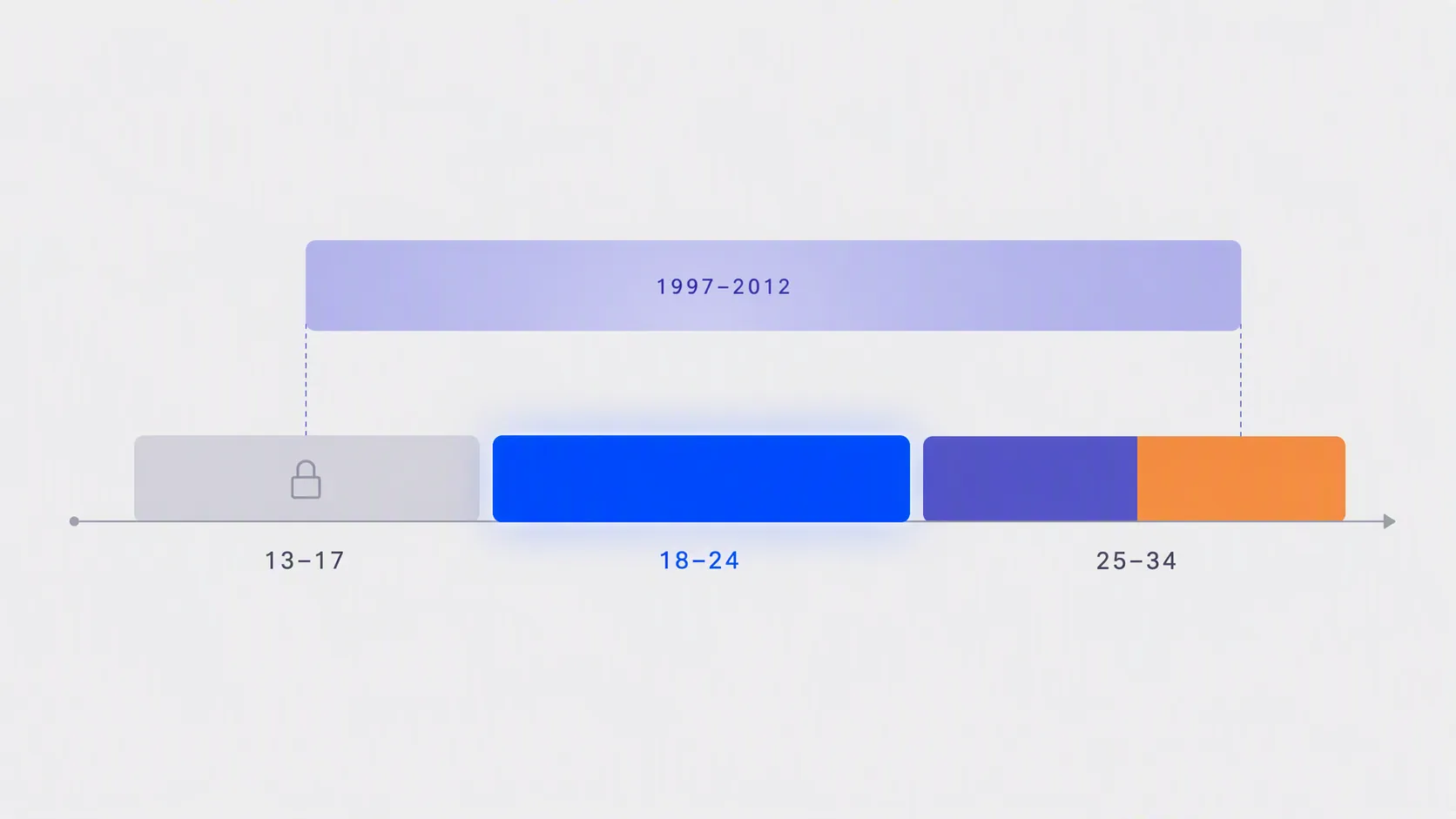
For a 2024 media plan, the practical translation looks like this.
| Platform | Selectable age proxy | How it maps to Pew Gen Z in 2024 | Buying implication |
|---|---|---|---|
| Meta | 18–24; 25–34; under-18 audiences only with platform-specific teen restrictions | 18–24 is fully inside Gen Z. 25–34 contains ages 25–27 from Gen Z and ages 28–34 from Millennials. Ages 12–17 are not equivalent to ordinary adult targeting. | Use 18–24 as the clean adult Gen Z proxy. Label 25–34 as mixed Gen Z/Millennial reach. Do not present teen reach as normal demographic targeting; confirm the current Meta teen-ad controls in Meta Help Center before a client-facing plan uses them.[5] |
| Google Ads | 18–24, 25–34, 35–44, 45–54, 55–64, 65+, plus Unknown | 18–24 is fully inside Gen Z. 25–34 mixes the oldest Gen Z with younger Millennials. There is no clean under-18 age bucket in the documented demographic targeting options.[4] | Use 18–24 when the plan needs a fully Gen Z adult age proxy. Treat 25–34 as an expansion bucket with generational bleed. Decide deliberately whether Unknown stays on. |
| TikTok Ads Manager | 13–17, 18–24, 25–34, 35–44, 45–54, 55+; TikTok says age is inferred from account sign-up data. The cited help page was updated in March 2025.[3] | 13–17 covers teen Gen Z above age 12. 18–24 is fully inside Gen Z. 25–34 mixes ages 25–27 Gen Z with ages 28–34 Millennials. | TikTok is the only platform in this set with a visible 13–17 bracket in the cited documentation, but that does not make it equivalent to adult targeting. Teen restrictions change what can be selected and how the audience can be reached.[3][5] |
What the age proxy actually buys
The cleanest adult proxy is 18–24. In 2024, every person in that bracket sits inside Pew’s Gen Z birth-year definition. That is why it is the safest age range to put in a plan when the client expects a “Gen Z” audience and the platform requires a selectable age bracket.
The tradeoff is that 18–24 does not represent all of Gen Z. It excludes teens and it excludes ages 25–27, even though both groups belong to the 1997–2012 cohort under Pew’s definition. That is not a flaw in the definition; it is a buying constraint. The plan should say “Gen Z adults 18–24,” not simply “Gen Z,” if that is the only age bracket being bought.
Google makes this especially plain because its documented demographic age buckets begin at 18–24 and then move to 25–34, with Unknown included as a default-on segment.[4] There is no documented Google age bucket that lets a buyer select 13–17 or 12–17 as a demographic target. If a plan says Google will target “Gen Z 12–27,” the setup does not match the sentence.
25–34 is not a Gen Z bucket
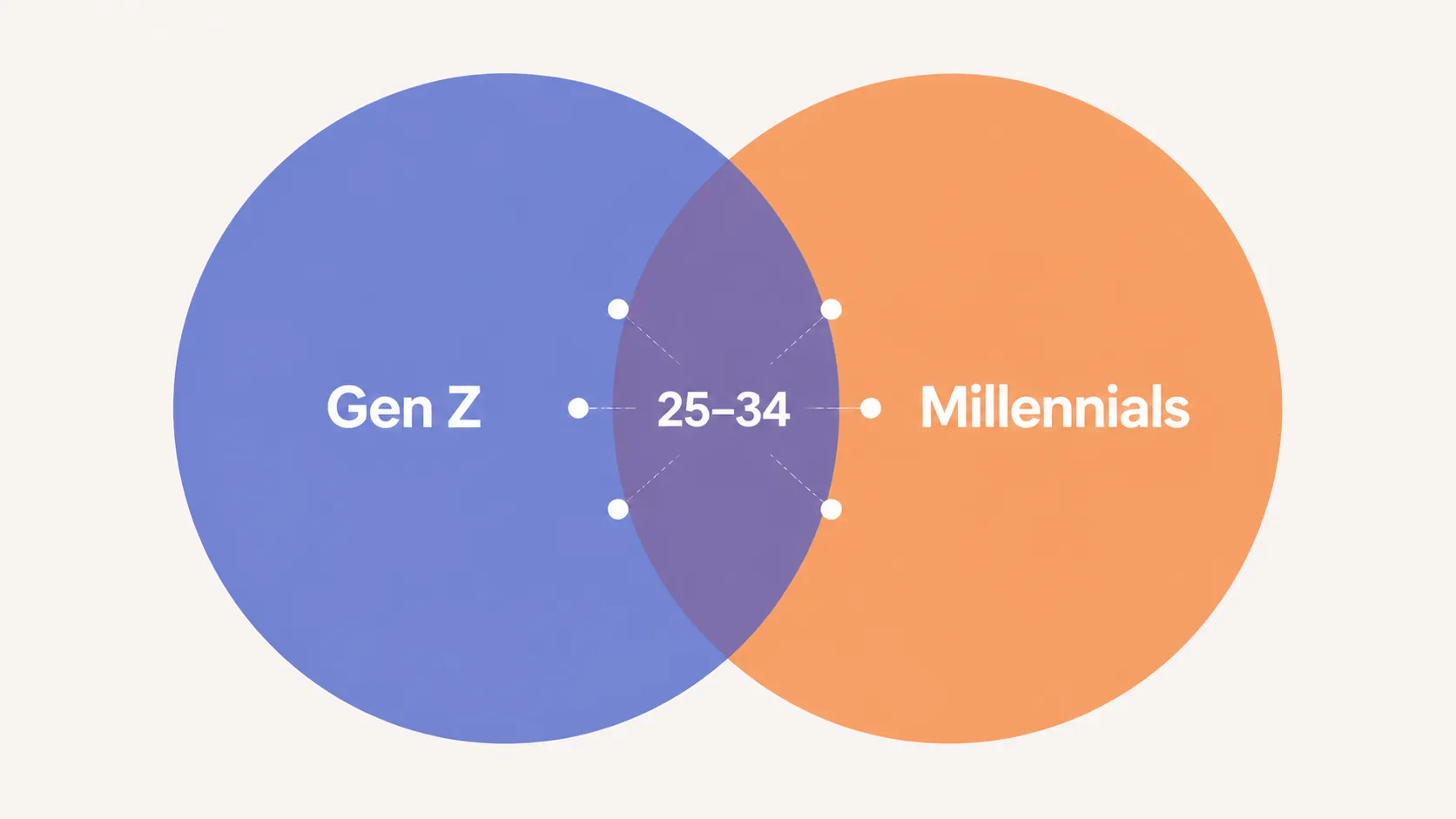
The 25–34 bucket is where plans quietly become misleading. In 2024, only ages 25, 26, and 27 fall inside Pew Gen Z. Ages 28 through 34 fall outside it. So 25–34 can be a legitimate expansion if the campaign wants older Gen Z plus adjacent younger Millennials, but it is not a clean Gen Z selection.
That distinction matters in reporting. If 25–34 carries spend, reach, conversions, or video views, the result should not be written up as if it came from Gen Z alone. The audience definition should say something like “18–24 core Gen Z, with 25–34 used as an older-Z/younger-Millennial expansion.” It is less elegant than the deck label, but it prevents a downstream reader from thinking the platform isolated the full cohort.
TikTok’s 13–17 option does not behave like normal adult demographic targeting

TikTok’s documented age brackets include 13–17, 18–24, 25–34, 35–44, 45–54, and 55+, and TikTok says age is inferred from account sign-up data.[3] That makes TikTok look closer to the Pew cohort than Google at first glance, because at least the teen portion appears as a selectable bracket.
The bracket alone is not enough. Teen targeting sits under a different rule set from adult targeting. Strike Social’s summary describes under-18 targeting restrictions across Meta, TikTok, Snapchat, and Google; the safe operational read is that a 13–17 selection should not be treated as if the buyer still has the same interest, behavioral, audience-list, or optimization levers used for adults.[5] For a plan, that means 13–17 is a restricted teen reach choice, not the missing lower half of a normal Gen Z campaign.
There is also a small but important age gap in the cohort math: Pew’s 2024 Gen Z range starts at age 12, while TikTok’s cited age bracket starts at 13.[2][3] A 13–17 TikTok audience is therefore not the full under-18 Gen Z slice. It is the platform’s teen bracket, subject to platform eligibility and restrictions.
Verification note before this reaches a client deck
The cited TikTok and Google controls are supported by platform help documentation.[3][4] The under-18 restriction picture is weaker for Meta because the official Meta teen-ad page was JavaScript-rendered during source checking and did not yield readable text. Any claim about the exact Meta teen targeting controls should be checked against the current Meta Help Center inside a logged-in or renderable environment and date-stamped before a client-facing plan goes live. Strike Social is useful as a cross-platform summary, but it is not a substitute for the original help-center page when a buyer is committing restrictions to a plan.[5]
Google’s Unknown segment is not a generation
Google’s demographic setup adds one more audit point: Unknown. Google says demographic targeting includes age buckets and an Unknown segment for users whose demographic information is not identified, and that Unknown is included by default.[4] Leaving Unknown on may preserve reach; excluding it may make the audience report look cleaner. Neither choice turns the campaign into a better Gen Z definition.
The useful control is documentation. If Unknown remains eligible, the plan should not report the campaign as if all delivered impressions were inside 18–24 or 25–34. If Unknown is excluded, the plan should note that reach was narrowed to users Google could classify demographically. Google also allows bid adjustments by demographic group, so a buyer can weight age segments differently, but that is a bidding decision layered on top of the proxy—not proof that the cohort itself was cleanly targeted.[4]
Why the Gen Z label still shows up in the plan
The label is not useless. Pew’s own guidance is a reminder that generational boundaries are analytical tools, not scientifically fixed walls.[6] That is exactly how the label should be used in media planning: helpful for aligning strategy, creative, and stakeholder language; insufficient as a direct buying instruction.
There is demand for the shorthand, which is why this keeps happening. HubSpot’s 2024 marketing statistics report that 36% of marketers target Gen Z, up from 34% in 2023.[7] That figure says the audience is on marketers’ planning radar. It does not say those marketers can buy the full cohort cleanly inside every ad manager.
The clean way to reconcile the two is to separate the strategy definition from the buying definition. Strategy can say Gen Z means born 1997–2012. Buying should say which platform brackets are being used, what portion of the cohort they cover, and where the audience spills into another generation.
How to write the audience definition in the media plan
A defensible plan does not need a long cultural description of Gen Z. It needs a short translation from cohort language to platform controls.
- Cohort definition: Gen Z is defined for planning as people born 1997–2012, equal to ages 12–27 in 2024 under the cited age math.[1][2]
- Core adult proxy: 18–24 is the clean adult Gen Z bracket on Google and the clean adult planning proxy for Meta.
- Expansion proxy: 25–34 includes older Gen Z only through age 27 in 2024 and also includes younger Millennials, so performance from this bracket should be labeled as mixed.
- Teen reach: TikTok documents a 13–17 bracket, but teen targeting should be treated as restricted and verified against current platform help pages before publication.[3][5]
- Google reporting: Unknown is not a Gen Z audience; if it remains on, reporting should acknowledge that some delivery is demographically unclassified.[4]
- Spend and performance: do not attach CPM, CPA, conversion-rate, or efficiency expectations to these demographic proxies unless they are backed by Signal & Convert Benchmarks or Tracker records.
That is the usable end point: define Gen Z by birth year for strategy, define selectable brackets for buying, label the Millennial bleed in 25–34, flag under-18 limits, and keep performance claims tied to actual benchmark records rather than demographic shorthand.
References
- Where Millennials end and Generation Z begins, Pew Research Center, January 17, 2019.
- Who is Gen Z?, USAFacts, April 2024.
- Age and gender targeting, TikTok Ads Help, March 2025.
- About demographic targeting, Google Ads Help.
- Marketing to Gen Z Audiences, Strike Social.
- 5 things to keep in mind when you hear about Gen Z, Millennials, Boomers and other generations, Pew Research Center, May 22, 2023.
- Marketing Statistics, HubSpot.