
Does AI Infrastructure Demand Really Raise Ad Costs?
Media buyers watching CPMs and CPCs climb keep hearing that the AI data-center buildout is the cause. This evidence-graded breakdown sorts the documented mechanisms — auction-side pressure and platform price-per-ad disclosures — from speculation like hidden platform fees, so you know what you can verify from public data.
- Platform
- Meta
- Bid strategy
- Automated bidding
- Last reviewed
- 0-07-31
No specific Benchmarks record is cited for this tactic yet — treat it as directional, not evidence-backed.
Yes, AI infrastructure demand can contribute to higher digital ad costs. No, that does not mean your CPM went up because a platform quietly added a data-center surcharge to your auction.
The cleaner answer is less satisfying but more useful: AI infrastructure demand affects digital ad costs through several different channels, and those channels do not have the same evidence behind them. Some are visible in platform disclosures. Some show up in auction behavior. Some can be checked in your own search and paid media trendlines. One popular version — that platforms are simply hiding AI buildout costs inside advertiser fees — is not documented by the public evidence available.
For a buyer trying to explain rising CPMs or CPCs, the job is not to decide whether AI is expensive. It is to separate what can be verified from what merely sounds plausible.
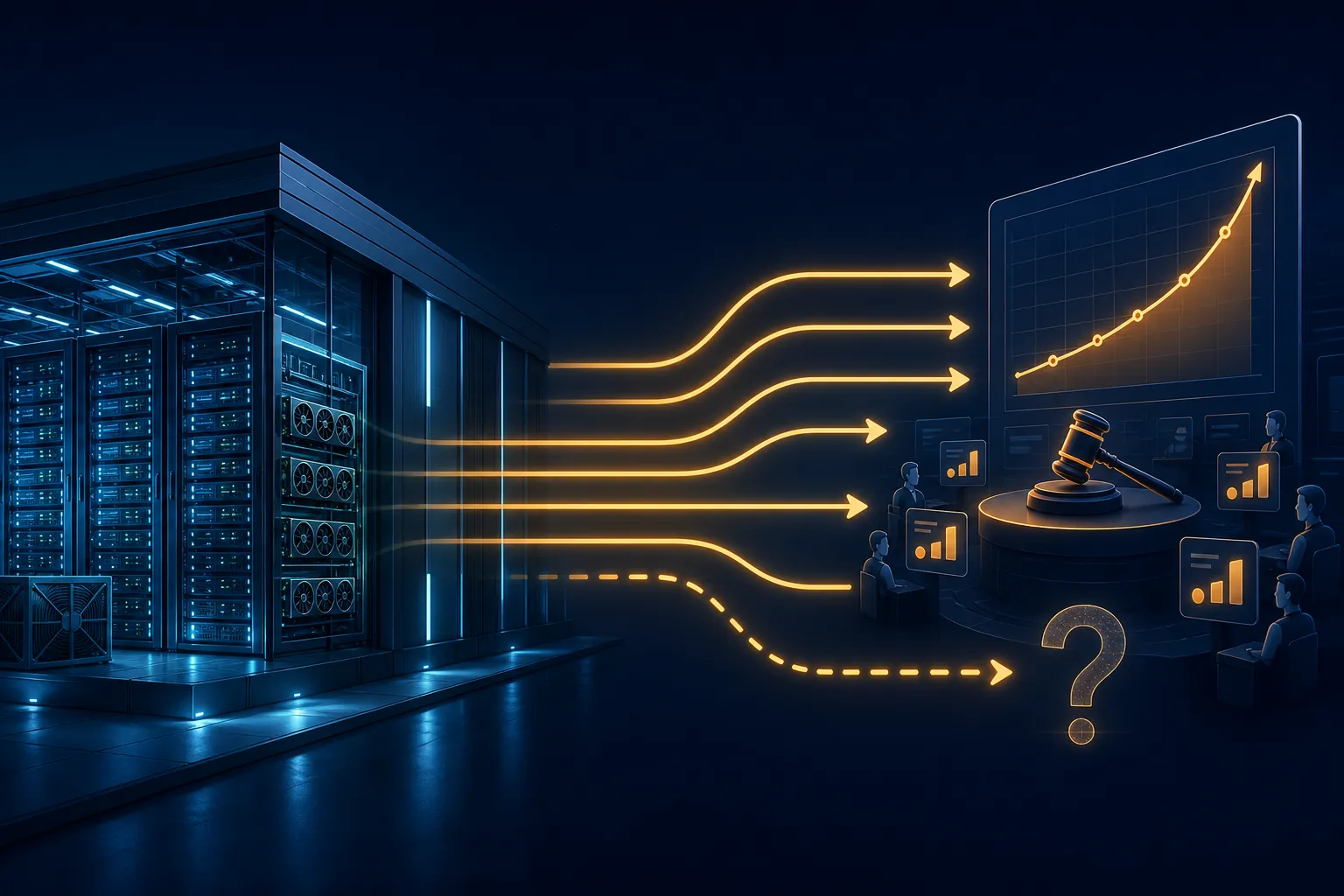
The evidence ladder
The claim usually gets compressed into one sentence: AI infrastructure demand is making ads more expensive. That sentence hides several different claims.
| Channel | What the claim says | Evidence quality | What a buyer can monitor |
|---|---|---|---|
| Platform capex and component costs | AI infrastructure requires more data-center investment, and higher component pricing can pressure platform economics. | Documented at the platform-disclosure level, but indirect for ad prices. | Capex guidance, component-cost language, data-center commentary in quarterly filings. |
| Platform price-per-ad monetization | A platform may report that the average price per ad increased, which means advertisers are paying more per delivered ad unit on that platform. | Documented when disclosed by the platform; still not proof of one cause. | Price-per-ad disclosures, ad impression growth, revenue growth, management commentary. |
| AI bidding and ranking mechanics | Automated bidding and ranking systems can intensify competition for valuable impressions and raise clearing prices in some auctions. | Mechanically plausible and observable in account data, but account-specific. | CPM, CPC, conversion rate, auction overlap, impression share, bid strategy changes, marginal CPA or ROAS. |
| AI Overviews and organic-to-paid pressure | If AI search surfaces reduce formerly free organic clicks, some demand may shift into paid search or other paid channels. | Observable through traffic and query-level reporting, but not universal across categories. | Organic clicks, paid search query volume, nonbrand CPCs, landing-page mix, branded versus nonbranded traffic changes. |
| Hidden AI infrastructure fee | Platforms quietly pass AI data-center costs to advertisers through an opaque surcharge. | Unverified in the public evidence available. | Do not treat as fact unless a platform discloses it or it appears in auditable billing terms. |
That ladder matters because each rung leads to a different response. If the issue is true auction pressure, you revisit targets, channel allocation, creative volume, and incrementality. If the issue is platform monetization, you track quarterly disclosures. If the issue is an unverified hidden-fee story, you do not build a client budget narrative around it.

Where Meta’s Q1 2026 disclosure actually helps
The most useful public bridge between AI infrastructure economics and ad pricing is not a rumor. It is the way Meta’s Q1 2026 results place two pieces of information in the same public reporting package: ad-pricing disclosure and capex guidance that cites “higher component pricing.” Meta reported a year-over-year increase in its average price per ad, and in the same results discussed capital expenditure expectations shaped in part by higher component pricing [1].
That does not prove that a GPU invoice moved directly into your CPM. It does not prove that every advertiser paid more because Meta’s infrastructure stack became more expensive. It does not document a surcharge. What it does provide is a dated, re-checkable public disclosure where infrastructure cost pressure and ad monetization are visible at the same platform and in the same reporting cycle.
That distinction is not pedantic. A price-per-ad increase is an outcome measure. It can reflect auction demand, supply mix, ad load, ranking changes, advertiser quality, geography, format mix, or pricing power. Capex and component pricing are cost-side disclosures. Seeing both in one filing is meaningful because it shows the platform is experiencing infrastructure cost pressure while advertiser prices are also moving. It still does not tell you the internal pricing equation.
For a weekly performance meeting, the honest sentence is: Meta has publicly disclosed higher average price per ad and has also cited higher component pricing in capex guidance; that supports monitoring infrastructure economics as one pressure point, but it is not evidence of a hidden AI fee [1].
Why auction-side AI can raise clearing prices without a surcharge
The more everyday path is the auction itself. Most large paid media accounts are already competing through machine-mediated bidding, ranking, and delivery systems. The buyer sets a target, budget, event, or value signal. The platform’s system decides which impression is worth entering, how aggressively to bid, and how to rank competing ads.
When more advertisers use similar automation against similar conversion signals, the auction can become more efficient at finding the same high-probability users. That can raise clearing prices for the impressions everyone’s models want. Nobody needs to add a line item called “AI infrastructure fee” for that to happen. The cost increase can be a consequence of better targeting, denser competition, and automated systems bidding into the same pockets of expected value.
This is also why account-level diagnosis matters. If CPM rises while conversion rate rises enough to preserve CPA or ROAS, you may be buying a more expensive but better-matched slice of inventory. If CPM rises and conversion rate does not follow, the account may be absorbing auction inflation, signal degradation, creative fatigue, or a poor bid target. Those are different problems, even if they all arrive as “costs are up.”

The auction path is easier to verify inside your own account than in a platform earnings release. Look for the timing of bid strategy changes, budget increases, conversion-event changes, learning resets, audience consolidation, creative declines, and impression-share movement. A macro explanation is weak if the cost jump lines up neatly with an account change you made last Tuesday.
AI Overviews can turn an organic problem into a paid media problem
The search-side version is different. AI Overviews do not have to raise paid search CPCs by charging advertisers more directly. They can change the supply of unpaid attention. If a page used to earn organic clicks for informational queries and those clicks decline, the business may try to recover volume through paid search, paid social, affiliates, creators, email capture, or other paid channels.
That creates a budget-pressure path rather than a simple pricing path. A brand that loses organic visibility may put more money into paid acquisition. If multiple competitors do the same around the same commercial queries, paid auctions can become more crowded. The result may look like AI made ads more expensive, but the operating chain is: AI search presentation changes organic traffic, organic shortfall moves demand into paid channels, and paid competition increases.
This will not hit every advertiser equally. A retailer with mostly branded demand, a B2B company dependent on informational SEO, and a local services advertiser bidding on high-intent queries are not exposed in the same way. The check is not whether AI Overviews exist. The check is whether your organic clicks, query mix, and paid search pressure moved together.
The hidden-fee claim is the weakest version of the story
The most dramatic claim is that advertisers will simply be made to pay for the AI buildout through hidden platform fees. It is easy to repeat because it compresses a complicated cost story into a villain, a bill, and a victim. It is also the part that needs the most caution.
A platform can disclose capex pressure. A platform can disclose price-per-ad movement. A buyer can observe higher CPMs, CPCs, or CPAs. None of those, by itself, proves an undisclosed fee. To make that claim responsibly, you would need evidence in billing terms, platform documentation, public filings, or some auditable disclosure that the charge exists and is tied to AI infrastructure costs.
Until then, the hidden-fee framing is speculation. That does not make platform pricing benign or transparent. It just means the documented story is different: visible infrastructure spending pressure, visible ad-price movement in at least one major platform disclosure, and auction mechanisms that can push prices higher without any separate surcharge.
What to verify before changing the budget story
Before telling a CFO or client that AI infrastructure demand is the reason costs rose, separate the evidence you can actually re-check.
- Platform disclosures: Track price-per-ad, ad impression growth, revenue growth, and management commentary in quarterly results. If a platform reports higher average price per ad, that is a real monetization signal, not a theory.
- Capex and component-cost language: Watch whether platforms continue to cite infrastructure, data-center, or component-pricing pressure. Treat this as cost-side context, not automatic proof of ad-price pass-through.
- Auction metrics in your own accounts: Compare CPM, CPC, CPA, ROAS, conversion rate, impression share, frequency, auction overlap, bid strategy changes, and budget changes by date. The account timeline often explains more than the macro narrative.
- Organic-to-paid search pressure: Look at organic clicks, query categories, landing pages, nonbrand paid search CPCs, and paid volume. If organic visibility falls while paid demand rises, the AI-search path deserves attention.
- Opaque fee claims: Do not treat them as fact unless the platform discloses the fee, the billing terms show it, or a filing gives you language you can quote and revisit next quarter.