
Audible's Jennifer Coolidge Campaign Can't Be Benchmarked
Audible's Jennifer Coolidge campaign (Australia-only, launched 20 Aug 2026 via agency Hello) is a top-funnel awareness play whose claims are all brand- or agency-sourced, with no disclosed spend, media mix, or campaign KPI. The verdict: top-funnel / unverifiable — the missing metrics are the finding, not a success signal.
- Platform
- Not disclosed
- Campaign type
- Integrated brand awareness
- Spend range
- Not disclosed
- Timeframe
- 2026-08-20
- Not disclosed
- Not disclosed
- Verdict
- Unverifiable
- Industry vertical
- Audiobooks
- Last reviewed
- 2026-08-31
Campaign record — 20 August 2026
| Field | Record |
|---|---|
| Brand | Audible |
| Talent | Jennifer Coolidge |
| Market | Australia only |
| Creative agency | Hello, an independent creative group |
| Opening move | A staged “spotted in Bondi” sighting |
| Public spend | Not disclosed |
| Media-mix split | Not disclosed |
| Per-campaign KPI | Not disclosed |
| Working verdict | Top-funnel / unverifiable |

The known record is easy to establish. Audible launched an Australia-only campaign featuring Jennifer Coolidge on 20 August 2026, with independent creative group Hello behind the work. It began with a staged Bondi sighting and was later revealed as the opening move of a broader integrated campaign.[1] The evidence record becomes much thinner when the question changes from what happened to what it achieved: there is no public spend figure, no disclosed allocation by channel, and no campaign-level performance measure.
What the campaign actually did
The campaign’s central idea was that “you can get lost in an audiobook.” The Bondi stunt gave that idea a public, celebrity-led entry point: Coolidge was presented as a sighting before the activity was connected to Audible. A Harris Farm activation extended the premise into a supermarket setting, involving a branded shopping trolley and Coolidge.[2]
Trade coverage describes the wider activity as spanning TV, out-of-home, social, creators and influencers, experiential, earned media, and retail.[3] That is a description of the stated campaign mix, not a disclosed media plan. The record does not provide channel weights, placement volumes, flighting, buying levels, or a clear distinction between paid, owned, earned, and partner activity. It also does not disclose CTV or audio as channels.
That distinction matters for a campaign that is easy to encounter as a piece of entertainment. A stunt, a retail activation, and celebrity coverage can all be part of an integrated awareness design. They do not, by themselves, establish how many people were reached, how often they were exposed, whether the intended audience remembered Audible, or whether listening behavior changed.
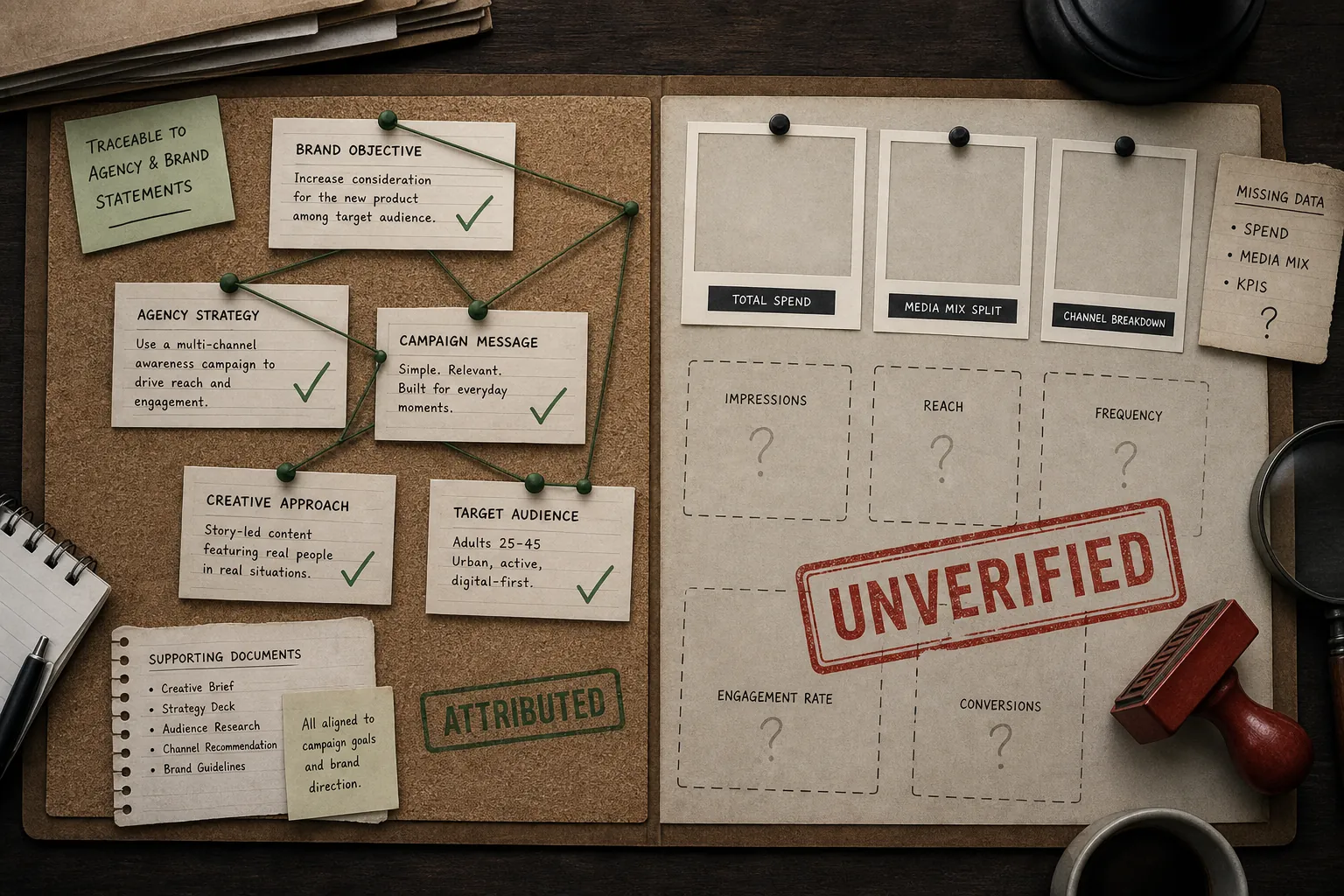
The claims are attributable; the results are not
The strategic rationale is presented through agency and brand-side commentary reported by trade publications. Hello’s stated platform is the experience of getting absorbed in an audiobook. The casting explanation is similarly qualitative: Jennifer Coolidge was selected for claimed intergenerational reach across Gen Z, millennials, and older audiences, alongside a production approach built around “Jennifer playing Jennifer” and improvisation.[4][3]
Those statements can support a description of intended positioning. They cannot independently verify that the campaign reached those generations, that the audiences understood the creative idea, or that Coolidge delivered incremental attention for Audible. The available material does not include an audience study, brand-lift result, platform reporting, or methodology for testing the intergenerational claim.
The same limitation applies to the media investment language. B&T describes the campaign as being “supported by heavy brand media investment,” but gives no amount.[4] There is therefore no basis for comparing investment with reach, earned-media value, cost per completed view, search response, listening starts, subscriptions, or any other outcome. “Heavy” is a characterization of scale, not a benchmarkable input.
One positive practitioner reaction is visible in a LinkedIn post from Andrew Tindall, who praised the campaign while noting that he generally dislikes celebrity PR stunts.[5] That is useful as evidence that the work attracted approval from at least one industry observer. It is not a campaign result, a measure of consumer response, or an independent effectiveness assessment.
What cannot be benchmarked
For a performance marketer reviewing the case file, the missing fields are more consequential than the creative description. The corpus contains no disclosed:
- Total spend or “heavy investment” amount
- Media allocation by TV, OOH, social, creators, experiential, earned, or retail
- Reach, frequency, impressions, or completed-view data
- Brand awareness, consideration, recall, or message-association lift
- Engagement, traffic, listening, subscription, or conversion results
- Independent measurement or a per-campaign KPI
This does not show that the stunt failed. It shows that the public record cannot distinguish between a well-funded awareness attempt, an efficiently distributed cultural moment, and a campaign whose business effect has simply not been disclosed. The design points toward the top of the funnel; the record does not demonstrate top-funnel effect.

Keep the record clean
The scope should also remain narrow. The evidence supports an Australia-only campaign; it does not support a global or U.S. rollout. There is no official Audible press-release text or independently established campaign title beyond the trade coverage. No Reddit, X, app-store, or other consumer-reception record was found in the supplied corpus, and that absence should not be converted into either approval or criticism.
A separate Yahoo item about Coolidge appearing in a Super Bowl-related spot should not be folded into this case. It concerns a Discover customer-service spot, not Audible.[6] Including it would inflate the campaign record through simple celebrity-name matching.
Verdict: top-funnel / unverifiable
Its effectiveness is not verifiable from the available record. No spend, media split, reach, lift, engagement, conversion, or other per-campaign KPI is public. An independent audit, a disclosed spend and delivery record, or a lift study with its methodology could change that assessment. Until then, the missing metrics are the finding—not a success signal.
References
- Jennifer Coolidge gets lost in Audible in new campaign following viral Bondi stunt via Hello — Campaign Brief
- Jennifer Coolidge is fronting a new campaign for Audible, whore-kitting out supermarket trolleys — 9Today
- Audible’s Jennifer Coolidge Bondi stunt — ContentGrip
- Exclusive: ‘Intergenerational reach’: Jennifer Coolidge fronts new Audible campaign — B&T
- Andrew Tindall LinkedIn post — LinkedIn
- Exclusive: Jennifer Coolidge to star in Super Bowl spot — Yahoo News
Built on this evidence
No Bidding tactic or Creative record currently cites this case file. Compare it against other results in Benchmarks.
Related benchmark reading
Report a corroborating or contradicting result
Seeing something different in your own account? Feed the data-integrity loop instead of leaving an open comment.