
What Amazon's $220B AI Capex Means for Advertisers
Amazon's 2026 AI capex is scaling to $220B, and the cost is surfacing in ad auctions rather than staying inside AWS margins. This explainer traces the build-out to the AI shopping placements Amazon monetizes and separates claimed lift figures from early independent data so advertisers know what to audit.
- Platform
- Amazon Ads
- Campaign type
- Sponsored Prompts
- Spend range
- $0B-$220B Amazon AI capex
- Timeframe
- Q0 2026
- CPC
- 0
- Verdict
- mixed
- Industry vertical
- ecommerce
- Last reviewed
- 0-08-01
Amazon’s 2026 AI capex number matters to advertisers because it no longer sits safely on the AWS side of the house. The spend line has moved from FY2019 capex of $16.9 billion to reported FY2024 capex of $83.0 billion, FY2025 capex of $131.8 billion, a February 2026 estimate of $200 billion, and then a July 30, 2026 raise to $220 billion. The FY2024 and FY2025 figures come through a secondary source and should be cross-checked against Amazon’s FY2025 10-K before publication-level use; the July 2026 raise is from CNBC’s Q2 earnings coverage.[1][2]
The account-level question is not whether $220 billion is “too much.” It is where that build-out shows up in Campaign Manager. In Q2 2026 alone, Amazon’s capex was $54.2 billion, up from $32.1 billion a year earlier; trailing-12-month free cash flow flipped to negative $7.6 billion from positive $18.2 billion; and long-term debt moved from $65.6 billion at Dec. 31, 2025 to $128.9 billion at Jun. 30, 2026, based on Amazon’s Q2 balance sheet.[2][3] At the same time, advertising services reached $19.809 billion in Q2, up 26% year over year and roughly one-tenth of Amazon’s revenue, with Sponsored Products called out by Andy Jassy as the largest driver.[3][4]
| Date or period | Amazon AI/capex marker | Why an advertiser should care |
|---|---|---|
| FY2019 | $16.9B capex reported by 24/7 Wall St. | Useful baseline for how far the infrastructure spend line has moved; secondary-source figure needs 10-K cross-checking before formal use.[1] |
| FY2024 | $83.0B capex reported by 24/7 Wall St. | The AI/data-center step-up was already visible before 2026 planning cycles.[1] |
| FY2025 | $131.8B capex reported by 24/7 Wall St. | Another secondary-source figure to verify against Amazon’s FY2025 10-K, but directionally important for budget context.[1] |
| Feb. 5, 2026 | 2026 capex discussed around $200B | The first 2026 planning anchor many advertisers would have seen before the July reset.[1] |
| Jul. 30, 2026 | 2026 capex raised to $220B | The number changed after many H2 Amazon Ads plans were already in market.[2] |
| Q2 2026 | $54.2B capex; TTM FCF −$7.6B; advertising services $19.809B | The infrastructure build, cash-flow pressure, and ad monetization engine are now moving in the same reporting window.[2][3] |
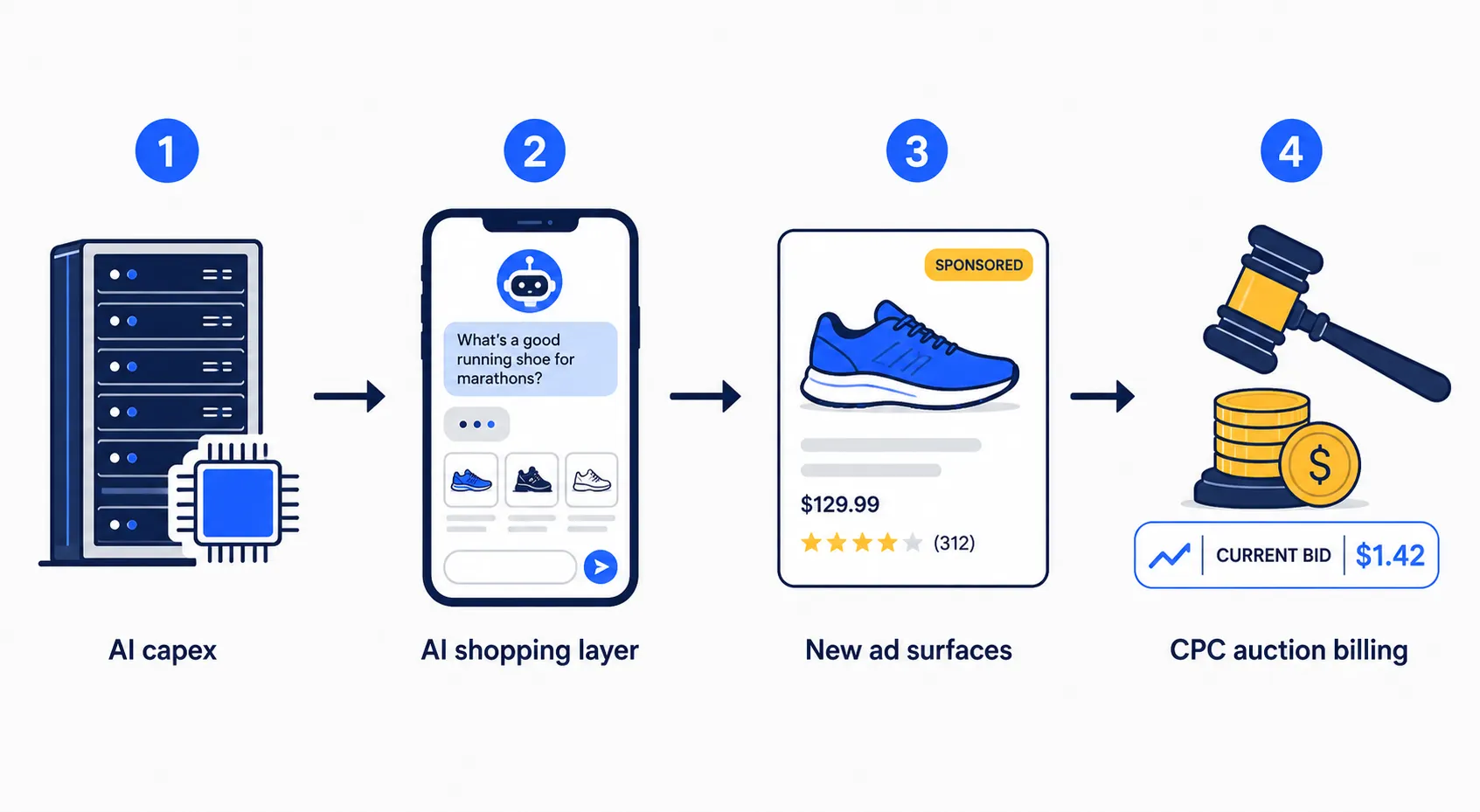
The capex-to-auction path
There is no clean accounting line that says one incremental dollar of AI capex becomes one incremental dollar of Amazon Ads revenue. That would be too neat. The advertiser-facing mechanism is still visible enough: Amazon spends heavily on the compute layer, uses that layer to add AI-assisted shopping and campaign surfaces, then monetizes those surfaces through ad products that run through auction logic and CPC billing.
- Infrastructure: AWS, Trainium, and the serving stack needed for AI shopping experiences and advertiser tools.
- Shopping layer: Rufus, Alexa+, and conversational product discovery surfaces that create more places where shoppers can express intent.
- Ad layer: Sponsored Prompts, Ads Agent, and the unified Campaign Manager experience that make those surfaces buyable, recommendable, or easier to activate.
- Billing layer: CPC auctions, auto-enrolled placements, reporting splits, and optimization suggestions that advertisers must now audit against existing Sponsored Products and Sponsored Brands traffic.
That last layer is the part that matters for media economics. A cheaper or more efficient chip stack does not automatically lower the advertiser’s CPC. The commercial product Amazon has actually put in front of buyers is new AI shopping inventory and automation. That is the same cost-pass-through pattern covered in Why Amazon’s custom AI chips won’t cut your ad costs and, more generally, in How AI Infrastructure Spending Reaches Your Ad Tech.
Sponsored Prompts are the cleanest example. Amazon’s prompt product became generally available on March 25, 2026. It is CPC-billed, tied to AI shopping prompts, and presented as an extension of Sponsored Products and Sponsored Brands activity rather than as a totally separate media channel.[5] Operational writeups describe prompt-level reporting in Campaign Manager, Rufus placement filters, and controls that allow advertisers to pause prompts even though the product is auto-enrolled and does not offer a true opt-out.[6] That is not an infrastructure discount. It is a new billable surface with control questions attached.
Ads Agent sits on the other side of the same build-out. It does not only place an ad into a shopper-facing assistant; it changes how campaign work is generated, recommended, and potentially accepted by the advertiser. Jassy said Ads Agent expanded to 11 new countries in 2026 and cited claimed efficiency improvements from its use.[4] That makes the buyer’s review trail important: which changes were suggested, which were accepted, which were automatically applied, and whether the account can isolate performance after those changes.
One naming caveat is worth keeping out of dashboards: a May 13, 2026 “Alexa for Shopping” rename appears in non-primary traces, but the verified Amazon point in the source set is narrower — Amazon said Rufus and Alexa+ were combined in Q2 2026.[3] Reporting labels should follow what the account and Amazon’s own product pages actually expose, not a half-verified rename.
What actually lands inside the ad account
The useful test is simple: can the buyer see it, pause it, segment it, compare it, and tie it back to account economics? If not, the feature may still be elegant, but it is not yet clean media inventory.
| Surface or tool | What the buyer should look for | Why it changes the media conversation |
|---|---|---|
| Sponsored Prompts | Prompt-level reporting, CPC charges, Rufus placement filters, and pause controls in Campaign Manager.[5][6] | These are AI-shopping placements that can spend against the account, not just organic assistant responses. |
| Rufus / Alexa+ shopping experiences | Traffic and conversion behavior from assistant-led discovery, separated from standard Sponsored Products and Sponsored Brands clicks where reporting allows.[3][6] | The shopper’s discovery path changes, so blended averages can hide whether the AI surface is incremental or merely cheaper, lower-volume traffic. |
| Ads Agent | Recommendation logs, accepted changes, automated setup outputs, and before/after performance by campaign type.[4] | Efficiency claims are not account results until the advertiser can reconcile changes against CPM, CPC, CPA, ACOS, TACOS, and contribution margin. |
| Unified Campaign Manager | Whether AI placements and prompt data can be filtered, exported, and reviewed alongside existing Sponsored Products, Sponsored Brands, and DSP reporting.[6] | A unified UI is helpful only if it does not blend away the placement economics the buyer needs to defend in a budget meeting. |
The awkward part is that auto-enrollment moves faster than finance sign-off. A shopper-facing feature can be good for product discovery and still create a budget-control problem if a media team notices it only after spend appears. Pausable is better than unmanageable. Pausable is not the same as opt-in.
Claims, early signals, and what they do not prove
Amazon’s lift figures are not useless. They are also not the same as verified account economics. A vendor claim can tell buyers what Amazon is optimizing toward, what the sales team will pitch, and which metrics may appear in product documentation. It cannot tell a specific brand whether the new traffic beats its existing Sponsored Products clicks after margin, promo funding, returns, and inventory constraints.
| Evidence type | Reported number or claim | How to read it |
|---|---|---|
| Amazon pitch claim for Sponsored Prompts | Sponsored Prompt clickers were claimed to convert 48% more and spend 21% more. The Adweek deck story is paywalled, so only preview-visible details should be used unless the team has licensed access.[7] | Treat as Amazon’s sales claim. Do not import the lift into forecasts unless your own prompt-level data reproduces it. |
| Amazon executive claim for Ads Agent | Jassy cited Ads Agent improvements of 8% lower CPM and 6% lower CPA.[4] | Useful directional benchmark, but still a platform claim. It needs an account-level holdout or at least a pre/post review of accepted recommendations. |
| unBoxed 2025 / Amazon-side product claims | Reported claims included 67% faster launch, 1.4x incremental reach, 45% higher detail-page views, and 26% stronger purchase rates.[5] | These are adoption and performance claims around product capability. They should not be treated as guaranteed media outcomes. |
| Single-seller early Rufus ad data | Paladone reportedly saw 88 Rufus-ad clicks versus 500,000 traditional clicks from Jan.–Mar. 2026, with Rufus CPC around $0.31 versus $0.50–$0.70 for traditional clicks.[8] | Interesting because it is account-adjacent and concrete. Weak as a benchmark because it is one seller, a short window, and tiny click volume. |
| AI-assistant usage comparison | Profitero data cited AI-assistant usage at 10% versus 37% for the search bar.[8] | This says something about shopper behavior mix, not ad effectiveness. It argues for segmentation, not for or against buying the placement. |
| Internal Amazon Rufus metric reporting | Business Insider reported on Amazon’s internal DSI metric and employee questions around it.[9] | A caution about internal measurement and forecasting. It is not proof that Rufus ads fail, and it is not a buyer-side performance readout. |
The Paladone data is the kind of thing buyers tend to like because it has clicks and CPCs attached. It is also exactly the kind of thing that gets abused in planning decks. Eighty-eight clicks cannot carry a category forecast. A $0.31 CPC can be attractive, irrelevant, or misleading depending on conversion quality and whether the traffic is incremental. The right takeaway is narrower: early Rufus ad volume can be small enough that a buyer should not let low CPC alone drive budget decisions.
The same caution applies to Amazon-claimed lift cases more broadly. If a platform says a new surface improved reach or detail-page views, the next step is not to reject the claim. The next step is to cross-check it against account economics. The Samsung Fold 8 Amazon Trade-In Ads case file is the same exercise: take the claimed lift seriously enough to test it, but not seriously enough to let it replace your own benchmark.
The audit to run before the next budget meeting
The buyer’s job now is not to decide whether Amazon’s AI build-out is strategically smart. It is to stop AI shopping traffic from disappearing into a blended Sponsored Products average.
- Pull prompt-level reporting in Campaign Manager and separate Sponsored Prompt traffic from standard Sponsored Products and Sponsored Brands traffic wherever the interface allows.[6]
- Use Rufus placement filters to isolate assistant-led inventory before judging CPC, conversion rate, ACOS, and revenue per click.[6]
- Find the Sponsored Prompt pause controls and document who is allowed to use them. Auto-enrolled inventory needs an owner, not just a notification trail.[6]
- Compare AI-shopping clicks against existing Sponsored Products and Sponsored Brands clicks by campaign objective, not just against account average CPC.
- For Ads Agent, keep a change log of recommendations generated, accepted, edited, or rejected. Claimed CPM and CPA reductions should be checked against the actual campaigns touched by the tool.[4]
- Check whether finance is evaluating the placement on media metrics only or on full account economics: contribution margin, promo stack, inventory position, return behavior, and incrementality.
There is a cross-platform version of this problem too. The question in Is the AI data center buildout inflating Demand Gen costs? is not identical to Amazon’s marketplace dynamics, but the billing habit is familiar: infrastructure spending becomes more tolerable for platforms when it can be attached to more sellable inventory, more automation, and more auction participation.
For advertisers, Amazon’s $220 billion AI capex does not justify expecting cheaper infrastructure-driven media. The safer operating assumption is more AI shopping inventory, more default exposure, and more auction competition to reconcile. If it cannot be seen, paused, segmented, compared, and tied back to account economics, it has not yet earned the right to be treated as efficient media.
References
- Amazon Is Spending $200B in AI This Year. Is That Good News for Investors? — 24/7 Wall St., July 14, 2026
- Amazon (AMZN) Q2 earnings report 2026 — CNBC, July 30, 2026
- Amazon.com Announces Second Quarter Results — Amazon Investor Relations, July 30, 2026
- Amazon CEO Andy Jassy: Amazon Ads growth in Q2 2026 earnings — About Amazon, 2026
- unBoxed 2025 Sponsored Products and Sponsored Brands prompts — Amazon Ads, March 25, 2026
- Amazon Rufus AI Prompts in 2026 — Ecomclips
- Exclusive: Leaked Pitch Deck Reveals Amazon’s Pitch to Get Advertisers on Rufus — Adweek
- Amazon’s Rufus AI Chatbot Ads Yield Data but Few Sales — Winbuzzer, April 2, 2026
- Amazon predicts $700 million potential gain from AI assistant Rufus — Business Insider, April 2025
Built on this evidence
No Bidding tactic or Creative record currently cites this case file. Compare it against other results in Benchmarks.
Related benchmark reading
Report a corroborating or contradicting result
Seeing something different in your own account? Feed the data-integrity loop instead of leaving an open comment.