
Why Burger King's Whopper Guarantee Needed the Right Sequence
Burger King's Whopper Guarantee wasn't a standalone promotion. This article explains why the guarantee only worked because it followed a specific sequence of credibility-building steps — and what marketers can learn about timing trust signals in their own campaigns.
Burger King’s Whopper Guarantee sounds, on the surface, like a tidy answer to a familiar marketing problem: reduce the buyer’s risk and give people a reason to try again. Announced on July 20, 2026, the offer says that if a Whopper does not meet a guest’s expectations, Burger King will remake it on the spot and provide a QR code for a free Whopper on the next visit, valid at participating U.S. restaurants through August 31, 2026.[1]
That is the visible policy. The more useful question for marketers is why this Whopper Guarantee made more sense in July than it would have made in March. A guarantee does not arrive as copy alone. It arrives as extra work for restaurant teams, managers, franchisees, support channels, and anyone close enough to the guest to absorb the gap between the promise and the product.
The guarantee mattered because it came after Burger King had already spent months creating permission to make it. First came public confession. Then listening. Then product and packaging fixes. Then a named in-restaurant role. Only after those deposits did the brand attach a public promise to the Whopper.
The guarantee was the last move, not the first
In March 2026, Burger King used its “There’s A New King And It’s You” Oscars campaign to do something most legacy brands avoid: it admitted the problem before asking for renewed belief. The campaign dismissed the King mascot and placed guests at the center. More importantly, Burger King U.S. & Canada President Tom Curtis said the brand “used to be King” before quality “fell off.”[2]
That line did more than set up a campaign. It changed the emotional contract. A brand that says “we are back” is asking customers to forget. A brand that says “we know where we slipped” is at least acknowledging the memory customers bring with them to the counter, the app, or the drive-thru lane.
The distinction matters because guarantees are often treated as conversion devices: a badge, a line near the button, a sentence meant to calm hesitation. But when customers already doubt whether the company understands the failure, a guarantee can sound like volume turned up on the same old claim. Burger King’s stronger move was not the refund-style offer. It was waiting until the brand had publicly named what customers had been judging.
Confession only worked because it created work
Curtis then took the campaign into a more exposed place: direct guest feedback. Burger King’s later announcement described “thousands of calls and texts” from guests after Curtis shared his phone number.[1] Lean Blog, drawing on reporting that it cites, described a larger figure of roughly 30,000 messages and about 2,000 personal replies from Curtis, but that more precise count should be treated as reported rather than as an independently verified Burger King disclosure.[3]
Even with that caveat, the useful point is not the exact message count. It is the order of burden. Burger King did not move straight from “we hear you” to “trust us.” It opened a channel that could produce specific complaints, inconvenient details, and operational demands. Listening is cheap when it is a social caption. It becomes expensive when the next campaign has to prove someone acted on what guests said.
That is where the Whopper sequence becomes more instructive than a standard brand refresh. The apology gave customers language for the problem. The listening gave the company a source of pressure. The product changes gave the eventual guarantee something to stand on.
The product had to change before the promise could carry weight
Burger King’s July announcement tied the guarantee to tangible changes around the Whopper: a glazed bun, creamier mayo, produce improvements, and updated clamshell packaging intended to protect the build and presentation.[1] Those are not glamorous details, but they are exactly the kind of details a guarantee depends on.
A guest does not evaluate a guarantee in the abstract. They evaluate the sandwich in front of them: whether the bun looks tired, whether the ingredients have shifted in the bag, whether the build matches the appetite the ad created. Packaging is part of that promise because the product has to survive the handoff. A better recipe that arrives flattened or sloppy still becomes a service problem.
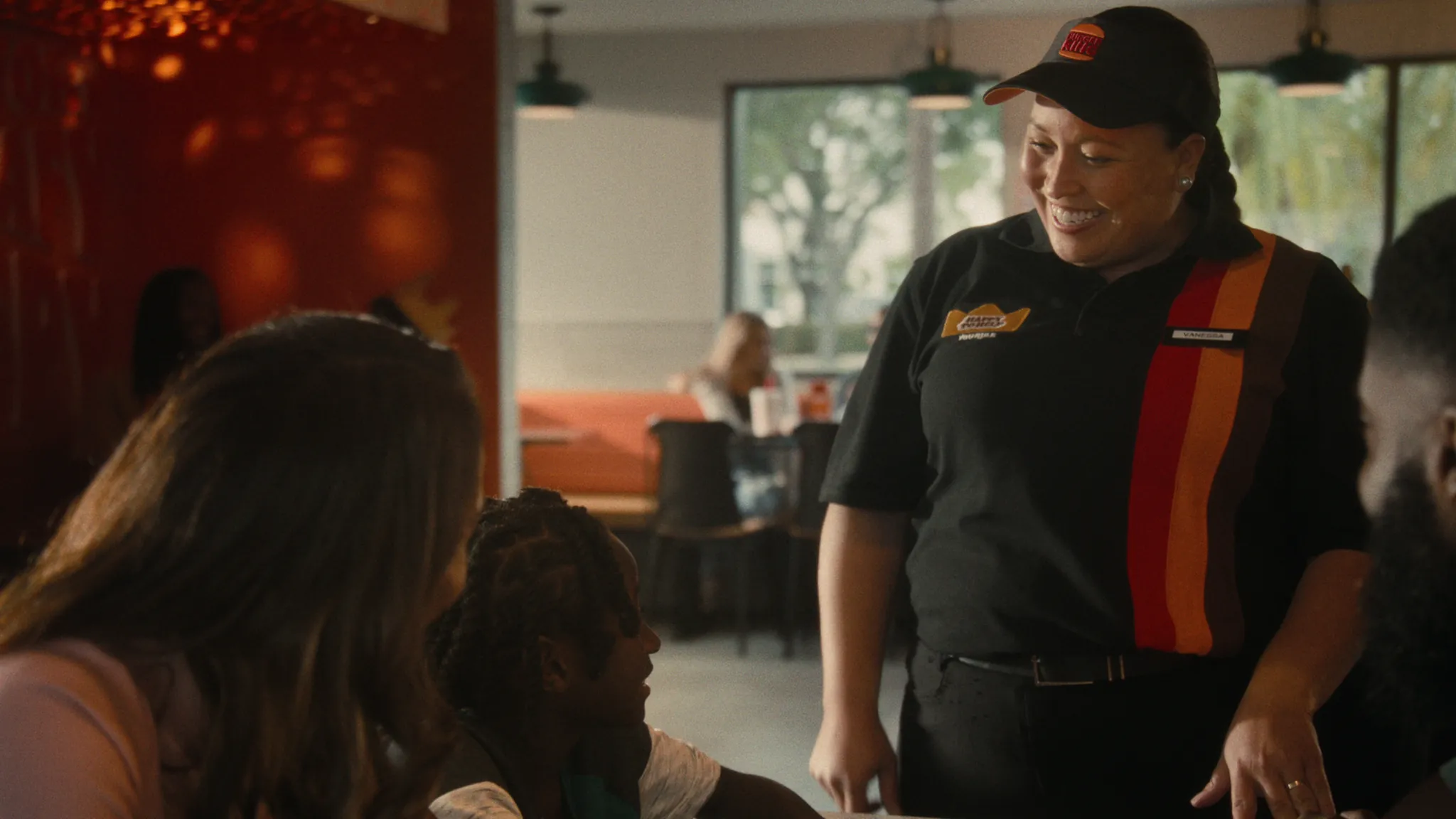
Burger King also introduced the “Your Way Champion,” a manager-level role meant to help restaurants act on guest feedback and keep the Whopper experience aligned with the campaign promise.[1] That role is easy to overlook if the story is treated as promotion news. It is harder to overlook if the story is treated as operational marketing. Someone has to notice when the promise is being tested. Someone has to decide whether the remake is warranted. Someone has to keep the line moving while the brand’s public confidence becomes a restaurant-level decision.
This is where guarantees become uncomfortable in useful ways. They force the company to define what it believes the product should be, then give customers a mechanism to challenge the gap. If the organization is not ready for that challenge, the guarantee creates more evidence against the brand. If it is ready, the guarantee can compress a long trust argument into a specific act: we will fix this while you are still here.
The sales evidence shows momentum, not guarantee causality
The strongest performance evidence came before the Whopper Guarantee was announced, which is exactly why it should not be used carelessly. In the first quarter of 2026, Burger King U.S. comparable sales rose 5.8%, above StreetAccount estimates of 3.5%, and reversed a 1.1% decline from the first quarter of 2025.[4] Restaurant Brands International also reported that Whopper average unit volume reached its highest level in more than three years.[4]
Those figures do not prove the guarantee worked. They predate it. What they do show is more important for the sequencing lesson: Burger King did not need the guarantee to manufacture the first sign of belief. It had already created momentum through the broader Reclaim the Flame turnaround, product attention, marketing investment, and franchisee alignment.
That franchisee alignment matters because national promises are often paid for and delivered locally. QSR Magazine reported that 97% of Burger King franchisees voted to maintain elevated advertising contributions, a signal that operators were willing to keep funding the push rather than retreat after an initial burst.[5] The Reclaim the Flame plan itself has been described as a multi-year turnaround with up to $700 million in investments through 2028.[5]
For a guarantee, that context is not decorative. A brand can write a promise in a week. It cannot quickly improvise operator confidence, product consistency, packaging discipline, and the budget logic that keeps a campaign from becoming a stunt.
A guarantee is an operational contract
Renascence’s CX analysis frames the Whopper Guarantee as an “operational contract,” which is a better description than simply calling it a promotion.[6] The customer-facing effect is obvious: the offer lowers perceived risk for someone who is unsure whether the Whopper is worth another try. The internal effect is sharper: it tells the organization that dissatisfaction now has a defined response.
That response has several layers. Crew members need to know when to remake the sandwich. Managers need discretion without turning every interaction into a negotiation. Packaging needs to carry the QR-code mechanism. Participating restaurants need to understand the offer window. Franchisees need enough confidence that the guarantee will not become an uncontrolled cost of overpromising.
The fine print is part of that alignment, too. Based on Burger King’s July release, the guarantee is limited to participating U.S. restaurants, runs through August 31, 2026, and is positioned around a QR code for a free Whopper on a future visit after a remake.[1] The available release language does not support treating it as a permanent national refund policy. It is a limited-time offer with defined mechanics.
That limitation does not make the campaign weaker. It makes it more honest. A bounded promise can be staffed, explained, tested, and retired or expanded based on what actually happens. An unbounded promise may sound braver in copy while being less believable to the people who have to honor it.
Why the same promise would have read differently earlier
Had Burger King opened with the guarantee before the confession campaign, before the guest-feedback push, and before the Whopper upgrades were visible, the same offer could have sounded like a shortcut. Customers who had already formed a judgment would have had an easy reply: why promise a fix now if you have not shown that you understand what needs fixing?
By July, the promise had a different job. It did not have to introduce the turnaround. It had to make the turnaround testable. That is a much stronger role for a guarantee. Instead of saying “believe our claim,” it says “hold us to the thing we have been working on.”
This is especially relevant for marketers working with AI products and AI-enabled services, where trust signals are often deployed before the buyer believes the seller understands the risk. A performance guarantee, accuracy promise, free rework offer, or satisfaction pledge can help only after the audience has seen evidence that the team understands the failure mode, has improved the workflow, and has assigned responsibility for what happens when the promise is tested.
The useful sequence is simple, but not easy: create emotional credibility by naming the problem, improve the product or workflow in ways the customer can experience, then attach a promise the organization can actually honor. Lead with the guarantee too early and it reads as pressure. Earn the right to make it, and it reads as confidence.
References
- Burger King Continues Turning Guest Feedback into Action with the Your Way Champion and Whopper Guarantee, PRNewswire, July 20, 2026.
- Burger King Crowns Its Guests King in New Ad Campaign, Burger King Newsroom.
- Admitting Mistakes: Leadership Lessons from Burger King’s President, Lean Blog, June 2026.
- Restaurant Brands International Inc. Reports First Quarter 2026 Results, Restaurant Brands International / PRNewswire.
- Burger King Sees U.S. Sales Surge as Reclaim the Flame Strategy Takes Hold, QSR Magazine.
- Burger King Whopper Guarantee: CX Strategy Behind the Pledge, Renascence.
This is a record of what happened and what was tested, not legal advice. Compliance determinations require qualified counsel.