
Three AI Funding Redirections Reshaping Marketing in 2026
Federal funding cuts, the pivot from foundation models to enterprise applications, and a startup funding crunch are converging in 2026. This article breaks down what each shift means for the tools marketers rely on, how budgets are evaluated, and which roles are most at risk.
The practical question for marketers is not whether AI is having a good year. In Q3 2026, that framing is too blunt to be useful. Worldwide AI spending is forecast to reach $2.59 trillion in 2026, up 47%, but Gartner’s forecast makes the important distinction: much of that money is going into infrastructure such as servers, chips, and data center capacity, while enterprises “have yet to flex their spending potential” in applications.[1] At the same time, disclosed funding for AI sales and marketing startups is down sharply year to date, even after a strong 2025.[2]
That is the contradiction marketing leaders are being asked to manage. Board decks still say AI investment is accelerating. Procurement queues are starting to say something more specific: which AI vendors can survive renewal scrutiny, which workflows deserve more automation, which roles become easier to justify, and which tools were bought during the experimentation phase but cannot prove they changed revenue, margin, or speed.
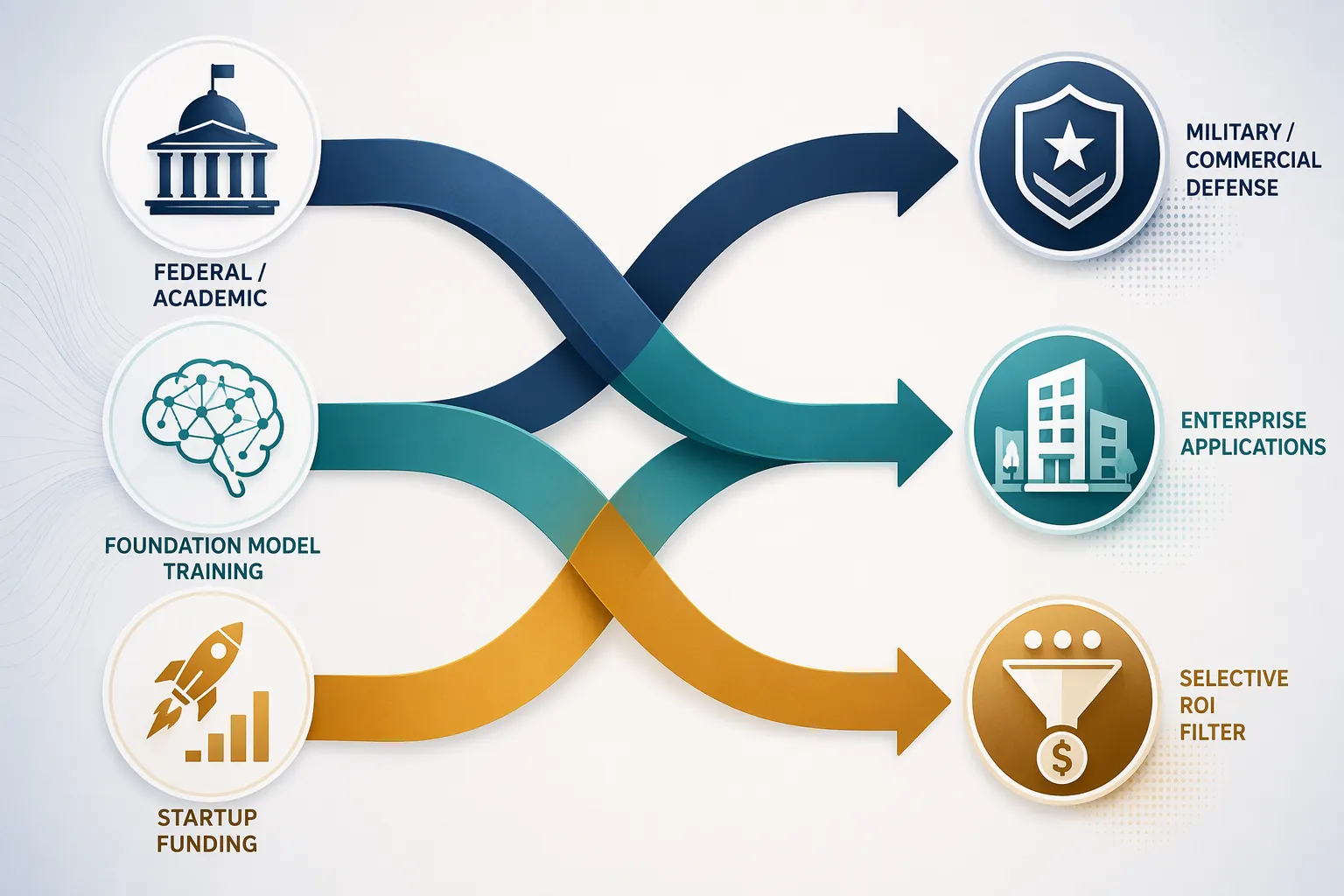
Three funding redirections are moving at once:
- Federal and academic AI funding is under pressure, with more capability likely to concentrate inside commercial and defense-oriented channels.
- Foundation-model investment is being reframed around enterprise application deployment, workflow ownership, and vertical integration.
- AI sales and marketing startup funding is becoming more selective, favoring categories that can attach themselves to measurable business outcomes.
Each redirection lands in a different part of the marketing operating model. The first affects the long-term supply of open research, talent, and widely available capability. The second affects the enterprise platforms and AI layers marketers will actually buy. The third affects the stability, pricing, and roadmap credibility of the specialist vendors sitting in the marketing stack.
The Spending Boom Is Mostly Not a Marketing Software Boom
The $2.59 trillion number matters because it can easily be misread. It is not a forecast that marketing departments will suddenly receive better AI tools at lower prices, or that every AI vendor selling into marketing has a secure path to growth. Gartner’s forecast spans the broader AI economy, and its center of gravity is infrastructure.[1]
For a VP of Marketing, that distinction changes the budget conversation. Infrastructure spending can make models faster, cheaper to run, or easier for vendors to embed over time. It does not automatically answer whether a content operations platform should be renewed, whether a sales intelligence vendor deserves expansion, or whether an AI analytics tool has enough usage to survive consolidation.
The mistake is treating macro AI spending as a proxy for marketer-accessible value. A procurement team does not renew a tool because the chip market is large. It renews because the tool owns a workflow, reduces cycle time, improves quality, increases revenue influence, reduces cost without creating new governance risk, or gives the organization a capability it cannot easily replace.
Redirection One: Public Research Pressure Pushes More Capability Behind Corporate Walls
The federal and academic funding shift is the least immediate for a marketing operations dashboard, but it may be the most important for the market’s long-term shape. DeepLearning.AI’s 2026 coverage warned that the NSF faced reductions of up to two-thirds and that more than $5 billion in NIH and NSF grants had been frozen, arguing that cuts to research funding weaken the open knowledge system that helped AI capabilities diffuse beyond a few large organizations.[3] Built In’s reporting similarly framed federal cuts as a threat to AI research continuity and the academic talent pipeline.[4]
Brookings’ 2026 overview adds necessary context: federal AI spending is not a single clean line item, and the landscape includes different agencies, purposes, and budget categories.[5] That matters because marketing leaders should avoid pretending that every federal reduction translates neatly into fewer martech features next quarter. The more defensible conclusion is narrower: if public research and academic training are constrained, more of the frontier capability and talent development burden shifts toward large commercial actors and government-priority use cases.
For marketers, the downstream effects are indirect but real. Open-source tooling may not disappear, but its pace, documentation quality, and enterprise-readiness could depend more heavily on corporate sponsorship. Universities may have fewer funded pathways for students and researchers working on open methods, evaluation, safety, multilingual capability, or applied tooling that is not immediately commercial. Vendors with strong balance sheets may absorb talent and research advantages faster than smaller teams can.
The planning error here is assuming that open capability will keep improving at the same pace and remain equally accessible to every vendor in the stack. If more AI capability is concentrated inside large platforms, marketers will feel it through packaging: premium tiers, preferred cloud relationships, model access restrictions, usage-based pricing, and fewer independent tools able to match platform-native features.
This does not mean smaller marketing teams are locked out of AI. They may experience the shift less through formal procurement and more through the everyday product surface: a feature that moves into an enterprise plan, a free research-grade tool that slows down, a startup that changes pricing because model costs or funding terms changed, or a workflow that becomes available only inside a larger suite.
Redirection Two: The Enterprise Application Layer Becomes the Real Battleground
The foundation-model race has not ended, but the enterprise buying question has moved closer to application deployment. A secondary, AI-generated analysis of OpenAI’s enterprise pivot described Sam Altman’s framing that AI is “an application problem, not a training problem,” and reported a market-share shift in which OpenAI’s enterprise share fell from 50% to 27% while Anthropic rose to 40%.[6] Because that article discloses AI generation, those figures should not carry the same weight as audited market research. They are useful mainly as a signpost for a broader vendor narrative: model capability alone is no longer the whole enterprise sale.
The point for marketers is not which lab wins a leaderboard. It is whether AI arrives as a general model, a platform layer, a workflow application, or a controlled enterprise system with security, governance, permissions, and reporting. Marketing teams rarely suffer from a shortage of impressive demos. They suffer from the work required to connect those demos to brand standards, data access, campaign calendars, approval flows, CRM fields, content repositories, localization needs, experimentation rules, and legal review.
This is why application-layer funding matters more than model noise for most marketing decisions. A generic model can draft copy. A workflow application can know which product line it supports, which claims are approved, which segments matter, which offers are active, where campaign assets live, who must approve regulated language, and which metric determines whether the work was worth doing.
That distinction should change vendor evaluation. The stronger question in 2026 is not “Which tool has the best model?” It is “Which tool owns a workflow deeply enough that switching costs are justified by measurable value?” For an AI content stack, that means looking past isolated generation quality and evaluating intake, brief creation, approvals, reuse, governance, publishing, measurement, and integration with the systems that already define work. A practical way to apply that lens is to compare vendors against stack-level failure points, not just feature lists, as in how to build an AI content stack that doesn't fail.
The decision mistake here is over-indexing on model access while under-indexing on workflow control. If foundation-model providers and large software platforms push harder into enterprise applications, some point solutions will be squeezed. Others will become more valuable because they sit in a specific operational gap the larger platforms do not handle well. The renewal question becomes less about AI novelty and more about defensibility: does the tool have proprietary workflow data, domain-specific evaluation, hard-to-replace integrations, or a role in governance that a bundled feature cannot easily displace?
Redirection Three: Startup Funding Is Sorting by Proximity to ROI
The AI sales and marketing startup market shows the clearest split between adoption enthusiasm and funding selectivity. New Market Pitch reported that AI sales and marketing startup funding rose 130% to $881 million in 2025, then fell about 44% year to date in 2026 versus the comparable period, from $309.65 million to $173.1 million. Median round size dropped from $22.5 million to $10.75 million.[2]
That dataset has boundaries. It covers disclosed equity rounds of $300,000 or more, so it excludes undisclosed rounds, SAFEs, and broader AI platforms that may still sell into marketing.[2] It should not be treated as a complete map of every dollar flowing into AI for marketing. But it is directionally useful because the category split lines up with what budget owners are already asking: where can AI prove revenue impact, cost reduction, or strategic control?
| Category Signal | What the Funding Pattern Suggests for Marketers |
|---|---|
| Customer data platforms received $203.5 million in the dataset | Data infrastructure and identity-linked activation remain easier to defend when AI depends on usable customer context. |
| Sales intelligence received $161 million | Revenue-adjacent tools with clear seller productivity or pipeline relevance still have a stronger budget story. |
| Marketing content AI tied to AI-search visibility received $131.5 million | Content tools are more compelling when attached to discoverability, distribution, or measurable demand outcomes. |
| AI sales assistants received $53 million year to date in 2026 | Assistant workflows remain investable, but buyers will ask how much work is actually removed or accelerated. |
| Ad optimization AI fell from $43.4 million to $20 million | Optimization claims face pressure when differentiation is unclear or already absorbed by major ad platforms. |
This is not a collapse story. It is a sorting story. Categories close to customer data, revenue workflows, and AI-search visibility still attract capital. Categories that sound like generic efficiency layers, especially where major platforms already provide automation, have a harder time defending standalone value.
The consequence for marketers is vendor risk. A startup with a useful feature but a weak funding path may raise prices, narrow its roadmap, sell to a larger platform, reduce support, or reposition toward a more lucrative buyer. In a less forgiving funding environment, the buyer has to evaluate the company as well as the product.
That does not mean defaulting to the biggest vendor. It means changing the diligence sequence. Before expanding an AI tool, ask whether the vendor can explain its cost model, whether usage grows with value or merely with seats, whether the product has a credible path beyond prompt wrappers, and whether the team can show outcomes that finance will recognize. For a deeper comparison of where AI marketing use cases are actually proving value, see AI marketing use cases ranked by ROI.
The ROI Gap Is Now a Budget Governance Problem
Marketers are not pulling back from AI in attitude. Jasper and Benchmarkit’s 2026 survey of more than 1,400 marketers found that 95% plan to increase AI investment.[7] The problem is proof. Only 41% said they can prove AI ROI, down from 49%, while governance concerns rose 3.4 times year over year.[7]
The same survey contains the procurement clue: among marketers who actively track ROI, 60% report returns of two times or more.[7] That does not prove tracking causes better returns. It does suggest that teams with measurement discipline are better positioned to defend investment, learn from usage, and separate productive automation from activity theater.
This is where the three funding redirections converge inside the marketing budget. If infrastructure spending is high but application value is uneven, if public research pressure gives large platforms more leverage, and if startup funding becomes more selective, the marketing team cannot use adoption as its main proof point. Usage is only the beginning of the case. Budget owners will ask whether AI changed throughput, conversion, margin, quality, compliance risk, or the mix of work the team can absorb.
PwC and ANA’s 2026 work draws a useful line between using AI to matter more and using it only to cost less. Their analysis found that marketing leaders using AI for growth, not just efficiency, deliver more than twice the marketing-driven profitability, and that leading marketers outperform peers by 79% in total shareholder return.[8] Those are not instructions to ignore efficiency. They are a warning that an AI program framed only as expense removal may win a short budget fight while weakening marketing’s strategic claim.
Which Marketing Roles Are Exposed, and Which Become Harder to Cut
The workforce anxiety around AI is justified, but it needs sharper categories. Spencer Stuart’s late-2025 survey of roughly 90 senior marketing leaders found that 36% expected headcount cuts within 24 months, while 54% expected steady headcount with capability shifts. Among companies with more than $20 billion in revenue, 47% expected cuts, and 37% of large-company CEOs and CFOs expected AI to deliver at least 20% cost savings in marketing within two years.[9] The sample is small, so the exact percentages should be handled cautiously. The direction is still hard to ignore.
McKinsey’s 2025 global AI survey points to a similar tension at broader scale: 88% of respondents reported using AI, but only about one-third said they were scaling it, and 32% expected workforce reductions.[10] Adoption is widespread; operating-model change is less mature. That gap is where role risk lives.
Roles most exposed to automation-only mandates are usually built around repeatable production without ownership of the system around the work: first-draft asset creation with no distribution accountability, manual reporting without interpretation, campaign setup without experimentation design, list building without data governance, or content adaptation without performance responsibility. These roles may still be necessary, but they are easier to compress if leadership defines AI success as doing the same work with fewer people.
Roles become harder to cut when they own workflows that AI makes more complex rather than simpler: marketing operations leaders who govern tool usage and data access, lifecycle marketers who connect segmentation to revenue, content leaders who manage brand risk and search visibility across human and AI discovery surfaces, analytics leads who can separate plausible dashboards from decision-grade measurement, and managers who redesign work instead of merely asking teams to produce more assets.
The more useful career question is not “Will AI replace marketers?” It is “Which parts of this role become a workflow, governance, or growth accountability that someone still has to own?” For a role-by-role view of that distinction, see best AI for marketing in 2026.
How to Prioritize the Three Redirections
A company does not need to respond equally to all three funding shifts. The right priority depends on where AI currently touches the marketing operating model.
- If your stack depends on open-source models, academic tools, or smaller vendors building on public research, watch the federal and academic funding shift most closely.
- If your company is consolidating platforms or negotiating enterprise AI agreements, focus on the foundation-model-to-application pivot and who will own the workflow layer.
- If your team bought multiple AI point solutions during the experimentation wave, prioritize startup funding selectivity, vendor durability, and proof of ROI.
- If leadership is already modeling AI savings into the budget, treat role design, governance, and growth measurement as the core defense against blunt cost-cutting.
The market mood is a poor planning input. The useful question is which redirection is closest to the decision in front of you: a renewal, a consolidation plan, a hiring freeze, a governance process, a data infrastructure investment, or a growth target that AI is now expected to support. Evaluate the tool, budget, or role against that specific pressure, not against the general claim that AI is booming or cooling.
References
- Gartner Forecasts Worldwide AI Spending to Grow 47% in 2026, Gartner, May 2026
- AI Sales and Marketing Funding Trends, New Market Pitch, July 2026
- Cut Research Funding, Weaken the Nation, DeepLearning.AI, 2026
- How Federal Cuts Are Affecting the Future of AI Research, Built In, 2026
- Where does federal AI spending stand in 2026?, Brookings, 2026
- Sam Altman's Enterprise Pivot, Elegant Software Solutions, 2026
- AI to ROI: The State of AI in Marketing 2026, Jasper/Benchmarkit, 2026
- Marketing in the AI era: To matter more or cost less?, PwC/ANA, 2026
- The AI Reckoning: Why Marketers Think 2026 Is a Make-or-Break Year, Spencer Stuart, December 2025
- The State of AI: Global Survey 2025, McKinsey, November 2025
This is a record of what happened and what was tested, not legal advice. Compliance determinations require qualified counsel.