
What the Tesla Doll-Head Hack Says About AI Marketing Claims
The viral exploit where a $15 doll head defeated Tesla's driver-monitoring system reveals a structural vulnerability in how AI products are marketed. This article explains why overclaiming creates brand risk and how AI marketers can build trust by being honest about system limits.
The uncomfortable part of the Tesla doll-head hack is not that someone found a silly prop. It is that the prop appears to work. Wired reported that Chinese Tesla drivers have used tiny plastic heads, paper cutouts, lenticular prints, and even looping video on a phone screen to satisfy Tesla’s cabin-camera safeguard while using Autopilot or Full Self-Driving features. Some of the props cost about $15; paper versions can cost around $1. The system, as described in that reporting, is being fooled by something that resembles a head in the right place, not by proof that an attentive human is actually supervising the car.[1]
That is why the story has traveled beyond automotive circles. It compresses a large trust problem into one cheap image: a product sold with the aura of intelligent oversight meeting a visual spoof that looks like a joke.
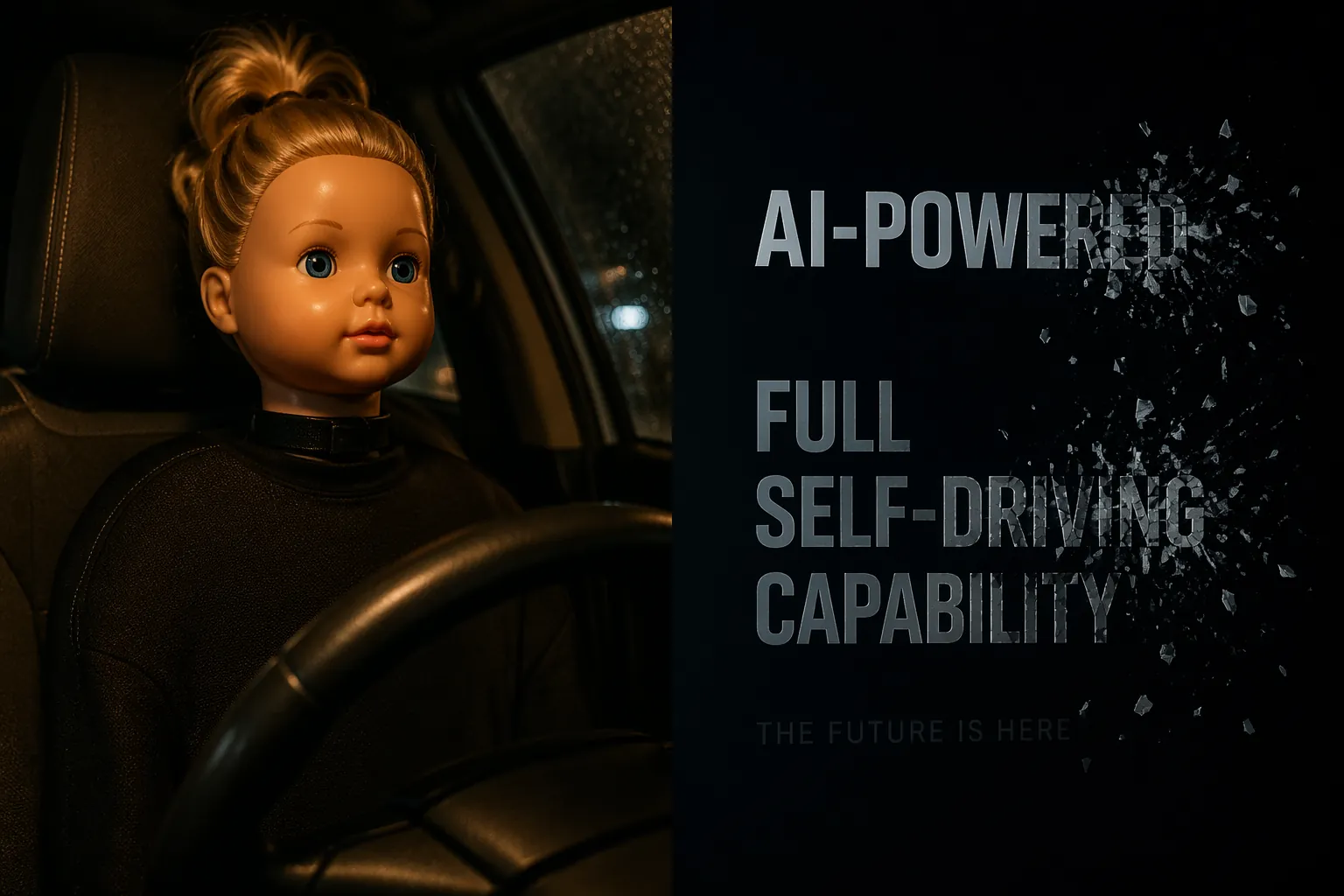
The doll head matters because it makes the boundary of the system visible. A driver-monitoring feature may sound, in a sales deck, like a watchful layer of AI safety. In practice, this one appears to rely on a conventional cabin camera and coarse visual cues. Tesla’s own documentation says the cabin camera “does not require full visibility of the driver’s eyes,” a detail that changes the meaning of the safeguard considerably.[1] If the system does not need to see the eyes, then it is not verifying gaze in the way many people would reasonably imagine when they hear that the car is monitoring driver attention.
The Claim Collapses Into a Prop
A bad AI claim often begins as a small compression. A technical team says the system detects enough signs of driver presence to satisfy a safety requirement. A product page turns that into driver monitoring. A sales conversation turns driver monitoring into confidence. A user hears confidence as permission.
Nobody has to be malicious for the gap to widen. Launch calendars reward clean language. Legal review often trims risk without restoring technical specificity. Product marketing is asked to make the feature legible, differentiated, and short. The result is a phrase that may be defensible under normal use but brittle under adversarial use.
The doll-head exploit is adversarial use at consumer scale. It does not require a lab, a jailbroken vehicle, or a sophisticated model inversion attack. It asks a simpler question: what is the system actually checking? If the answer is “a head-shaped object in the right zone,” then the marketing language cannot safely imply “an attentive driver.”
That distinction is not pedantic. It is the difference between describing a detection input and selling a safety outcome. The public tends to test the outcome. Competitors, regulators, and online communities tend to test the input. When those two meanings diverge, the screenshot writes the headline.
This Was an Arms Race, Not a One-Off Prank
The doll head is the most visually absurd version of a longer pattern. Wired places it after earlier attempts to defeat Tesla safeguards, including steering wheel weights associated with products such as Autopilot Buddy around 2018, then camera-obscuring accessories such as sunglasses and hats, and later paper cutouts, lenticular prints, plastic heads, and video loops used in 2025 and 2026.[1]
| Safeguard Pressure | User Workaround | Marketing Lesson |
|---|---|---|
| Hands-on-wheel detection | Steering wheel weights | A compliance signal is not the same as supervision. |
| Cabin camera attention checks | Camera-blocking accessories | Users will search for the cheapest way to reduce friction. |
| Visual presence detection | Doll heads, cutouts, prints, and looping video | If the system checks appearance, attackers will manufacture appearance. |
This sequence matters for AI marketers because it shows how safeguards become part of the product experience. A feature meant to reduce misuse also creates a new surface for user adaptation. If the company describes the safeguard as though it closes the risk, the next workaround does more than expose an engineering limitation. It makes the company’s confidence language look naive.
It is tempting to treat this as a driver-behavior story: people are reckless; therefore, no language can save them. That is too easy. Reckless behavior exists, but it does not erase the company’s obligation to describe what the system verifies. The more ambitious the product name and the broader the promise, the more creative the public test will be.
“AI-Powered Monitoring” Is Not One Capability
The technical comparison is where the marketing risk becomes clearer. Tesla’s approach, as described by Wired, uses a conventional RGB cabin camera. That camera can observe the cabin in visible light, but it is not the same as an active infrared eye-tracking system designed to track gaze and attention more directly.[1]
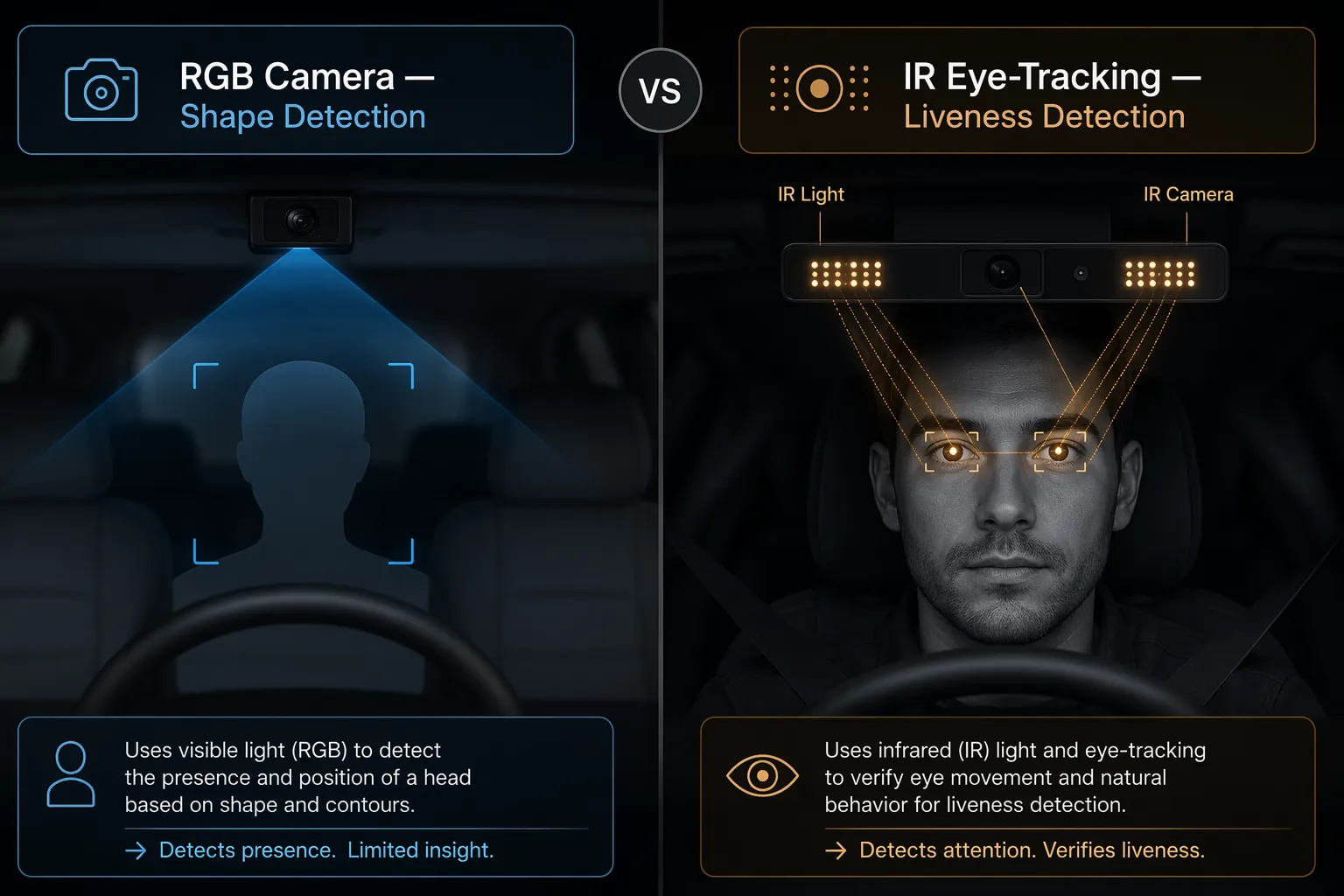
GM Super Cruise and Ford BlueCruise use infrared-based driver monitoring that actively tracks the driver’s eyes, making the relevant question less about whether something head-shaped is present and more about whether the driver’s gaze is where it needs to be.[1] That does not make any system impossible to defeat. It does mean the systems should not be described as if they occupy the same robustness category.
This is a familiar problem in AI positioning. Two products can both be called “AI-powered,” while one relies on shallow pattern recognition and the other uses stronger sensing, verification, or fallback design. The label hides the implementation. The implementation determines the failure mode.
A marketer does not need to publish a sensor datasheet in every campaign. But if the public claim implies a level of assurance the implementation cannot carry, the gap becomes a brand liability. “Detects a driver-like shape” and “confirms attentive supervision” are different promises. The doll head is what happens when those promises are allowed to blur.
The Legal and Regulatory Exposure Builds Slowly, Then Looks Obvious
The doll-head reporting is not the only pressure point around Tesla’s driver-assistance claims. Electrek reported in March 2026 that the National Highway Traffic Safety Administration upgraded its investigation into Tesla FSD visibility issues to an engineering analysis, EA26002, covering 3.2 million vehicles. Electrek described that stage as the step that typically precedes a recall.[2]
Wired also reported that 10 Chinese Tesla owners filed fraud lawsuits over Full Self-Driving capability claims.[1] That number should not be stretched into a global conclusion about all Tesla drivers or all jurisdictions. It does, however, show how capability language can migrate from product positioning into legal argument. Once customers believe they bought a meaning rather than a feature, the exact words matter.
Reuters added another layer in June 2026, reporting that Tesla presented misleading Full Self-Driving safety data to European regulators.[3] That is a different issue from a doll head fooling a cabin camera, but the trust damage accumulates in the same account. A brand can survive one narrow technical limitation. It has a harder time surviving a repeated pattern in which public-facing confidence runs ahead of what the system has demonstrated.
This is where AI marketers should resist the instinct to separate “messaging” from “safety.” Messaging shapes the expectations under which people use the system. If the name, launch copy, demos, investor language, and sales scripts all lean toward autonomy, a limitation buried elsewhere will not carry equal weight in the user’s mind.
Write Claims Against the Hardest Plausible Misuse Case
The practical lesson is not that every AI feature must disclose every internal detail. It is that capability claims need to be drafted against misuse, not only against the ideal demo. If a motivated user can create an adversarial condition cheaply, the public claim should anticipate that condition.
For an AI product marketer, that changes the review questions before launch:
- What exactly does the system detect: a signal, a proxy, a behavior, or an outcome?
- What does the system not verify, even if users may assume it does?
- What cheap workaround would a frustrated user, competitor, journalist, or online community try first?
- Does the claim still read as true if that workaround works?
- Where does human responsibility remain, and is that responsibility visible at the moment of use?
Those questions are uncomfortable because they make the copy less impressive. They also make it more durable. “Helps detect whether a driver-like presence appears in view” may be too weak for a campaign, and it may not be the exact language a company chooses. But the discipline behind it is useful: name the proxy before selling the promise.
The same discipline applies far beyond cars. A support chatbot that performs well on common tickets is not necessarily reliable under adversarial prompt injection. A fraud model that flags obvious anomalies is not necessarily robust against coordinated evasion. A document assistant that summarizes routine contracts is not necessarily safe for high-stakes legal review. The marketing problem begins when ordinary-condition performance is written as if it were adversarial robustness.
The Person Who Has to Repair Trust Needs Better Raw Material
After a viral failure, the repair work usually lands on people who did not create the original overclaim: lifecycle marketers rewriting help-center copy, brand leads preparing statements, content teams building explainers, safety communications staff trying to separate what the product does from what users thought it did. They inherit the gap after it has already become visible.
That repair is harder when earlier language treated supervision as autonomy, normal-condition success as general reliability, or partial safeguards as if they were adversarially secure. A careful clarification then sounds like a retreat. The company may be telling the truth at last, but the timing makes truth look defensive.
This is why limitation language should not be treated as legal residue. It is part of the product experience. It tells users how to cooperate with the system. It gives customer-facing teams a stable explanation when something goes wrong. It gives regulators less reason to assume the company was selling beyond its evidence.
The broader consumer environment makes this less forgiving. People are already wary of AI brand experiences, and practitioners are already frustrated by inaccuracy and overclaiming. A viral exploit does not land on neutral ground. It lands inside a market trained to suspect that “AI-powered” often means less than the packaging suggests.
The Safer Claim Is the More Exact One
The Tesla doll-head hack should not be flattened into a universal verdict on autonomous driving, or into a joke about foolish drivers. The supported conclusion is narrower and more useful: when an AI system depends on proxies, the marketing must not sell the proxy as proof.
A responsible claim makes the boundary conditions legible. It says what the system detects. It says what it does not verify. It does not imply liveness when it checks appearance. It does not imply gaze when it does not require full visibility of the eyes. It does not let a product name do more work than the system can defend.
The cheapness of the exploit is the lesson. If the public can expose the distance between claim and robustness with a toy, louder assurance is not the safe marketing position. More exact truth is.
References
This is a record of what happened and what was tested, not legal advice. Compliance determinations require qualified counsel.