
What Tesla Autopilot Crash Data Means for AI Marketers
Tesla's decade-long pattern of overclaiming Autopilot and Full Self-Driving capabilities has led to crashes, legal verdicts, and regulatory crackdowns. This article extracts three lessons from the Tesla saga that every marketer selling AI tools needs to understand about where the line between persuasive positioning and deceptive marketing lies.
Autonowashing is what happens when a product is made to sound more autonomous than it is. In AI marketing, it rarely starts as a cartoonish lie. It usually starts in a launch review: one adjective added for excitement, one limitation moved below the fold, one demo edited to keep the story clean, one comparison chosen because the bigger number looks better.
That is why Tesla Autopilot crash data matters for AI marketers. The lesson is not that ambitious AI products should be described timidly. The lesson is that autonomy claims change what customers believe they can safely delegate. Once that belief changes behavior, the claim is no longer just positioning.
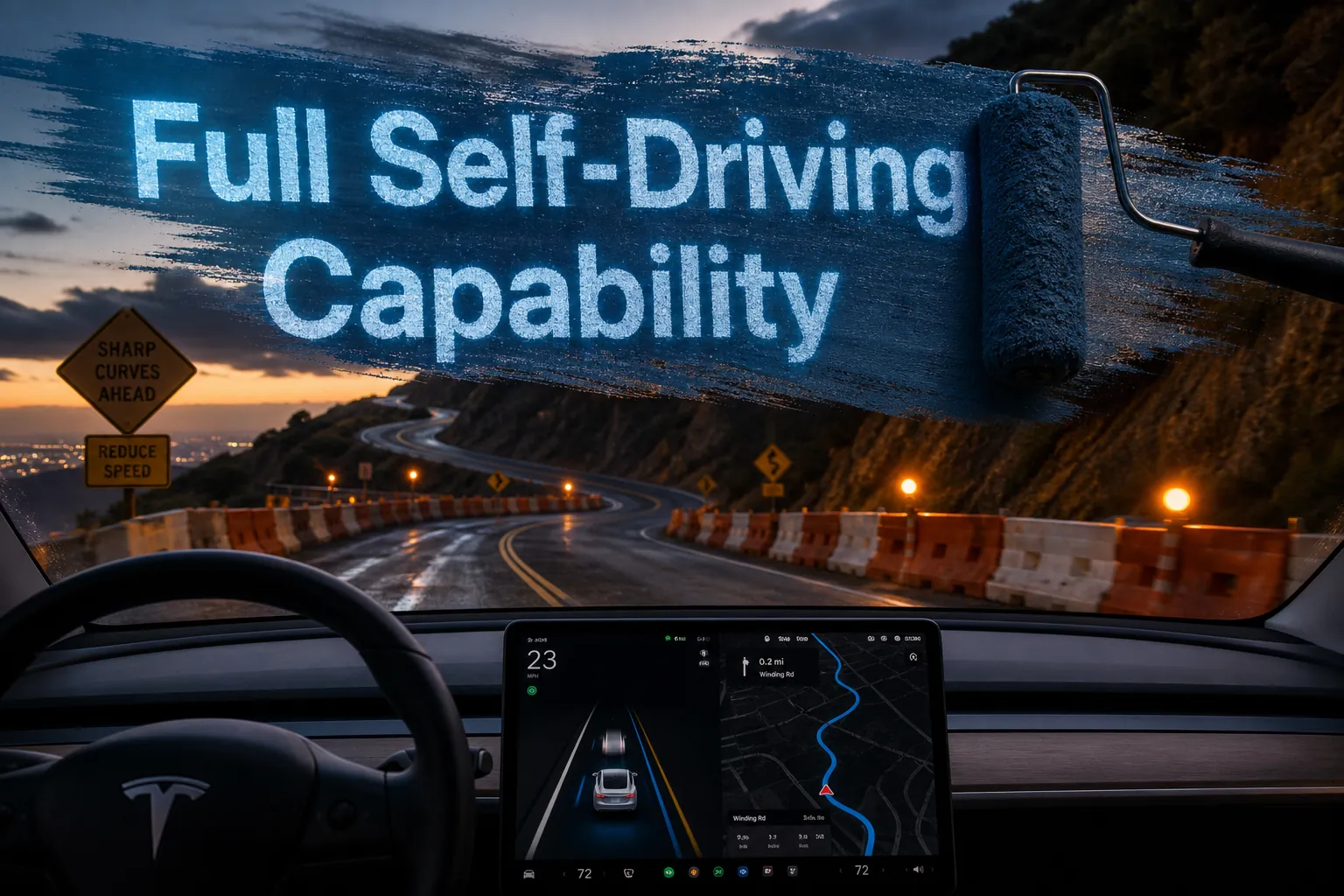
Tesla is the load-bearing case because its marketing record has had time to move through the whole chain: product naming, demos, user belief, crash evidence, courtroom arguments, regulatory findings, and public trust damage. In December 2025, a California DMV administrative law judge ruled that Tesla’s use of “Full Self-Driving Capability” was “unambiguously false and counterfactual,” a finding aimed directly at the gap between the product name and what the cars could actually do without human supervision.[1]
That phrase is not a small naming mistake. “Full Self-Driving Capability” gives the buyer a mental model before the manual, tooltip, or safety prompt has a chance to qualify it. A reasonable person can hear “capability” as future potential, optional package branding, or software ambition. But many customers do not buy adjectives as legal taxonomy. They buy the plain-language promise.
The evidence that buyers absorbed the plain-language promise is uncomfortable. A 2022 Insurance Institute for Highway Safety survey found that 42% of Tesla Autopilot buyers believed their vehicles were fully self-driving.[2] That does not prove every unsafe use, and it does not mean every buyer ignored warnings. It does show that the market did not merely encounter bold language. A substantial share of buyers came away with a dangerous misunderstanding of the product category.
When the Name Becomes the Operating Instruction
The Key Largo wrongful-death verdict made that marketing chain legally visible. In August 2025, a jury found Tesla 33% at fault and awarded $243 million in damages in a case involving a fatal crash. The verdict is under appeal, so the final liability may change. But the arguments that persuaded the jury are the part AI marketers should study: Tesla had not geofenced the system to roads it was designed to handle, had not used driver monitoring sufficient to prevent foreseeable misuse, and had marketed the system in a way that fostered a “reasonable belief” in capabilities it did not deliver.[3]
That third argument is the bridge from marketing copy to operational consequence. A landing page does not have to touch the steering wheel to contribute to misuse. It can make the driver more confident than the system warrants. It can make edge cases feel like rare exceptions rather than design boundaries. It can turn a supervision requirement into a background formality.
This is the part many AI teams underestimate. A disclaimer can say “human review required,” while the product name, demo, sales script, and benchmark slide all imply “the machine has it handled.” Customers do not experience those messages separately. They synthesize them into a working belief about what can be delegated.
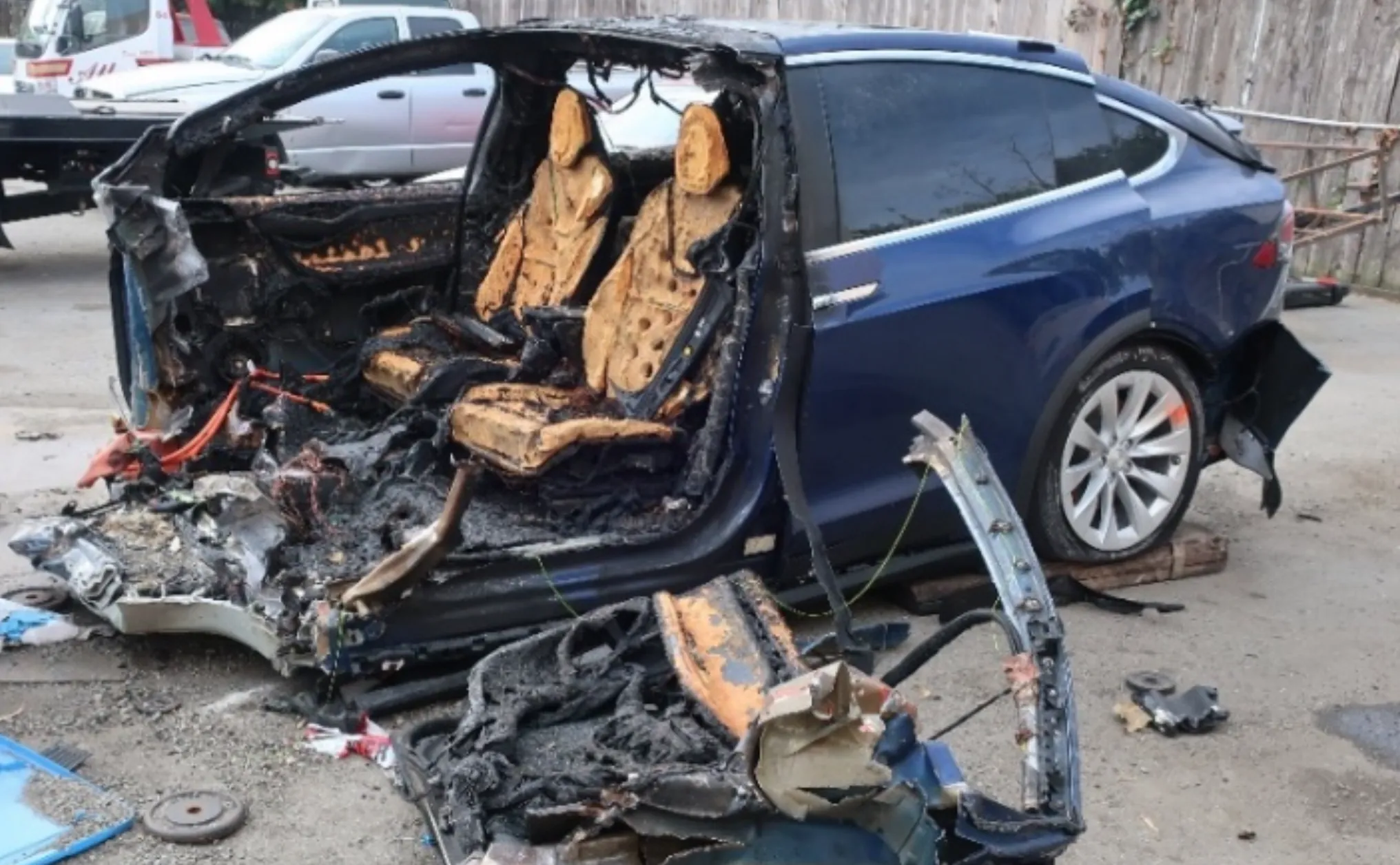
Tesla’s 2016 “Paint It Black” demo video shows how that belief can be manufactured visually. The video presented a Tesla driving itself with no hands on the wheel. Court records later cited the demo as evidence of deceptive marketing, including the fact that a fence collision was edited out of the final cut.[3] A staged or selectively edited demo may feel like ordinary launch storytelling inside the building. Outside the building, it becomes proof.
That proof has a long shelf life. The 2016 video was still surfacing in 2025 proceedings because buyers, lawyers, regulators, and journalists treat launch artifacts as representations of capability. Product marketers should assume that the demo shown during the optimistic phase will be replayed during the failure phase.
The Statistics Problem Is a Marketing Problem
The second Tesla lesson is less cinematic but just as important: the comparison baseline can do more persuasive work than the product claim itself. For years, Tesla’s safety reporting created an impression that Autopilot was dramatically safer than ordinary driving. Brad Templeton’s November 2025 analysis in Forbes argued that Tesla’s older reports compared Autopilot-on-freeway crash rates using only airbag-deployment incidents against all police-reported crashes in the general population, a mismatch that inflated the apparent safety advantage by roughly 5–6x before the company even added “10x safer” framing.[4]
That distinction matters because the denominator had changed. Freeway driving is not the same population as all driving. Airbag-deployment crashes are not the same outcome as police-reported crashes. Autopilot-engaged miles are not interchangeable with general miles driven by people across road types, vehicle ages, driver profiles, weather, and traffic conditions.
When Tesla later released more segmented Full Self-Driving crash data in November 2025, the city-street comparison appeared much less dramatic: about 1.5x safer, not 9x or 10x safer.[4] That narrower number may still be meaningful. It may show progress. It may be directionally useful. But it does not support the same sales sentence.
| Claim Pattern | Why It Persuades | Marketing Risk |
|---|---|---|
| Compare a narrow favorable metric with a broad messy baseline | The ratio looks larger than a like-for-like comparison would | The audience believes the product performs better in contexts not actually measured |
| Use severe incidents for the product and all incidents for the baseline | The product appears safer or more accurate because the outcome definitions differ | The statistic becomes difficult to defend when regulators or plaintiffs inspect the methodology |
| Promote a rounded multiplier instead of the measured condition | The number is easy for sales teams, executives, and press to repeat | The shortcut survives after the footnotes are forgotten |
The equivalent mistake in AI software is easy to recognize. A vendor claims an AI assistant is “80% faster” by measuring a narrow internal task, then lets buyers apply that figure to an entire workflow. A model is described as “more accurate than humans” based on a benchmark that excludes the messy inputs customers actually upload. A support automation product reports deflection without separating solved issues from customers who gave up.
Those examples are hypothetical, but the pattern is not. If the metric population, operating conditions, and outcome definition do not match the claim, the statistic is doing reputational debt financing. It gives the launch a lift and leaves support, legal, and customer success to pay interest later.
Crash Data Does Not Speak Cleanly Unless the Conditions Match
Some Tesla crash numbers are alarming, but they cannot all be stacked into one simple scorecard. NHTSA Standing General Order data, as analyzed by FinanceBuzz in 2026, showed Tesla accounting for 2,093 reported semi-autonomous vehicle crashes, compared with 112 for Honda and 47 for Subaru.[5] That is a real signal for regulators to inspect. It is not, by itself, a clean per-mile safety comparison because reporting exposure, fleet size, system usage, and operating context differ.
The same caution applies in the other direction. Tesla’s internal safety figure of one crash per 6.36 million miles and NHTSA’s broader ADAS-suspected crash data measure fundamentally different things. One can reflect Autopilot-engaged freeway airbag deployments; the other can capture suspected advanced driver-assistance crashes across road types. Comparing them directly is not analysis. It is number theater.
Regulators appear to be treating the gap between claims, conditions, and real-world operation as a safety issue. In March 2026, NHTSA escalated its Full Self-Driving probe to an engineering analysis covering 3.2 million vehicles, a stage typically preceding a potential recall.[5] Separately, Fortune calculated in February 2026 that Tesla’s Austin robotaxis crashed once per roughly 57,000 miles, compared with about 229,000 miles for the average Tesla driver, making the robotaxi rate roughly 4x worse in that comparison.[6]
None of this means every Tesla safety claim is false or every autonomy metric is useless. It means the marketer’s job is not finished when a number is technically sourced. The job is finished when the claim, the metric, and the customer’s likely interpretation all point to the same operating conditions.
Three Marketing Lessons From the Tesla Pattern
The Tesla record is unusually dramatic because cars crash in public and the consequences are immediate. But the marketing lessons travel easily to AI tools that draft, classify, predict, recommend, summarize, approve, or act on behalf of users.
Name the Capability at the Level the Product Can Deliver
Product names are not decoration. They are the shortest user manual most buyers will ever read. “Full Self-Driving Capability” implied a level of autonomy that the system did not deliver without supervision, and a California judge treated that implication as legally meaningful.[1]
For AI marketers, the same discipline applies to names like “autopilot,” “agent,” “copilot,” “analyst,” “reviewer,” “approver,” or “fully automated.” Some of those names can be defensible when the product genuinely acts within constrained conditions. They become risky when the name suggests independent judgment while the product still requires close human supervision.
A safer naming question is simple: if the customer saw only the product name and the primary headline, would they understand what the system cannot do? If the answer is no, the limitation cannot be rescued entirely by a footnote.
Use Comparisons Only When the Populations Match
Benchmark claims fail most often at the boundary. The product was tested on one type of work, but the claim is written for all work. The model improved one metric, but the headline implies overall business performance. The comparison uses expert reviewers for one side and average users for the other. The denominator is where overclaiming hides.
Tesla’s older safety-report framing is the cautionary example: a narrow favorable crash measure was placed against a broader general-population baseline, creating a far larger apparent safety story than the later segmented data supported.[4] The fix is not to avoid numbers. The fix is to make the comparison boringly precise.
- State what population was measured, such as new users, expert users, enterprise customers, or internal evaluators.
- State what task was measured, instead of letting one task stand in for an entire workflow.
- State what outcome counts as success, including whether human review, rework, escalation, or abandonment is included.
- Avoid turning a conditional benchmark into an unconditional market claim.
Treat Demos and Disclaimers as Part of the Product Experience
A demo is not just a narrative asset. It teaches users what to expect. If failures are edited out, if handoffs are hidden, if human cleanup is presented as machine output, the demo becomes a capability claim even when no sentence says “fully autonomous.”
The Tesla “Paint It Black” video is painful because it looks like the kind of launch artifact a team might defend as aspirational. But once a fence collision is omitted and hands-free driving is centered, the artifact stops being harmless mood-setting. It becomes evidence of what the company wanted buyers to believe.[3]
Disclaimers need the same treatment. A limitation that appears only after the buyer has absorbed the autonomous story is not functionally equal to a limitation built into the headline, onboarding, UI, and sales training. The support team will eventually have to explain whichever version the customer believed.
Regulators Are Now Looking at AI Claims the Same Way
The Tesla case is not isolated from the broader AI market. From 2024 through 2026, the Federal Trade Commission escalated enforcement against deceptive AI claims and schemes, including actions focused on companies that overstated what AI products could do.[7][8] In July 2026, the agency sought public comment on a policy statement addressing AI accuracy, signaling that accuracy and capability claims are moving closer to the center of advertising enforcement.[9]
That escalation should change how AI launch teams review copy. The old question was often, “Can we make this sound bigger without being plainly false?” The better question is, “What will a reasonable customer believe they can safely rely on after seeing this?”
For marketing teams, the operational standard is practical substantiation. If the claim says the system acts autonomously, the evidence should come from the environment where customers will let it act. If the claim says the system improves accuracy, the test should resemble the customer’s input quality, workflow, and review process. If the claim says the system saves time, the measurement should include setup, supervision, correction, and escalation.
Persuasive positioning is still allowed. Ambition is still allowed. Clear category creation is still allowed. What is no longer safe is treating autonomy language as ordinary hype. Once customers act on an inflated belief, the harm is no longer theoretical, and the marketing record becomes part of the evidence.
References
- California judge says Tesla engaged in deceptive Autopilot marketing — CNBC/TechCrunch, Dec. 16, 2025
- IIHS survey on Tesla Autopilot buyer beliefs — Insurance Institute for Highway Safety, 2022
- Court coverage of the Key Largo wrongful-death verdict and Tesla 2016 demo video — Multiple court coverage, Aug. 2025
- Tesla Finally Releases FSD Crash Data That Appears More Honest — Forbes, Nov. 14, 2025
- Self-Driving Car Statistics 2026 — FinanceBuzz
- By Tesla's own math, it reveals that its robotaxis are 4x worse at driving than humans — Fortune, Feb. 26, 2026
- FTC Announces Crackdown on Deceptive AI Claims and Schemes — Federal Trade Commission, Sept. 2024
- FTC Settlement Highlights Risks of Deceptive AI Marketing Claims — All About Advertising Law, June 2026
- Advertising Law Compliance in 2026: Five Developments Every Advertiser Should Know — AFS Law
This is a record of what happened and what was tested, not legal advice. Compliance determinations require qualified counsel.