
What ServiceNow AI marketing tools can and can't do
Many enterprise marketing teams ask whether ServiceNow now offers viable AI marketing tools. This article provides an honest, gap-aware inventory of ServiceNow's actual AI marketing capabilities, the recent Tenon partnership that fills the biggest automation gap, and where dedicated marketing platforms remain necessary.
Yes, there are ServiceNow AI marketing tools worth evaluating in 2026. No, ServiceNow by itself is not a native campaign production suite. That distinction matters because the platform is getting stronger at the work around marketing: qualifying and routing demand, coordinating sales and service handoffs, governing approvals, building custom workflow apps, and connecting external systems. It is still not where most teams would build emails, manage paid media, run attribution, or replace Marketo, HubSpot, or Salesforce Marketing Cloud.
The cleanest way to evaluate ServiceNow is to separate marketing workflow orchestration from campaign execution. ServiceNow is moving aggressively into AI-enabled CRM and customer operations. Its CRM business reached $1.4 billion in annual contract value with 30% year-over-year growth, which is meaningful enterprise momentum, but that figure reflects a broader sell-fulfill-service platform strategy rather than proof of built-in marketing automation depth.[1]
The Capability Inventory
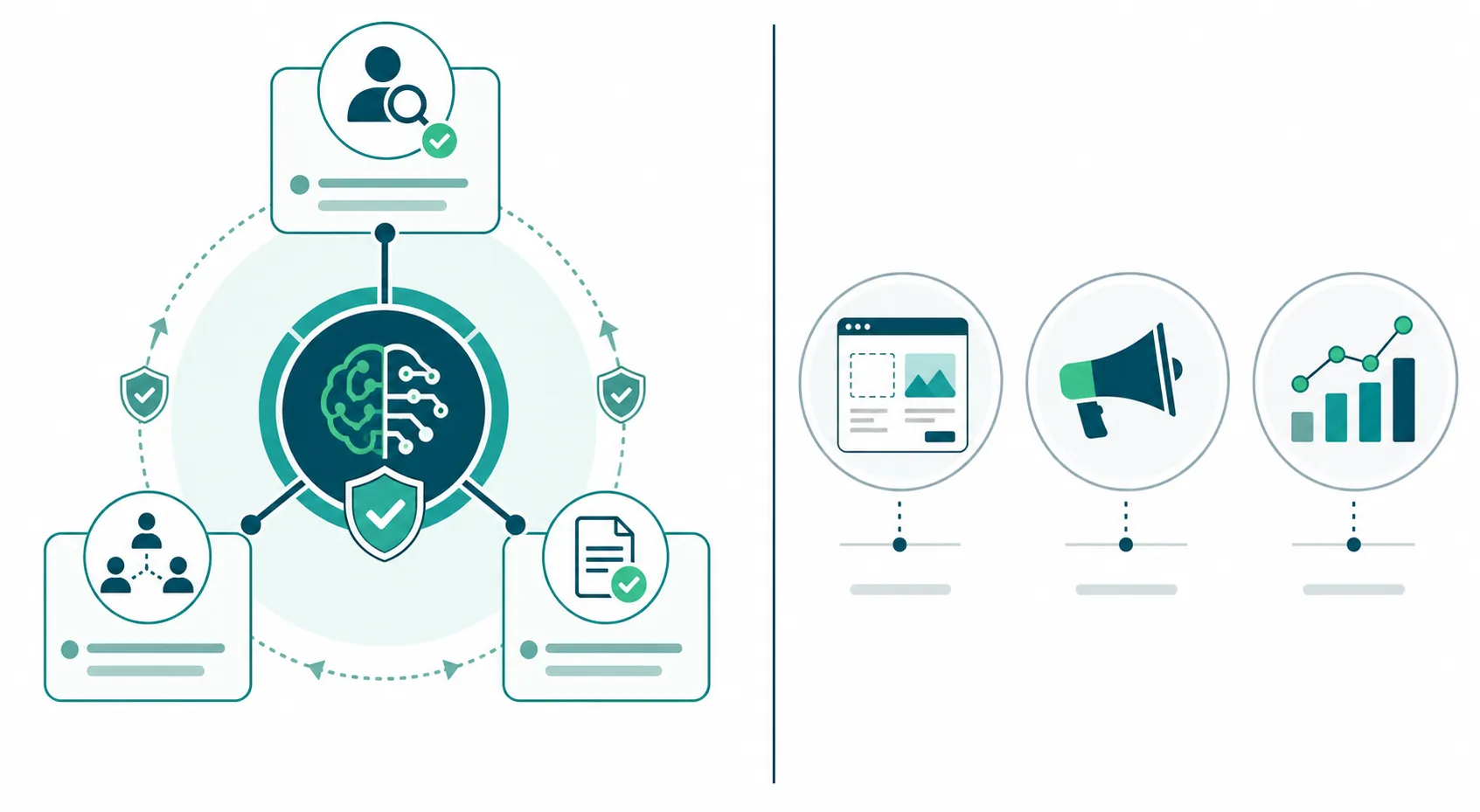
For a marketing operations team, the useful inventory is not “does ServiceNow have AI?” It clearly does. The better question is which marketing jobs those AI capabilities can complete without quietly moving the hardest work back into another platform.
| Capability | What it can help marketing-adjacent teams do | What it does not replace |
|---|---|---|
| Autonomous CRM and AI Specialists | Qualify leads, support quote generation, assist with renewals, and automate adjacent sales or service tasks | Campaign creation, nurture logic, email design, paid media activation |
| Otto | Move work across departments through agentic task execution and workflow coordination | A channel-native marketing automation platform |
| App Engine | Build custom workflow apps for approvals, intake, content tracking, and operational dashboards | A packaged marketing campaign suite |
| IntegrationHub | Connect ServiceNow workflows to external systems, including marketing platforms through APIs | The external systems themselves |
| Tenon integration | Bring email, SMS, and omnichannel journey orchestration into the ServiceNow environment | A ServiceNow-built native marketing automation product |
The first row is where some category confusion starts. At Knowledge 2026, ServiceNow’s Autonomous CRM announcements included AI Specialists that can qualify leads, generate quotes, resolve invoice disputes, and handle renewals autonomously.[2][3] Lead qualification is clearly relevant to marketing. Quote generation and renewals can improve revenue motion. Invoice dispute resolution can reduce friction after the sale. But these are not the same jobs as building a campaign, selecting an audience, writing channel-specific creative, deploying messages, optimizing spend, or reporting attribution.
That is not a criticism of the CRM work. In many enterprises, the failure point is not the subject line or the landing page. It is the handoff after a form submit, the missing sales follow-up, the approval that sits with legal, the customer record that never reaches service, or the fulfillment task that no one owns. ServiceNow is built for that kind of visibility. Calling it marketing automation without qualification, though, creates the wrong implementation expectation.
Where ServiceNow Is Strong: Governed Movement of Work
ServiceNow’s best fit for marketing is the operational layer that begins when campaign activity becomes enterprise work. A lead needs qualification. A sales team needs context. A quote needs to move. A customer request needs routing. A campaign asset needs approval. A compliance review needs an audit trail. A regional team needs to know whether a launch dependency is blocked.
Those are not glamorous marketing jobs, but they are often the jobs that decide whether a campaign becomes revenue or just another dashboard artifact. ServiceNow’s workflow model, permissions, case handling, and cross-functional tasking can be valuable precisely because they make ownership visible outside the marketing department.
App Engine is the practical piece here. ServiceNow community guidance describes using App Engine to support digital marketing workflows such as campaign approval chains, content tracking, analytics dashboards, and integrations with systems such as Marketo and HubSpot through REST APIs and IntegrationHub.[4] That is a credible pattern for teams that need custom operational apps around the campaign stack. It is not the same as saying ServiceNow now includes the campaign stack.
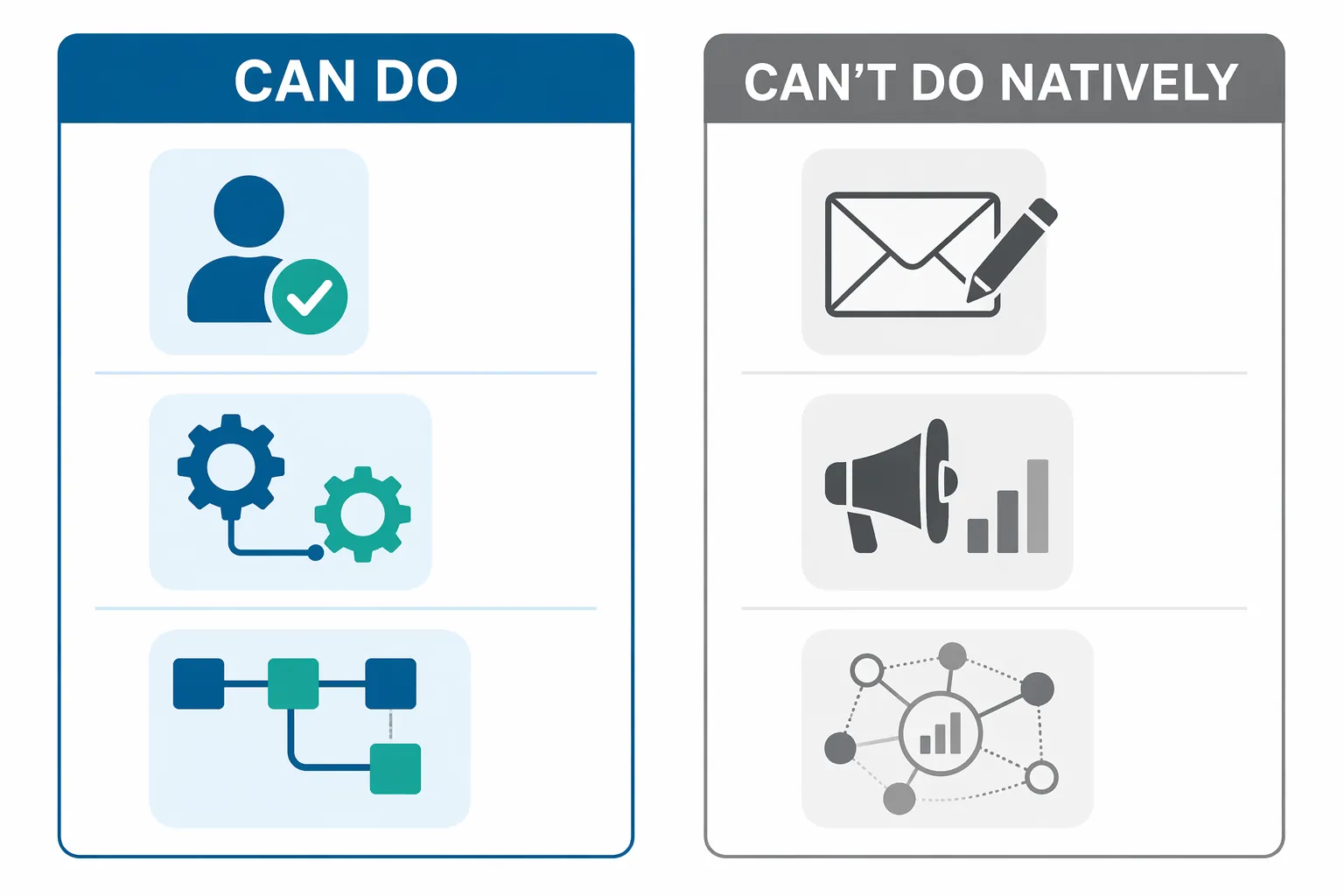
A realistic ServiceNow marketing workflow might look like this: a lead comes from a marketing automation platform, ServiceNow applies qualification or routing logic, a sales task is created, a quote workflow begins if the account is ready, customer service history is surfaced, and exceptions are escalated with auditability. The campaign still originates elsewhere. ServiceNow makes the downstream work harder to lose.
The Native Campaign Gap
The missing layer is straightforward: ServiceNow does not, on its own, look like a full marketing automation platform. The available materials do not support claims of a native email builder, native ad platform management, native audience activation across paid channels, built-in marketing attribution modeling, or the kind of packaged nurture and campaign operations environment that marketers expect from dedicated platforms.
That gap changes the buying question. If leadership asks whether ServiceNow can reduce scattered intake forms, disconnected approval paths, unmanaged handoffs, and opaque customer operations, the answer may be yes. If leadership asks whether ServiceNow can replace the system used to build, launch, optimize, and report campaigns across email, SMS, paid media, and web journeys, the answer is no unless another layer is added.
This is also where AI language can get slippery. An AI agent that qualifies a lead is useful. An AI assistant that helps route work is useful. A governed workflow layer that monitors tasks across departments is useful. None of those automatically becomes campaign AI. The work object is different: a lead, case, approval, quote, or task rather than a message, segment, channel, bid, experiment, or attribution touchpoint.
The Tenon Update Changes the Shape, Not the Ownership
The most important 2026 development for this evaluation is Tenon. In July 2026, Tenon announced an expansion of marketing automation into the ServiceNow AI platform, positioning the integration around native omnichannel journey orchestration inside ServiceNow, including email and SMS.[5] That is the closest current answer to the campaign execution gap.
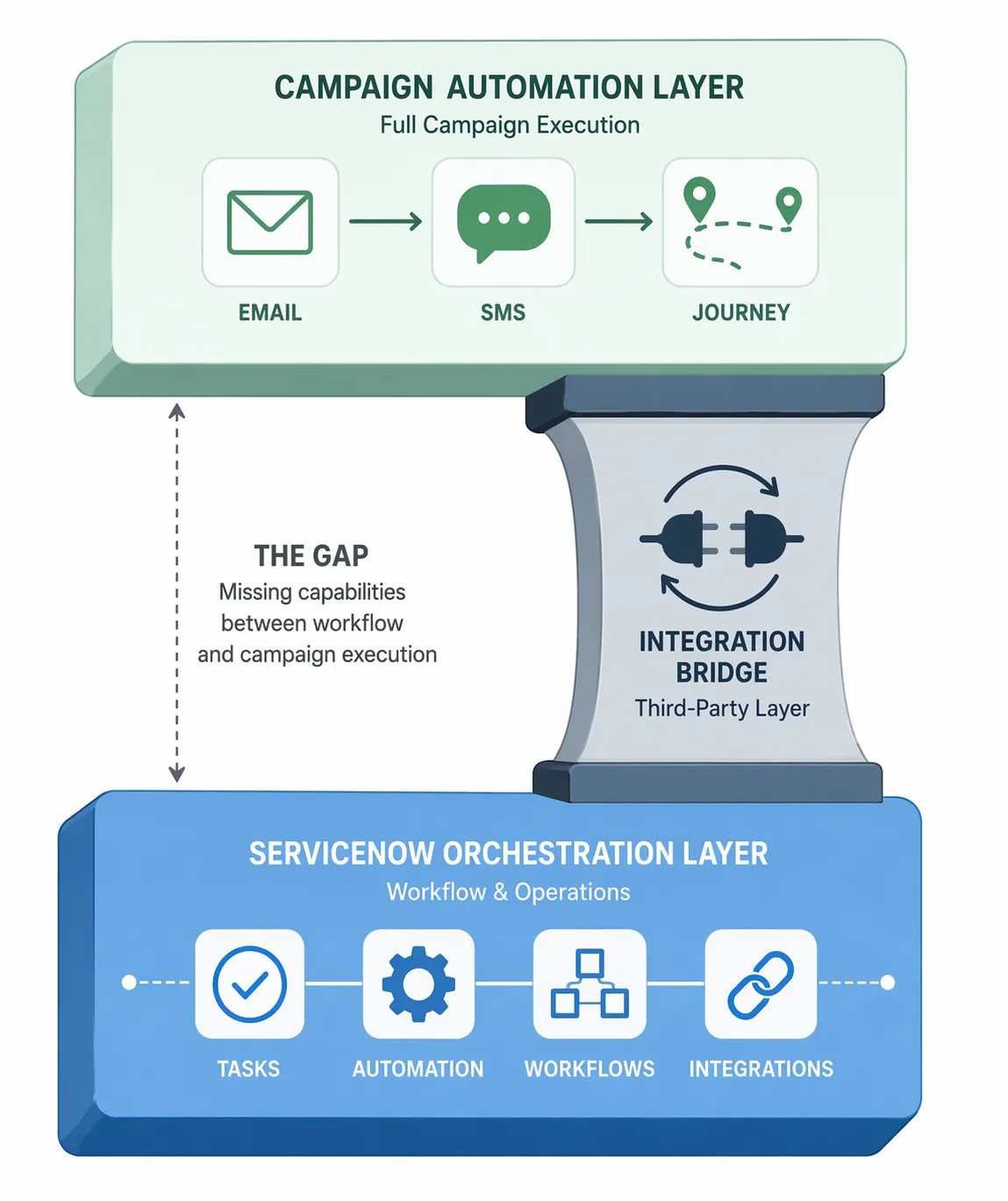
It deserves attention because it addresses the exact absence that would otherwise end the conversation for many marketing teams. If email, SMS, and journey orchestration can operate inside the ServiceNow environment, an enterprise already standardized on ServiceNow gets a more plausible path to running marketing operations without forcing every operational handoff back into a separate campaign system.
The ownership still matters. Tenon is an announced third-party addition, not evidence that ServiceNow has built a native marketing automation suite. The available evidence comes from coverage of the partnership announcement, not from independent analyst testing of production deployments at scale.[5] That does not make it unimportant. It does mean buyers should evaluate it as an integrated partner layer with its own roadmap, commercial terms, implementation model, data handling, and support boundaries.
In procurement terms, that distinction is not academic. If a journey breaks, who owns the incident? If consent data is inconsistent, which system is authoritative? If the marketing operations team needs a new segmentation rule, does it configure that in Tenon, ServiceNow, an external CDP, or the CRM? If a regional campaign needs a custom approval path and localized SMS logic, who tests the end-to-end path? The value of the integration depends on whether those answers are clean enough for the enterprise operating model.
What AI Adds Beyond Normal Workflow Automation
The AI layer is most credible when it reduces manual decisioning inside governed workflows. Lead qualification is the obvious marketing-adjacent case. Cross-department routing is another. ServiceNow’s agentic direction also makes sense for tasks where a system can inspect a record, apply policy, trigger a next step, and escalate exceptions.
There are useful scale signals behind that direction, though most are not marketing-specific. A ServiceNow partner article says ServiceNow’s own AI agents automate 37% of the company’s customer support case workflows.[6] Another partner source says the platform processes more than 7 million CPQ transactions and more than 100 million customer service cases monthly.[7] Those figures support the idea that ServiceNow has substantial operational data and workflow volume to apply AI against. They do not demonstrate campaign performance lift.
Governance is part of the story, too. AI Control Tower has been described as a way to govern, monitor, and measure deployed AI agents, with the same source stating that 95% of organizations cannot measure AI investment value.[8] For marketing teams under enterprise AI review, that governance layer may matter more than another copy-generation feature. It gives IT, operations, and business owners a place to ask what the agent is doing, where it is deployed, and whether the process has measurable value.
The caution is that several available proof points come from ServiceNow, ServiceNow events, or partner commentary rather than independent testing. They are useful for understanding product direction and platform ambition. They should not be treated as neutral benchmarks for marketing effectiveness.
Where It Fits Best
ServiceNow makes the most sense as an AI-enabled marketing operations layer in enterprises that already use it heavily for IT, service, sales operations, fulfillment, or internal workflow. In that environment, adding another campaign platform may not solve the actual problem. The bottleneck may be that campaign requests, sales follow-up, legal approval, customer case context, and fulfillment tasks sit in different queues with different owners.
The strongest use cases are operational rather than creative:
- Lead intake, enrichment, qualification, routing, and escalation across marketing and sales.
- Campaign request management, approval chains, compliance review, and launch readiness tracking.
- Account or customer workflows where marketing activity needs service, renewal, quote, or fulfillment context.
- AI agent governance for revenue and customer workflows that cross departmental boundaries.
- Integration of marketing systems into broader enterprise process visibility.
Those are valuable jobs. They are also the jobs that get underfunded when marketing technology evaluations focus only on campaign screens. A team can have a polished email builder and still lose revenue because no one owns the next action after engagement. ServiceNow is better suited to fixing that ownership problem than to replacing the email builder.
Where It Does Not Fit
ServiceNow is a poor standalone choice if the main requirement is campaign production. A marketing team that needs sophisticated email design, drag-and-drop journey building, paid media integrations, experimentation, channel analytics, attribution, landing page tooling, consent-aware audience activation, and marketer-friendly reporting will still need dedicated marketing technology.
Tenon may cover some of that gap for teams that want email, SMS, and journey orchestration inside the ServiceNow environment. But the due diligence should be closer to a platform integration review than a simple feature checkbox. Buyers should ask how data sync works, how journeys are authored, where consent is enforced, what reporting exists, what happens when ServiceNow and Tenon roadmaps diverge, and how much marketing operations work is required to administer the combined model.
The enterprise AI maturity data also argues for caution. A Knowledge 2026 recap attributed to ServiceNow CEO Bill McDermott said only 16% of enterprises have successfully embedded AI workflows across business functions and that AI maturity declined 20% year over year.[2] Treat that as vendor-event context, not an independent market benchmark. Still, the operational lesson is familiar: AI pilots often look impressive until they need permissions, records, approvals, exception handling, and accountability across departments.
A Practical Architecture Decision
The clean architecture is not “ServiceNow versus marketing automation.” It is “which layer owns which job?” In many enterprises, the answer will be split.
| Job | Likely owner |
|---|---|
| Campaign design, audience selection, email production, paid media activation, channel reporting | Dedicated marketing platform |
| Lead qualification, routing, SLA tracking, approval workflow, sales and service handoff | ServiceNow |
| Email, SMS, and journey orchestration inside a ServiceNow-centered model | Tenon integration, evaluated as a partner layer |
| Custom intake apps, dashboards, exception queues, and operational workflow tools | ServiceNow App Engine and IntegrationHub |
| AI agent governance and cross-functional process monitoring | ServiceNow AI governance capabilities |
That division gives marketing operations a more honest implementation path. Keep the systems that are good at campaign execution. Use ServiceNow where the work becomes enterprise process. Add Tenon only if its integration depth, authoring experience, support model, and reporting meet the campaign team’s requirements.
For leadership, the buying boundary is simple: ServiceNow AI marketing tools are real when the job is orchestrating governed customer and revenue workflows. They are incomplete when the job is producing, launching, optimizing, attributing, and reporting campaigns across channels. Use ServiceNow as the AI-enabled workflow layer when the enterprise process is the problem. Keep or add dedicated marketing platforms when campaign execution is the problem.
References
- ServiceNow Reimagines CRM for the AI Era to Sell, Fulfill and Service on One Unified Platform, Providing Exceptional End-to-End Experiences, ServiceNow Newsroom, 2025
- ServiceNow Knowledge 2026 Key Takeaways, Kanini
- ServiceNow Knowledge 2026 Key Highlights, Aelum Consulting
- Building ServiceNow Apps to Support Digital Marketing Workflows, ServiceNow Community
- Tenon Expands Marketing Automation Into ServiceNow AI Platform, MarTech Cube, July 2026
- ServiceNow AI Tools, Aelum Consulting
- ServiceNow Agentic AI 2026 Guide, Kellton
- ServiceNow Knowledge 2026 Agentic AI Platform, Efficiently Connected
This is a record of what happened and what was tested, not legal advice. Compliance determinations require qualified counsel.