
How Nothing Bundt Cakes' Overlapping Crises Expose Brand Risk Gaps
Nothing Bundt Cakes faced four overlapping crisis events between January 2025 and July 2026 — franchisee lawsuits, viral social media scandals, fraud probes, and an ownership transition — while consumer demand held steady. This case study examines how franchise brands must rebuild crisis infrastructure for an era where every incident becomes part of a persistent AI-retrieval narrative.
Between January 2025 and July 2026, Nothing Bundt Cakes became a useful case study precisely because the sales story and the trust story moved in different directions. The brand faced a franchisee class action over required Sunday openings, public operator anger, a state-level carve-out fight in Utah, a viral NDA controversy, a Jacksonville fraud probe, a Pennsylvania phone scam, a trademark lawsuit, and a private equity ownership transition. At the same time, the system reportedly reached $982 million in systemwide sales in FY2025, up 15.5%, with average unit volume around $1.4 million, according to a third-party analysis of FDD Item 19 data.[1]
That is the uncomfortable part of treating Nothing Bundt Cakes as a fraud-and-crisis marketing communication case. Customers kept buying cakes. The visible demand engine did not appear to collapse. But franchise systems can absorb consumer demand while quietly damaging the operator trust, local response discipline, and retrievable public record that future growth depends on.

The Sunday Mandate Was Not Just a Scheduling Dispute
The structural crack appeared first in the Sunday-opening fight. CNN reported on January 20, 2025, that Nothing Bundt Cakes began requiring stores to open on Sundays, a change that angered some franchisees who said they had bought into the system with a different understanding of how their local businesses could operate.[2] QSR Magazine also covered the pushback, quoting franchisees who objected to the mandate and framed it as a breach of the expectations under which they had invested.[3]
The legal version of that conflict is Harty v. Nothing Bundt Cakes Franchising, LLC, filed in the Eastern District of California in 2025 as case 2:25-cv-01431.[4] A lawsuit does not decide the facts by existing, and it should not be treated as proof that the franchisor acted unlawfully. But it does mark the moment when an operating disagreement stopped being an internal franchising argument and became part of the brand’s permanent public record.
For headquarters, Sunday coverage has a business logic. A growing consumer brand wants consistent availability, national marketing simplicity, and fewer exceptions that make the system harder to explain. Private equity-backed systems also tend to value standardization because standardization makes scale more legible. But for franchisees, a mandate changes labor planning, owner schedules, local religious or family commitments, and the bargain they believe they purchased.
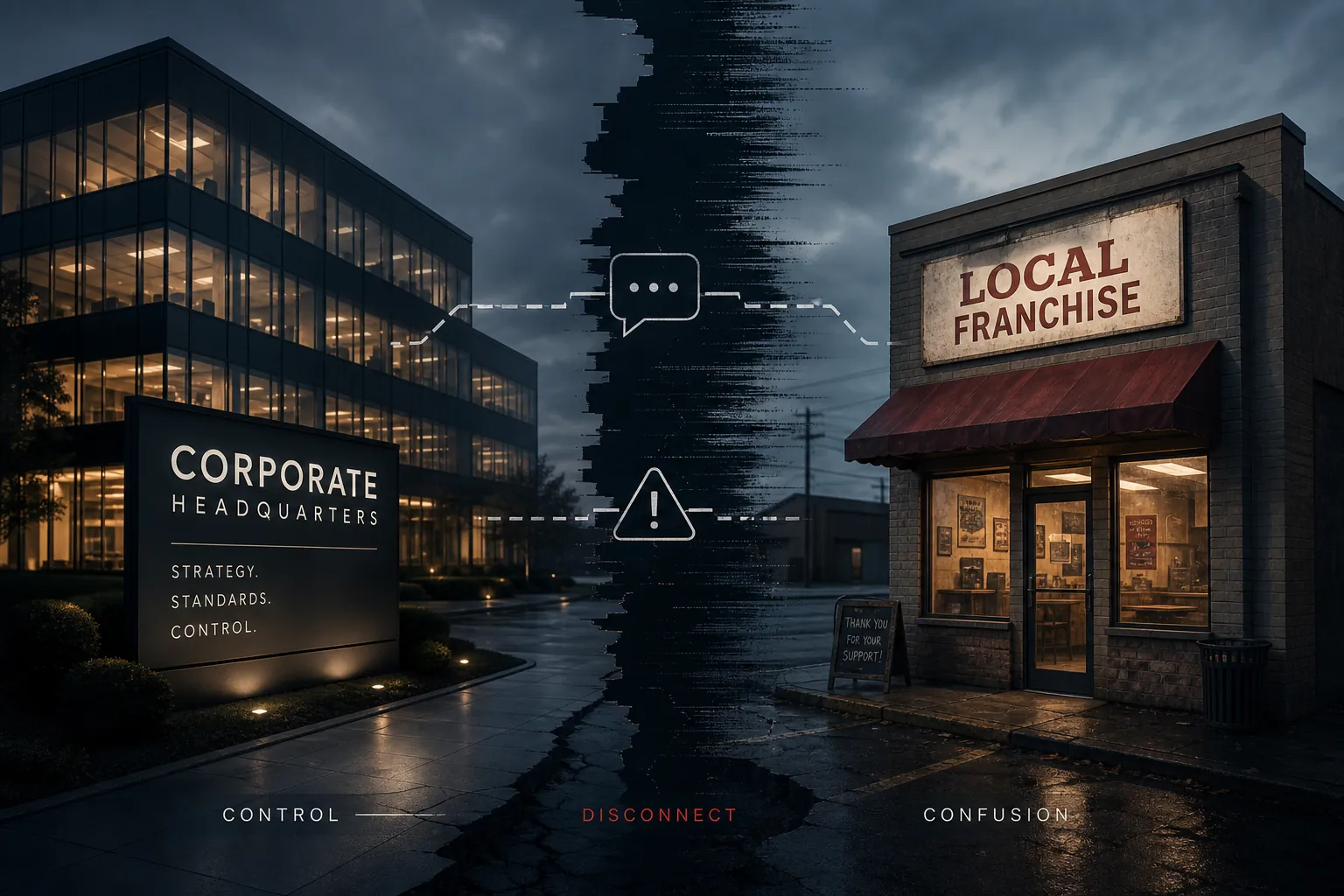
That is why the communications problem was never only the wording of a corporate statement. Once operators were willing to speak to national trade and business press, they became credible public narrators of the brand. In a franchise system, that is a second communications front. It cannot be shut down by polishing the corporate line.
Utah Made the Conflict Harder to Treat as Isolated
The Utah dispute mattered because it moved the issue from operator complaint to regulatory exception. Franchise Times reported that Utah franchisees fought to remain closed on Sundays, and the state-level carve-out gave the dispute a practical precedent other franchise systems would notice.[5] A carve-out does not settle the broader business question. It does show that when headquarters tries to impose uniformity across a values-sensitive operating issue, local political and franchisee coalitions can become part of the brand’s governance reality.
This is where brand control gets expensive. The more the franchisor insists on one national operating rule, the more it must be ready to explain why the rule applies, how exceptions work, who decides them, and what happens to franchisees who entered under a different expectation. If those answers are not shared internally before they are needed externally, every operator group chat becomes a parallel newsroom.
Strong Sales Complicate the Crisis Narrative
The easy version of a crisis story says public controversy damages the brand, customers flee, and leadership learns a lesson. Nothing Bundt Cakes is more useful because the available financial indicators do not support that simple arc. FranchiseInvestorData reported FY2025 systemwide sales of $982 million, 15.5% growth, and average unit volume of about $1.4 million, based on aggregated FDD data.[1]
Those figures should be handled carefully. They come from a third-party analyst, not directly from the original filing among the sources cited here. They also measure demand and unit economics, not franchisee trust. Still, they make one point hard to avoid: the consumer-facing reputation of the cake brand appeared resilient while the operator-facing reputation was under stress.
That split is common in franchising. Customers encounter the storefront, the product, the staff, the birthday pickup, the office celebration. Franchisees encounter royalty structures, labor requirements, corporate notices, development obligations, and the way headquarters behaves when disagreement becomes public. A brand can look healthy at the register while becoming harder to lead from the inside.
Ownership Pressure Belongs in the Middle of the Story, Not as a Villain
Reuters reported in October 2025 that Roark Capital was exploring a sale of Nothing Bundt Cakes at a valuation of more than $2 billion.[6] Public reporting placed the broader ownership transition from Roark to KKR across late 2025 and early 2026. That context matters, but it should not be used as a lazy explanation for every conflict that followed.
Private equity ownership does not automatically create a franchise relations crisis. It does, however, raise the stakes around consistency, growth, governance, and the appearance of system discipline. If a brand is being evaluated for scale, leadership has incentives to make operating rules cleaner and national positioning more coherent. The risk is that standardization arrives faster than the trust infrastructure needed to support it.
The Sunday mandate therefore sits at the intersection of brand strategy and franchise governance. It is not simply a customer convenience decision. It changes how operators experience the franchisor’s authority at the exact moment the system is being made more attractive to investors, buyers, and future development partners.
Then the Narrative Split Into More Channels
By March 2026, the brand was dealing with a different kind of public pressure: a viral Threads controversy around an alleged NDA issue. The original Threads post became part of the searchable record of the dispute, and the public sources reviewed here did not identify a visible corporate statement responding to it.[7] That does not prove Nothing Bundt Cakes did nothing privately. It only means the public record available to customers, reporters, franchisees, and AI systems was thin.
This is where modern crisis communication has changed. A company may decide that a viral post does not merit amplification. Sometimes that is sensible. But silence also leaves the indexing layer open. Search engines, social platforms, Reddit-style commentary, short-form video, and AI answer tools do not wait for a complete record. They assemble what is available.
For a franchise brand, the danger is not that every online accusation becomes true. The danger is that every unresolved fragment becomes adjacent. Sunday mandate, NDA controversy, fraud probe, phone scam, trademark lawsuit, ownership transition: different classes of risk begin to look like one continuous story because no durable public source keeps them separated.
| Event | Risk Class | What the Available Record Supports |
|---|---|---|
| Sunday mandate and Harty docket | Franchisee trust and franchisor control | A serious operator-relations dispute with litigation and national media coverage |
| Utah Sunday-closing carve-out | Regulatory and local-market governance | A state-level exception that made uniform operating control more complicated |
| NDA Threads controversy | Social narrative and public-record vacuum | A viral controversy with no visible corporate response found in the public record reviewed |
| Jacksonville fraud probe | Local law-enforcement incident | A developing police matter involving a location, not evidence of systemwide fraud |
| Pennsylvania phone scam | Local scam exposure | A single reported theft incident, relevant to search association but limited in scope |
| Trademark lawsuit | IP enforcement and brand control | A separate legal action over frosting design, not a franchisee-trust issue |
The Fraud Items Need Precision, Not Drama
The Jacksonville fraud probe is relevant because it added the word “fraud” to the brand’s crisis portfolio in July 2026. WCTI12 reported that police in Jacksonville sought public help identifying a person of interest in a fraud probe connected to the Marlin Drive Nothing Bundt Cakes location on July 20, 2026.[8] The available information is limited. It should not be stretched into a claim about internal theft, franchisee misconduct, corporate behavior, or a systemwide pattern.
The Pennsylvania incident is similarly narrow. YourErie reported that more than $2,000 was stolen from a Nothing Bundt Cakes location in a phone scam, citing Pennsylvania State Police Erie.[9] That is a real local incident, and local incidents matter to the people who answer the phone, talk to guests, and reassure employees. But it is not evidence that the franchise system had a broad fraud problem.
The marketing communication problem is subtler. Even when separate fraud-related events are limited, they can become retrievable next to larger franchisee and legal disputes. If headquarters has no central page distinguishing incident types, dates, status, and responsibility, future audiences may see a pile of search results rather than a set of bounded facts.
Brand Control Was Visible Elsewhere
Nothing Bundt Cakes was not passive about brand protection in every arena. Gerben Law reported in January 2026 that the company sued a Texas bakery over frosting design.[10] That kind of trademark enforcement fits a franchisor’s normal obligation to protect distinctiveness. It also shows that the company understood the value of controlling visible brand assets.
At roughly the same time, the public values language around the company remained polished. Nation’s Restaurant News reported in April 2026 that Nothing Bundt Cakes was honored with a Pacesetter Award, quoting CEO Dolf Berle’s emphasis on “joy, caring, kindness, and gratitude.”[11] There is nothing inherently wrong with that positioning. It is probably part of why the consumer brand works. But values language becomes fragile when operators are publicly saying the system no longer feels aligned with the bargain they joined.
A franchise brand cannot protect frosting lines more clearly than it protects the rules for who speaks, who updates, and who owns disputed facts. Legal control and emotional positioning are both useful. Neither replaces a crisis operating system.
What a Better Crisis Infrastructure Would Have Changed
Everything-PR’s 2026 franchise crisis playbook identifies six operating moves for franchise systems: speed with operational substance, clear corporate-versus-franchisee accountability, communication with the franchisee network during external crisis, real-time social media response capacity, pre-built crisis infrastructure, and AI retrieval recovery planning.[12] Applied to Nothing Bundt Cakes, the framework points less to a better apology and more to a missing coordination layer.
Speed with operational substance would not mean rushing out a generic statement after each headline. It would mean publishing a dated, factual update that says what changed, who is affected, what remains disputed, and when more information will be available. In the Sunday mandate fight, that could have separated the national operating rationale from the legal claims and from state-specific exceptions.
Clear accountability would have mattered even more in the fraud-related incidents. A police probe involving a location, a phone scam targeting a store, and a franchisor-franchisee lawsuit are not the same thing. The public record should make those boundaries easy to see. Local law enforcement owns an investigation. A franchisee may own local employee and guest communication. The franchisor owns brand-level clarification when unrelated incidents begin to merge under its name.
Franchisee network communication is the part many brands underbuild. Operators need more than the statement sent to reporters. They need talking points that match legal constraints, escalation contacts, approved customer-facing language, and a place to ask what they can say without creating new liability. When franchisees are surprised by the public answer, they do not become quieter. They become less coordinated.
Real-time social response capacity does not require chasing every post. It does require deciding, before the next viral thread, what thresholds trigger a response, who approves it, which channels carry it, and how the answer is preserved after the feed moves on. The NDA controversy shows why this matters: even a decision not to engage publicly should have an internal rationale and a retrievable external fallback.
The Missing Asset Is a Durable Update Hub
The simplest structural fix is also the least glamorous: a centralized crisis update hub. It should not read like a press release archive. It should function like an operating record for customers, reporters, franchisees, employees, and future AI retrieval systems.
- A dated status line for each active issue, including what is known and what is still unresolved
- A clear distinction between corporate matters, franchisee-operated local incidents, law-enforcement matters, and third-party scams
- A franchisee-only escalation path paired with public language operators can safely use
- Links to legal filings, public statements, and law-enforcement notices when appropriate
- A correction mechanism for outdated or inaccurate claims that continue circulating
A hub like that would not make the Sunday mandate popular with dissenting franchisees. It would not stop every TikTok, Thread, or local crime story. Its value is narrower and more practical: it prevents every new event from becoming another loose fragment that someone else gets to assemble.
AI Retrieval Makes Old Crisis Habits Too Weak
Media Minefield’s 2026 crisis communication guidance emphasizes that crisis response now has to account for a changed information environment, including how quickly narratives spread and persist across digital channels.[13] For franchise brands, the AI layer adds a specific problem: the answer a future customer, candidate, journalist, investor, or franchise prospect receives may be compiled from scattered fragments rather than from the brand’s best explanation.
That does not mean companies should write for machines instead of people. It means the public record has to be structured enough that machines do not flatten different risks into one accusation. A class action over Sunday operations, a viral NDA complaint, a local fraud probe, and a phone scam may all be legitimate search results. They should not all point to the same vague impression.
AI retrieval planning is still an emerging discipline, and there is no clean measurement standard in the available public record for how these Nothing Bundt Cakes events affected generated answers. The risk is directional rather than quantified. But brand teams do not need perfect measurement to see the operational issue: if the company does not maintain a current, structured, citation-ready version of events, other sources will supply the connective tissue.
The Managerial Lesson for Franchise Brands
Nothing Bundt Cakes does not look, from the available sales data, like a brand whose consumer demand was destroyed by crisis. That matters. Overstating reputational damage would make the case less useful. The harder lesson is that a franchise system can keep growing while its response infrastructure falls behind the complexity of the business.
The Sunday mandate exposed the deepest issue because it involved the operating bargain between franchisor and franchisee. The social controversy exposed the risk of public silence becoming the retrievable version of events. The fraud-related local incidents showed how narrow facts can widen through search association. The ownership transition raised the stakes around consistency and governance. None of those risks are identical, but they became adjacent.
Communication alone cannot repair that. A franchise brand needs shared rules before the next incident: who owns facts, who updates franchisees, who speaks locally, where the public goes for current information, how exceptions are explained, and how the record is maintained after the news cycle has moved on. Without that infrastructure, headquarters may win the polished statement and still leave operators, customers, and future search systems to reconcile the story themselves.
References
- Nothing Bundt Cakes Franchise Cost & Profit 2026 [Real FDD Data], Franchiseinvestordata, 2026
- Nothing Bundt Cakes now requires stores to open on Sundays. Some franchisees are furious, CNN, January 20, 2025
- Nothing Bundt Cakes Franchisees Push Back Against Mandate to Open on Sunday, QSR Magazine
- Harty v. Nothing Bundt Cakes Franchising, LLC, Justia
- Utah's Nothing Bundt Cakes franchisees fight to remain closed on Sundays, Franchise Times
- Roark Capital eyes sale of bakery chain Nothing Bundt Cakes at over $2 billion, Reuters, October 29, 2025
- @donovan.styles post on NDA 'scandal', Threads
- Fraud probe at Nothing Bundt Cakes prompts Jacksonville police to seek public help, WCTI12, July 20, 2026
- Over $2K stolen from Nothing Bundt Cakes: PSP Erie, YourErie
- Nothing Bundt Cakes Sues Texas Bakery Over Frosting Design, Gerben Law
- Nothing Bundt Cakes honored with 2026 Pacesetter Award, NRN, April 2026
- The Franchise Crisis Playbook: Six Operating Moves, Everything-PR, 2026
- New Rules for Crisis Communication in 2026, Media Minefield
This is a record of what happened and what was tested, not legal advice. Compliance determinations require qualified counsel.