
How Nothing Bundt Cakes Uses AI for New Product Launches
Discover how Nothing Bundt Cakes achieved 4x-6x ROAS on new product launches by using identity-based targeting to match limited-time flavors to customer occasions, and why they replaced ROAS with 'share of occasion' as their key metric.
Nothing Bundt Cakes’ most useful new product marketing lesson is not that it promoted a Snickers cake. It is that the brand did not treat the launch as a generic cake-buyer campaign. For the limited-edition flavor, it used Zeta’s identity-based targeting to reach people buying candy bars who had not previously purchased from Nothing Bundt Cakes, turning a flavor cue into a prospecting signal rather than another message to existing birthday or celebration buyers.[1]
That distinction matters because the reported results are strong enough to attract vendor-deck skepticism. Zeta says Nothing Bundt Cakes drove 4x-6x ROAS across campaigns, shortened conversion lag from 9 days to 6 days, and doubled in-store traffic.[1] Those figures should be read as vendor-reported performance, not independently audited proof. Still, the case is worth studying because the mechanics are visible: the campaign changed who was targeted, why they were considered relevant, which channel role was assigned, and how success was judged.

The Snickers Launch Changed the Prospecting Logic
A normal limited-time dessert launch can drift into soft audience logic quickly: target dessert lovers, target past cake buyers, target people with birthdays coming up, then let creative carry the specificity. The Snickers example did something sharper. It connected the product attribute to a behavior outside the brand’s own purchase file: candy-bar buying.
That made the new product useful as a bridge. Someone buying candy bars is not automatically in-market for a bundt cake, and Zeta’s case study does not prove every candy buyer was a likely dessert customer. But the signal had a reason to matter for this product in a way it would not for a standard vanilla or red velvet push. The campaign was not simply asking, “Who likes cake?” It was asking, “Whose current behavior makes this flavor a plausible reason to try this brand?”[1]
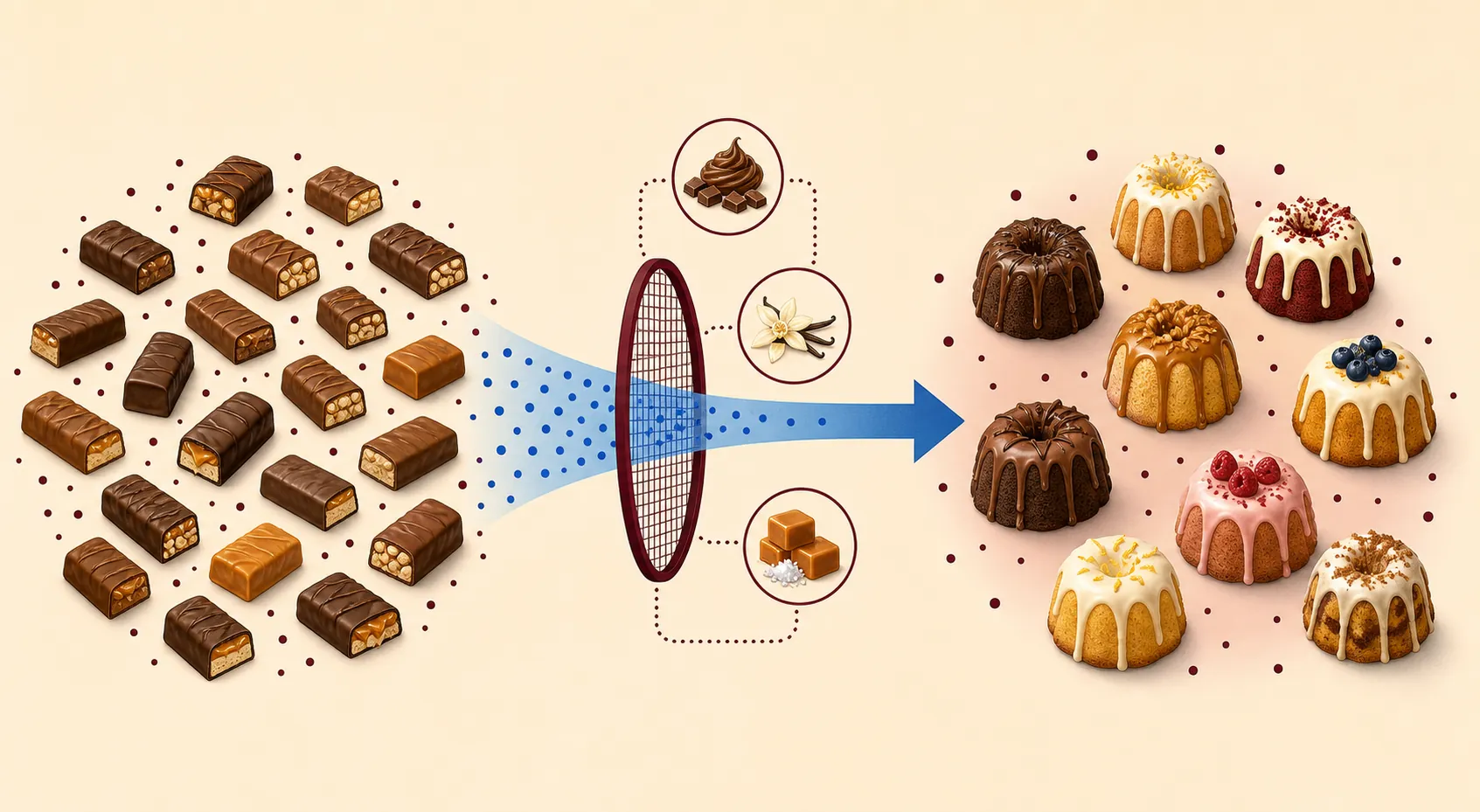
For paid media teams, that is the transferable part. The platform may be Zeta, LiveRamp, UID2-enabled buying, a retail media network, or another identity environment. The strategic move is narrower than “use AI personalization.” It is to find a behavioral signal that becomes more predictive only because the product gives it context.
| Campaign Question | Broad Awareness Answer | Occasion-Based Answer |
|---|---|---|
| Who should see the Snickers cake? | People who buy cakes or desserts | Candy-bar buyers who have not purchased from the brand |
| What makes the audience relevant? | General dessert interest | A behavior that matches the limited-time flavor |
| What is the campaign trying to change? | Awareness of a new flavor | Trial from cold prospects with a product-specific reason to care |
| What should measurement watch? | Return from exposed audiences | Whether the campaign captures more of the relevant eating or gifting occasion |
The cleanest read on the campaign is that Nothing Bundt Cakes used the flavor as an audience-selection device. Creative still mattered, but it was not asked to rescue a vague audience. The segmentation did part of the selling before the ad appeared.
Why Precision Matters for This Brand
Nothing Bundt Cakes is not a tiny challenger brand trying to prove product-market fit. In a June 2024 Nation’s Restaurant News interview, CEO Dolf Berle said the company had more than 600 locations and more than $750 million in revenue, while brand awareness remained below 40% based on an internal study cited in the article.[2] The same report said the company had opened about 100 bakeries per year since 2023 and was targeting 1,000 locations by 2027.[2]
That is the awkward growth zone where broad reach has an obvious appeal and an obvious waste problem. A brand with hundreds of stores needs more households to know it exists. But a sub-40% awareness constraint does not automatically mean every campaign should become a mass-awareness buy. For limited-time products, the better question is which occasions can be captured now, in the markets where stores can fulfill demand.
This is where the case becomes more interesting than the headline ROAS. The company’s challenge is not only to make people aware of bundt cakes. It has to make the brand relevant at the moment a customer is choosing a treat, a gift, a party contribution, a seasonal indulgence, or a small celebration. Those are not identical audiences, even when the product is physically the same.
The Brief Moves From Product Launch to Occasion Capture
Zeta describes Nothing Bundt Cakes’ approach as using identity, behavioral, and intent data to align campaigns with occasions such as Valentine’s Day, Mother’s Day, birthdays, and limited-time product launches.[1] The meaningful change is upstream of media buying. Before asking which channel gets the budget, the team has to define what demand moment the product is trying to intercept.
A Valentine’s campaign, for example, is not just a dessert campaign with hearts in the ad. It may need to reach people shopping for gifts, people planning a small celebration, or people who are looking for a shareable treat. A Mother’s Day campaign may overlap with flower searches, brunch planning, gift browsing, and local pickup behavior. A Snickers cake can use candy behavior as a prospecting clue because the flavor gives that behavior a relevant bridge to the product.
This is the part many AI-personalization stories skip. The AI or identity layer does not make the campaign smarter by existing. It becomes useful when it changes the campaign brief: who is eligible, which signal qualifies them, which message is appropriate, and what action the brand expects next.
- The product attribute has to point to a real behavior, not a decorative theme.
- The audience has to be defined by an occasion or intent signal, not only by demographics or broad category interest.
- The channel has to be assigned a job beyond reach, frequency, or cheap conversions.
- The measurement has to show whether the brand captured more of the relevant occasion, not only whether exposed users returned revenue.
CTV Became a Consideration Channel, Not Just an Awareness Buy
The CTV example is smaller than the Snickers playbook, but it shows the same operating model touching channel strategy. Zeta says Nothing Bundt Cakes used intent signals to repurpose CTV from an upper-funnel awareness channel into a mid-funnel consideration tool, including targeting people searching for florists around Mother’s Day.[1]
That is a practical channel shift. Without an intent layer, a Mother’s Day CTV buy can easily become a household-reach campaign with seasonal creative. With the florist signal, the audience is still not guaranteed to buy cake, but the media is no longer aimed at a generic viewer. It is aimed at someone whose behavior suggests they are assembling a gift or celebration moment.
This is also where performance interpretation needs discipline. If a CTV-exposed household later visits a store, the case study can report a positive outcome, but the available material does not isolate CTV as the sole cause. The more defensible takeaway is that Nothing Bundt Cakes used identity and intent data to make CTV carry a more specific job in the plan.
ROAS Was Not Enough as the Main KPI
The reported 4x-6x ROAS is the easy number to pull into a slide.[1] It is also the number most likely to flatten the case into a platform success story. The more useful measurement shift is Colleen Glendinning’s move toward “share of occasion” as the primary KPI, as described in Zeta’s case study.[1]

ROAS asks whether media returned revenue. Share of occasion asks whether the brand won more of the moments it has decided are strategically important. That changes planning pressure. A campaign can generate efficient revenue from existing customers and still fail to expand the brand’s role in Mother’s Day gifting, Valentine’s treats, birthday celebrations, or limited-time indulgence. Conversely, a launch may be worth funding if it increases the brand’s presence in a valuable occasion even when immediate ROAS is not the only useful read.
The conversion-lag metric helps explain why this is not just a branding preference. Zeta reports that Nothing Bundt Cakes reduced conversion lag from 9 days to 6 days, a 33% reduction.[1] If accurate, that suggests the audience and message were reaching people closer to a relevant decision. For a local bakery model, three fewer days between exposure and conversion can affect budget pacing, offer timing, inventory expectations, and store-level readouts.
| Metric | What It Measures | What It Can Miss |
|---|---|---|
| ROAS | Revenue returned against media spend | Whether the brand grew its role in a specific occasion |
| Conversion lag | Time between exposure and conversion | Whether the conversion was incremental or would have happened anyway |
| In-store traffic | Store visits associated with campaign activity | Whether traffic quality or purchase value improved |
| Share of occasion | The brand’s presence in a defined customer moment | Requires a clear occasion definition and reliable signal coverage |
The caveat belongs close to the metric. Zeta’s case study reports doubled in-store traffic, 4x-6x ROAS, and a shorter conversion lag, but the public material does not provide an independent audit, full attribution methodology, incrementality test design, or confidence interval.[1] That does not make the numbers useless. It makes them directional evidence from a vendor partner.
What Marketers Can Responsibly Take From the Case
The lesson is not “buy Zeta and expect 4x-6x ROAS.” The public evidence does not support that. The useful lesson is that Nothing Bundt Cakes appears to have made its new product launches more accountable by tying each campaign to a customer occasion before choosing audiences and channels.
A marketer adapting the approach would start with the occasion map, not the platform demo. What occasions does the product credibly serve? Which behaviors reveal that someone is entering one of those occasions? Which audiences should be excluded because they would have bought anyway? Which channel can move someone from awareness into consideration at that moment? Which metric will show whether the campaign captured the occasion, not only whether media looked efficient?
The Snickers example is strong because the signal, product, and prospecting objective line up. Candy-bar purchasers are not a perfect audience by default. They become interesting because the limited-time cake creates a reason to connect candy behavior to bakery trial. That is a better standard than most “AI-powered personalization” claims meet.
There are real prerequisites. This kind of campaign needs usable first-party data, identity resolution, access to reliable behavioral or intent signals, channel integrations, and a measurement setup that can separate useful directional learning from overclaimed attribution. Smaller brands may be able to borrow the planning logic, but they should not assume they can reproduce the media mechanics without comparable data maturity and platform investment.
The Bottom Line on the Case
Nothing Bundt Cakes’ AI-driven launch strategy is useful because it shows the campaign brief changing before the budget is spent. The brand did not only personalize messages after selecting a broad dessert audience. It used identity data and occasion signals to decide which prospects were worth reaching, how CTV could support consideration, and why share of occasion could be a better planning lens than ROAS alone.
The reported outcomes make the case worth attention, but not imitation without scrutiny. The 4x-6x ROAS, doubled in-store traffic, and 9-day to 6-day conversion-lag improvement come from Zeta’s own materials.[1] The responsible read is that occasion-based segmentation can make new product launches sharper and more measurable when the data foundation exists. It is not a universal benchmark, and it is not a substitute for independent validation.
References
- Nothing Bundt Cakes Marketing Strategy, Zeta Global, https://zetaglobal.com/resource-center/nothing-bundt-cakes-marketing-strategy/
- Nothing Bundt Cakes outlines its plan to become a $1 billion brand, Nation’s Restaurant News, June 2024, https://www.nrn.com/fast-casual/nothing-bundt-cakes-outlines-its-plan-to-become-a-1-billion-brand
This is a record of what happened and what was tested, not legal advice. Compliance determinations require qualified counsel.