
Your 72-Hour Marketing Response Plan for a Loyalty Program Breach
A time-boxed marketing response plan for the first 72 hours, two weeks, and 60 days after a loyalty program data breach — with communication templates, retention tactics, and coordination steps for marketing teams.
By the time marketing hears about a loyalty program data breach, the incident is usually no longer contained inside security. Customer care is asking what to say. The loyalty team is deciding whether to pause a rewards promotion that was supposed to go live that morning. Email is waiting on legal language. An executive wants a reassuring statement before anyone can confirm whether passport numbers, account credentials, points balances, or only profile fields were exposed.
That first morning is uncomfortable because loyalty programs are built on recognition. The brand knows the member’s status, birthday, saved preferences, trip history, points balance, and sometimes linked payment behavior. When that same familiar database becomes the source of harm, the breach feels less like a generic account problem and more like a broken promise.

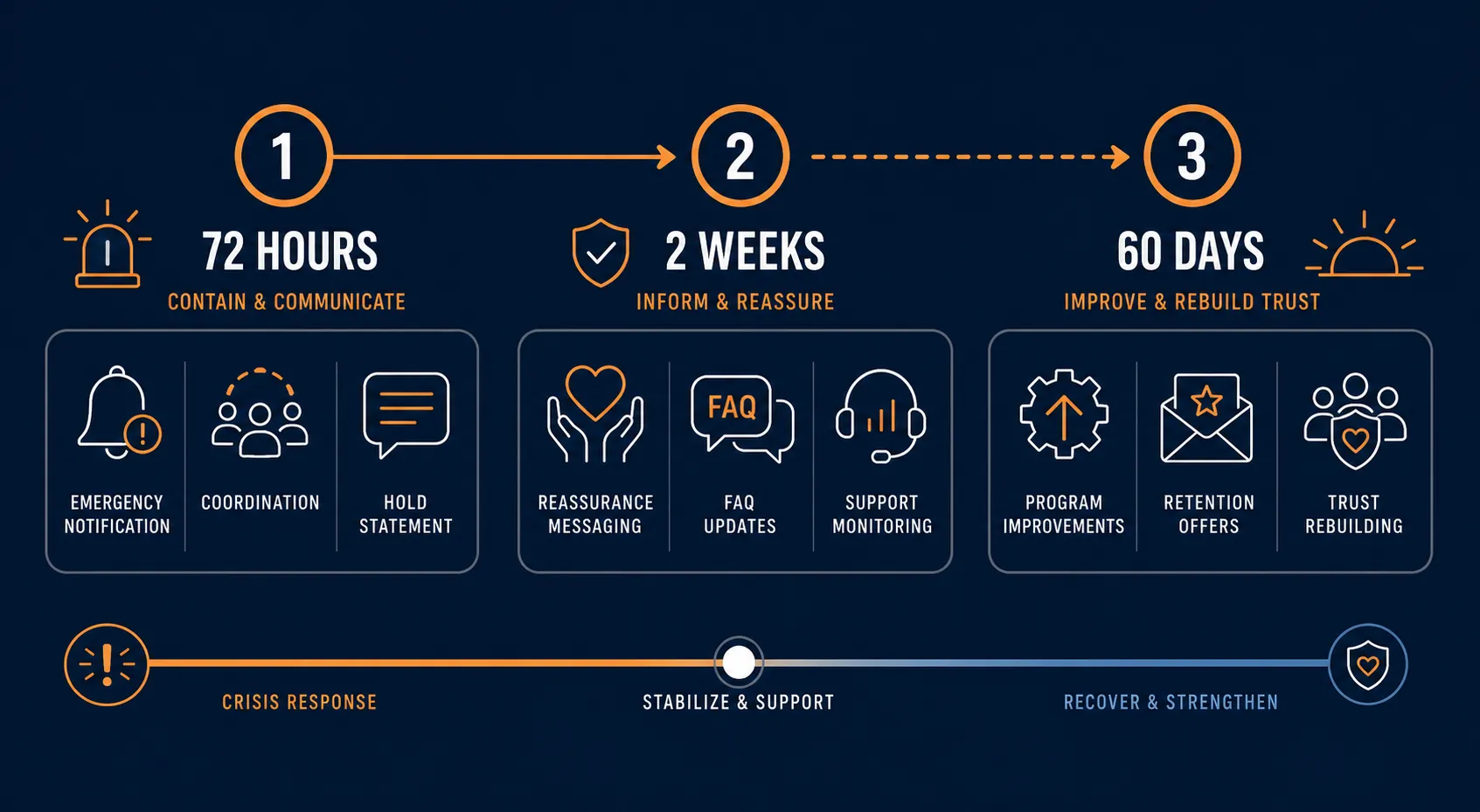
The marketing response cannot wait for the perfect forensic narrative. It does need boundaries. In the first 72 hours, the job is to communicate quickly without guessing, stop routine loyalty marketing from colliding with member anxiety, and give customers a practical reason to believe the brand is coordinating internally. The apology can improve later. The first message cannot be vague, promotional, or wrong.
The first 72 hours set the trust trajectory
The Carnival Mariner Society breach is a useful case because it shows the exact kind of ambiguity a loyalty and lifecycle team may have to communicate through. SecurityWeek reported that Carnival notified roughly 6 million people after a data breach involving personal information, while Have I Been Pwned indicated about 7.5 million Mariner Society accounts, and ShinyHunters claimed 8.7 million records; PKWARE’s 2026 breach tracker also described the incident as involving a social-engineered employee and loyalty-account data including passport numbers and driver’s licenses.[1][2]
The mismatch in figures is not a side issue for marketers. It is the working condition. One team may be writing to members while security is still validating record counts, legal is deciding whether identity-document exposure changes the notification language, and social channels are already repeating the largest number in circulation. In that environment, “we are investigating” is not a dodge if it is attached to what the brand knows, what it is doing, and when members will hear again.
The stakes are not abstract. A 2025 meta-analysis in ACR-Journal reported that 65% of customers lose trust after a data breach and 80% would potentially abandon the brand.[3] Those figures measure attitudes and potential behavior, not guaranteed churn. Still, they are enough to make the first message a retention event, not just a compliance artifact.
| Time box | Marketing decision | What changes for members |
|---|---|---|
| 0-12 hours | Create the response cell, freeze risky campaigns, draft a holding statement | Members see that the brand is aware and not pretending business is normal |
| 12-24 hours | Send the first direct member message if exposure is plausible or confirmed | Members get known facts, practical precautions, and a promised update window |
| 24-48 hours | Update FAQs, support scripts, login prompts, and social response guidance | Members hear the same answer across channels |
| 48-72 hours | Segment follow-up by exposure risk and loyalty value without turning compensation into a distraction | Members see next steps that match their situation |
| First 2 weeks | Move from notification to reassurance, support, retention monitoring, and offer governance | Members receive updates, help, and account-protection guidance |
| First 60 days | Prove what changed in the program, then rebuild loyalty momentum | Members can judge the response by operations, not apology copy |
0-12 hours: build the response cell before writing the email
The first marketing deliverable is not the public statement. It is a small decision group with authority to approve facts, timing, channel choices, and campaign changes. At minimum, that group needs security, legal, customer care, loyalty, lifecycle or CRM, social, PR, and an executive sponsor who understands that “say something reassuring” is not a strategy.
The group should agree on four live fields before any customer-facing copy moves forward: what is confirmed, what is suspected, what is not yet known, and what customers can do now. If one of those fields is empty, the message will either overclaim or sound hollow.
- Confirmed: systems, member groups, data categories, and dates that security and legal will allow in writing.
- Suspected: areas under investigation that may affect member behavior, such as passwords, identity documents, stored payment methods, or points balances.
- Unknown: record counts, attacker claims, specific member impact, or exposure categories that are still being validated.
- Member action: password reset, account review, phishing caution, support contact, credit or identity-monitoring information if applicable.
At the same time, marketing should pause or review campaigns that could read as oblivious. A double-points promotion, status-upgrade countdown, referral push, or “we know what you love” personalization module can become evidence that the brand is not listening. Pausing does not have to mean disappearing. It means separating emergency member communication from acquisition and monetization.
The campaign pause should be surgical
A blanket stop across every message can create its own confusion, especially for transactional emails, password resets, receipts, service alerts, and travel or delivery updates. The safer rule is to freeze promotional, personalized, and urgency-driven loyalty marketing until the response cell has reviewed it. Keep operational messages running, but check their footers, banners, dynamic modules, and app placements. A member trying to secure an account should not land on a celebratory rewards takeover.
12-24 hours: send a holding message that can survive the next update
A good first message does not need every answer. It needs to be specific about uncertainty. If the brand only says it “takes privacy seriously,” members learn nothing. If it names unconfirmed data categories, it may have to correct itself later. The practical middle is a holding statement that names the loyalty program, acknowledges the investigation, separates confirmed from unconfirmed facts, gives immediate precautions, and commits to an update cadence.
| Message element | Use this | Avoid this |
|---|---|---|
| Subject line | Important update about your [Program Name] account | A note from our team |
| Opening | We are investigating unauthorized access involving [Program Name] member information. | We recently became aware of an incident that may or may not affect you. |
| Known facts | At this time, we have confirmed [specific data categories or systems]. | Some information may have been involved. |
| Unknowns | We are still determining whether [category] was involved and will update this page by [time window]. | We cannot comment further. |
| Member action | Reset your password, review recent account activity, and be cautious of messages asking for your login or rewards details. | There is no need to take any action unless we contact you again. |
| Tone | Direct, accountable, plain language | Reassuring before the facts support reassurance |
A usable first-message template might look like this:
We are investigating unauthorized access involving [Program Name] member information. We are working with our security team and outside specialists to determine what information was involved and which members are affected. At this time, we have confirmed [confirmed fact]. We are still determining [unknown fact].
As a precaution, please reset your [Program Name] password, review recent account activity, and be cautious of emails, texts, or calls asking for your login, verification codes, rewards balance, or payment information. We will post the next update at [location] by [time]. If we determine that additional personal information was involved, we will contact affected members directly.
That template is intentionally plain. It gives the email marketer something legal can tighten rather than a brand manifesto legal has to dismantle. It also gives customer care the same words members have already seen.
This is where speed matters, but the comparison should stay modest. Phoenix Strategy Group’s discussion of breach communication uses T-Mobile’s 2021 breach, involving more than 50 million records, as an example of quicker public acknowledgment relative to slower responses, while also discussing Optus and Mailchimp as communication cases rather than proof that any single tone prevents churn.[4] The useful lesson is not that every fast statement succeeds. It is that silence leaves customers to assemble the story from attackers, headlines, Reddit threads, and screenshots.
24-48 hours: make every channel tell the same truth
The second day is when inconsistency starts to look like concealment. The email says passwords may be affected. The help-center article says they are not. The app banner says “some accounts.” A support agent tells a platinum member that points are safe because that was true two hours ago. None of this requires bad intent; it only requires a missing source of truth.
Marketing should maintain one breach-response page or help-center article that all channels point to. It should carry a visible “last updated” line, the current member actions, the support path, and a short list of what the brand will never ask for in an email or text. The page is not just for SEO or PR. It reduces the odds that every team writes its own version of the incident.
- Email: send only from a recognizable domain, avoid shortened links, and link to the central response page.
- App and web: place account-protection prompts where members log in, redeem, or view points.
- SMS: use only if the program already uses verified SMS patterns; do not train members to click unfamiliar links during a phishing-sensitive moment.
- Social: acknowledge the incident, direct people to the official page, and avoid debating exposure details in threads.
- Customer care: give agents approved language for confirmed facts, unknowns, escalation triggers, and angry-member responses.
Credential messaging belongs here because loyalty accounts often sit in the uncomfortable space between low-friction retail login and high-value stored assets. Verizon DBIR data, cited by Varonis, found that 81% of confirmed breaches involve weak, reused, or stolen passwords.[5] That statistic should not be stretched into a claim about this specific breach unless the investigation supports it. It does justify clear member education: reset this password, do not reuse it elsewhere, watch for phishing, and enable stronger authentication if the program offers it.
If the program has points, miles, vouchers, free nights, stored credits, or saved payment methods, the FAQ should address account value directly. Members will ask whether points can be stolen, whether redemptions are frozen, whether status is protected, and whether pending rewards still count. A vague privacy FAQ will not answer the loyalty-specific fear: “Can someone use what I earned?”
48-72 hours: segment follow-up without making compensation look like hush money
By the third day, the marketing team usually wants to move from one broad notice to segmented follow-up. That is sensible. A member whose passport number may have been exposed needs a different message from a member whose email address was involved. A top-tier customer with upcoming travel, a family account, or a large rewards balance may need priority support. Segmentation becomes a problem only when it looks like the brand is trying to buy quiet before explaining the harm.
The safest order is: explain exposure, provide protection, then consider goodwill. If identity documents were involved, protection may mean dedicated support, identity-monitoring information if offered, and clearer guidance on fraud risks. If only login credentials are implicated, protection may mean forced password resets, session invalidation, stronger authentication prompts, and points-activity review. Goodwill can follow, but it should not replace the security action.
| Segment | Primary communication job | Retention move to consider |
|---|---|---|
| Confirmed high-risk exposure | State the specific data categories and support options | Dedicated service path; no promotional framing |
| Potentially affected members | Explain what is still being determined and what to do now | Account-protection reminders; later goodwill if disruption continues |
| Unaffected members asking questions | Clarify current status without implying permanent safety before the investigation closes | Transparent FAQ and normal service continuity |
| High-value or high-balance loyalty members | Protect access, points, status, and upcoming redemptions | Manual review, status protection, or redemption assistance where operationally justified |
| Dormant members | Avoid using the breach as a reactivation hook | Suppress promotional reactivation until the incident message cycle is stable |
Loyalty-fraud context matters, but it should be handled with discipline. Dark Reading reported in 2019 that Forter saw an 89% year-over-year increase in loyalty card fraud; that is a historical marker, not proof of the current rate in 2026.[6] The durable point is simpler: rewards accounts have value, and members understand that value when they see a balance. Breach communication should treat points and status as assets customers care about, not as marketing decoration.
Consumer purchase expectations add another pressure point. Enzoic reported that 52% of consumers say security is critical in purchase decisions.[7] Again, that does not mean half of members will leave after any loyalty incident. It does mean security has become part of the value proposition customers evaluate, especially when the program asks them to keep logging in, saving preferences, and engaging.
What not to promise in the first 72 hours
The most damaging breach messages often fail because they try to close the emotional loop before the facts are ready. A brand can be empathetic without promising safety it cannot verify. It can be confident in the response process without declaring the incident contained too soon.
- Do not say “no sensitive information was exposed” unless the investigation supports that exact phrase.
- Do not say “only loyalty data” when loyalty data may include identity documents, travel history, stored value, saved preferences, or linked accounts.
- Do not promise that members are safe from fraud; tell them what monitoring and precautions are available.
- Do not resume personalized promotional messages before the incident page, support scripts, and login guidance are aligned.
- Do not let executive reassurance outrun security and legal verification.
Carnival’s reported range of affected Mariner Society records shows why this restraint matters. If one public source says roughly 6 million people, another indicates about 7.5 million accounts, and an attacker claims 8.7 million records, the brand’s communication burden is not to pick the most comforting number. It is to explain the number it can substantiate, acknowledge ongoing validation where necessary, and update members when the scope changes.[1][2]
The first two weeks: move from alert to managed reassurance
After the first 72 hours, the rhythm changes. The first notice has gone out. The response page exists. Customer care has a script. Now the risk is drift: updates slow down, promotional teams restart old calendars, support queues reveal questions the FAQ never anticipated, and leadership starts asking when the brand can “move on.”
The two-week job is to make the response feel managed rather than episodic. That means publishing updates even when the update is that a specific investigation step is still underway. It means rewriting the FAQ based on actual member questions, not the questions the brand hoped members would ask. It also means watching behavior closely enough to spot distrust while there is still time to intervene.
Support signals are retention signals
Marketing teams often look first at unsubscribe rates and campaign performance. In a loyalty breach, support data may be more revealing. Track contact volume by topic: password resets, missing points, account lockouts, identity-document concerns, phishing reports, redemption questions, status protection, and refund or cancellation requests. These topics show where trust is breaking down in operational terms.
| Metric | What it may indicate | Useful response |
|---|---|---|
| Password-reset completion | Members received and acted on the account-protection message | Improve login prompts and resend guidance to non-completers where appropriate |
| Support contacts about exposed data | FAQ language is unclear or exposure categories are still too vague | Update the response page and agent scripts |
| Points-redemption disputes | Members fear stored value loss or see suspicious activity | Prioritize loyalty operations review |
| Offer engagement drop among active members | Promotional trust has weakened | Delay aggressive campaigns and use service-led updates |
| Unsubscribes and app opt-outs | Members are rejecting the communication channel, not only the program | Reduce nonessential sends and consolidate updates |
| Churn, cancellations, or account closures | Trust loss is turning into behavior | Escalate recovery support and leadership review |
This is also the period to decide how normal marketing returns. The answer should not be “after the apology email.” A better test is whether affected members have received the promised follow-up, whether the help center reflects current facts, whether frontline teams can answer loyalty-specific questions, and whether the brand has stopped sending messages that contradict the seriousness of the incident.
Retention offers need a reason
A goodwill offer can be appropriate when members experienced disruption, lost access, had redemptions delayed, or had to spend time protecting an account. It becomes grotesque when it appears before accountability. “Here are 500 bonus points” is not a substitute for explaining whether the member’s driver’s license number was exposed.
The cleaner approach is to tie retention actions to concrete member impact. Status protection can make sense if account locks or investigation steps interfere with travel, purchase, or redemption behavior. Fee waivers can make sense if members must rebook or cancel because account access was restricted. A bonus can make sense as an apology for service disruption, but it should be framed after the protective steps, not before them.
The first 60 days: prove the program changed
By 60 days, members are no longer judging only the notification. They are judging whether the program works differently. If login security is still confusing, points disputes are unresolved, phishing warnings are generic, and the same personalization machinery restarts without explanation, the brand has taught members that the breach was an interruption rather than a lesson.
This is where crisis recovery leaves the inbox. The useful parallel is not another data breach case but a broader recovery pattern: durable trust repair comes from visible operational improvement and then communication about that improvement. The United Airlines crisis recovery marketing playbook is relevant because it treats messaging as the later expression of changed operations, not the replacement for them.
For a loyalty program, the visible changes may be simple: stronger authentication options, clearer account-activity history, easier points-dispute reporting, reduced reliance on risky identifiers, better suppression rules during incidents, and a security explainer that members can understand without becoming security professionals. Marketing does not have to own every fix. It does have to know which fixes are real before it builds a trust-recovery narrative around them.
The 60-day message should be evidence-based
A 60-day update can say what changed, what remains under review, and how members can protect their accounts going forward. It should avoid triumph. The point is not to declare trust restored. The point is to give members a reason to continue participating without feeling foolish for doing so.
| Weak rebuild message | Stronger rebuild message |
|---|---|
| We have enhanced our security. | We added [specific account-protection feature] and updated [specific loyalty process]. |
| Your trust is our top priority. | Members can now review recent points activity from [location] and report unfamiliar redemptions through [support path]. |
| We are moving forward. | We will continue posting incident-related updates at [page] until [defined condition]. |
| Enjoy this exclusive offer. | Because account access was disrupted for some members, we are extending [status/reward/deadline] through [date or condition]. |
The metrics should widen, too. Keep tracking direct breach signals, but add loyalty-health measures that show whether members are willing to behave normally again: login recovery, active-member rate, redemption volume, points-dispute resolution time, offer engagement by exposure segment, repeat purchase or booking behavior, support sentiment, and account closures. None of these proves forgiveness by itself. Together, they show whether trust is returning as behavior rather than survey language.
A practical decision rule for marketing leaders
If a loyalty breach happens, marketing should not wait for a fully closed investigation before acting. It should wait for verified words. That distinction matters. “We are investigating unauthorized access involving the loyalty program” may be responsible on day one. “No meaningful member information was exposed” may be irresponsible until security can support it.
The first 72 hours are for speed, coordination, and carefully bounded facts. The first two weeks are for managed reassurance, support learning, and disciplined retention choices. The first 60 days are for operational proof. Customers may forgive a breach faster than they forgive confusion, minimization, or promotional behavior that resumes before the brand has shown what changed.
References
- Carnival Data Breach Exposed 6 Million People, SecurityWeek
- 2026 Data Breaches, PKWARE
- Examining the Impact of Personal Data Breaches on Consumer Trust and Privacy Protection Behavior in E-Commerce, ACR-Journal, November 2025
- Breach Communication Strategies: Case Studies, Phoenix Strategy Group
- Data Breach Statistics, Varonis
- 7 Loyalty Program and Rewards App Attacks, Dark Reading, 2019
- Protect Loyalty Programs & Rewards Accounts, Enzoic
This is a record of what happened and what was tested, not legal advice. Compliance determinations require qualified counsel.