
Did the July ChatGPT Outage Disrupt AI Ad Creative?
The July 25, 2026 outage took down ChatGPT, the developer API, and Codex simultaneously, which puts API-based ad creative pipelines directly in scope. No documented evidence ties it to a named creative team or a quantified delay, so the actionable read is to verify your own exposure and test fallbacks before the next outage.
- Platform
- OpenAI
- Creative type
- AI ad copy
- Failure type
- API outage
- Last reviewed
- 2026-09-01
On July 25, 2026, ChatGPT, the developer API, and Codex reportedly failed simultaneously worldwide in the fourth OpenAI disruption in four days. Cloud Security Alliance attributed the correlated failure to a shared backend or control-plane layer.[1] TNW reported status-page 503 errors carrying the message “biscuit_baker_service_me_circuit_open” under incident 01KYC921K145JTR1JK7DYKGWH1.[2]
| Question | Verdict |
|---|---|
| Were API-based creative pipelines within the reported failure scope? | Yes. The developer API was among the services reported as failing alongside ChatGPT and Codex.[1][2] |
| Is there documented proof that a named creative team lost production time? | No. The supplied sources identify no agency, advertiser, campaign, stranded asset count, or quantified creative delay. |
That distinction matters for anyone investigating the ChatGPT outage impact on AI ad creative generation. The incident establishes that workflows calling the reported API tier were exposed. It does not establish how much creative work failed, whether a launch slipped, or whether any particular team recovered through another provider.
What the incident record establishes
The chronology and service split come from CSA and TNW, not from an official OpenAI incident timeline. Neither source provides an official UTC start time, end time, or total duration. Nor should the reported scope be silently extended to Sora, DALL·E, or any other image or video service that the sources do not name.
TNW reported that the incident moved from investigation to monitoring within an hour.[2] That is relevant operationally: the service was not described as remaining indefinitely unresolved. It does not make the event negligible. A production queue can accumulate blocked requests during a relatively short loss of generation capability, particularly when the same window contains scheduled batch work, human reviews, and launch approvals.
CSA’s broader conclusion addresses a different timescale. When an application, developer API, and coding service depend on a shared backend, their simultaneous failure exposes concentration risk. Application-side caching cannot bypass a failed model layer when there is no independent path to the required capability.[1] Quick mitigation and structural dependency can therefore both be true.
Why retries, caches, and queues do not restore generation
Follow a typical API request far enough and the limitation becomes visible. A creative system accepts a brief, assembles approved product facts and instructions, and asks a model for a new headline, description, script, or transformation. The response may then pass through validation, brand review, asset assembly, and trafficking. If the model-serving dependency cannot answer, the workflow stops before it receives the new material required by those downstream steps.
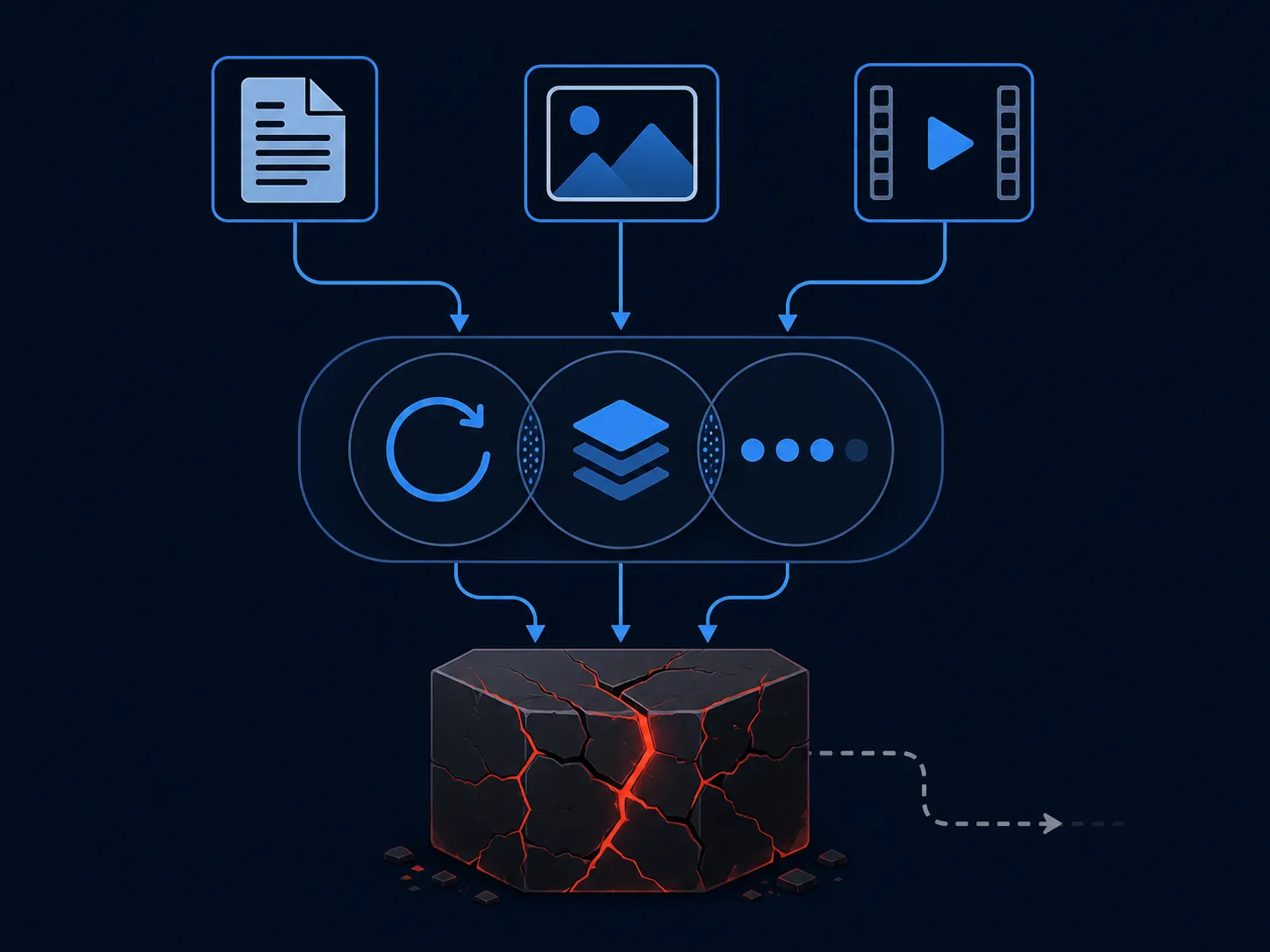
The familiar resilience mechanisms still perform useful but narrower jobs:
- Retries can recover from transient request failures after service returns. While the shared dependency remains unavailable, they repeatedly approach the same blocked route and may add load unless backoff and retry limits are enforced.
- Queues preserve deferred work and can prevent requests from disappearing. They do not turn a waiting request into a generated asset.
- Caches can return previously stored outputs when reuse is valid. They cannot create a new campaign-specific variant that has never been generated.
- Saved workflow state helps operators resume from the interrupted stage rather than restart the entire job. It preserves progress, not model availability.
Consider a hypothetical campaign job that fans one approved brief into several copy requests. If generation fails, a durable queue can retain those requests and the brief can remain safely stored. The operator may resume processing when service recovers. During the interruption, however, the variants are deferred rather than produced. If review depends on receiving the complete set, reviewers are also waiting even though their own systems are healthy.
This is the operational difference between data resilience and capability resilience. A system can avoid losing inputs, prior outputs, and job state while still being unable to perform fresh generation. Describing that condition as “continuity” hides the part of the workflow that is actually unavailable.
Audit the production path, not the vendor logo
The useful audit begins with each creative task, not a general question such as whether the organization “uses ChatGPT.” A team may use the consumer interface for occasional ideation while a separate orchestration service calls an API for production copy. Another workflow may store approved assets locally but depend on fresh generation for every resize or localization request. Those arrangements have different failure behavior.
| Audit point | What to record | What an outage test should reveal |
|---|---|---|
| Generation dependency | Every task that calls an external model service, including drafting, rewriting, classification, extraction, or asset instructions | Which jobs stop when that specific capability is unavailable |
| Job state | Where briefs, prompts, source assets, intermediate outputs, and approval status are stored | Whether interrupted work can resume without lost inputs or duplicate production |
| Queue behavior | Retry limits, backoff rules, expiration, ordering, and dead-letter handling | Whether work waits safely, fails visibly, or generates a retry storm |
| Downstream dependency | Reviews, assembly steps, publishing actions, and launch gates that require the missing output | Who becomes blocked and how operators can see the blockage |
| Fallback route | Alternative provider or process, credentials, model mapping, data controls, quality thresholds, and human ownership | Whether the route can produce an acceptable deliverable rather than merely accept a test request |
| Recovery evidence | Request logs, queue depth, failure codes, timestamps, manual interventions, and completed outputs | The operator-supplied impact and recovery record for the team’s own environment |
Visibility deserves special attention. When a dependency fails, the incoming brief often remains visible in one system while drafts, variants, or approvals become stranded in another. A useful operations view should show which jobs are waiting on generation, which are retrying, which have exhausted retries, and which downstream reviewers are blocked. A healthy queue is not necessarily an empty queue; it may be a queue that is retaining work exactly as designed while making the delay explicit.
Fallback testing must also reach beyond provider configuration. Having credentials for another model does not prove that prompts map correctly, required context can be transferred under the organization’s data rules, outputs meet brand and policy requirements, or downstream parsers accept the response. No cited source shows that Claude, Gemini, a local model, or any other alternative succeeded or failed during the July 25 incident. Any such claim would need the team’s own dated test or production record.
Teams formalizing ownership, approvals, and production controls can use the governed AI creative workflow playbook as operational context. Governance can make dependencies and recovery decisions easier to manage, but it is not evidence that an alternative route worked during this outage.
What the available material cannot prove
A Noetic Creative post offers general practitioner context about AI and media buying, but it supplies no July 25 outage result, affected account, or production metric.[3] It cannot be used to convert technical exposure into a claim of realized creative damage.
The available StatusGator excerpt shows entries only for July 7–9.[4] Because that excerpt is truncated, the absence of later entries does not establish that August or September was quiet. Likewise, the August 31, 2026 ChatGPT release notes provide date and product-release context, not evidence about the July incident’s scope or business impact.[5]
The defensible conclusion is conditional. The reported simultaneous failure puts API-dependent ad creative generation within the incident’s technical scope, and the shared-backend pattern makes that dependency worth auditing. Whether a particular production operation would continue through the next such failure can be established only by its own dependency map, observable queue behavior, and a fallback exercised far enough to produce an acceptable creative deliverable.
References
- The ChatGPT Outage Pattern: Concentration Risk in Practice — Cloud Security Alliance.
- OpenAI hit by another outage as ChatGPT, Codex, and APIs stumble together — TNW.
- AI didn’t kill media buyers. It killed bad… — Noetic Creative, LinkedIn.
- OpenAI ChatGPT Status — StatusGator.
- ChatGPT — Release Notes — OpenAI, August 31, 2026.
This is a record of what happened and what was tested, not legal advice. Compliance determinations require qualified counsel.